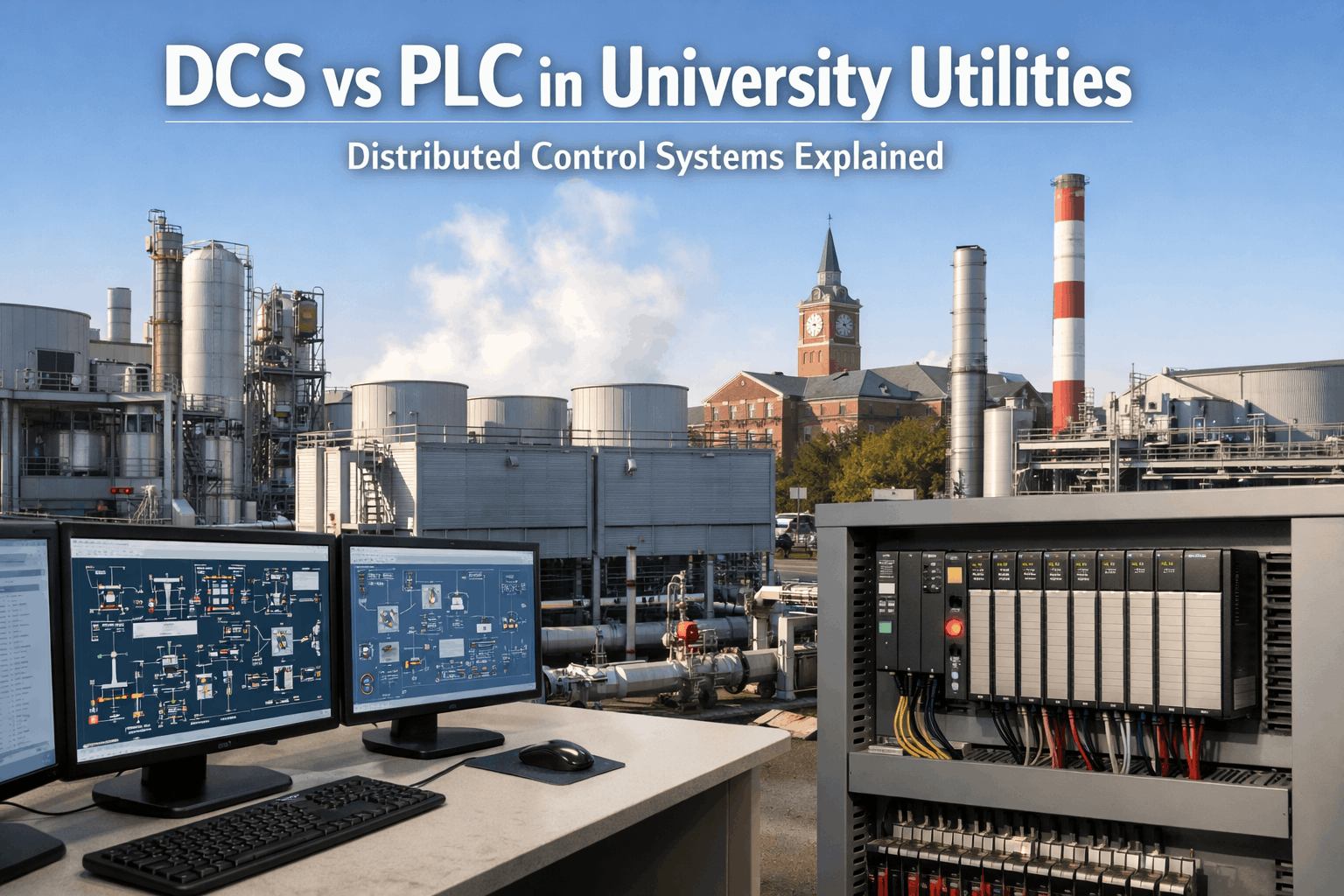
DCS vs PLC for University Utilities: Distributed Control Systems Explained for Campuses
By Oxmaint on March 11, 2026
When a university facilities director asks "Why is the West Campus chiller plant cycling rapidly while the East heating loop is losing pressure?" and the plant operator responds "I have to check three different panels, pull the trend logs manually, and call the technician at the sub-station to verify the valve positions," the lack of integration is compromising campus reliability. Managing a modern university utility infrastructure is not just about keeping the lights on; it is about creating a centralized ecosystem where steam plants, chilled water loops, power distribution, and renewable energy assets feed real-time data into a unified control platform. If your campus utilities rely on isolated PLCs and manual overrides, your operational efficiency is leaking through disconnected silos. The difference between high-performing campuses and those plagued by utility instability is the implementation of a Distributed Control System (DCS)—a seamless integration of process control, asset monitoring, and maintenance workflows. Talk to our team about modernizing your campus control architecture.
Higher Education Utilities Guide — 2026 Edition
DCS vs PLC for University Utilities: Distributed Control Systems Explained
Learn why Distributed Control Systems (DCS) are replacing siloed PLCs in campus utility plants to provide unified oversight for steam, chilled water, and power distribution through CMMS-connected reliability.
Uptime required for critical research labs and medical campus facilities
15%
Average energy savings when centralizing chiller and boiler plant controls via DCS
65%
Faster troubleshooting when maintenance alerts are unified with control system alarms
Zero
Tolerance for catastrophic utility failure in high-stakes university environments
What is a DCS and Why Does Your Campus Need One?
A Distributed Control System (DCS) is a computerized control system for a process or plant, wherein control elements are distributed throughout the system rather than centrally located. In the context of a university campus, a DCS acts as the "brain" of the utility infrastructure. While a Programmable Logic Controller (PLC) is excellent at managing a single piece of equipment (like a specific pump or air handler), a DCS manages the entire interconnected process—balancing the load across multiple boilers, chillers, and substations to ensure the entire campus remains stable and efficient.
Core Advantages of DCS Over PLC
Process-Centric Design
DCS focuses on the entire campus utility lifecycle, coordinating complex interactions between steam production and building demand seamlessly.
Built-In Redundancy
Unlike standard PLCs, DCS architectures typically feature redundant controllers and networks, ensuring no single point of failure stops campus power or heat.
Unified CMMS Alerts
DCS integrates directly with maintenance platforms, auto-triggering work orders when a pump vibrates or a furnace temperature deviates.
Historical Data Trending
Rich data logging allows facility managers to analyze seasonal energy usage and predict future capacity needs for campus expansion.
Scalable Architecture
Easily add new buildings or renewable microgrids to the existing DCS without rebuilding the entire control logic from scratch.
Operator Accountability
Detailed audit trails and shift reports ensure that all manual overrides or adjustments are logged for safety and compliance.
DCS vs. PLC: Choosing the Right Fit for Campus Utilities
University utilities are complex processes requiring high availability. While PLCs are cost-effective for discrete control (on/off tasks), the continuous, interconnected nature of a campus energy plant favors the DCS approach. A DCS provides a unified database, meaning changes to a tag in the controller are automatically updated in the HMI and the historian—saving hundreds of engineering hours. Book a demo to see how DCS integration simplifies utility management.
Comparison of Control Solutions for Education Utilities
System Architecture
PLC ApproachHardware-Centric
DCS ApproachSystem-Centric
Hybrid OptionsIntegrated PLCs
Best For: Individual machines, small pump stations
Scalability: High manual effort per addition
Redundancy & Reliability
PLC RedundancyAdd-on Option
DCS RedundancyNative/Built-in
Failover Speed<100ms
Best For: 24/7 Research/Medical Labs
Risk: Low risk of total plant blackout
Engineering Workflow
PLC ConfigurationSiloed Tags
DCS ConfigurationGlobal Database
HMI IntegrationSeamless
Best For: Fast-track construction projects
Efficiency: High initial setup, low maintenance
Bridge the Gap Between Control and Maintenance
Oxmaint integrates your campus DCS data with modern maintenance workflows. By connecting real-time utility alarms to your CMMS, you can auto-generate work orders for failing steam traps, vibrating chiller pumps, or cooling tower drift before they impact campus comfort or research continuity.
To prioritize facilities investment, campus utility programs must be assessed by their control integration. Moving from Level 1 (Manual/Paper) to Level 5 (AI-Optimized) is a journey that requires upgrading from isolated PLCs to a unified DCS architecture. Most universities currently operate at Level 2 or 3, with significant opportunities for energy reduction through better integration. Start your free trial to elevate your campus reliability.
Campus Utility Control Maturity Scale
5
Autonomous — AI-Driven Energy Orchestration
AI models predict campus load based on weather and class schedules, auto-adjusting DCS setpoints for maximum efficiency. Predictive maintenance identifies equipment failure weeks in advance.
Action: Continuous model training & carbon neutrality optimization
Goal State
4
Integrated — Unified DCS & CMMS
Centralized DCS manages all plants. Maintenance platform is live-linked to control data. Alarms automatically trigger technician dispatches. Trends are used for multi-year capital planning.
Action: Centralize all sub-stations & satellite plants into one DCS
High Efficiency
3
Hybrid — Networked PLC/SCADA Systems
PLCs are networked to a central SCADA, but databases are separate. Operators must manually transfer data between control and maintenance systems. Some automated reporting exists.
Action: Unify databases into a DCS architecture to reduce engineering overhead
Standard
2
Basic — Isolated PLCs
Local control panels for each boiler/chiller. No centralized visibility. Troubleshooting requires walking to the physical equipment. Maintenance is purely reactive or calendar-based.
Action: Network local panels to a central supervisory system
Inefficient
1
Manual — Local/Pneumatic Control
Heavy reliance on manual valves and legacy pneumatic controls. No digital records. High risk of human error and utility outages. Impossible to track energy efficiency.
Action: Identify critical assets for first digital control pilot
High Risk
The Cost of Fragmented Controls: Compounding Utility Loss
Operating a university with disconnected PLCs isn't just a technical debt—it's a financial drain. A chiller plant operating without load-sharing logic wastes electricity. A boiler plant with poor O2 trim control wastes fuel. When these issues aren't flagged by a central DCS, they persist for months. The cost of upgrading to a unified system is often paid for by the energy savings and the prevention of a single research-halting utility outage.
Cost of Control System Disconnection Over Time
Financial impact of utility inefficiencies and unplanned downtime
5 Integrated DCS
$5k (Optimized Operations)
1x
4 Hybrid SCADA
$25k (Manual Efficiency Gaps)
5x
3 Isolated PLCs
$150k (Undetected Failures)
30x
2 Reactive Fix
$400k (Emergency Utility Repair)
80x
1 Plant Outage
$1.2M+ (Campus Shutdown)
240x
Upgrading to a unified DCS prevents the "hidden tax" of energy waste and the catastrophic costs of unplanned utility shutdowns that impact critical campus operations.
Turn Utility Data Into Actionable Maintenance
Oxmaint helps university facilities teams convert DCS alarms into organized work orders—ensuring your steam, chilled water, and power systems are maintained proactively, reducing energy waste and protecting your campus mission.
Building the Roadmap: 5 Phases of DCS Modernization
Modernizing campus controls requires a disciplined approach to ensure continuity of service while upgrading critical infrastructure. From initial audit to AI optimization, this lifecycle ensures that your investment results in a more resilient and efficient campus environment.
Campus Control Modernization Lifecycle
1
Utility Infrastructure Audit
Inventory all existing PLC, SCADA, and pneumatic systems. Identify "blind spots" where utility data is not being captured and areas with the highest risk of failure.
Months 1–2
2
DCS Architecture Design
Select a DCS platform and design a redundant fiber-optic network backbone. Map the integration of central steam/chilled water plants with building-level controls.
Months 3–6
3
Pilot Plant Implementation
Migrate the most critical utility plant (e.g., the Main Chiller Plant) to the DCS. Test redundancy, HMI performance, and alarm notification logic.
Months 7–12
4
Campus-Wide Integration & CMMS Link
Roll out DCS control to all substations and satellite plants. Integrate real-time DCS data with Oxmaint CMMS for automated reliability-centered maintenance.
Year 2
5
Advanced Optimization & AI
Deploy AI-driven load forecasting and energy optimization modules. Use historical data to drive capital replacement strategies and carbon reduction goals.
Year 3+
Expert Perspective: The Shift to Unified Control
"
For years, our campus utilities were a patchwork of different PLC brands and manual logs. When a boiler tripped, we’d spend hours tracing the fault across different systems. Moving to a Distributed Control System changed the game. Now, we see every valve, pump, and temperature sensor on a single screen. When our DCS detects an anomaly, it doesn't just sound an alarm; it sends a detailed work order to Oxmaint. Our maintenance team knows exactly what tools to bring before they even leave the shop. We’ve cut our emergency utility calls by 40% and improved our energy efficiency by 18% in the first year alone. More importantly, we finally have the data to prove to the board exactly where our utility budget is going and how we’re protecting the university’s research assets.
— Facilities Director, R1 Research University
40%
Reduction in emergency utility service calls
18%
Overall energy efficiency improvement in Year 1
100%
Data visibility across all campus utility plants
Universities that lead in sustainability and reliability treat their utility controls as a unified strategic asset. By moving away from siloed PLCs toward an integrated DCS architecture, facilities leaders can ensure uptime for critical research, reduce environmental impact, and streamline maintenance workflows. When control data drives maintenance action, the result is a safer, smarter, and more cost-effective campus. Start building your resilient campus utilities program today.
Modernize Your Campus Utility Management
Oxmaint bridges the gap between your Distributed Control System (DCS) and your maintenance team—centralizing alarms, automating work orders, and providing the data-driven insights needed for a 21st-century university campus.
What is the main difference between a DCS and a PLC in a university setting?
The main difference is scope and integration. A PLC (Programmable Logic Controller) is typically used for "local" control of a specific machine or small process. A DCS (Distributed Control System) is designed to manage large, interconnected processes across an entire plant or campus. In a DCS, the HMI (Human Machine Interface), historian, and control logic share a single database, making it much easier to manage complex interactions between different utility systems like steam and chilled water.
Is it possible to integrate existing PLCs into a new campus DCS?
Yes. Modern DCS architectures are highly flexible and can communicate with legacy PLCs via protocols like Modbus, OPC UA, or Ethernet/IP. This allows universities to phase their modernization, keeping functional local PLCs in place while bringing them under the "supervision" of a centralized DCS for campus-wide visibility and reporting.
How does a DCS improve campus energy efficiency?
A DCS improves efficiency by enabling "Global Optimization." Instead of individual chillers or boilers running based only on their local sensors, the DCS looks at total campus demand, weather forecasts, and electricity pricing to run the most efficient combination of equipment. It also provides high-resolution trending data to identify "energy leaks," such as simultaneous heating and cooling in a building or a bypass valve stuck open.
Why is DCS considered more reliable for critical research facilities?
DCS systems are built with "native redundancy." This means the controllers, power supplies, and communication networks are typically doubled up. If one controller fails, the secondary one takes over instantly without the process stopping. This level of built-in reliability is critical for university medical centers and laboratories where a utility outage could ruin years of research or compromise patient safety.
Can Oxmaint CMMS connect directly to my DCS?
Yes. Oxmaint is designed to integrate with modern industrial control systems. By connecting your DCS alarms and performance data to Oxmaint, you can automate "Condition-Based Maintenance." For example, if the DCS detects a drop in heat exchanger efficiency, Oxmaint can automatically generate a work order for the maintenance team to clean the tubes, preventing a future failure.