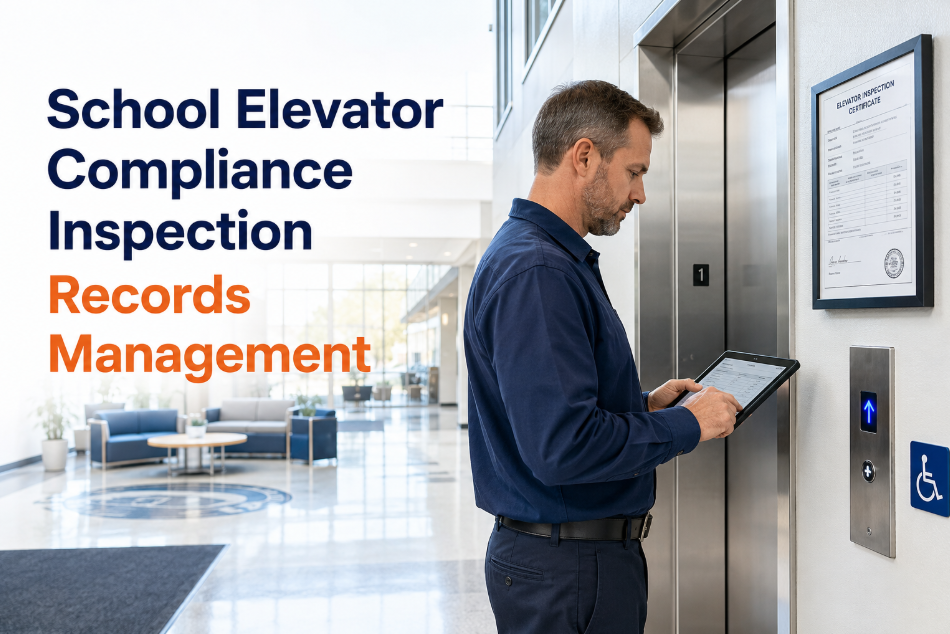
Elevator and Accessibility Equipment Maintenance for Campus Buildings
By Jamie lanister on March 30, 2026
Elevator and accessibility equipment on campus represents some of the most regulated and liability-intensive maintenance in educational facilities. ASME A17.1 mandates a multi-layered inspection programme — monthly periodic checks, annual Category 1 tests, and five-year Category 5 full-load tests — each requiring a licensed contractor and a signed report posted before the elevator returns to service. But compliance is only one dimension. A single elevator out of service for 72 hours in a building where it is the only accessible route to a classroom is an ADA violation for each of those 72 hours. OxMaint manages every elevator, lift, and door operator with automated ASME A17.1 test reminders, ADA response timers, and a complete inspection history per car — so no test is ever deferred and no failure goes undocumented.
average hydraulic elevator failure event — emergency pump replacement, oil recovery, and reactive downtime
72 hrs
before elevator outage in an ADA critical-path building constitutes a documented civil rights violation
3.2×
average cost multiplier for reactive elevator maintenance versus a planned ASME A17.1-compliant PM programme
25 yrs
typical campus elevator lifespan with full ASME A17.1 PM programme vs 12–15 years without one
ASME A17.1 Compliance: Inspection Schedule by Equipment Type
ASME A17.1 establishes four categories of elevator inspection and testing. Each requires a licensed elevator inspector, a completed state-form report, and a new certificate of operation posted before the elevator returns to service. OxMaint tracks every ASME A17.1 interval per car — auto-generating work orders 30 days before each required test date and storing the signed report in the asset record.
Equipment Type
Monthly PM
Annual Cat 1
3-Year Cat 3
5-Year Cat 5
Standard
Traction Elevator MRL / Geared
Safety device
Safeties, limits
Partial load
Full load drop
ASME A17.1 Rule 8.6
Hydraulic Elevator Direct / Holeless
Oil level, valve
Pressure, safeties
Valve test
Full load descent
ASME A17.1 Rule 8.6
Wheelchair / LULA Lift Platform
Function test
Full safety test
—
Load test
ASME A18.1
Inclined Platform Lift Stair lift
Rail + drive
Safety, stops
—
Load + stability
ASME A18.1
Auto Door Operator Accessible entry
—
Force + timing
—
—
ANSI A156.10 / ADA 404
Escalator / Moving Walk If applicable
Step + chain
Safety device
Brake test
Full Cat 5 test
ASME A17.1 Part 6
Maintenance Cost Escalation: What Deferral Really Costs
Every gap in a campus elevator's PM programme compounds: component wear accelerates without lubrication and adjustment, and when a test-category deadline is missed, the elevator must be taken out of service in most states until the overdue test is completed. The four scenarios below show the real annual cost per elevator car at each level of PM discipline.
ANNUAL MAINTENANCE COST PER ELEVATOR CAR — BY PM DISCIPLINE LEVEL
BASELINE
Full ASME A17.1 Programme
Monthly + annual + 5-yr Cat 5 — all on schedule
$2,800
per car / year
1.75×
Annual Only — No Monthly PM
Annual tests completed, monthly checks skipped
$4,900
per car / year
2.9×
Periodic Only — Cat 5 Deferred
Monthly + annual done, Category 5 test delayed 2+ years
$8,100
per car / year
6.4×
Reactive Only — No PM Programme
Service at breakdown only — avg 1.4 major repairs per car per year
$18,000+
per car / year
Cost includes PM labour, licensed contractor fees, parts, emergency callouts, and reactive repair events. Multiplier shown relative to full ASME A17.1 planned programme baseline.
Technology: PLC, AI Digital Twin & SAP for Elevator Reliability
Modern elevator controllers produce diagnostic data continuously — door cycle counts, motor current draw, levelling accuracy, fault codes. When connected to a CMMS this data enables predictive maintenance that identifies failures weeks before they produce an outage. OxMaint integrates with elevator controller diagnostic platforms to trigger PM work orders at pre-failure threshold, not at breakdown.
PLC / Elevator Controller
97%
Pre-failure fault detection
Drive fault codes, door motor current anomalies, and levelling sensor drift feed OxMaint directly — triggering maintenance work orders at pre-failure threshold, not at breakdown.
AI Digital Twin
91%
Accessibility route modelling
Virtual campus model identifies buildings where a single elevator failure creates an ADA path-of-travel violation — enabling prioritised response and alternative access routing.
AI Camera Vision
94%
Cab and door anomaly detection
Elevator cab cameras detect worn door seals, floor-levelling drift, and lighting failures during overnight scans — creating morning work orders before the first student enters the building.
SAP Integration
3.8 hrs
Contractor response time cut
Elevator PM work orders are pre-scheduled in SAP with licensed contractor assignments — ensuring the firm is booked weeks before the ASME test deadline, never called reactively.
ASME Compliance Export
100%
Inspection records per car
Each completed inspection generates an OxMaint record with date, inspector, test category, findings, and sign-off — producing the full A17.1 document package per car for any state or OCR request.
IoT / OBD Sensors
24/7
Live elevator status monitoring
Door cycle counters, drive health sensors, and UPS monitors report continuously — OxMaint triggers an alert the moment any monitored elevator parameter crosses the maintenance threshold.
Wheelchair Lifts & Platform Lifts: Most Under-Maintained Accessibility Assets
Wheelchair lifts and LULA lifts are among the most failure-prone accessibility assets on any campus — and consistently the least frequently inspected. Unlike elevators, they often have no visible state certificate requirement in many jurisdictions, leading facilities teams to treat them as unmaintained equipment until a complaint occurs. Their ADA failure consequence is identical to an elevator: a student who cannot reach a classroom because the platform lift is out of service has been denied a programme by the institution.
Wheelchair / LULA Lifts
Monthly: Full travel, gate and safety operation test
Monthly: Hydraulic fluid level + drive mechanism
Annual: ASME A18.1 Category 1 — signed inspection report
5-year: Full load test + Category 5 inspection
Failure response: 24 hours max — ADA path-of-travel
Inclined Platform Lifts
Monthly: Rail lubrication, drive unit, limit switches
Quarterly: Platform, footrest, and fold-down mechanism
Annual: Safety brake, load test, full ASME A18.1 inspection
3-year: Motor, controller, and brake system overhaul
Failure response: 24 hours max — ADA path-of-travel
Automatic Door Operators
Monthly: Activation distance + sensor sweep
Quarterly: Opening force calibration — max 5 lbf per ANSI A156.10
Quarterly: Closing time + hold-open duration
Annual: Full operator + actuator + safety edge inspection
Failure response: 24 hours max — ADA primary entry
❝
We have 14 elevator cars and 6 wheelchair lifts across campus. Before OxMaint our Cat 5 test on Building C was 9 months overdue — discovered when the state inspector arrived unannounced. Now OxMaint schedules contractor assignments 45 days before every ASME test deadline. We have not had a deferred test in three years.
Associate VP for Facilities — Mid-size university · 32 buildings · 14 elevators · 6 wheelchair lifts · OxMaint user since 2020
Frequently Asked Questions
Monthly periodic inspections, annual Category 1 no-load safety device tests, and Category 5 full-load tests every five years for most elevator types. Each requires a licensed elevator inspector, a signed inspection report, and a posted certificate of operation before the car returns to service.
Planned ASME-compliant maintenance typically costs $2,800–$4,200 per car per year. Reactive maintenance averages $14,000–$22,000 per car per year when including emergency callout fees, major component replacement, and downtime costs — a consistent 3–5× cost multiplier across elevator types.
There is no federal time limit, but OCR's benchmark used in complaint investigations is 24 hours for any failure that eliminates the only accessible route to a programme or classroom. A 72-hour or longer outage in an ADA critical-path building typically results in a violation finding.
Monthly function tests covering full travel, gate and safety operation; annual ASME A18.1 Category 1 inspections with signed reports; and five-year full load tests. Wheelchair lifts are the most under-maintained accessibility asset on most campuses and have identical ADA failure consequences to full elevators.
OxMaint tracks each car's inspection history and auto-generates a contractor work order 30–45 days before each ASME category test deadline — ensuring the licensed inspector is booked in advance, never deferred. Signed test reports are stored in the asset record upon completion.
Traction elevators require machine room inspections, governor testing, and rope inspections not required for hydraulic systems. Hydraulic elevators require monthly oil level and valve checks, quarterly pressure tests, and environmental compliance for hydraulic fluid containment. OxMaint maintains separate PM templates for each type.
14 Elevators. 6 Wheelchair Lifts. Zero Overdue ASME Tests. That's What OxMaint Delivers.
ASME A17.1 test scheduling · A18.1 wheelchair lift PM · ADA outage response timers · 5-year inspection history per car · traction and hydraulic elevator PM templates. Free to start.