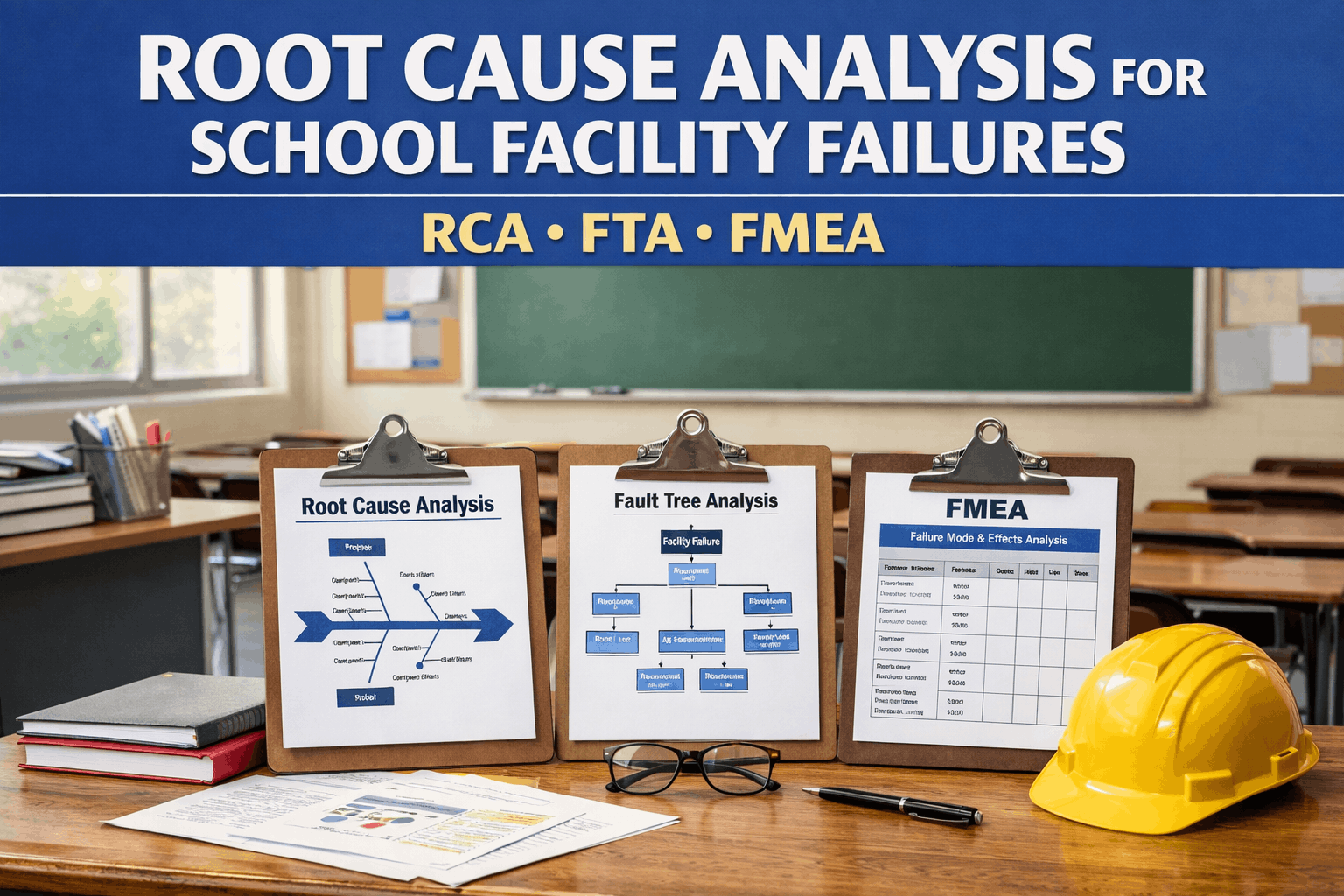
Root cause analysis differs fundamentally from routine troubleshooting. Where troubleshooting restores function, RCA prevents recurrence by identifying causal chains from immediate failure mechanisms back through contributing factors to systemic root causes. Properties implementing structured RCA methodologies achieve 70-85% reduction in repeat elevator failures while building documented institutional knowledge that survives personnel changes.
This guide establishes a comprehensive framework for conducting elevator failure RCA, implementing corrective actions, and integrating findings into maintenance software property management CMMS platforms. Facilities teams ready to systematically eliminate recurring issues can sign up free to centralize failure analysis and corrective action tracking.
What if your campus could eliminate 70% of recurring elevator failures by understanding what really causes breakdowns?
Why Root Cause Analysis Transforms Campus Elevator Reliability
Traditional reactive maintenance focuses on "what broke"—RCA investigates "why it broke" and "how do we prevent it from breaking again." The distinction determines whether campuses perpetually fight the same failures or systematically eliminate them from operational history.
- Fixes immediate symptoms without addressing underlying causes
- Allows same failure mode to recur with predictable frequency
- Knowledge lost when experienced technicians leave
- Creates expensive cycle of repeated emergency repairs
- Leaves campus vulnerable to accessibility violations
- Permanently eliminates failure modes from operational history
- Builds institutional knowledge base accessible to all staff
- Identifies systemic issues affecting multiple elevators
- Optimizes preventive maintenance based on actual failure drivers
- Provides audit-ready documentation for compliance reviews
The Five Whys Framework for Elevator Failure Investigation
The Five Whys methodology provides structured progression from observable failure symptoms to underlying root causes. Each "why" moves deeper through causal layers until reaching systemic issues that drive recurrence. Campus facilities teams find this approach particularly effective because it doesn't require specialized engineering expertise—just disciplined questioning and documentation.
| Question Level | Example: Elevator Door Won't Close | Investigation Focus | RCA Value |
|---|---|---|---|
| Why #1: What Failed? | Door operator stopped responding to close command | Immediate failure mechanism | Symptom identification |
| Why #2: Why Did It Fail? | Safety sensor detected false obstruction signal | Component-level cause | Technical diagnosis |
| Why #3: What Caused That? | Sensor mounting bracket vibration caused intermittent misalignment | Contributing factors | Pattern recognition |
| Why #4: Why Did That Occur? | Set screws on mounting hardware loosened from daily cycle vibration | Design/maintenance issue | Systemic weakness |
| Why #5: Root Cause? | Preventive maintenance checklist didn't include hardware torque verification | Procedural root cause | Corrective action target |
Common Root Cause Categories in Campus Elevators
Structured RCA Process for Campus Facilities Teams
Effective root cause analysis follows repeatable methodology that ensures consistency regardless of which team member conducts the investigation. The framework below integrates with property management CMMS best practices to create permanent institutional knowledge from each failure event.
Capture failure symptoms, timeline, environmental conditions, and immediate response actions within work order system
Document physical evidence through photos, measurements, failed component preservation, and witness statements
Progress through causal layers from symptom to root cause using systematic questioning methodology
Develop immediate fixes plus permanent solutions targeting identified root causes with implementation timelines
Document findings in searchable CMMS database, update SOPs, and share lessons learned across facilities team
Critical Evidence Collection for Elevator Failures
Quality RCA depends on thorough evidence gathering before repairs alter physical conditions. Mobile inspections property management workflows enable systematic documentation that supports accurate causal analysis while creating audit-ready records for compliance reviews.
Failure Classification System for Campus Elevators
Triggers: Student entrapment, free fall protection activation, door strike injuries, emergency communication failure
Response: Full RCA within 24 hours, findings to safety committee, regulatory notification if required
Triggers: Same failure mode 2+ times in 90 days, pattern across multiple elevators
Response: Systematic RCA to identify root cause, corrective action plan with timeline, fleet-wide inspection if applicable
Triggers: Extended outage during peak usage, accessibility impact, significant repair cost
Response: Document findings to prevent future occurrence, update preventive maintenance if indicated
Triggers: Expected wear-out failures within normal service life, one-time minor issues
Response: Record failure in maintenance history, monitor for pattern development over time
Ready to transform failure investigations into permanent solutions?
Join facilities teams using Oxmaint to document RCA findings and track corrective actions systematically.
Case Study: Eliminating Recurring Door Operator Failures
Main library elevator door operator fails every 45-60 days
Each failure attributed to "sensor malfunction" by service contractor
Sensors replaced 4 times at $850 each plus $1,200 emergency service fees
Students filing accessibility complaints due to repeated outages
Why #1: Sensor detects false obstructions → testing confirms intermittent misalignment
Why #2: Sensor bracket position shifts over time → vibration measurement shows excessive movement
Why #3: Bracket mounting loosens → inspection finds inadequate fastener torque specification
Why #4: Fasteners not checked during monthly PM → SOPs lacked specific torque verification step
Root Cause: Preventive maintenance checklist designed for residential elevators, not high-cycle campus use
Immediate: All door sensor brackets re-torqued and secured with thread-locking compound
Procedural: PM checklists updated to include quarterly torque verification for all mounting hardware
Systemic: Contractor SLA revised to require campus-appropriate maintenance specifications
Preventive: Other elevators inspected and corrected before failures occurred
Zero recurrences of door sensor failures across 12 campus elevators
$14,600 savings from eliminated emergency repairs over 12-month period
Accessibility complaint rate decreased from 8 per semester to zero
RCA findings documented in CMMS for institutional knowledge retention
Integrating RCA Findings into Maintenance Operations
Root cause analysis delivers maximum value when findings systematically improve operational practices. CMMS for property management provides the framework to convert investigation conclusions into preventive maintenance updates, training enhancements, and design modifications that prevent recurrence across the entire elevator fleet.
Revise preventive maintenance checklists to address root causes identified through RCA investigations
Adjust spare parts inventory based on actual failure modes rather than generic recommendations
Conduct regular case study reviews teaching identification and prevention of common root causes
Require service contractors to perform RCA on recurring issues as contractual obligation
Implement permanent design improvements addressing systemic vulnerabilities discovered through RCA
Apply corrective actions to all similar equipment before failures occur elsewhere
"The transformation came when we stopped accepting 'it just happens sometimes' as an explanation. Implementing structured RCA for every recurring elevator failure revealed that 80% of our repeat incidents stemmed from just four root causes—inadequate PM procedures, contractor knowledge gaps, environmental factors we could control, and design issues that needed one-time corrections. Within 18 months, we cut unplanned elevator downtime by 73% while actually reducing our maintenance budget because we stopped paying for the same emergency repairs repeatedly. The key was making RCA a standard practice, not something reserved for catastrophic failures. Document everything in your CMMS because that institutional knowledge becomes invaluable when technicians retire or contractors change."
Conclusion: Building Reliability Through Systematic Analysis
Root cause analysis transforms elevator maintenance from perpetual crisis response to continuous improvement. Educational facilities that invest 4-6 hours thoroughly investigating each significant failure eliminate those failure modes permanently, building reliability that compounds over time. The alternative—repeated temporary fixes—costs 3-5x more while leaving campuses vulnerable to accessibility violations and student safety incidents. Properties ready to break the recurring failure cycle can start with free RCA documentation tools to capture institutional knowledge systematically.
Stop paying for the same elevator repairs over and over. Start building permanent solutions through systematic root cause analysis.
Frequently Asked Questions
Conduct formal RCA for three trigger scenarios: (1) any safety-related failure (entrapments, injuries, emergency system failures), (2) recurring problems—same failure mode occurring twice within 90 days or showing pattern across multiple elevators, and (3) high-impact failures causing extended outages during peak usage or significant financial cost. Routine troubleshooting suffices for first-time occurrences of expected wear-out failures within normal component service life. The distinction: if preventing recurrence would provide meaningful value, invest in RCA.
Effective elevator RCA investigations average 4-7 hours including evidence collection, Five Whys analysis, corrective action development, and documentation. This represents 0.3-0.5% of typical annual maintenance labor hours but prevents recurring failures costing 3-5x the investigation time investment. Facilities teams conducting 8-12 RCA investigations annually on recurring issues typically achieve 70-85% reduction in repeat failures, generating 6-8x ROI on time invested. Try free RCA documentation templates that streamline the process.
Contractor resistance often stems from concern that RCA will reveal maintenance deficiencies. Address this by framing RCA as collaborative improvement rather than blame assignment—the goal is preventing recurrence, not punishing past actions. Many institutions make RCA participation a contractual requirement for recurring failures, with investigation costs absorbed as part of annual maintenance fees. Consider incentive structures rewarding contractors for reducing overall failure frequency rather than maximizing billable service calls. If contractors consistently resist systematic problem-solving, that's a strong indicator to re-evaluate the service relationship.
Document every RCA finding in your CMMS platform with searchable keywords, photos, and corrective actions taken. This creates a living knowledge base accessible to all staff regardless of tenure. When technicians retire, their accumulated problem-solving wisdom remains institutionally available. Many campuses conduct quarterly "lessons learned" sessions where RCA findings get reviewed as team training exercises. The combination of documented case studies plus regular knowledge sharing sessions ensures critical insights survive personnel transitions that would otherwise reset institutional experience to zero.
Absolutely—this is where RCA delivers exponential value. When investigation reveals a systemic root cause (inadequate PM procedure, design vulnerability, environmental factor), immediately inspect all similar equipment for the same condition. Example: if RCA on Elevator #3 reveals that vibration loosens specific mounting hardware, proactively check and correct that hardware on Elevators #1, #2, #4-8 before failures occur. This fleet-wide preventive application transforms one investigation into campus-wide reliability improvement. Schedule a demo to see how CMMS platforms track and replicate corrective actions across multiple assets.