The Hidden Cost of Reactive Maintenance in Schools and Universities (2026 Guide)
By Oxmaint on February 24, 2026
At 6:14 AM on a Tuesday in January, the head custodian at a 1,400-student middle school received a call from the overnight security system: water detected in the library. A 22-year-old hot water circulating pump on the second floor had seized overnight. Without a functioning mechanical seal — one that had been leaking intermittently for five months but was never documented in a work order — the pump housing cracked under thermal stress, sending 40-degree water cascading through the ceiling into the library below for approximately four hours before the alarm triggered. By the time the custodian arrived, 2,200 square feet of ceiling tile had collapsed onto bookshelves. Eleven desktop computers used for standardized testing prep were destroyed. The carpet, saturated beyond remediation, required full replacement. The library was closed for nine weeks. The pump replacement cost $1,800. The emergency water extraction, ceiling replacement, carpet removal and installation, computer replacement, temporary testing accommodations, and mold remediation totaled $187,000. The district's insurance deductible covered the first $25,000. The mold remediation alone — required because water sat in ceiling cavities for four hours — cost $61,000. The mechanical seal that failed had a replacement cost of $340 and a rated service interval of 36 months. It had been in service for 58 months. No one knew, because no one was tracking it.
This is not an unusual story. According to the Government Accountability Office, 53% of U.S. public school districts need to update or replace multiple building systems, and the American Society of Civil Engineers estimates the deferred maintenance backlog in K-12 facilities alone exceeds $85 billion. Universities carry an additional $112 billion in deferred maintenance according to APPA. These are not abstract infrastructure statistics — they are $340 seals and $1,800 pumps that become $187,000 catastrophes because nobody was tracking service intervals. Every dollar spent on reactive emergency repair is a dollar that could have funded four to seven dollars of preventive maintenance. Schools and universities ready to stop the cycle can sign up free.
This guide quantifies the true cost of reactive maintenance in educational facilities — not just the repair invoices, but the hidden expenses that never appear on a single line item: learning disruption, compliance exposure, accelerated asset degradation, staff burnout, and the institutional reputation damage that follows a preventable facility failure during a board meeting or commencement ceremony. Facilities leaders building the case for predictive maintenance investment can schedule a consultation to discuss ROI frameworks specific to education.
The Scale of the Crisis: 2026 Education Facility Data
The reactive maintenance problem in American schools and universities is not a maintenance department issue — it is an institutional solvency issue. Facilities represent the second-largest budget line in education after personnel, and reactive maintenance inflates that line by 300–400% compared to planned approaches. The data is unambiguous.
$197B
Combined K-12 + Higher Ed deferred maintenance backlog in the United States
53%
U.S. school districts needing multiple building system updates (GAO)
3-5×
Reactive repair cost multiplier vs. planned preventive maintenance
68%
Schools still managing maintenance with paper, spreadsheets, or nothing
Every emergency repair invoice tells the same story: a $200–$2,000 preventive service was skipped, and a $15,000–$200,000 catastrophe followed. The question is not whether your district can afford predictive maintenance — it is whether you can survive another year without it.
When a school board reviews maintenance expenses, they see repair invoices and contractor payments. What they do not see — and what reactive maintenance obscures — are the compounding costs that multiply the true financial impact by 4–8× beyond the visible repair line item. Understanding these hidden costs is the first step toward building the business case for transformation.
1. Emergency Premium Pricing
Emergency HVAC, plumbing, and electrical contractors charge 2.5–4× standard rates for after-hours and same-day service. A $3,000 planned chiller repair becomes $8,000–$12,000 when the unit fails on the hottest day of September and classes must be relocated. Districts averaging 60%+ reactive work orders pay $180,000–$500,000 annually in avoidable emergency premiums — money that buys nothing except restoring functionality that planned maintenance would have preserved.
2. Cascading Collateral Damage
Equipment failures rarely remain contained. A failed pump floods a library ($187,000). A neglected roof leak destroys a server room ($94,000). A seized exhaust fan allows moisture buildup that grows mold requiring $40,000–$120,000 in remediation and weeks of classroom closure. Collateral damage from reactive failures averages 3–8× the cost of the original equipment failure — and these secondary costs are the ones that consume capital reserves and trigger emergency board appropriations.
3. Instructional Time Loss
Every classroom closure, building evacuation, or HVAC failure that triggers early dismissal represents lost instructional time that directly impacts student achievement metrics. NCES data indicates facility-related disruptions account for 8–15 lost instructional days per affected school annually. At a per-pupil funding rate of $50–$80/day, a single building closure affecting 600 students costs $30,000–$48,000 in state funding exposure per day — a cost that never appears on a maintenance invoice.
4. Compliance & Legal Exposure
Reactive maintenance creates systematic compliance gaps. Overdue fire suppression inspections, expired elevator certifications, unverified emergency lighting, non-functional ADA equipment, and uninspected playground structures expose districts to OCR complaints ($85,000–$500,000+), ADA litigation ($50,000–$300,000 per case), OSHA citations ($15,000–$156,000 per violation), and insurance coverage denial. Districts without documented maintenance records have no affirmative defense.
5. Accelerated Asset Degradation
Equipment maintained reactively lasts 30–40% shorter than equipment on preventive schedules. A commercial HVAC rooftop unit rated for 20 years lasts 12–14 years without PM. A boiler rated for 30 years lasts 18–22. Across a 15-building district with $45 million in mechanical assets, 30% accelerated depreciation represents $13.5 million in premature capital replacement — replacement that hits bond capacity and competes directly with instructional program funding.
6. Energy Waste
Unmaintained HVAC systems consume 15–30% more energy than properly serviced equipment. Dirty coils, failed economizers, stuck dampers, degraded insulation, and miscalibrated controls waste $2–$5 per square foot annually. For a 500,000 sq ft campus, that is $1–$2.5 million per year in excess utility costs — a recurring annual penalty that reactive districts pay every year without realizing it, because they have no baseline for comparison.
7. Staff Burnout & Turnover
Maintenance teams trapped in reactive mode experience 40–60% higher turnover than proactive operations. The constant crisis management, weekend emergency calls, and inability to complete planned work creates chronic burnout. Replacing a skilled HVAC technician or electrician costs $15,000–$25,000 in recruiting, onboarding, and lost productivity. A 5-person maintenance team with 50% annual turnover spends $37,500–$62,500 per year just replacing people — while the remaining staff absorb additional workload, accelerating the cycle.
The true cost of reactive maintenance is not what you spend on repairs. It is the $4–$8 in hidden damage, lost time, compliance exposure, and accelerated depreciation for every $1 on the repair invoice. Districts that quantify total reactive cost discover they are already spending enough to fund a world-class preventive program — they are just spending it on the wrong things.
The gap between reactive and predictive maintenance operations is not a technology gap — it is a visibility gap. Reactive districts do not lack skilled technicians or adequate budgets. They lack the data infrastructure to know what needs attention before it fails, to document what was done, and to prove compliance when regulators arrive. Sign up for Oxmaint to bridge that gap.
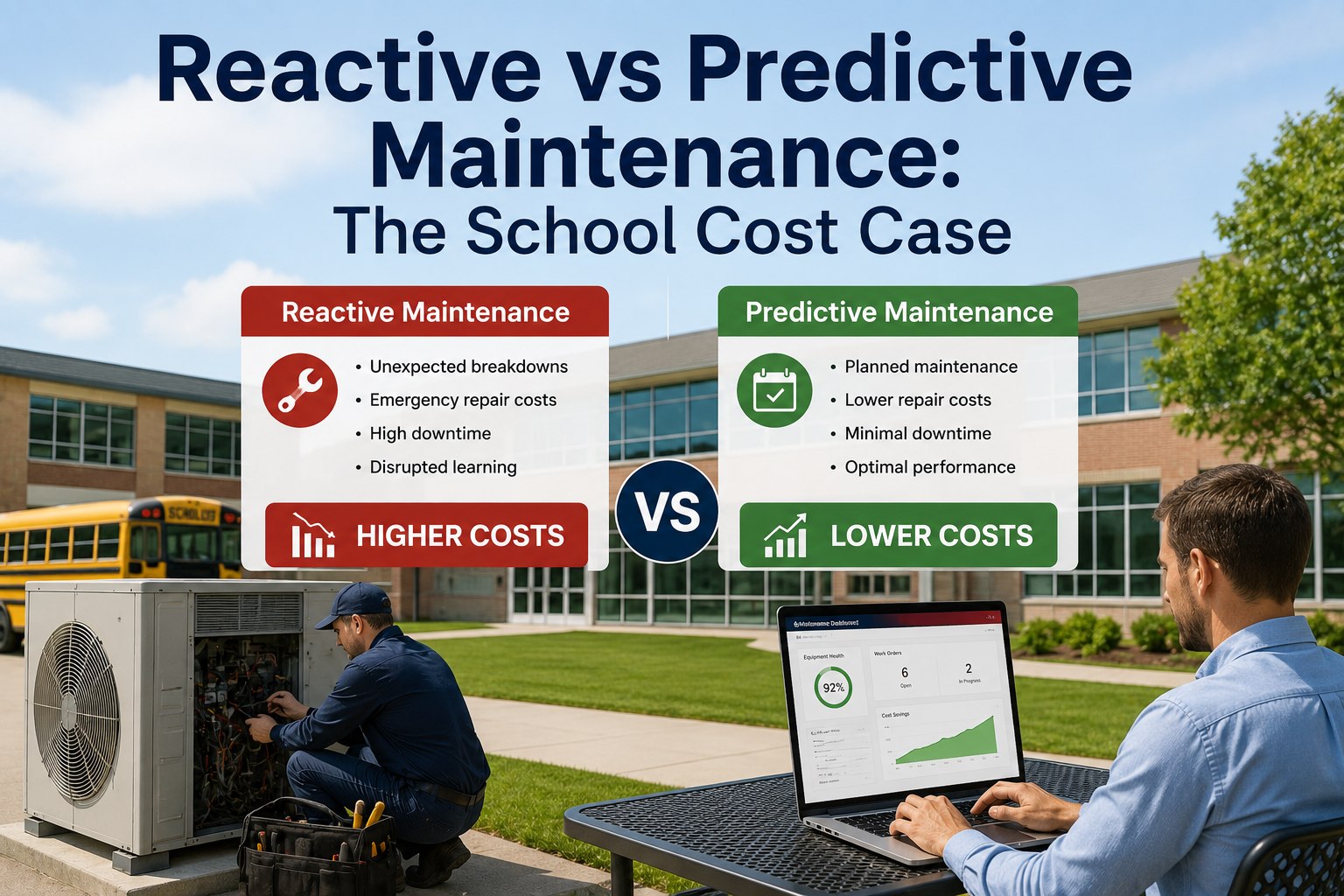
Reactive Maintenance Culture
Equipment runs to failure — repairs begin after disruption
Paper work orders lost, delayed, or never created
No asset condition visibility — surprises are constant
Compliance documentation incomplete or nonexistent
Emergency contractors consume 40–60% of maintenance budget
Capital requests based on crisis, not data
Maintenance staff in perpetual firefighting mode
3-5×Higher total cost of ownership
Predictive CMMS Operations
Condition monitoring identifies failures weeks before they occur
Digital work orders with automated routing and tracking
Real-time asset health dashboards across every building
100% audit-ready compliance documentation
Planned maintenance consumes 80%+ of budget at standard rates
Capital planning driven by asset condition data and lifecycle cost
Maintenance staff executing proactive programs with pride
60-75%Lower total cost of ownership
How Modern CMMS Eliminates Hidden Costs
A CMMS does not fix equipment — technicians fix equipment. What a CMMS does is ensure the right technician reaches the right equipment with the right parts at the right time, before a $340 seal becomes a $187,000 flood. Every capability below directly eliminates one or more of the seven hidden costs.
Automated Preventive Maintenance Scheduling
Configure PM schedules by runtime hours, calendar intervals, or condition triggers for every asset across every building. Automated work order generation ensures nothing falls through the cracks — the 58-month seal that should have been replaced at 36 months gets flagged, scheduled, and documented automatically. Eliminates Hidden Cost #1 (emergency premiums) and #5 (accelerated degradation).
Digital Work Order Management
Create, assign, prioritize, and track every work order digitally — from a teacher reporting a leaking faucet to a technician completing an annual boiler inspection. Photo documentation, time tracking, parts usage, and completion verification create the audit trail that paper systems cannot provide. Eliminates Hidden Cost #4 (compliance exposure) and #7 (staff burnout through workload visibility).
Asset Lifecycle & Condition Tracking
Every asset carries a complete digital history: installation date, warranty status, maintenance history, repair costs, condition assessments, and remaining useful life estimates. When cumulative repair costs approach 50% of replacement value, the system flags it — turning reactive capital emergencies into planned replacements scheduled during summer breaks. Eliminates Hidden Cost #5 (accelerated degradation) and enables data-driven capital planning.
Compliance Calendar & Audit Readiness
Automated scheduling for every regulatory inspection: fire suppression, elevator certification, backflow preventer testing, ADA equipment verification, playground safety, and indoor air quality monitoring. Overdue inspections trigger escalation alerts. When OCR, OSHA, or the fire marshal arrives, every record is one click away. Eliminates Hidden Cost #4 (compliance exposure) entirely.
Mobile-First Technician Tools
Technicians receive work orders, access equipment history, scan QR asset tags, attach photos, log parts, and close work orders from their phone — on the roof, in the boiler room, or at the top of a ladder. No trips back to the office. No paper forms that get lost. Response times drop from hours to minutes, and every action is timestamped and documented. Eliminates Hidden Cost #7 (staff burnout) by removing administrative friction.
Energy & Performance Analytics
Track energy consumption trends by building, correlate maintenance activities with utility costs, and identify the HVAC units, boilers, and lighting systems consuming disproportionate energy. Districts implementing maintenance-driven energy optimization reduce utility costs 15–30% within 12 months — savings that directly fund the maintenance program. Eliminates Hidden Cost #6 (energy waste) and creates a self-funding improvement cycle.
Implementation Path for Schools & Universities
Transitioning from reactive to predictive maintenance follows a proven sequence. Districts that attempt to digitize everything simultaneously achieve 30–40% adoption. Phased implementation with early wins in high-impact areas drives sustainable transformation.
1
Weeks 1-3
Facility Assessment & Asset Inventory
Walk every building and document every critical asset: HVAC units, boilers, chillers, elevators, fire suppression systems, electrical switchgear, roof systems, and plumbing infrastructure. Record make, model, age, condition, and last known service date. Tag each asset with a QR code. Establish the baseline that reveals the true scope of deferred maintenance.
2
Weeks 4-6
PM Schedule Configuration & Compliance Mapping
Build preventive maintenance schedules for every critical asset based on manufacturer recommendations and regulatory requirements. Configure automated work order generation for fire inspections, elevator certifications, ADA equipment checks, and all recurring compliance obligations. Prioritize: address any equipment with overdue safety inspections immediately.
3
Weeks 7-10
Team Training & Process Launch
Train maintenance technicians on mobile work order tools — receiving, updating, and closing work orders from their phones. Train building principals and teachers on digital service request submission. Train facilities directors on dashboards and reporting. Launch with high-visibility wins: clear the backlog of overdue inspections and document the compliance improvements for administration.
4
Months 4-12
Optimization, Analytics & Capital Planning
Analyze work order data to identify recurring failures, highest-cost assets, and buildings consuming disproportionate maintenance resources. Build data-driven capital replacement schedules. Expand to energy tracking and predictive condition monitoring. Generate quarterly board reports demonstrating cost avoidance, compliance improvement, and asset life extension. The data from months 1–3 funds the case for months 4–12.
Measurable Outcomes: Before and After CMMS
The metrics below reflect documented outcomes from educational institutions that transitioned from reactive to CMMS-enabled predictive maintenance operations. These are not projections — they are measured results from districts and universities that made the shift.
Unplanned Downtime Reduction
45-60%Reactive WOs
→
15-20%Reactive WOs
80/20 planned-to-reactive ratio achieved within 12 months
Emergency Repair Cost Reduction
$180K+Annual Emergency Spend
→
$30-45KAnnual Emergency Spend
60-75% reduction in emergency contractor costs within Year 1
Compliance Audit Readiness
35-50%Records Available
→
100%Records Available
Every inspection, certification, and repair documented and retrievable instantly
Equipment Life Extension
60-70%Of Rated Lifespan
→
90-100%Of Rated Lifespan
30-40% longer asset life defers millions in capital replacement
Energy Cost Reduction
$4-6/sqftAnnual Energy Cost
→
$3-4/sqftAnnual Energy Cost
15-30% utility reduction through maintenance-driven efficiency
Work Order Response Time
24-72 hrsAverage Response
→
<4 hrsAverage Response
Critical issues addressed before they escalate to classroom disruption
"
We were spending $220,000 a year on emergency repairs and convinced ourselves we couldn't afford a maintenance management system. When we finally tracked total reactive costs — including the collateral damage, the overtime, the compliance gaps, and the energy waste — we discovered we were spending $680,000 annually to not have a system. The CMMS paid for itself in 11 weeks.
Director of Facilities, 18-School District — Southeastern United States
Building the Business Case for Your Board
Facilities directors know the maintenance problem intimately. The challenge is translating operational reality into budget language that school boards and university CFOs approve. The most effective business cases frame CMMS investment not as a maintenance expense but as institutional risk mitigation and cost avoidance — because that is precisely what it is.
Frame 1: Total Reactive Cost
Document every emergency repair, overtime hour, rental equipment charge, contractor premium, collateral damage repair, and insurance claim from the past 24 months. Include the hidden costs: classroom closure days multiplied by per-pupil funding rates, compliance citations, and any litigation or OCR complaints. Total these. Most districts discover their annual reactive cost is 3–5× what they believed — because nobody had aggregated the data before. This number is the baseline the CMMS investment is measured against.
Frame 2: Capital Preservation
Calculate the replacement value of every major asset (HVAC, roofing, elevators, boilers, electrical) currently operating without preventive maintenance. Apply a 30–40% accelerated depreciation factor for each year without PM. Present the board with the capital replacement cost being accelerated by reactive management — typically $2–$8 million over a 5-year planning cycle for a mid-size district. A $30,000–$80,000 annual CMMS investment that defers $2 million in capital is a 25:1 return.
Frame 3: Compliance Liability
List every regulatory obligation with inspection or documentation requirements: fire code, elevator certification, ADA accessibility, OSHA workplace safety, EPA indoor air quality, backflow prevention, and playground safety. Document which inspections are current, overdue, or undocumented. Calculate potential exposure per violation. A single OCR resolution agreement ($85,000–$500,000) or OSHA willful violation ($156,259 per violation in 2026) exceeds the lifetime cost of a CMMS deployment.
Frame 4: Operational Efficiency
Quantify maintenance staff time currently consumed by administrative tasks: driving between buildings for paper work orders, calling contractors, searching for equipment manuals, hand-writing reports, and re-explaining repair history to every new contractor. Most maintenance teams spend 30–40% of their time on tasks that CMMS automation eliminates — equivalent to adding 1.5–2 FTE to a 5-person team without hiring. Present this as capacity that can address the deferred maintenance backlog without budget increase.
Need help building your business case? Our education facilities specialists work with districts and universities to quantify total reactive costs, model ROI scenarios, and prepare board-ready presentations. We have helped over 200 educational institutions secure maintenance transformation funding.
Every Day Without Visibility Is Another Day Accumulating Hidden Costs
The $340 seal. The $1,800 pump. The $187,000 flood. Every reactive catastrophe in your district's history was a preventive maintenance task that nobody tracked. Oxmaint gives school districts and universities the complete asset management platform needed to shift from reactive firefighting to predictive operations — automated PM scheduling, digital work orders, compliance tracking, mobile technician tools, and the analytics that turn maintenance data into board-ready budget justifications. The question has never been whether you can afford it. The question is how much another year of reactive maintenance will cost.
What does reactive maintenance actually cost a typical school district per year?
When all hidden costs are included — emergency contractor premiums, collateral damage, accelerated asset degradation, energy waste, compliance exposure, staff turnover, and instructional time loss — the total cost of reactive maintenance for a mid-size district (10–20 schools) typically ranges from $400,000 to $1.2 million annually. Most districts significantly underestimate this figure because the costs are distributed across multiple budget lines and departments. Emergency repair invoices represent only 25–35% of total reactive cost — the remaining 65–75% is hidden in utility bills, capital budgets, insurance claims, legal fees, and lost instructional funding. A CMMS deployment costing $20,000–$50,000 annually typically recovers 3–5× its cost in the first year through emergency repair reduction alone, with compounding savings from energy optimization and capital preservation in subsequent years. Book a consultation for a customized cost analysis for your district.
How quickly can a school district or university see results from CMMS implementation?
Measurable results appear in three phases. Phase 1 (30–60 days): improved work order tracking eliminates lost requests, reduces response times by 50–70%, and creates immediate visibility into maintenance workload distribution — facilities directors can see for the first time exactly where staff time is being consumed. Phase 2 (60–180 days): automated PM scheduling begins catching equipment issues before failure, emergency repair frequency drops 30–45%, and compliance documentation gaps close — the district achieves audit readiness for inspections that were previously scrambled. Phase 3 (6–12 months): predictive patterns emerge from accumulated data, capital planning shifts from reactive to data-driven, energy optimization produces measurable utility savings, and the 80/20 planned-to-reactive ratio becomes achievable. Most districts report that the CMMS investment pays for itself within 3–6 months through emergency repair cost reduction alone.
How does CMMS help with the current school facilities funding crisis?
CMMS directly addresses the funding crisis in three ways. First, it stretches existing maintenance budgets 60–75% further by shifting spending from emergency premiums to planned services at standard rates — the same dollar buys 3–4× more maintenance when spent proactively. Second, it extends equipment lifespan 30–40% by ensuring manufacturer-recommended service intervals are followed, deferring capital replacement costs that compete with instructional funding. Third, it generates the asset condition data that strengthens bond measure applications, state facility funding requests, and federal grant applications — data that demonstrates systematic stewardship rather than crisis-driven spending. Districts with CMMS-generated facility condition assessments receive significantly more favorable treatment from state facilities funding programs because they can document both need and management capacity.
Can a small district with limited IT resources implement a CMMS?
Yes. Cloud-based CMMS platforms like Oxmaint require no on-premise servers, no IT infrastructure, and no specialized technical staff. Implementation involves web browser access and a smartphone app — if your maintenance team can use a phone, they can use the system. Small districts (3–8 schools) typically complete implementation in 4–6 weeks with a single facilities coordinator managing the setup. The most critical success factor is not IT capability — it is commitment from the facilities director to standardize work order submission and PM scheduling. Districts with as few as 2 maintenance technicians have successfully implemented CMMS and achieved the same proportional cost reductions as large districts. Sign up free to explore the platform with no IT requirements.
What compliance requirements does CMMS help schools manage?
A comprehensive CMMS manages documentation and scheduling for all recurring facility compliance obligations: NFPA fire suppression system inspections (annual, semi-annual, and quarterly testing schedules), state elevator and platform lift certifications (annual safety inspections plus monthly operational testing), ADA accessibility equipment maintenance (elevator operational status, automatic door operators, accessible route condition), OSHA workplace safety (lockout-tagout verification, heat illness prevention under the 2026 rule, chemical storage), EPA and state indoor air quality requirements (HVAC filter schedules, ventilation verification), backflow preventer testing (annual cross-connection certification), playground safety inspections (CPSC and ASTM F1487 standards), and emergency systems testing (fire alarm, emergency lighting, generator load testing). Each obligation is scheduled with automated work order generation, escalation alerts for overdue items, and permanent documentation that provides instant audit readiness when inspectors arrive.