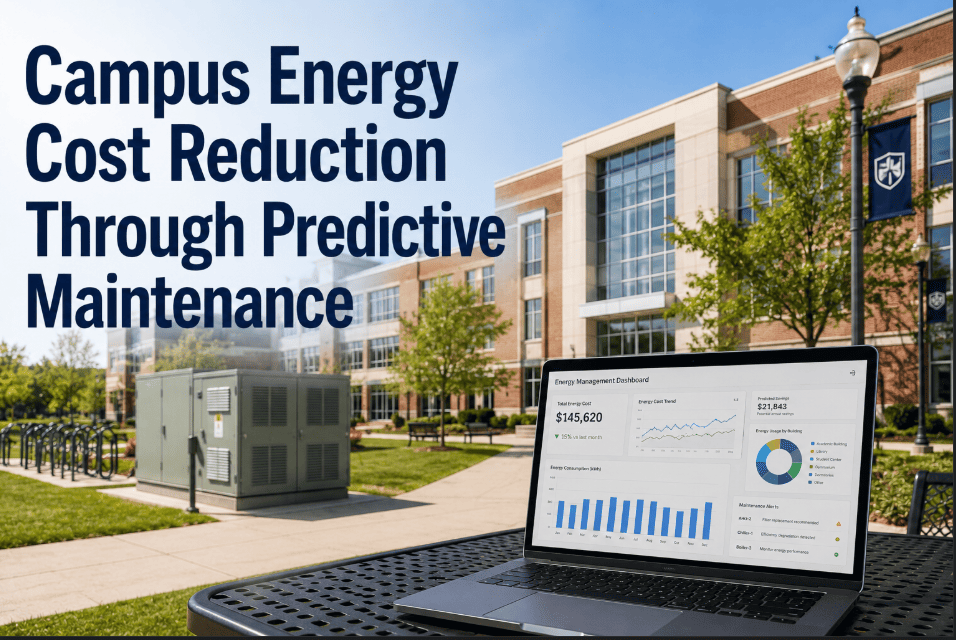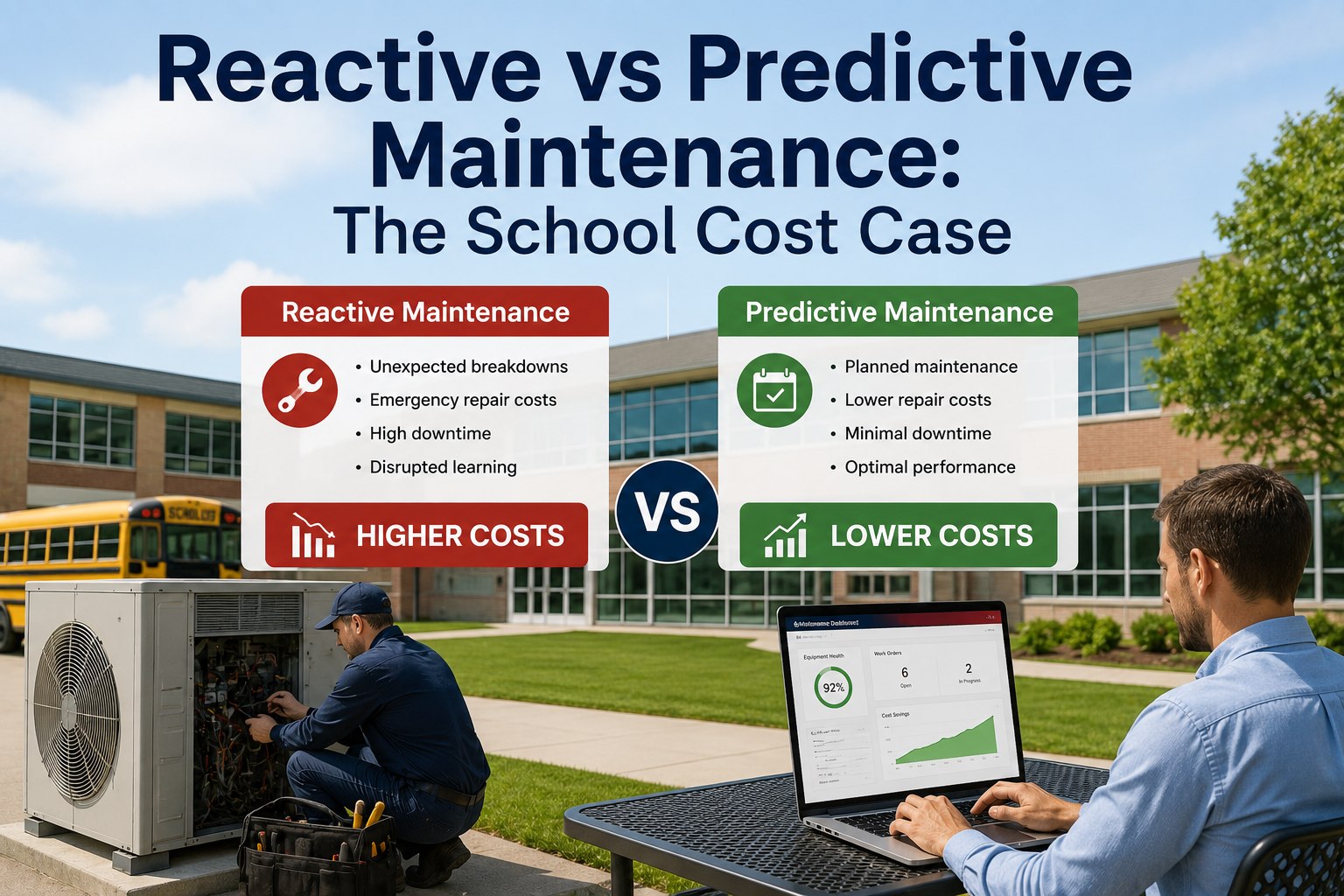
Reactive maintenance feels free until a boiler dies mid-period and a substitute teacher is reassigned while a gym fills with students waiting for heat. The honest cost case for predictive over reactive maintenance in schools shows up only when you add overtime, expedited parts, secondary damage, and lost instructional time into the same ledger. Most districts that measure honestly find emergency repairs cost three to nine times more than a scheduled fix on the same asset. If you are ready to see the math on your own buildings, you can Start Free Trial and run the comparison in under an hour.
Every emergency repair quietly taxes your classroom time.
Reactive maintenance looks cheapest on the purchase order — until overtime, expedited freight, secondary damage, and class disruption compound into a bill nobody budgeted for. Here is the honest cost case, broken down line by line.
- 2.4 hr technician overtime @ 1.5x
- Next-day expedited part freight
- 1 relocated class · 38 students
- Scheduled during off-hours window
- Standard part delivery
- Zero classroom disruption
Six hidden taxes on every reactive work order
A $340 part becomes a $1,800 repair once you stack the charges districts rarely track. Industry benchmark data from APPA and ASBO International puts the fully-loaded reactive premium at 3x–9x a planned fix — here is where it hides.
After-hours dispatch at 1.5x–2x rate
Emergencies rarely fall on the day shift. A failed boiler at 6:40 a.m. means a tech rolls at 7:15 a.m. on overtime, and the call-out minimum is typically two hours even if the fix takes twenty minutes.
Next-day and same-day freight surcharges
A $180 contactor becomes a $480 contactor when it ships same-day from a distributor three states away. Multiply that across 40–60 emergency orders per year and the freight line alone exceeds a technician's annual salary.
One failure cascades into three more
A seized bearing on an AHU motor can crack the shaft, burn the drive belt, and overheat the VFD — turning a $260 repair into a $2,400 one. Predictive sensors catch the vibration shift weeks before the cascade.
Relocated classes and lost instructional minutes
When a chiller fails in May, 30+ students get crammed into a shared library or cafeteria. Districts lose roughly 45–90 instructional minutes per relocation event — a cost that never shows up on a maintenance ledger.
Liability exposure when systems fail unannounced
A frozen fire-suppression line or a tripped emergency generator that nobody caught in time becomes an OSHA and insurance issue. One documented near-miss can raise a district's premium by 8–14% at renewal.
Emergency fixes accelerate replacement cycles
Assets run to failure lose 20–40% of their rated service life. A rooftop unit that should last 15 years is replaced at year 9 — pushing $28K–$42K of capex forward by half a decade.
A 14-school district, 420 assets, one honest year
Below is a real composite from a 4,200-student suburban district that tracked reactive vs. predictive costs across one fiscal year. The numbers below use their actual vendor rates and FTE costs.
Includes overtime, expedited parts, secondary damage, and relocation labor. Excludes lost instructional time.
Sensor-driven work orders scheduled during off-hours windows. Standard part delivery, no overtime.
| Cost Line | Reactive (Run-to-Fail) | Predictive (PdM) | Annual Delta |
|---|---|---|---|
| Labor (regular + overtime) | $48,200 | $6,140 | −$42,060 |
| Parts & freight | $31,400 | $2,890 | −$28,510 |
| Secondary damage repairs | $18,600 | $642 | −$17,958 |
| Class relocation labor | $5,800 | $0 | −$5,800 |
| Compliance & insurance premium impact | $3,126 | $0 | −$3,126 |
| Total Annual Cost | $107,126 | $9,672 | −$97,454 |
From reactive to predictive in one school quarter
A typical 8–15 building district moves from run-to-fail to a functioning predictive program in 90 days. Here is the realistic timeline most facilities directors follow.
Asset register & criticality ranking
Pull every asset above $1,500 replacement value into a single register. Rank by criticality to instruction, safety, and occupancy. Most districts surface 380–460 assets for a 14-school footprint.
Sensor deployment on top 20% of assets
Wireless vibration and temperature sensors go on the 20% of assets that drive 80% of emergency calls — typically AHUs, boilers, chillers, and main electrical panels. Install is non-invasive, ~25 minutes per asset.
Baseline learning & first alerts
The platform learns normal vibration and thermal signatures for 3–4 weeks, then begins surfacing anomalies. Most districts catch 4–7 emerging failures in the first 30 days of active monitoring.
Scheduled-fix workflow locked in
Alerts auto-generate work orders scheduled into off-hours windows. Parts ship standard freight. By month four, 70–85% of formerly-emergency repairs are now planned work.
What business managers assume — and what actually happens
"We can't afford sensors on every asset, so predictive won't work for us."
The 80/20 rule applies: 20% of assets drive 80% of emergency cost. Sensor only that 20% — typically 60–90 assets in a 14-school district — and you capture 80% of the savings for under $15K in hardware.
"Our CMMS already tracks work orders, so we're basically doing this already."
A CMMS records what already broke. Predictive maintenance tells you what is about to break, 2–6 weeks before it does. The two work together — PdM feeds the CMMS, it doesn't replace it.
"Our buildings are too old for sensors — nothing is networked."
Modern wireless vibration and thermal sensors are battery-powered (5–7 year life) and use cellular or LoRaWAN backhaul. They install on 1990s-era equipment in minutes with no building network changes.
Stop paying the emergency tax. Start seeing failures before they happen.
Run the same reactive-vs-predictive cost model on your own work order history. Most districts finish the analysis in under an hour and find six-figure annual savings hiding in plain sight.
Reactive vs predictive maintenance — answered
How much does predictive maintenance actually cost a school district to deploy?
A typical 8–15 building district spends $8K–$18K in year one: wireless sensors on the top 60–90 critical assets, the monitoring platform, and onboarding. Ongoing cost runs $4K–$9K per year. Against $97K+ in avoided reactive cost, the payback lands at 4–5 months for most districts.
Which assets should we monitor first to get the fastest payback?
Start with assets that fail expensively and disrupt instruction: boilers, chillers, air handlers, domestic water pumps, and main electrical panels. A good rule of thumb — if an unplanned failure would force a class relocation or an after-hours call-out, it belongs in the first wave. You can Book a Demo and we'll rank your top 20% from your existing asset list.
How long does it take before the sensors actually catch a failure?
The platform needs 3–4 weeks to learn each asset's normal vibration and thermal signature. After that baseline period, most districts catch 4–7 emerging failures in the first 30 days of active monitoring — typically bearing wear, belt slip, or motor electrical faults that would have cascaded into emergencies within 2–6 weeks.
We already have a CMMS — does predictive maintenance replace it?
No. A CMMS records and routes work orders; predictive maintenance feeds it. When a sensor detects an anomaly, it auto-generates a work order inside your CMMS, scheduled into an off-hours window with the part pre-ordered. The two systems are complementary — PdM makes your existing CMMS dramatically more effective.
What if our maintenance team is already stretched too thin to take on more technology?
Predictive maintenance reduces workload, not adds it. The average district eliminates 40–55 emergency call-outs per year — each one consuming 3–6 hours of unplanned, high-stress work. Those hours get redirected to planned, scheduled fixes during normal shifts. Most teams find the net labor burden drops within 60 days of going live.
Your first predictive alert could be 30 days away.
Upload your asset register and work order history today. See your reactive cost baseline, your predictive savings model, and a deployment plan tailored to your buildings — all in one session.
Free 14-day trial · No credit card