Schools face a maintenance constraint that most industrial sites never experience: students occupy the building roughly 180 days a year, which means every major repair, inspection, and capital project must squeeze into a narrow window of interrupted access. Summer break is the single largest opportunity — typically 8 to 10 weeks — but it is also the season when every competing department wants the same contractors, the same gymnasium, and the same boiler room. The teams that consistently finish summer PM on time are the ones that lock the schedule in February, not June. If your maintenance calendar is still a spreadsheet pinned to a workshop wall, the simplest next step is to spin up a CMMS trial and see how calendar-aware scheduling changes the math — you can Start Free Trial in minutes.
School PM · Academic Calendar Scheduling
Are you scheduling 12 months of preventive maintenance into an 8-week summer window?
For most districts, summer break is the only uninterrupted block large enough for boiler overhauls, gym floor refinishes, roof work, and HVAC controls upgrades. The teams that finish on time start sequencing work orders in January — not the last day of school.
Why It Matters
The 180-day constraint: every industrial facility envies it, every school dreads it
A manufacturing plant can take a line down on a Tuesday night and bring it back by Wednesday morning. A school cannot. Once students are in the building, the only acceptable disruption is one nobody notices — and that shrinks your PM menu to filter changes, belt inspections, and light-bulb swaps.
When 70% of your preventive maintenance labor compresses into a single quarter, scheduling discipline stops being a nice-to-have. A two-week delay on a boiler tube cleaning in June pushes the start of school into contingency heating mode, exposes the district to a facilities-related closure, and turns a $6,000 planned job into a $22,000 emergency call-out in October.
The Academic Calendar Playbook
Mapping PM work to every break in the school year
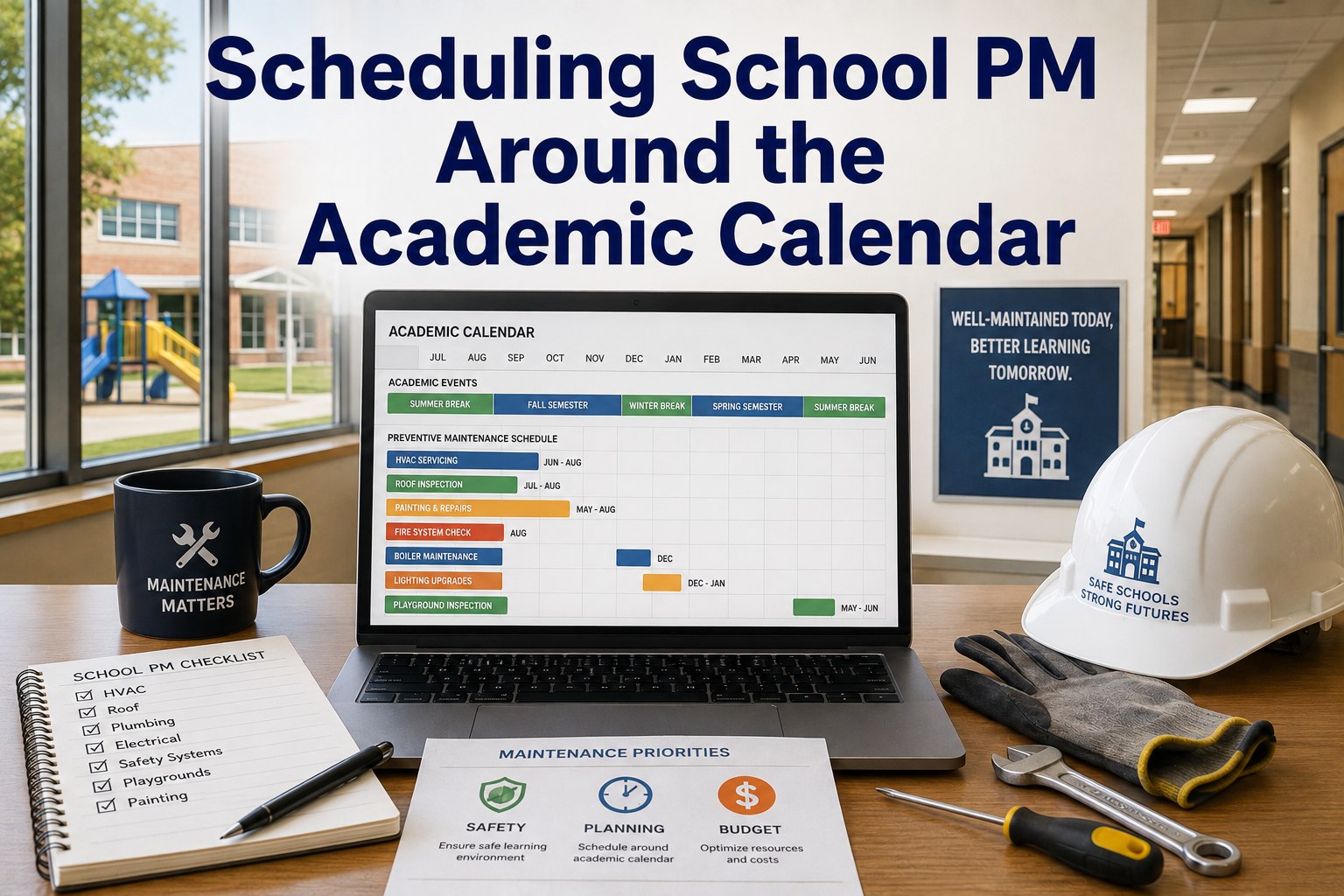
A calendar-aware school maintenance program assigns each PM task to the smallest break that can safely contain it. Major work goes to summer; mid-complexity jobs go to winter or spring break; low-impact tasks roll into weekends or after-hours windows during the academic term.
Summer scope lock & bid window
Finalize the summer PM scope, issue vendor RFPs for boiler overhauls, roof coatings, and gym re-finishes. Lock contractor schedules before the March rush — by April, the best HVAC and roofing crews are booked through August.
Spring break sprint & pre-summer staging
Use the 5–9 day spring break for mid-complexity PM: cooling tower descaling, AHU filter and belt changes, parking lot crack-sealing. Stage parts, scaffolding, and rental equipment for summer so June 1 is a start date, not a procurement date.
The 8-week summer execution window
Boiler tube cleaning, chiller overhauls, gym floor sanding and re-coating, roof membrane replacement, VFD installations, parking lot milling and repaving. Run two shifts where possible; sequence trades so demolition, mechanical, and finishing do not collide in the same corridor.
Term-time weekend & after-hours PM
During the academic year, restrict PM to low-impact, low-noise work: filter changes, belt tensioning, light fixture retrofits, fire-life-safety inspections. Schedule weekend windows for tasks needing 6–8 undisturbed hours; use after-hours (3:30–10:00 PM) for 2–4 hour jobs.
Winter break catch-up
A 10–14 day winter break is the second-largest PM window. Target heating system repairs, boiler annual combustion analysis, and any summer PM that slipped. Verify snow equipment, test emergency generators under load, and re-balance hydronic zones before January return.
Break-Type Assignment
Which maintenance belongs in which window
Mis-assigning a PM task to the wrong break is the most common cause of summer overruns. A job that needs 5 continuous days should never be scheduled into a 3-day weekend — and a job that produces fumes should never be planned during term time, no matter how "quick" it looks on paper.
| PM Task Category | Summer Break (8–10 wks) | Winter Break (10–14 days) | Spring Break (5–9 days) | Weekend / After-Hours |
|---|---|---|---|---|
| Boiler overhaul & tube cleaning | Primary window | Catch-up only | Not feasible | Not feasible |
| Chiller / cooling tower descale | Primary window | Season mismatch | Primary window | Small units only |
| Gym floor sand & re-coat | Primary window | If 10+ days | Risky cure time | Not feasible |
| Roof membrane repair / coating | Primary window | Weather risk | Weather dependent | Not feasible |
| AHU filter & belt change | Bulk change-out | Scheduled | Scheduled | Primary window |
| Fire-life-safety inspections | Bulk annual | If due | If due | Primary window |
| Parking lot milling & repave | Primary window | Weather risk | Pothole patch only | Not feasible |
| Lighting retrofit / LED upgrade | Bulk retrofit | Scheduled | Scheduled | Primary window |
Primary window Conditional Avoid
CMMS Scheduling
Calendar-aware scheduling: how a CMMS removes the spreadsheet tax
A spreadsheet cannot tell the difference between a school holiday and a regular Tuesday. A calendar-aware CMMS imports the district academic calendar, tags each day as instructional, break, or weekend, and auto-routes PM work orders to the correct window — flagging conflicts before they become October emergencies.
Import the academic calendar
Load the district's instructional calendar as a layer in the CMMS. Every date is tagged: instructional day, holiday break, professional development day, or summer recess. PM triggers then respect those tags automatically.
Tag each asset by access window
Classify assets by the minimum disruption window they require. A boiler gets "summer-only"; a corridor light fixture gets "after-hours OK." The CMMS then refuses to auto-schedule a summer-only asset into a weekend slot.
Auto-balance summer capacity
The CMMS sums labor hours across all summer-scoped work orders and compares them to available technician-hours. If you have 1,600 hours of summer PM and 1,100 hours of capacity, it flags a 500-hour shortfall in February — while you still have time to act.
Conflict detection before it costs you
If two trades try to book the same gymnasium in the same week — floor refinishing and HVAC duct cleaning — the CMMS blocks the double-booking and suggests a sequence. No more discovering on June 15 that the scaffold crew and the floor crew are fighting for the same space.
A 12-school district moved from spreadsheet scheduling to a calendar-aware CMMS and recovered 340 labor hours in the first summer — the equivalent of two extra weeks of capacity — simply by eliminating conflicts the spreadsheet had hidden.
— Worked example: mid-size suburban district, 12 buildings, 4 technicians
The Cost of Getting It Wrong
When summer PM slips: the October cascade
A delayed summer PM does not stay delayed — it cascades. The boiler that was not cleaned in June runs less efficiently through January, consumes 8–12% more natural gas, and is 3x more likely to fail during the first cold snap. That failure becomes an emergency call-out at 2x labor rates, a facilities closure, and a make-up day the superintendent has to explain to parents.
That 3.6x cost multiplier is before you count the instructional disruption, the parent complaints, and the school-board questions. The summer window is not just convenient — it is the cheapest labor and parts environment your maintenance program will see all year.
Lock your summer PM schedule before vendors are booked
Start a free CMMS trial, import your academic calendar, and see your summer capacity gap in under an hour.
Frequently Asked Questions
School PM scheduling, answered
When should we start planning summer maintenance?
Start the summer scope in January and lock it by mid-February. The best HVAC, roofing, and flooring contractors are booked by April — if you wait until May to issue an RFP, you will either pay a premium or get pushed to the following summer. A January start also gives you time to stage long-lead parts like chillers, transformers, and custom AHU coils, which can carry 10–14 week lead times.
How do we handle PM tasks that cannot wait for summer?
Assign each task to the smallest break that can safely contain it. Use winter break (10–14 days) for heating system work and catch-up on slipped summer PM. Use spring break (5–9 days) for cooling tower descaling, AHU service, and exterior repairs. During term time, restrict work to low-noise, low-impact tasks — filter changes, belt tensioning, lighting retrofits — scheduled into weekend or 3:30–10:00 PM after-hours windows.
Can a CMMS actually import our district academic calendar?
Yes. A calendar-aware CMMS like OxMaint lets you import the district instructional calendar as a date layer, then tags every day as instructional, break, or weekend. PM triggers respect those tags, so a summer-only boiler overhaul will never auto-schedule into a school week. You can Book a Demo to see the academic calendar import workflow in about 30 minutes.
How do we know if we have enough summer capacity?
Sum the labor hours of every PM work order tagged "summer" and compare that number to available technician-hours (technicians × hours per day × working days in the break). If scoped hours exceed capacity, the CMMS flags the shortfall in February — giving you time to bring in seasonal help, shift work to winter/spring breaks, or defer non-critical PM. Most districts discover a 20–35% capacity gap the first time they run this calculation honestly.
What PM should never be done during the school day?
Anything that produces fumes, dust, or noise above 65 dB inside an occupied building. That includes welding, solvent-based floor coatings, paint spraying, masonry cutting, and any work requiring lockout-tagout of life-safety systems. These tasks belong in summer, winter break, or weekends — never during instructional hours. The liability and indoor air quality exposure of doing them during the school day far outweighs the scheduling convenience.
Stop fighting the calendar. Start scheduling around it.
Import your academic calendar, auto-route PM to the right break, and recover weeks of summer capacity you didn't know you had.
Free 14-day trial · No credit card