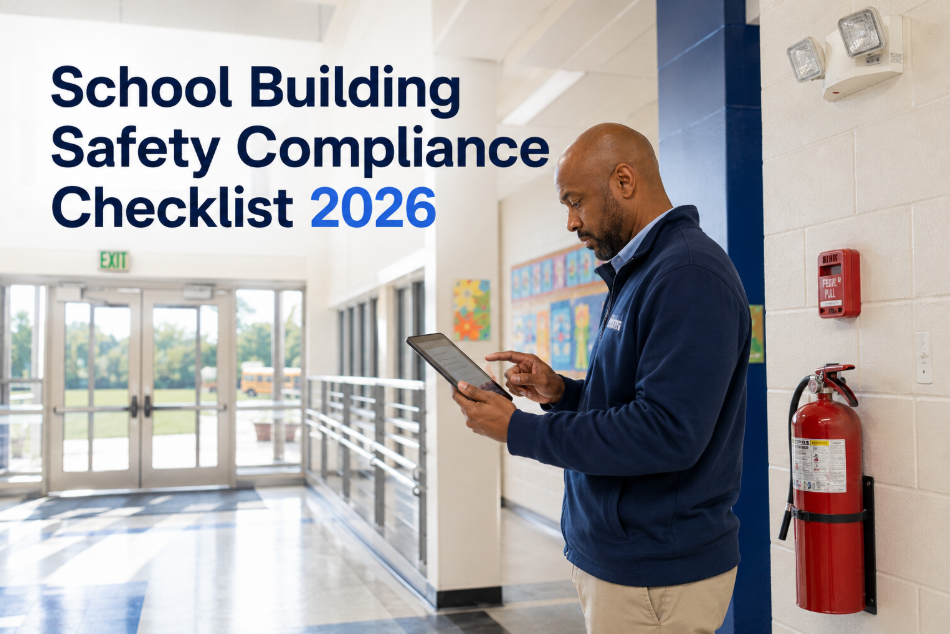
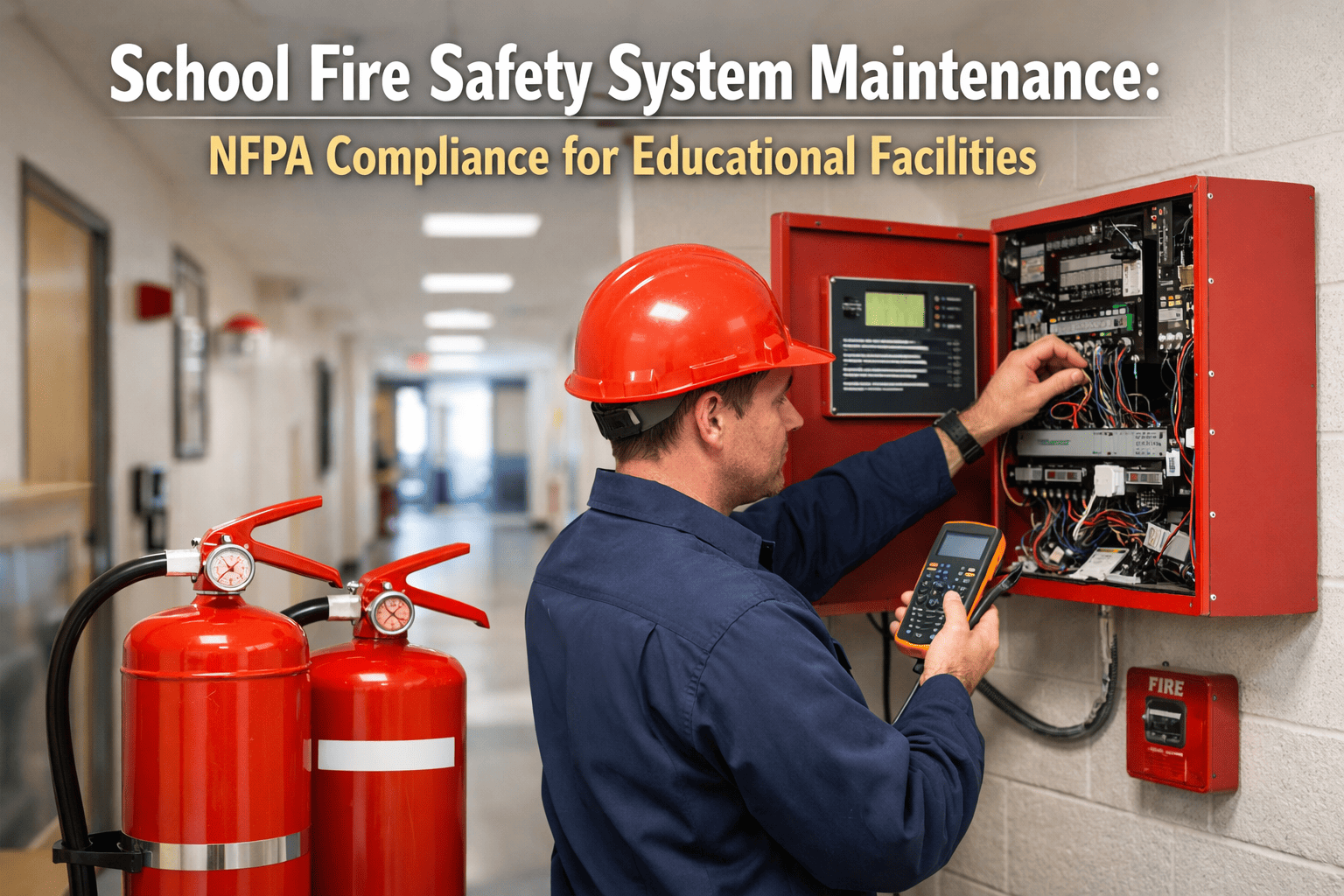
The fire marshal arrived at Jefferson Middle School on a Tuesday morning in March. By 11 AM, three buildings had occupancy holds. The sprinkler flow test in Building C was 14 months overdue. The fire alarm panel in the gymnasium had an expired certification — nobody realized the service contract had lapsed. And the kitchen hood suppression system log showed a gap: six months with no documented inspection. The principal learned about it when 840 students were relocated to the cafeteria and two portable classrooms. The repairs and expedited inspections cost $47,000. The disruption lasted nine days. The reputational damage — parent complaints, school board questions, local news coverage — lasted longer. None of it had to happen. Every one of those failures was a missed calendar entry on a paper tracking system that nobody owned. The fume hood drain that leaks for eleven days, the fire panel that expires without notice, the ADA ramp that degrades past compliance — these aren't maintenance failures. They're information failures. The building knew it was out of compliance. The system that was supposed to track it didn't. In 2026, with OSHA's Heat Illness Prevention rule expanding enforcement, EPA testing mandates tightening, NFPA codes adding documentation requirements, and ADA complaint-driven audits increasing 23% year over year, the cost of paper-based compliance tracking isn't a line item. It's an institutional risk. Start your free Oxmaint account and digitize every inspection, every deadline, and every compliance obligation across your campus.
Every Missed Inspection Is a Liability. Every Paper Log Is a Risk. Automate Both.
The 2026 Compliance Landscape: What's Changed and What It Costs
School safety compliance isn't one regulation — it's a web of overlapping federal, state, and local mandates, each with its own inspection frequency, documentation requirements, and penalty structure. In 2026, three major shifts have expanded the compliance burden for every K-12 district and university in the country:
Paper Tracking vs. Digital Compliance: The Risk Comparison
The gap between paper-based compliance tracking and automated compliance management isn't about convenience — it's about institutional risk exposure. Every paper calendar is a single point of failure. Every spreadsheet is a version control problem. Every filing cabinet is an audit liability.
68% of School Compliance Citations Are Documentation Failures. Eliminate All of Them.
Oxmaint automates every inspection schedule, digitizes every checklist, tracks every deficiency to closure, and generates audit-ready reports — so your team focuses on safety, not paperwork.
The 7 Compliance Domains Every Campus Must Track
Campus compliance isn't one system — it's seven distinct regulatory domains, each with its own inspection frequencies, documentation requirements, and enforcement agencies. Oxmaint automates all seven from a single platform:
Fire & Life Safety (NFPA)
Fire alarm testing (annual), sprinkler flow tests (quarterly/annual), fire extinguisher inspections (monthly/annual), kitchen hood suppression (semi-annual), emergency lighting (monthly), exit sign verification (monthly), fire door inspections (annual). Each generates a digital inspection record with checklist completion, deficiency notation, and corrective action tracking.
Occupational Safety (OSHA)
2026 Heat Illness Prevention compliance: temperature monitoring, heat action plans, training records. Plus ongoing: lockout/tagout procedures, confined space entry logs, hazard communication (SDS accessibility), PPE inventories, electrical safety inspections, fall protection for maintenance staff. Every training event and safety inspection auto-documented with completion evidence.
Environmental (EPA)
Water quality testing (lead/copper at all outlets), Legionella water management plans, AHERA asbestos management documentation, stormwater discharge monitoring, hazardous waste storage (paint, chemicals, lab waste), refrigerant management (Section 608), and underground storage tank compliance. Test results linked to specific fixtures and buildings with trend monitoring.
Accessibility (ADA / Section 504)
ADA transition plan maintenance, accessible route condition monitoring (ramps, doors, signage, restrooms), elevator inspection scheduling, assistive device inventory, barrier identification and remediation tracking. Complaint-driven audits are increasing 23% YoY — proactive documentation is the only defense against findings that trigger expensive retrofits.
Indoor Air Quality (ASHRAE 241)
Ventilation rate verification, CO2 monitoring, filter replacement scheduling, outdoor air damper testing, humidity control documentation, and IAQ complaint tracking with investigation records. ASHRAE 241 — the first standard specifically addressing infection risk through ventilation — requires documented evidence of equivalent clean air delivery in occupied spaces.
Elevator & Vertical Transport
State-mandated elevator inspections (annual/semi-annual), escalator safety checks, wheelchair lift testing, dumbwaiter inspections, and fire service recall testing. Certificates of operation must be current — expired certificates can result in immediate shutdown orders. Oxmaint tracks certification expiration and auto-schedules re-inspection with the appropriate vendor.
Playground & Athletic Safety (CPSC / ASTM)
Playground equipment inspection (CPSC guidelines), surfacing depth and impact attenuation testing, bleacher safety inspections, pool chemistry and drain compliance, gymnasium equipment inspection, and athletic field condition documentation. K-12 districts face particular exposure: playground injury claims average $28,000 and are the #2 source of school liability after bus accidents. Monthly inspection documentation demonstrating proactive maintenance is the primary defense against negligence claims.
The Compliance Automation Calendar
Compliance isn't a one-time event — it's a continuous cycle of inspections, documentation, deficiency tracking, and corrective action that repeats across every building, every system, every month. Here's what a fully automated compliance calendar looks like for a campus:
Never Miss an Inspection Again. Never Scramble for an Audit Again.
Oxmaint's compliance engine schedules every inspection across every regulatory domain, assigns it to the right person, captures digital documentation, tracks deficiencies to closure, and generates the audit-ready reports that keep inspectors satisfied and students safe.
Building the Business Case: Compliance ROI for School Leadership
Compliance automation isn't just about avoiding fines — though the fines alone justify the investment. It's about converting a chaotic, reactive, person-dependent process into a systematic, documented, defensible program that protects students, reduces liability, and frees facilities staff to focus on maintenance instead of paperwork.
Implementation: Audit-Ready in 60 Days
Oxmaint's compliance implementation is designed for school districts and universities that need results before the next inspection — not next year. The 60-day fast-track puts every regulatory obligation on autopilot:
Week 1–2: Compliance Inventory
Catalog every compliance obligation across every building: fire, OSHA, EPA, ADA, ASHRAE, elevator, playground, and state-specific requirements. Map inspection frequencies, responsible parties, and current status. Identify all overdue items for immediate remediation prioritization.
Week 3–4: Digital Checklist Build
Convert every paper inspection form into a digital checklist with photo capture, pass/fail criteria, deficiency notation, and automatic work order generation for findings. Configure each checklist to match the specific regulatory standard it addresses — NFPA 25 for sprinklers, NFPA 72 for fire alarms, CPSC for playgrounds.
Week 5–6: Schedule Activation
Activate the automated compliance calendar: every inspection at every building scheduled for the correct frequency with the correct assignee. Overdue items flagged and escalated. Auto-reminders sent to inspectors, vendors, and supervisors. Dashboard shows real-time compliance status across every domain and every building.
Week 7–8: Audit Readiness Validation
Run a simulated audit across all seven compliance domains. Generate compliance reports for each regulatory area. Identify and close any remaining documentation gaps. Train facilities team on report generation, deficiency tracking, and inspector access procedures. Deliver first board-ready compliance status report to superintendent.
Why 2026 Is the Compliance Tipping Point
OSHA's Heat Illness Prevention rule isn't optional — it applies to every school district and university with employees who work in environments that can exceed heat thresholds, which includes virtually every campus in America during summer months. The EPA's revised Lead and Copper Rule requires testing at every drinking water outlet in schools — not just representative samples. ADA complaint-driven investigations have increased 23% year over year, and the Department of Justice has signaled expanded enforcement focus on educational institutions. NFPA codes continue adding documentation requirements that transform fire safety from "install and forget" to "inspect, document, and prove." And state regulators are increasingly requiring digital documentation rather than accepting paper records.
The districts and universities that automate compliance in 2026 will operate from a position of defensible documentation — where every inspection is scheduled, every finding is tracked, every corrective action is verified, and every audit is answered with a digital report instead of a filing cabinet search. The ones that don't will continue paying the premium for reactive compliance: expedited inspections at emergency rates, citations for documentation gaps that the system should have prevented, and the constant anxiety of not knowing which building, which system, which regulation is the one that's about to fail.
Free Campus Compliance Risk Assessment
Find out exactly where your campus is exposed. Oxmaint's Compliance Risk Assessment inventories every regulatory obligation across your buildings, identifies overdue inspections and documentation gaps, and delivers a prioritized remediation roadmap with projected cost avoidance — within 10 business days.
Frequently Asked Questions
Does Oxmaint cover state-specific compliance requirements?
Yes. Every state has regulations that go beyond federal mandates — California's Division of the State Architect (DSA) structural inspections, Texas's Risk Management for Educators (RMFE) requirements, New York's Building Condition Survey mandates, Florida's SREF standards, and similar state-specific obligations. Oxmaint's compliance engine is configurable by state, so your district's calendar includes every federal, state, and local requirement applicable to your specific jurisdiction. During implementation, we inventory your state's regulatory landscape and configure the system accordingly. Updates to state regulations are incorporated as they take effect.
How does Oxmaint handle third-party inspections (fire, elevator, environmental)?
Many compliance inspections are performed by licensed third-party contractors — fire alarm testing companies, elevator inspection services, environmental testing labs. Oxmaint manages the entire vendor workflow: scheduling the inspection, sending the vendor notification with building access details, providing a digital checklist for their inspection scope, and capturing their report and certification documents directly into the building's compliance record. When a vendor completes an inspection, the system auto-updates the compliance calendar with the next inspection date and tracks any deficiencies found for corrective action. Vendor certifications and licenses are tracked with expiration alerts so you never use an unlicensed inspector.
Can inspectors and auditors access compliance records directly?
Yes. Oxmaint provides read-only auditor access that you can grant to fire marshals, OSHA inspectors, EPA auditors, or ADA investigators. Instead of pulling paper files during an inspection visit, you provide the inspector with a login that shows the specific compliance domain they're reviewing — complete inspection history, checklist completions, deficiency tracking, corrective actions, and certifications. Inspectors consistently report that digital records accelerate their review and demonstrate a level of institutional commitment to compliance that paper systems cannot match. Districts using Oxmaint report 50-70% shorter inspection visits and significantly fewer findings.
How does the system handle the new OSHA Heat Illness Prevention requirements?
Oxmaint includes a dedicated Heat Illness Prevention module designed for the 2026 OSHA rule. It integrates with weather forecast APIs to automatically trigger heat action plan protocols when temperature or heat index thresholds are forecast for your location. When triggered, the system generates documentation tasks: verify water stations are deployed, shade structures are available, acclimatization plans are active for new workers, and rest break schedules are communicated. Indoor facilities with inadequate HVAC are flagged automatically based on temperature sensor data. Every action is documented with timestamps and responsible parties — creating the compliance record OSHA inspectors will request during any heat-related investigation.
What's the ROI timeline for compliance automation?
Most districts see positive ROI within 90 days from three sources. First, avoided citations: the average OSHA fine is $15,625 per violation, fire code citations run $5,000-$50,000+, and EPA water violations average $25,000-$75,000. A single prevented citation often covers the entire annual software investment. Second, staff time recovery: the 0.5-1.0 FTE currently devoted to manual compliance tracking is redeployed to productive maintenance work. Third, insurance impact: carriers offer 5-15% premium discounts for documented, systematic compliance programs — savings that recur annually. Total documented savings of $118,000-$413,000 annually against platform costs of $20,000-$50,000 represents a 3:1 to 8:1 return. Book a demo for a customized ROI projection based on your district's building count and current compliance status.