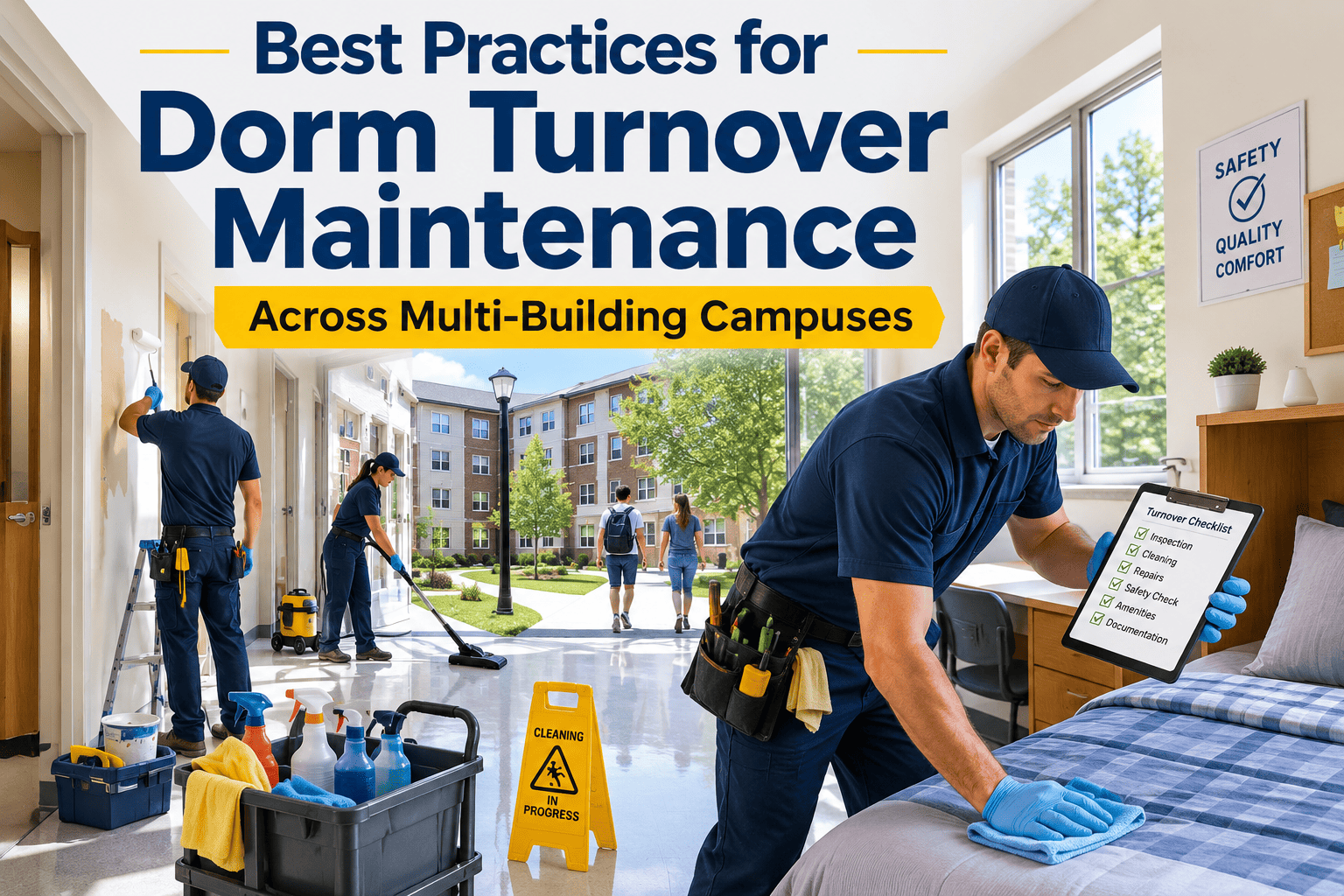
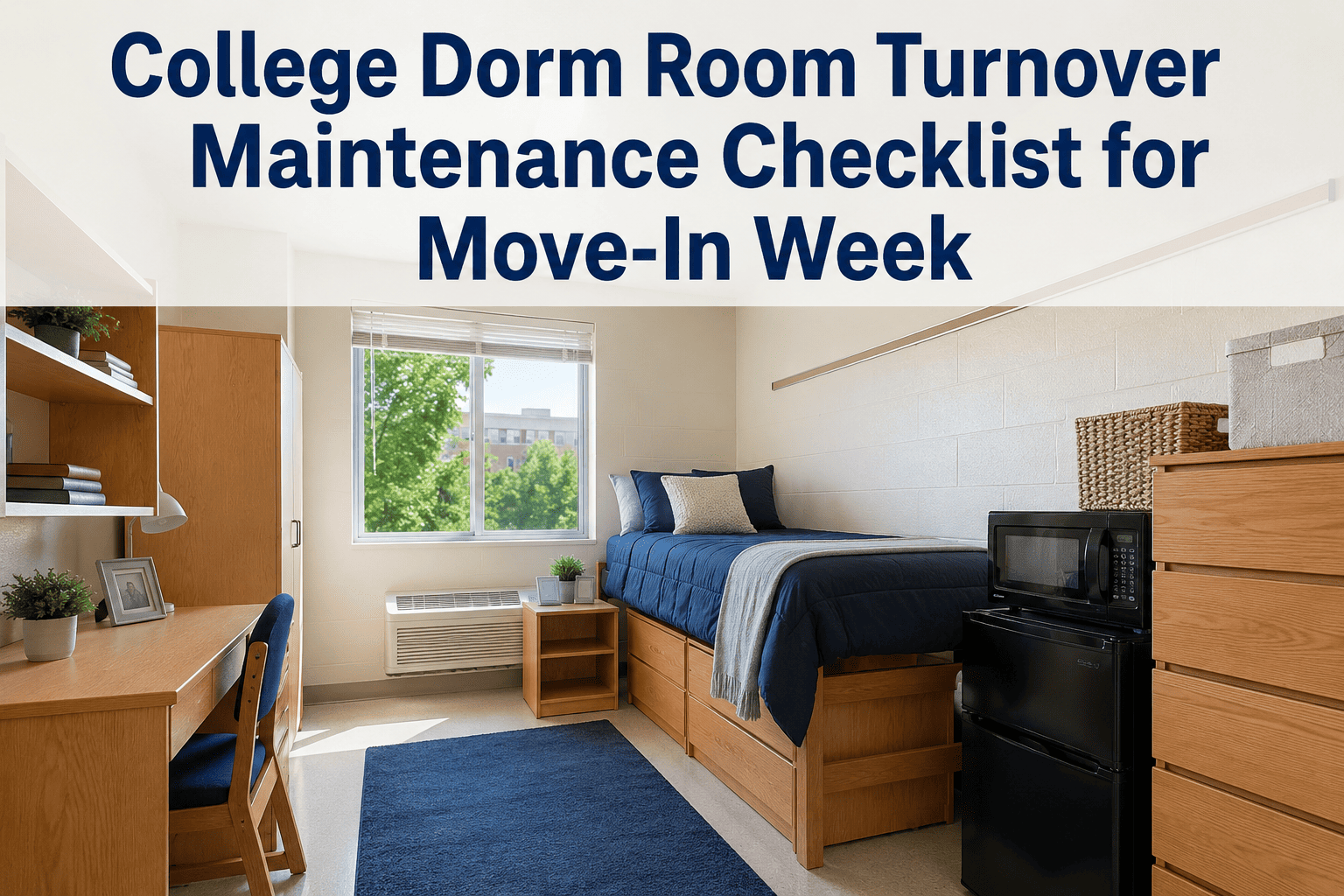
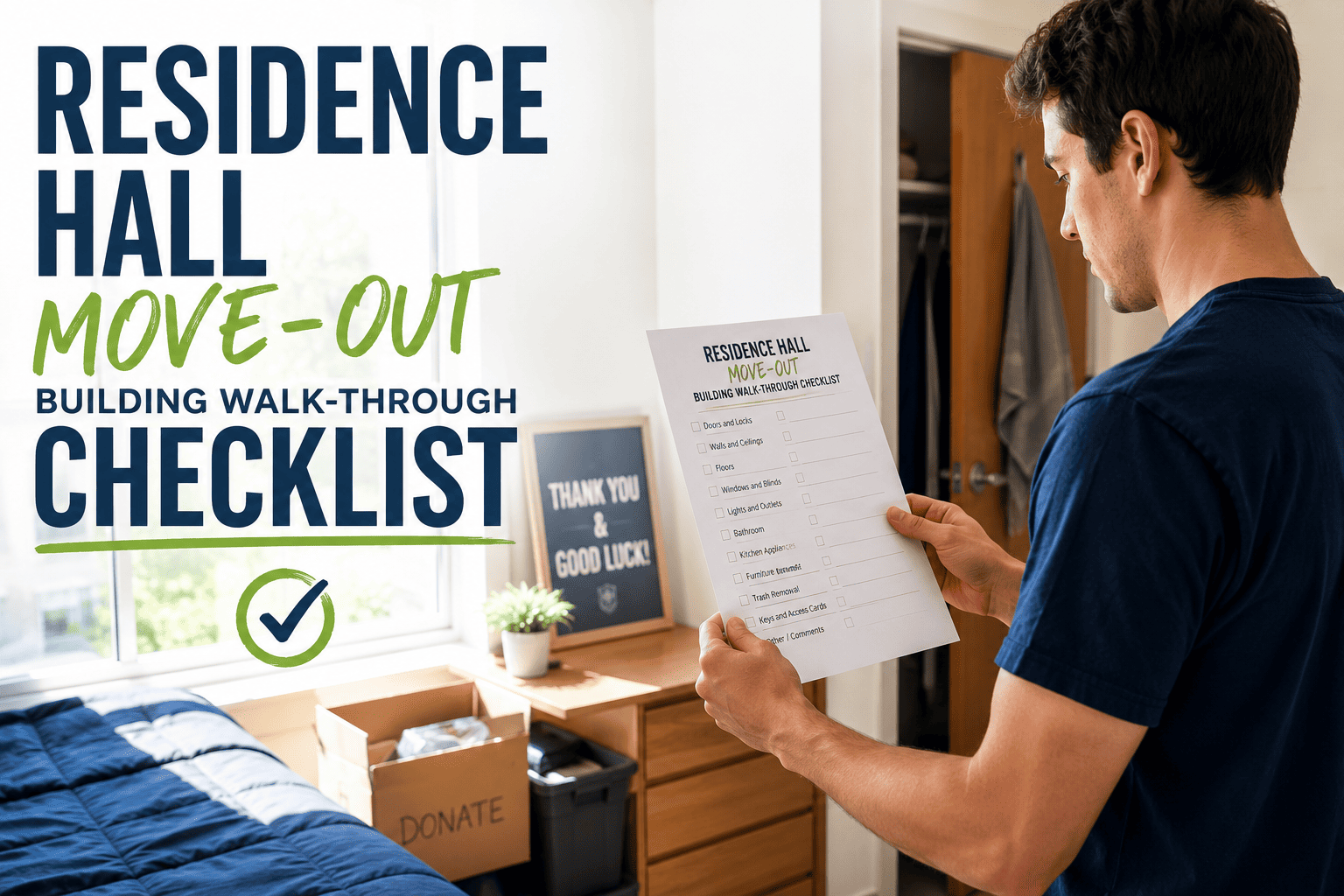
University housing turnover is one of the most operationally compressed events in higher education facilities — thousands of students vacating or occupying residence halls within 48 to 96 hours, with facilities teams expected to inspect, repair, clean, and certify every room between cycles. A single residence hall of 400 rooms can generate 600 to 900 work orders during a move-out window, overwhelming any team that relies on paper logs, verbal assignments, or shared spreadsheets. Start a free trial or book a demo to see how Oxmaint manages surge work order volume for campus housing operations.
University Move-In / Move-Out Surge Maintenance Playbook
A 400-room residence hall generates 600–900 work orders in a single turnover window. Without a CMMS-driven playbook, surge season becomes a documentation crisis, a vendor coordination failure, and a student satisfaction problem — all at once.
Move-In Week Is Not the Time to Discover What Move-Out Missed
Broken window locks, failed HVAC units, damaged furniture, and burned-out lighting found by a student on move-in day cost more to resolve — in emergency labor, vendor callouts, and student satisfaction damage — than they would have cost if caught and repaired during the pre-stage window. Oxmaint gives housing facilities teams a CMMS-driven surge playbook that stages inspection work orders by building and floor, routes repairs to the right technician, tracks vendor progress, and closes every room before students arrive. Start a free trial or book a demo to map your surge schedule today.
The 6-Phase Surge Maintenance Playbook for University Housing
A successful housing turnover is not improvised — it is planned in six sequential phases, each with its own work order type, staffing model, and completion gate. Missing a phase does not just create extra work. It compounds into the next phase and creates the move-in complaints that dominate the first week of the semester. Teams ready to structure their surge workflow in CMMS can start a free trial or book a demo.
Complete all deferred PM on HVAC units, elevators, plumbing fixtures, and electrical panels before the surge window opens. Stage parts inventory — filters, lamps, faucet cartridges, lock cores, and window hardware — at building-level storage points. Parts not staged before move-out create the procurement delays that compress the repair window.
Oxmaint pre-generates inspection work orders for every room — organized by building and floor — with standardized checklists covering furniture, plumbing, HVAC function, window and door hardware, lighting, and flooring. Inspectors complete checklists on mobile, attach photos of damage, and submit findings that auto-create repair work orders before leaving the room.
Repair work orders from inspection findings route automatically by trade — plumbing, electrical, HVAC, carpentry — with priority assigned by repair type. Structural and safety items receive P1 routing. Cosmetic repairs queue as P3. Sequencing by floor ensures trades complete building sections before moving to the next — reducing the travel time waste that kills productivity in surge.
Carpet replacement, window glass, painting, and appliance vendors receive Oxmaint work orders with scheduled access windows, room-by-room scope, and completion SLAs. Vendor progress is tracked in the same dashboard as internal staff — giving the housing director a unified view of what is done, what is in progress, and what is at risk of missing the move-in gate.
Every room receives a certification inspection work order before keys are assigned. The certification checklist confirms all repair work orders are closed, HVAC is functional, plumbing is clear, furniture is present and intact, and the room is clean. Only rooms with a closed certification work order appear as available in the housing assignment system.
Move-in day generates a second wave of work orders — students discovering issues, requesting furniture adjustments, and reporting maintenance items. Oxmaint routes these requests by priority and building, with SLA clocks running from submission time. Response SLAs configured at 2 hours for safety items, 24 hours for comfort items, and 72 hours for cosmetic requests.
6 Surge Failures That Paper-Based Coordination Cannot Prevent
These are the failure modes that generate the move-in complaints, student satisfaction dips, and post-occupancy work order spikes that housing directors face every semester. All of them are process failures, not staffing failures — and all of them are preventable with a CMMS-structured playbook.
Paper inspection logs do not show which rooms have been inspected and which have not. Inspectors skip rooms when time runs short, and the gap is not discovered until a student moves into an uninspected — and potentially damaged — space on move-in day.
Inspectors note damage on paper forms. Forms go to the office. Someone creates work orders manually — sometimes the same day, sometimes three days later. By then, the surge repair window has compressed and the damage is still unrepaired when students arrive.
Carpet and painting vendors working across 12 buildings have no coordination system beyond a phone number. Housing directors discover incomplete vendor work 24 hours before move-in — too late to recover without emergency overtime and student accommodation costs.
Without a formal room certification step, keys are assigned to rooms that still have open repair work orders. Students discover problems that should have been caught — and the resulting complaints, compensation requests, and emergency repairs cost more than the certification process would have.
Move-in day generates hundreds of concurrent maintenance requests across multiple buildings. Radio dispatch cannot prioritize, route, or track that volume. Safety items and comfort items receive identical treatment — and neither receives adequate tracking.
Without work order data from the surge cycle, next year's planning is based on last year's memory. Which buildings generated the most repairs? Which trade had the biggest backlog? Which vendor missed SLAs? The data to improve next year's playbook does not exist in a paper-based operation.
How Oxmaint Runs the Surge Playbook Across the Full Housing Portfolio
Oxmaint pre-generates the full surge work order set, routes findings to repair queues in real time, tracks vendor progress alongside internal staff, enforces the certification gate, and captures post-surge analytics for continuous improvement. Every phase of the playbook runs in one system — not split across clipboards, spreadsheets, and contractor text threads. Teams ready to digitize their surge operations can start a free trial or book a demo.
Inspection work orders for every room, common area, and mechanical space generate automatically from the residence hall asset hierarchy — building, floor, wing, room — before the first student vacates. Inspectors arrive with their full task queue ready on their mobile device, not a blank clipboard.
When an inspector marks a finding — damaged door hardware, failed HVAC, broken furniture — Oxmaint creates the repair work order immediately with the room location, photo, and priority. The repair work order appears in the trades queue before the inspector has left the floor, not three days later when someone processes paper forms.
Carpet, paint, and appliance vendors access their scoped work orders through Oxmaint's contractor portal — room list, access schedule, completion requirements, and SLA deadline visible in one view. Vendor completion status updates in real time on the housing director's dashboard.
No room receives a closed certification status until all repair work orders for that room are closed and the certification checklist is completed with technician sign-off. Housing assignment systems can integrate the certification status — only certified rooms appear as available for student assignment.
Student requests submitted on move-in day route by building zone, trade type, and priority level — with SLA clocks visible to supervisors in real time. Safety items escalate automatically if not acknowledged within the configured window. Every request has a tracked response time, not just a radio call that may or may not have been heard.
After the surge cycle closes, Oxmaint generates building-level reports: rooms with the highest repair counts, most common damage types, vendor SLA performance, trade backlog peaks, and pre-stage PM completion rate. Next year's surge playbook is built on data instead of memory.
Paper-Based Surge vs. CMMS-Driven Housing Turnover
What Housing Facilities Teams Measure After CMMS Surge Deployment
Pre-generated work orders and mobile completion tracking eliminate the missed-room gaps that generate move-in day complaints
Finding-to-repair routing and certification gates resolve pre-occupancy issues before students arrive — not after they complain
Contractor work order status updates eliminate the last-minute discovery of incomplete vendor scope that triggers emergency overtime
SLA-tracked routing replaces radio dispatch — every safety-level request is acknowledged and assigned within the configured response window
Frequently Asked Questions
How far in advance should housing teams begin surge preparation in Oxmaint?+
Can student RAs or student workers use Oxmaint to submit move-out inspection findings?+
How does Oxmaint handle buildings with different room configurations and turnover schedules?+
What happens if a repair cannot be completed before move-in and a student is assigned to that room??+
Run Surge Season Like a System, Not a Scramble
Every residence hall turnover is predictable — the dates, the room count, the trade requirements, the vendor scope. The only variable is whether your team has the right system to manage that predictable event or whether they improvise it again this year. Oxmaint turns surge into a structured, trackable, continuously improving playbook. First work orders generated before move-out begins. Certification gates enforced before a single key is assigned.