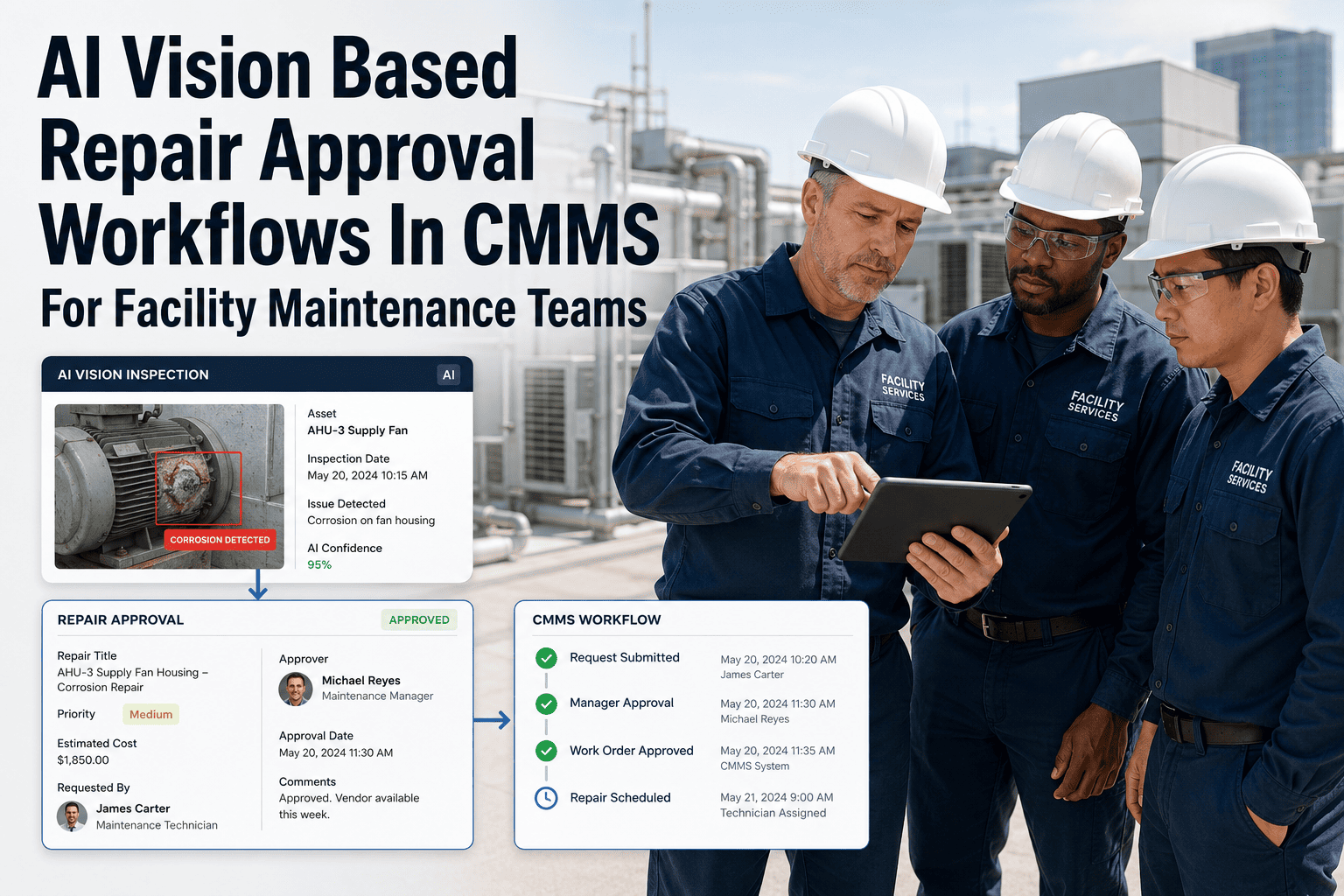
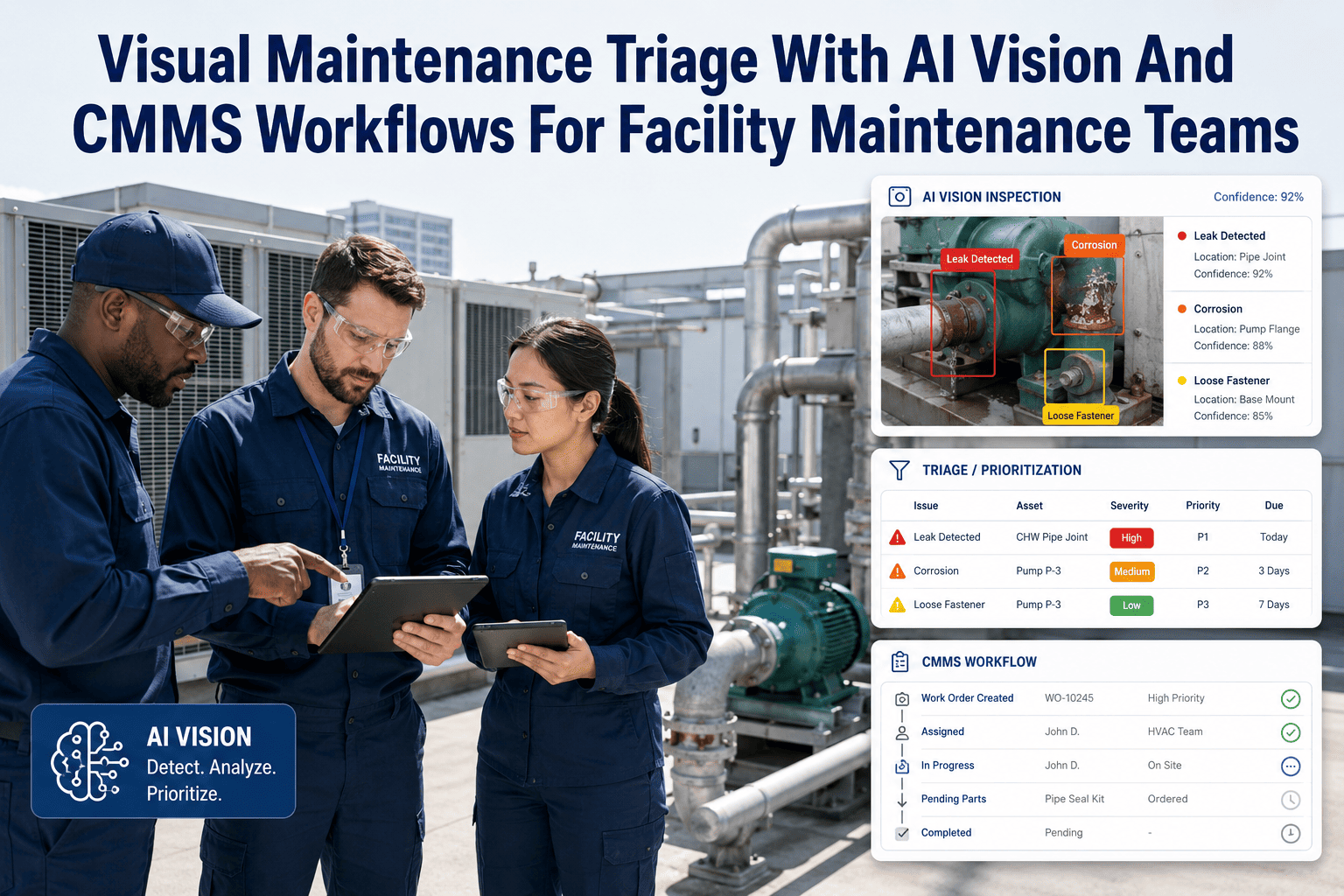
AI-powered visual defect detection is transforming how facility maintenance teams convert inspection findings into structured work orders — eliminating the lag between spotting a problem and dispatching a technician. OxMaint's AI Vision integration captures defects from cameras or photos, classifies them automatically, and generates fully-formed CMMS work orders with zero manual data entry. Whether your team manages a single plant floor or a multi-building campus, the pipeline from visual evidence to repair action is now instant, consistent, and audit-ready. Maintenance managers relying on OxMaint report faster mean-time-to-repair, fewer missed defects, and a documented photo trail for every work order — all from one connected platform. Book a live demo to see the visual defect-to-work-order pipeline in action.
AI Vision · CMMS · Facility Maintenance
See a Defect. Create a Work Order. Automatically.
OxMaint AI Vision Integration converts every visual defect — from a camera feed or inspection photo — into a structured CMMS work order with photo evidence, priority, and team assignment already filled in.
How It Works
From Photo to Work Order in 4 Steps
1
Capture
Camera or uploaded inspection photo is received by OxMaint AI Vision. No special hardware required — IP cameras, mobile uploads, and fixed sensors all supported.
2
Detect
Vision model scans the image for defect signatures — corrosion, leaks, cracks, obstructions, PPE gaps, and 40+ other defect categories configurable per asset class.
3
Classify
AI assigns defect type, severity level, and recommended action — matching the defect to your facility's asset-specific work order template and priority rules.
4
Dispatch
CMMS work order is created with photo evidence attached, technician assigned, and supervisor notified — the repair team has everything they need before they reach the asset.
Before vs After
What Changes When Vision Automates Your Defect Pipeline
| Workflow Step |
Without AI Vision |
With OxMaint AI Vision |
| Defect Discovery |
Inspector walks asset, notes defect on paper or phone |
Camera detects defect automatically — 24/7 coverage |
| Work Order Creation |
Inspector manually writes WO description, attaches photo separately |
WO auto-created with photo evidence, asset ID, and priority pre-filled |
| Priority Assignment |
Relies on inspector judgment — inconsistent across shifts |
AI classifies severity using consistent, asset-specific rules every time |
| Team Routing |
Planner manually assigns to the right technician or crew |
Auto-routed to correct team based on asset type and shift schedule |
| Audit Evidence |
Photos stored separately, often lost or unlinked from WO |
Photo evidence permanently linked to WO — retrievable for any audit |
| Time to Dispatch |
30–90 minutes from defect discovery to technician assignment |
Under 60 seconds from detection to dispatched work order |
Operational Impact
What Facilities See After Deploying AI Vision Integration
78%
Reduction in manual WO entry time
3.2×
More defects captured vs manual inspection
94%
Photo evidence attached to every WO
41%
Faster mean-time-to-repair (MTTR)
OxMaint AI Vision · Facility CMMS · Free to Start
Stop Writing Work Orders. Let AI Vision Write Them for You.
OxMaint connects camera detection to CMMS dispatch in seconds — so your team focuses on fixing, not filing.
Expert Perspective
"The biggest friction in facility maintenance is not finding defects — inspectors are good at that. The friction is in converting what they found into a work order that contains enough context for someone else to act on it correctly. AI vision integration eliminates that translation step entirely. The defect IS the work order, from the moment it is detected."
Marcus T. Henley
Facility Operations Lead · 22 years in industrial and commercial FM · IFMA CFM, CEM
Defect Coverage
Defect Types OxMaint AI Vision Detects and Routes
■
Fluid Leaks
Pooled liquid, drip staining, pipe joint seepage — routed to Leak Investigation WO
■
Surface Corrosion
Rust bloom, coating failure, structural steel degradation — routed to Condition Assessment WO
■
Electrical Anomalies
Panel door open, heat signatures, moisture ingress — routed to Electrical Safety Inspection WO (Urgent)
■
Mechanical Wear
Belt tracking, bearing staining, misalignment — routed to Corrective Maintenance WO
■
Structural Cracks
Concrete spalling, crack propagation, delamination — routed to Structural Assessment WO
■
PPE Non-Compliance
Missing helmet, vest, or gloves in restricted zones — routed to Safety Compliance Alert
FAQs
AI Vision Integration for Visual Defect to Work Order — Common Questions
Does OxMaint AI Vision require special cameras or hardware to operate?
No specialized hardware is required. OxMaint AI Vision works with standard IP cameras, mobile device uploads, and fixed sensors already present in most facilities. The vision model runs in the OxMaint platform — your camera sends the image, and OxMaint handles detection, classification, and
work order creation automatically. Teams with no existing camera infrastructure can start with mobile photo uploads and expand to live feeds over time.
How accurate is the AI defect classification compared to a trained inspector?
OxMaint AI Vision achieves over 91% accuracy on priority classification for the defect types it is configured to detect, based on facility deployment data. The model is trained on asset-class-specific defect signatures and improves over time as it accumulates facility-specific images. For edge cases or novel defects, the system flags the work order for planner review rather than auto-assigning — ensuring no defect falls through without human verification.
Book a demo to review accuracy benchmarks for your asset types.
Can the work order templates be customized per asset type or facility location?
Yes — OxMaint allows full customization of work order templates per asset class, equipment group, and site. During setup, your asset register is mapped to defect categories and corresponding WO templates. This means a fluid leak on a chiller follows a different template than the same defect type on a roof drain, with the appropriate task list, parts, and team assignment for each.
Start a free trial to configure your asset and template structure.
Is the visual evidence retained for audit and compliance purposes?
Every work order created through OxMaint AI Vision has the originating image permanently attached and time-stamped to the work order record. This creates a complete visual audit chain — the defect photo, the detection event, the WO creation timestamp, the assigned technician, and the closure record are all stored together and retrievable for compliance audits, insurance claims, or root cause analysis.
See how OxMaint structures visual evidence for audit in a live demo.
OxMaint AI Vision · Defect to Work Order · Start Free
Every Defect Deserves a Work Order. AI Vision Makes Sure It Gets One.
OxMaint AI Vision Integration closes the gap between visual discovery and repair dispatch — with photo evidence, correct priority, and team assignment in place before a technician leaves the desk.