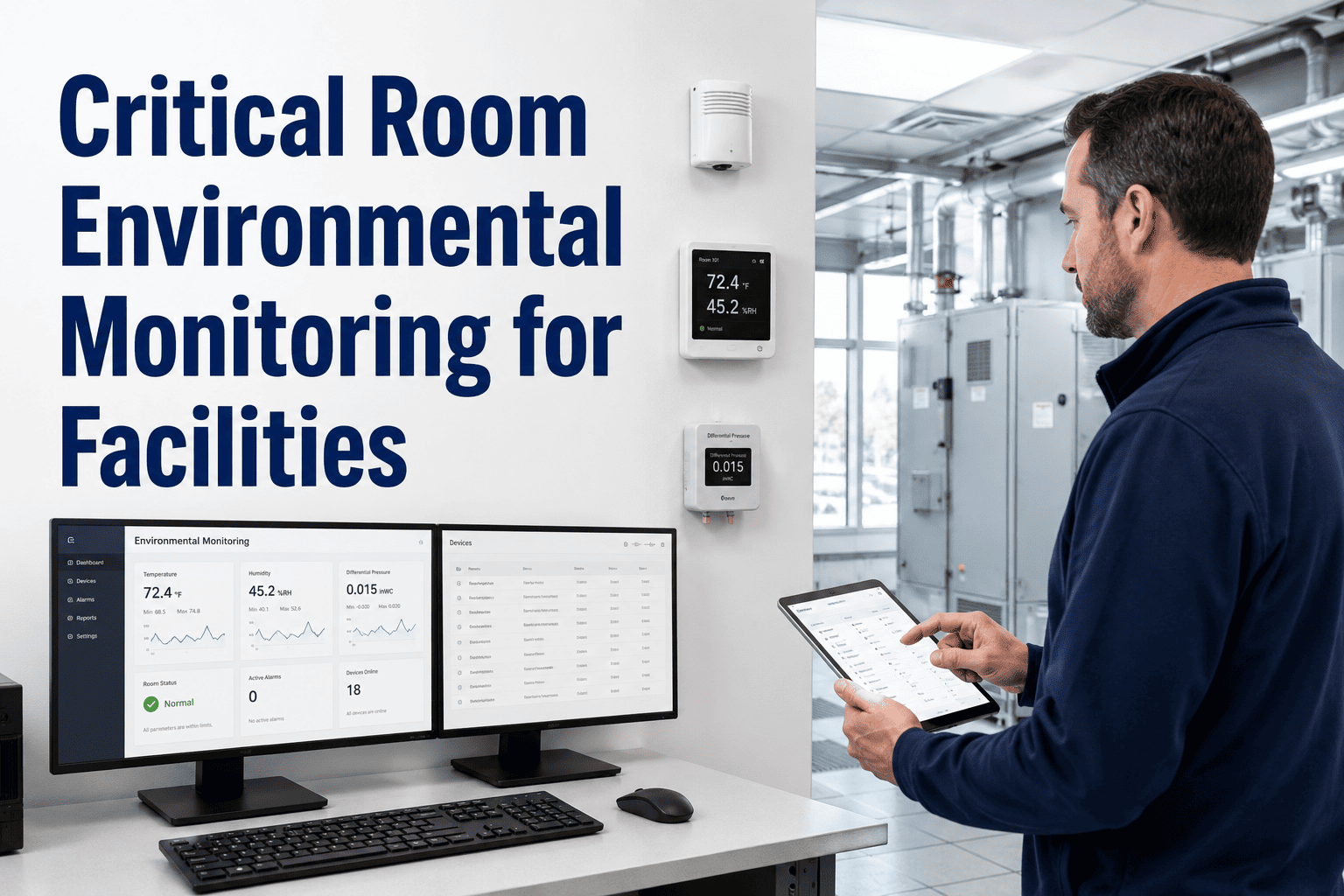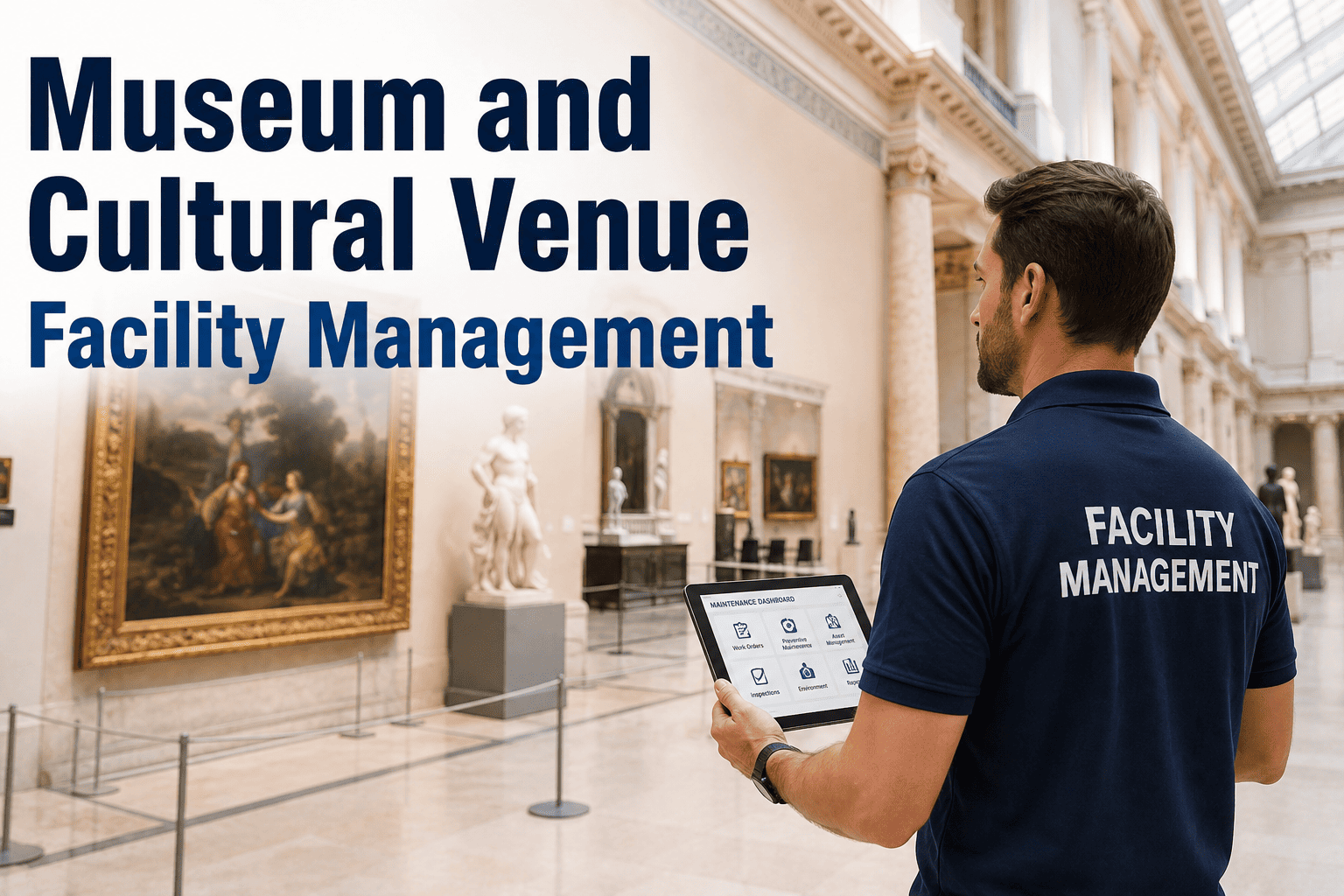
Museum and cultural venue facility management is the discipline of operating buildings where conservation-grade environmental control, artifact safety, and high-volume public access must coexist inside the same envelope. Collections demand tighter temperature, humidity, and light tolerances than human comfort requires — often ±1°C and ±5% RH — making cultural venue FM fundamentally different from commercial property management. A single HVAC failure or condensation event can cause irreversible damage to irreplaceable artifacts valued in the millions, so gallery facility management teams rely on preventive maintenance schedules, real-time sensor integration, and rigorous work-order documentation to stay audit-ready. OxMaint brings AI-powered CMMS and EAM capabilities — work orders, preventive and predictive maintenance, asset tracking, spare-parts inventory, and maintenance analytics — into one platform built for the conservation and public-service standards of cultural institutions. Start Free Trial to see how digitized maintenance workflows protect both collections and budgets.
Cultural Venue FM
Can your museum's facility operation protect 10,000 artifacts and 400,000 annual visitors at the same time?
Museum environmental control FM demands precision that commercial buildings never face. When a gallery HVAC system drifts 2°C outside spec, condensation forms on display cases within hours — and irreversible collection damage begins. OxMaint's AI-powered CMMS catches the drift before the curator does.
Conservation-Critical Operations
What makes museum facility management fundamentally different
A commercial office building maintains 21–23°C for occupant comfort. A museum maintains 20°C ± 1°C and 50% RH ± 5% — because organic artifacts, paintings, textiles, and metals each respond differently to environmental fluctuation, and the damage is cumulative and irreversible.
Heritage facility management teams operate under a dual mandate that no other building type faces. On one side, the building envelope, HVAC plant, lighting systems, security infrastructure, and fire suppression must perform at peak reliability — a failed chiller in July can close an entire wing. On the other side, every maintenance action itself carries conservation risk: a technician walking through a gallery with tools, a ladder placed near a vitrine, or a spare-part delivery routed through a collections corridor introduces vibration, dust, and bio-burden that conservators must account for. Cultural building FM is not simply building maintenance in a nicer building — it is a specialized discipline where facility operations are planned around artifact safety, loan agreement compliance, and public-access schedules.
The cost of reactive maintenance in a museum compounds faster than in any other facility type. A single undocumented temperature excursion can invalidate a $500K traveling-exhibition loan agreement, trigger an insurance audit, and require months of conservation assessment — all from a filter change that was deferred two weeks. Museum facilities operations teams that still run on spreadsheets and paper work orders are carrying risk that digitized, preventive-maintenance-driven workflows eliminate entirely.
Operational Checklists
Museum gallery facility management: what must be on the FM checklist
Cultural venue facilities that meet conservation standards run on structured, repeatable inspection cycles. These are the four checklist domains that separate compliant museum FM operations from reactive patch-and-pray maintenance.
Environmental Control Systems
- Daily RH and temperature log review against setpoint bands
- HVAC filter replacement on 90-day cycles, HEPA on 180-day
- Chiller and boiler compressor performance trending
- Humidifier/dehumidifier desiccant or steam-unit service
- Calibration of gallery dataloggers every 12 months
Artifact-Safe Building Operations
- UV and lux-level verification on all gallery lighting
- Display-case gasket and microclimate seal inspection
- Pest-monitoring trap checks on 30-day intervals
- Vibration-damping verification near sensitive exhibits
- Dust and particulate filtration efficiency testing
Visitor-Facing Service Reliability
- Elevator and escalator preventive-maintenance compliance
- Restroom plumbing and fixture inspection twice daily
- Emergency egress and fire-door functional testing
- Wayfinding and exhibit lighting outage response under 2 hrs
- HVAC noise-level checks in quiet-gallery zones
Compliance and Loan Documentation
- Facility reports for incoming loan agreements (RAA/AAMD)
- Environmental data export for insurance renewals
- Fire-suppression inspection records (NFPA 72 compliance)
- Security system and access-control test logging
- IAQ (indoor air quality) trending for occupant wellness
The Cost of Reactivity
How much does reactive museum building management actually cost?
Consider a mid-sized cultural venue with 1,200 tracked assets, 85,000 square feet of conditioned gallery space, and an annual operating budget of $3.8M. When FM runs on paper work orders and memory-based scheduling, the costs compound silently — until a loan-condition violation forces them into the open.
Annual cost of reactive museum FM (worked example)
Unplanned HVAC downtime (3 events × $14K emergency repair + artifact risk) + Deferred PM backlog cleanup + Extended conservator assessment after excursions + Loan-agreement penalty risk + Overtime from emergency callouts
= $127,000+ per year in avoidable cost — before any artifact damage is factored in
The scenario above is conservative. A single prolonged humidity excursion in a gallery housing loaned oil paintings can trigger conservation assessments costing $15,000–$40,000, potential loan-fee forfeiture, and increased insurance premiums for years. Museum conservation FM teams that shift to preventive, sensor-informed maintenance typically recover their CMMS investment within 4–7 months — not through savings on labor, but through the avoidance of a single serious incident that would have dwarfed the software cost.
"We spent $18K on a CMMS. In month five, it caught a chiller vibration trend that would have failed during a Monet loan. The avoided incident paid for the system four times over."
— Facilities Director, regional art museum (320,000 annual visitors)
OxMaint for Cultural Venues
How OxMaint solves museum and cultural venue facility management
OxMaint is an AI-powered CMMS and EAM platform built to run the full maintenance stack — work orders, preventive and predictive maintenance, asset tracking, spare-parts inventory, and analytics. For museums and cultural venues, it maps directly to the four operational domains where spreadsheet-based FM fails.
Predictive environmental monitoring
OxMaint's AI-driven analytics layer ingests sensor data from your BMS — temperature, humidity, lux, UV, vibration — and trends it against asset-level thresholds. Instead of discovering a 2°C drift during a morning walkthrough, the platform flags declining chiller performance or a sticking damper 7–14 days before the gallery environment goes out of spec. Teams catch 80% of environmental excursions before they breach the conservation setpoint band.
Outcome: 30–50% fewer unplanned environmental excursions and zero surprise loan-condition violations.
Automated preventive maintenance scheduling
Every filter change, calibration, inspection, and service task is attached to its parent asset with a condition-based or time-based trigger. OxMaint auto-generates work orders, assigns them to the right technician, and routes them around gallery hours — no maintenance activity lands during peak visitor flow or private events without explicit approval. The PM compliance rate becomes a live dashboard, not an end-of-quarter scramble.
Outcome: 95%+ PM compliance and 60% reduction in emergency callout overtime.
Audit-ready work-order documentation
Every work order in OxMaint captures technician, timestamp, parts consumed, readings taken, before/after photos, and digital sign-off. When an insurance underwriter or a lending institution requests a facility report, the data exports in minutes — not the two weeks it takes to reconstruct paper records. Loan-condition compliance becomes a query, not a project.
Outcome: facility reports that took 80 hours now compile in under 30 minutes.
Asset and spare-parts inventory for conservation equipment
OxMaint's EAM layer tracks every asset — from the 200-ton chiller serving Gallery A to the UV-filter film on a specific display case — with full lifecycle history, warranty status, and criticality rating. Spare-parts inventory for conservation-critical systems (replacement HEPA filters, case gaskets, desiccant cartridges, lamp ballasts) is tracked with min/max reorder points so the part is on the shelf before the work order opens.
Outcome: 40% reduction in parts stockouts and 25% lower inventory carrying cost.
Comparison
Spreadsheets vs. CMMS for museum facilities operations
Most cultural venues under 100,000 square feet still run maintenance on a shared spreadsheet and a wall calendar. The table below shows where that approach breaks down — and where a purpose-built CMMS like OxMaint changes the risk profile.
| Capability | Spreadsheet / Paper | OxMaint CMMS + EAM |
|---|---|---|
| PM schedule generation | Manual entry; missed when staff change | Auto-generated by asset triggers and time cycles |
| Environmental excursion detection | Discovered during walkthrough; hours late | AI-trended; flagged 7–14 days before breach |
| Work-order documentation | Paper forms; lost or incomplete | Digital, photo-attached, GPS and timestamp verified |
| Loan-condition facility report | 80+ hours to reconstruct manually | Exports in under 30 minutes on demand |
| Spare-parts visibility | Counted annually; stockouts common | Real-time min/max with auto-reorder alerts |
| Audit and insurance readiness | Reactive; weeks of preparation | Continuously audit-ready; one-click export |
| Mobile access for technicians | None; clipboard-dependent | Full mobile app; works offline in basements |
See OxMaint on your assets — book a 30-minute demo
Walk through a live environment configured for a museum or gallery: environmental-monitoring alerts, PM calendars aligned to gallery hours, and one-click loan-report exports. No slide deck — just the product on your real workflow.
FAQ
Museum facility management: common questions
What is museum facility management and how is it different from commercial FM?
Museum facility management combines standard building operations (HVAC, plumbing, electrical, security) with conservation-critical environmental control — maintaining temperature, humidity, light, and air-quality bands far tighter than human comfort requires. Commercial FM targets occupant comfort at ±2–3°C; museum FM targets artifact preservation at ±1°C and ±5% RH, with every maintenance action itself screened for conservation risk. A museum FM team also manages loan-agreement compliance documentation that commercial buildings never touch.
What environmental standards must cultural venue FM maintain?
Most museums follow standards from the Canadian Conservation Institute (CCI), the Image Permanence Institute (IPI), and AAMD facility-report guidelines. Typical setpoints are 18–22°C with ±1°C tolerance and 45–55% RH with ±5% tolerance, adjusted by material type — metals prefer low RH, organic materials need tighter humidity bands. Light levels are capped at 50 lux for light-sensitive materials and 200 lux for robust objects, with UV below 75 microwatts per lumen. OxMaint's asset-level threshold configuration lets you set different bands per gallery and alert automatically on breach.
How does a CMMS help with museum conservation and loan compliance?
A CMMS like OxMaint creates an auditable record of every maintenance action, environmental reading, and asset inspection tied to each gallery and system. When a lending institution or insurer requests a facility report, the data — PM compliance rates, environmental logs, work-order history, equipment condition assessments — exports in minutes rather than weeks. This documentation is often a condition of loan approval, and gaps in records can cause a venue to be declined for major exhibitions.
How much does museum facility management software cost?
A CMMS for a mid-sized museum (50–200 staff, 500–3,000 tracked assets) typically ranges from $300 to $1,200 per month depending on user count and sensor-integration depth. The ROI calculation is not labor savings — it is risk avoidance: a single avoided environmental excursion or loan violation pays for 2–5 years of software. You can Book a Demo for a scoped quote, or start a free trial at https://app.oxmaint.ai to evaluate the platform on your own assets.
How long does it take to implement a CMMS in a museum or gallery?
A focused implementation for a cultural venue with 500–2,000 assets typically takes 4–8 weeks: asset data import, PM schedule migration, user setup, and sensor/BMS integration. OxMaint's onboarding team handles the data migration and configuration, so your FM team is operating in the system — not building it. Museums migrating from spreadsheets see the fastest value because the baseline is low; the first environmental alert that prevents an excursion usually arrives within the first 30 days of go-live.
Protect Your Collection
Stop managing museum maintenance on spreadsheets and paper work orders
Every day without structured, preventive, sensor-informed facility management is a day your collections sit inside an unmonitored envelope. OxMaint gives your FM team the tools to prevent excursions before they happen, document compliance on demand, and keep every gallery visitor-ready — all from one AI-powered platform.
Free 14-day trial · No credit card