Buildings account for approximately 30% of global final energy consumption. That single fact now sits at the intersection of regulatory enforcement, investor pressure, and operational cost management in a way that makes net-zero not a distant ambition but an active FM programme. The EU's revised Energy Performance of Buildings Directive requires zero emissions for all new public buildings from 2026 and all new buildings from 2028. The IEA's NZE Scenario calls for 20% of the existing building stock to be zero-carbon-ready by 2030. Local Law 97 in New York, BERDO in Boston, and Colorado Regulation 28 are already fining non-compliant buildings today. The global net-zero energy buildings market reached USD 55.9 billion in 2026 and is growing at 19.8% annually. The financial pressure to act is no longer theoretical. Sign up free to start tracking your buildings' carbon footprint and net-zero progress today, or book a demo to see how Oxmaint maps your portfolio against net-zero milestones through 2030 and 2050.
Track Your Net-Zero Progress Continuously — Not Just at Reporting Time
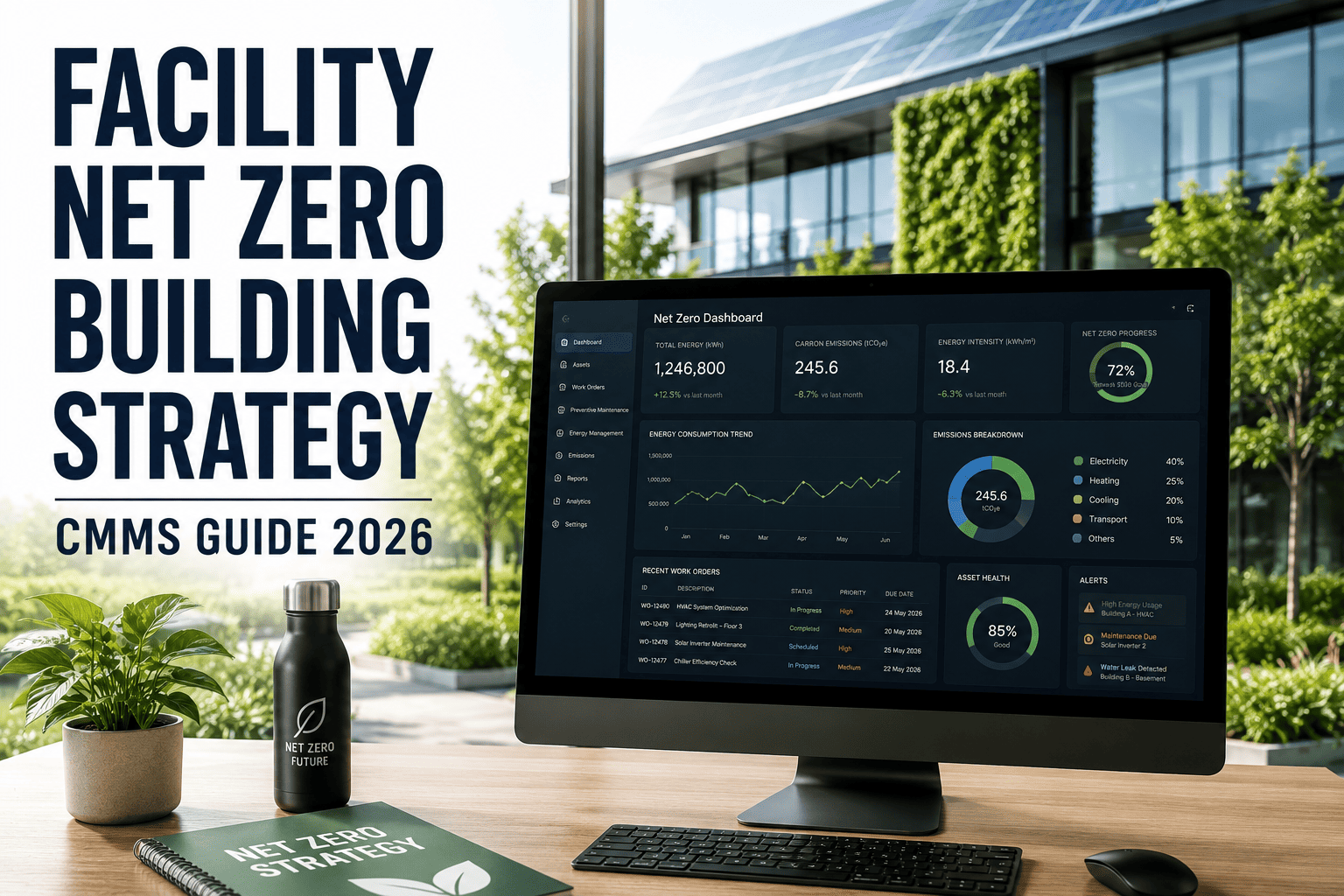
Oxmaint collects Scope 1, 2, and 3 data from IoT sensors, utility meters, and maintenance records — and maps each building's live carbon intensity against your 2030 and 2050 milestones in real time. Book a demo to see your portfolio's net-zero dashboard configured against your specific targets.
What a Net-Zero Building Actually Means in Operational Terms
A net-zero building produces as much energy as it consumes over a 12-month period, or achieves net-zero carbon emissions through a combination of on-site efficiency, electrification, renewable generation, and verified carbon offsets for any residual emissions. The definition matters operationally because regulators and investors apply it differently.
Energy balance over 12 months
Total energy consumed equals or is less than total clean energy produced on-site or through contractually sourced renewables over the calendar year. Common in ASHRAE zero net energy standard and many voluntary certifications. Does not require zero carbon if the grid is not clean.
Zero Scope 1 and 2 emissions annually
Zero direct emissions from on-site combustion (Scope 1) and zero indirect emissions from purchased electricity (Scope 2) after electrification and renewable energy sourcing. Residual Scope 3 emissions covered by verified carbon offsets. Required by NYC LL97 2030 pathway, BERDO, and EU EPBD.
The Net-Zero Decarbonization Hierarchy: Sequence Matters
Every kilowatt-hour eliminated through efficiency improvements is one that does not need to come from renewable sources, battery storage, or carbon offsets. The decarbonisation hierarchy exists because sequencing reduces total capital cost. FM teams that jump straight to solar PV or heat pumps before optimising operations consistently overspend by 15 to 30% on equipment that is sized for a building consuming more energy than it needs to.
Deploy IoT sub-meters and connect utility data to establish baseline EUI and carbon intensity per building system. Identify ghost loads, after-hours waste, HVAC overcycling, and simultaneous heating and cooling. Most commercial buildings find 10 to 15% immediate savings from operational changes before spending a dollar on capital.
Energy Conservation Measures identified from the energy audit and live monitoring data. Includes lighting retrofits, building envelope improvements, HVAC controls optimisation, ventilation scheduling, and commissioning. Indoor air quality and ventilation optimisation alone typically reduce HVAC energy 15 to 25% without capital equipment replacement.
Replace gas boilers with electric heat pumps, upgrade central plant to maximise energy recovery, transition to electric domestic hot water, and phase out any remaining oil or gas combustion equipment. Modern heat pumps in 2026 operate at COP above 4.0, meaning they are 400% more efficient than the gas furnaces they replace. Electrification enables the rest of the net-zero pathway.
On-site solar PV offsets remaining electricity consumption. Battery storage time-shifts renewable generation and reduces demand peaks. Where on-site generation is constrained by roof area or building type, Virtual Power Purchase Agreements, Renewable Energy Credits, and Power Purchase Agreements cover the remaining consumption with verifiable clean energy sourcing.
Scope 3 emissions — embodied carbon from capital replacements, contractor supply chain, tenant energy use — cannot always be eliminated operationally. High-quality, verified carbon offsets from VERRA or Gold Standard provide a bridge for residual emissions while permanent decarbonisation measures deploy. Offsets should supplement, not replace, operational improvement.
Regulators do not accept annual utility bills as compliance proof. GRESB, CSRD, and BPS enforcement all require continuous, timestamped records showing performance trajectory against targets. A CMMS that connects energy data, maintenance records, and carbon calculations is the only platform that makes net-zero progress auditable, reportable, and investor-grade in real time.
Phase-by-Phase Net-Zero Roadmap for FM Teams
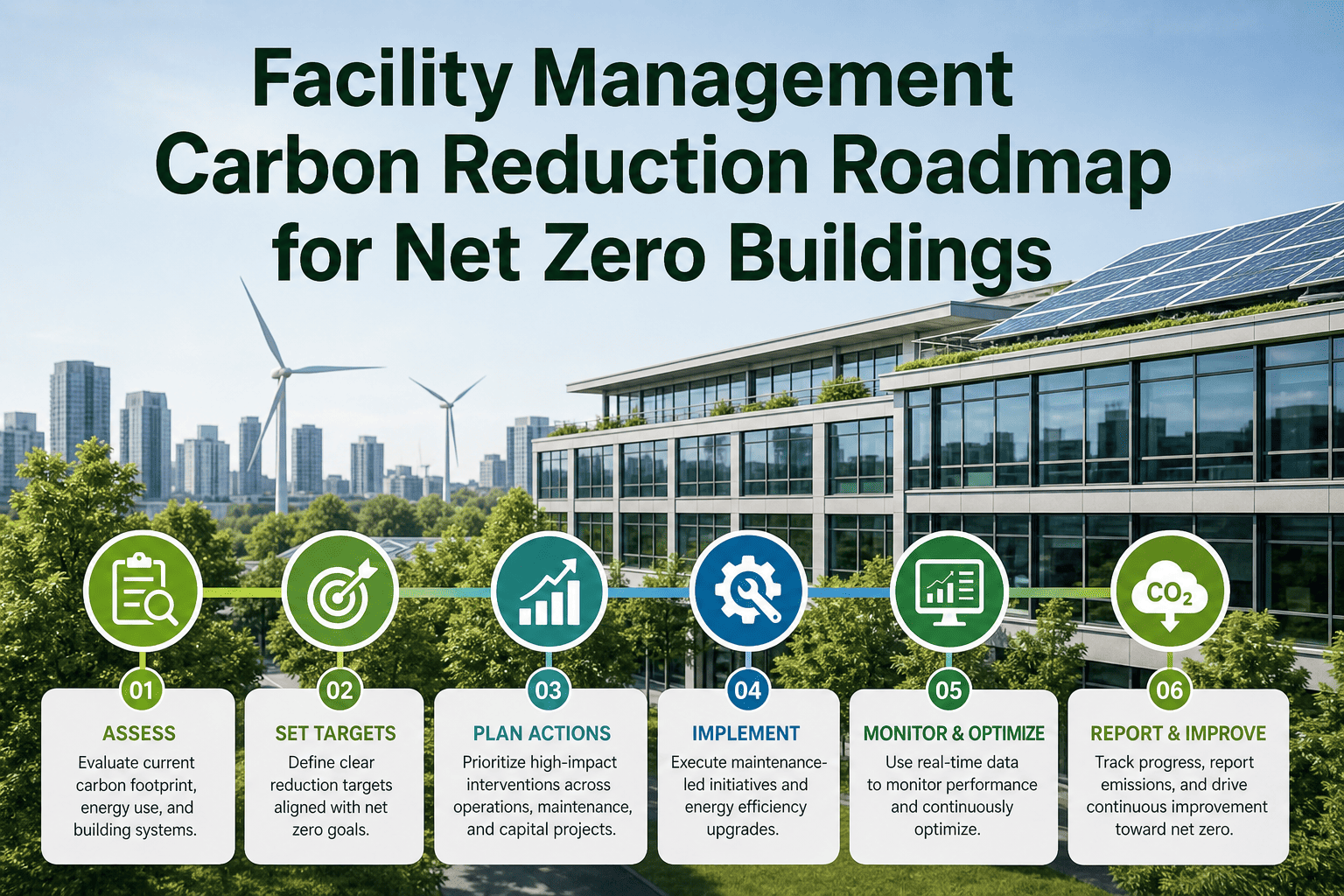
This roadmap is structured for a commercial building portfolio targeting NYC Local Law 97 compliance by 2030 and carbon neutrality by 2050. The phases and timelines apply equally to BERDO, DC BEPS, Colorado Regulation 28, and UK MEES/UK SRS compliance pathways.
| Phase | Timeline | Actions Required | Oxmaint Tracks |
|---|---|---|---|
| Phase 1: Baseline and Audit | Months 1 to 3 | Deploy IoT sub-metering per building system. Complete ASHRAE Level 2 energy audit. Calculate Scope 1 and 2 baseline per building. Identify top 5 energy waste sources per asset. | Live EUI per system, baseline carbon intensity, anomaly alerts, energy waste source identification from meter data |
| Phase 2: Quick Win ECMs | Months 2 to 9 | Implement no-cost operational changes from monitoring data. HVAC scheduling to actual occupancy. Lighting controls. Setpoint optimisation. Building commissioning to design spec. | EUI reduction vs baseline, HVAC runtime efficiency, carbon intensity improvement trend, ECM work order tracking with measured outcome |
| Phase 3: Capital ECMs | Months 6 to 24 | LED lighting retrofit. Building envelope improvements. Variable speed drives on pumps and fans. HVAC controls upgrade. Right-size equipment based on actual load data from monitoring. | CapEx vs projected savings model, energy intensity by system before and after, maintenance work order history for replaced equipment |
| Phase 4: Electrification | Months 18 to 48 | Replace gas boilers with electric heat pumps. Upgrade domestic hot water to heat pump system. Eliminate remaining on-site fossil fuel combustion. Phase in EV charging infrastructure. | Scope 1 emissions reduction tracking, gas meter disconnection records, heat pump performance monitoring, electrification CapEx lifecycle model |
| Phase 5: Renewable Integration | Months 24 to 60 | Install on-site solar PV sized to load after Phases 1 to 4. Deploy battery storage for demand optimisation. Source VPPAs or RECs for remaining grid consumption. Verify renewable sourcing documentation. | Scope 2 market-based emissions, renewable generation vs consumption, demand charge impact of battery dispatch, REC retirement documentation |
| Phase 6: Reporting and Compliance | Ongoing | Generate annual GRESB Performance Component data. Produce CSRD ESRS E1 reports. Submit BPS compliance documentation. Track year-on-year EUI and carbon intensity vs targets. | Full audit trail behind every metric, GRESB and CSRD formatted reports on demand in under 2 minutes, BPS penalty forecasting dashboard |
Map Your Portfolio Against Net-Zero Milestones in Real Time
Oxmaint tracks every building's live EUI, carbon intensity, and decarbonisation progress against your 2030 and 2050 milestones — connecting IoT energy data to the maintenance work orders that determine whether your targets are hit. Book a demo to see your portfolio's net-zero roadmap dashboard configured against your specific buildings and regulatory obligations.
Net-Zero Compliance Requirements by Region and Target Year
| Region | Key Mandate | 2030 Target | 2050 Target | Penalty for Non-Compliance |
|---|---|---|---|---|
| USA (NYC) | Local Law 97 | 40% GHG reduction vs 2005. Office limit 4.53 kgCO2e per sq ft | 80% GHG reduction vs 2005 for covered buildings | USD 268 per metric ton CO2e over annual cap, assessed until compliant |
| USA (Boston) | BERDO 2.0 | Declining emissions limits in 5-year cycles, individual reduction plans required | Carbon neutrality across all covered buildings by 2050 | USD 234 per metric ton over cap plus USD 1,000 per day for 35,000+ sq ft buildings |
| EU | EPBD Revised 2023 | Zero emissions for all new public buildings from 2026. All new buildings from 2028 | Climate neutrality for the entire building sector by 2050 | Member state enforcement varies. CSRD non-compliance risk is financial and reputational |
| UK | UK SRS and MEES | MEES minimum EPC band C for all commercial leases from 2027 | Net-zero target 2050 for UK economy. FM teams in supply chain of fund clients face SFDR and ESOS obligations | MEES non-compliance: enforcement by local authority. ESOS: civil penalties up to GBP 50,000 |
| Australia | NABERS and NGER Act | Net-zero government buildings by 2030. NABERS 5.5+ star for new leases | Net-zero built environment by 2050 under national climate targets | NGER non-reporting: AUD 7,800 per day. NABERS non-compliance affects asset financing |
| UAE | Dubai Net Zero 2050 | Net-zero energy for all new government buildings. Estidama Pearl 2+ for private sector new builds | Net-zero carbon for the emirate by 2050 under Dubai Clean Energy Strategy | Green permit non-compliance affects construction approvals and occupancy certificates |
Four Net-Zero Planning Failures That Waste Capital and Miss Deadlines
Installing heat pumps in a building that is still wasting 20% of its HVAC energy through scheduling mismatches and poor building envelope performance means the heat pump is oversized for the building's actual post-efficiency load. The capital cost is 20 to 35% higher than necessary. FM teams that baseline, optimise, and then electrify consistently achieve better economics and smaller, lower-cost equipment than those that jump directly to hardware replacement. Book a demo to see load-reduction monitoring before electrification planning.
A building that hits its 2025 EUI target but drifts 12% above baseline in 2026 because of a degraded chiller or changed occupancy pattern will not discover the non-compliance until the annual report is assembled months later. BPS regulators require demonstrated ongoing performance, not a point-in-time snapshot. FM teams without continuous carbon tracking cannot see drift from net-zero targets until the compliance deadline has already passed.
Embodied carbon from capital replacements, contractor supply chain emissions, and tenant energy use represent 20 to 40% of a commercial building's total carbon footprint. CSRD ESRS E1 and GRESB Performance Component are both increasing Scope 3 expectations at asset level. FM teams without structured maintenance records for capital replacements cannot produce credible Scope 3 data — and "we do not track this" is no longer an acceptable audit response in 2026. Book a demo to see Scope 3 tracking in Oxmaint.
A net-zero roadmap is a collection of targets until the CMMS connects each target to the specific work orders, PM schedules, and equipment conditions that determine whether the target is reached. A heat pump that is not maintained to OEM efficiency specifications within 18 months of installation is already degrading from its modelled carbon performance. FM teams managing net-zero targets and maintenance work in separate systems cannot see when equipment degradation is eroding their carbon progress.
Net-Zero Progress: Without vs With Oxmaint
Net-Zero Performance Results After Oxmaint Deployment
Frequently Asked Questions: Net-Zero Buildings and FM Roadmaps
QWhat is the correct sequence for a commercial building net-zero roadmap?
QHow does Oxmaint connect maintenance work orders to net-zero carbon tracking?
QHow much can a commercial building reduce carbon through operational optimisation before capital investment?
QDoes Oxmaint generate the carbon reporting documentation required for GRESB and CSRD net-zero submissions?
Continue Reading: Net-Zero and Energy Resources
Explore these related resources to build your complete net-zero implementation programme — from IoT energy monitoring and building energy audits through to Building Performance Standards compliance and building electrification strategies.
Turn Your Net-Zero Targets Into a Live Managed Programme — Not a Once-a-Year Report
Oxmaint connects IoT energy data, maintenance work orders, Scope 1 to 3 carbon tracking, and compliance reporting into a single platform that monitors your buildings' net-zero trajectory in real time. You see EUI drift, equipment degradation, and compliance risk as they develop — not months later when the annual report is assembled. Book a 30-minute demo to see your portfolio's net-zero roadmap dashboard configured against your specific buildings, regulatory targets, and 2030 milestones.