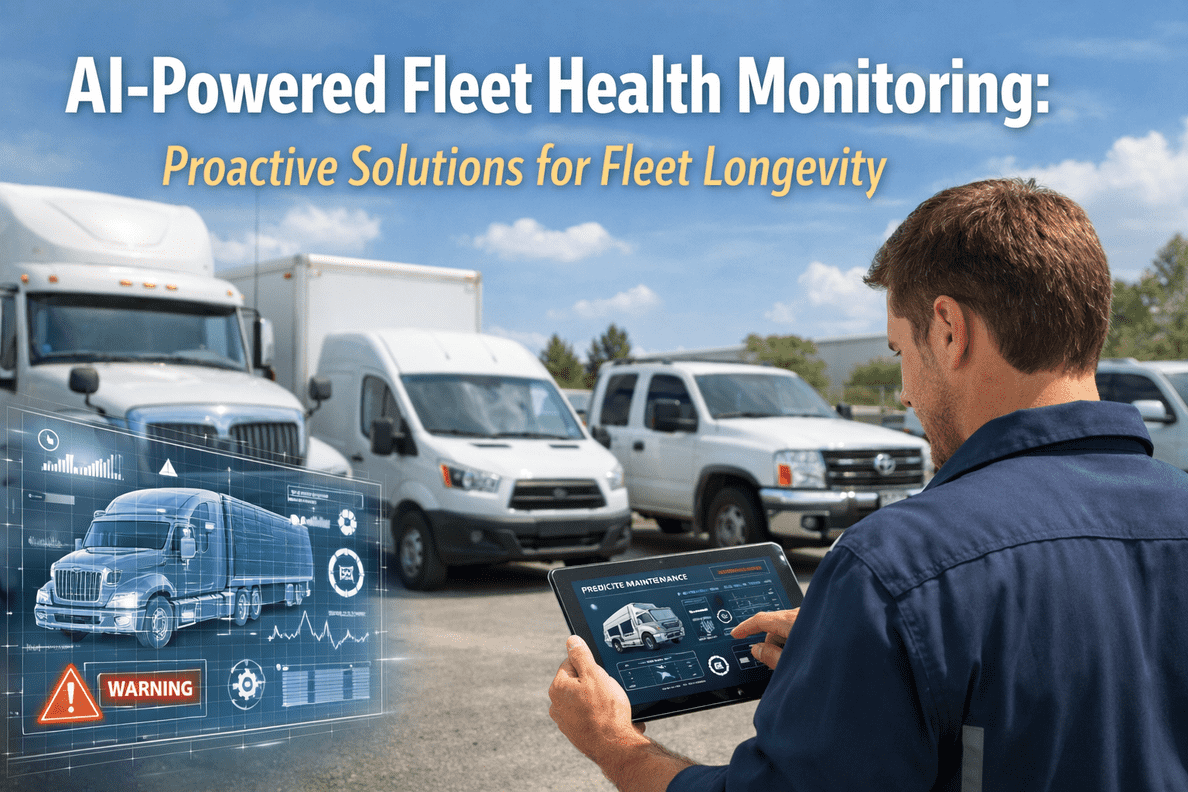
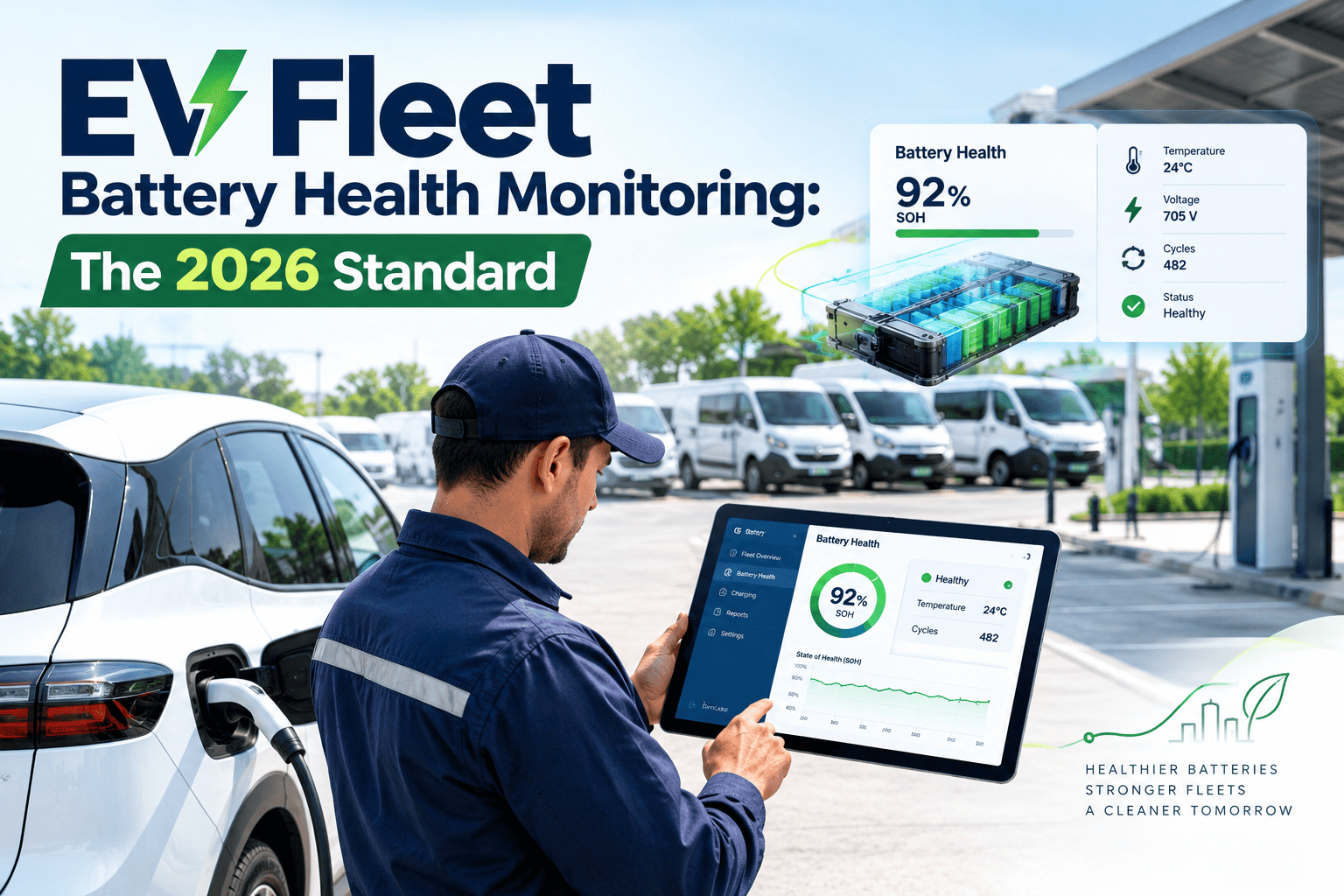
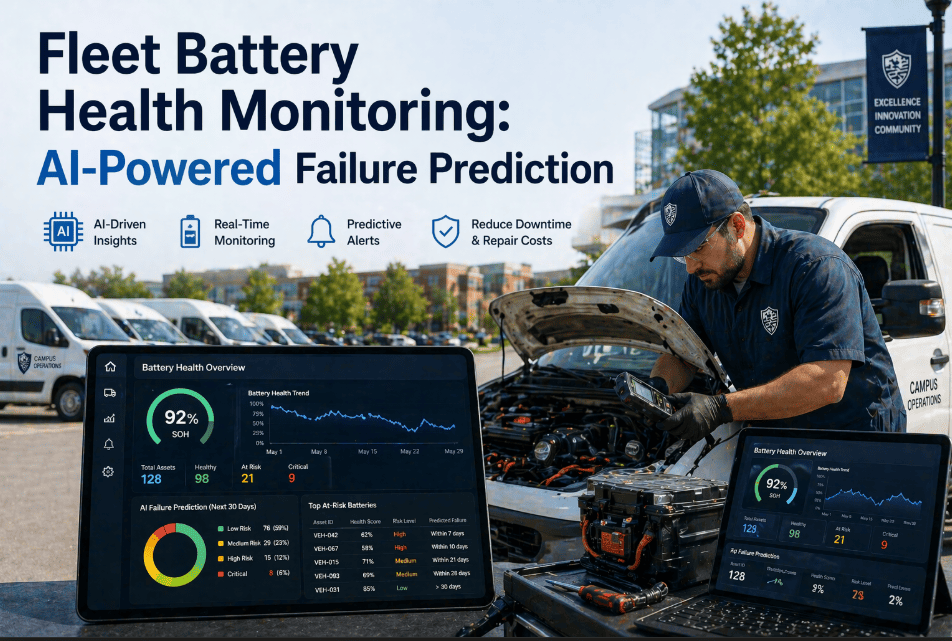
Only 27% of fleets have operationalized AI-powered predictive maintenance in 2026 — yet the competitive gap between those that have and those still running on fixed intervals and reactive repairs is widening every quarter. The average fleet loses 8.7 days of unplanned downtime per vehicle annually, at $448–$760 per vehicle per day. Multiply that across 50, 100, or 500 vehicles and the reactive maintenance tax becomes a structural profitability problem that no amount of overtime or expedited parts can solve. AI-powered fleet health monitoring replaces the guesswork of calendar-based servicing with continuous condition intelligence — analyzing thousands of sensor data points per vehicle per day to flag failures 2–4 weeks before they cause a breakdown. The result is not just fewer emergencies. It is a fundamentally better-managed fleet that runs longer, costs less to maintain, and gives operations managers the visibility to make decisions before consequences are irreversible. Start monitoring your fleet free on Oxmaint or book a demo to see AI fleet health in action.
$27B
Global fleet management market in 2025 — growing at 16.9% CAGR through 2030
70%
Breakdown reduction when AI predictive maintenance is deployed fleet-wide (Deloitte)
27%
Of fleets have operationalized predictive maintenance — 73% still reactive or interval-based in 2026
90%+
AI failure prediction accuracy after 3–6 months of fleet-specific model training
Oxmaint · AI Fleet Health Monitoring
Your fleet is generating thousands of health signals every day. Oxmaint turns them into failure predictions — automatically.
AI-powered predictive alerts. Automated work orders. Real-time asset health dashboards. Cost-per-mile analytics. DOT-ready compliance documentation. One platform. Free to start.
40%Lower maintenance costs
50%Less unplanned downtime
200–500%First-year ROI documented
3–6 moPayback period
What It Is
What Is AI-Powered Fleet Health Monitoring — and Why 2026 Is the Tipping Point
AI fleet health monitoring is the continuous analysis of real-time vehicle data — telematics, sensor streams, engine diagnostics, historical repair records, and operating conditions — to calculate the probability that specific components will fail within a defined window and trigger maintenance action before the failure occurs.
Reactive
Fix it when it breaks. Emergency repair costs run 4.8x planned rates. Average roadside breakdown generates $760–$2,600 in direct costs plus lost revenue, towing, driver downtime, and missed SLAs.
Preventive (Interval)
Service on fixed mileage or calendar schedules. Over-services assets that are healthy, misses failures that develop between service windows. Vehicles 10+ years old drive only 12.1% of miles but consume 33.5% of service spend.
AI Predictive (Condition-Based)
Continuous AI analysis of sensor data flags specific component failure risk 2–4 weeks before breakdown. Work orders generated automatically. Service happens during planned windows — not during peak delivery hours or on the side of the road.
Oxmaint AI Platform
Hardware-agnostic. Connects to OEM telematics, GPS devices, OBD-II sensors, and existing CMMS data. Predictive alerts auto-generate prioritized work orders with parts, timing, and cost avoidance figures before any human sees the alert.
8 AI Health Signals
8 Vehicle Health Signals That AI Monitors Continuously — and What Each One Catches
01
Engine Temperature and Oil Pressure
Sustained elevation above vehicle-specific baseline signals cooling inefficiency, lubrication degradation, or developing combustion issues. AI catches these 2–6 weeks before fault codes trigger or driver symptoms appear.
Manual: fault code after damageAI: 2–6 weeks advance warning
02
Vibration and Transmission Stress Patterns
Transmission bearing failures average $3,500–$8,000 per event. ML models identify stress signature deviations from per-vehicle baseline 3–6 weeks before driver-perceptible symptoms — converting a major repair into a routine fluid service.
$8,000 avg transmission failureAI converts it to $900 service
03
Brake Wear and Pressure Response
Brake wear rates vary significantly by route, load, and driver behavior — making fixed-interval brake service simultaneously over-servicing some vehicles and under-servicing others. Per-vehicle AI scheduling eliminates both waste categories.
Fixed intervals: 20–30% wasteAI: per-vehicle actual wear
04
Tire Pressure and Temperature
10 PSI underinflation increases fuel consumption by 3% and accelerates tread wear by 15%. TPMS-integrated AI monitoring catches underinflation events between manual inspections and flags thermal anomalies indicating adjacent bearing stress.
Manual checks: gaps betweenAI: continuous per-wheel tracking
05
Battery and Electrical System Health
Battery failures cause 38% of commercial vehicle roadside breakdowns — and they are almost entirely predictable. AI monitors cold cranking amps, alternator output voltage, and charge cycle efficiency to predict end-of-life 30–60 days before failure.
38% of roadside breakdownsAI: 30–60 day advance warning
06
Fuel Consumption Trend Analysis
A vehicle consuming 5–8% more fuel than its baseline without a route change is signaling degrading engine efficiency — often from injector wear, air filter restriction, or turbocharger issues. AI flags this pattern weeks before it becomes a repair event.
Manual: discovered at fuel billAI: week 2 of deviation
07
Driver Behavior and Wear Acceleration
AI correlates harsh braking patterns, aggressive acceleration, and excessive idling to component wear rates — identifying which specific driver behaviors are accelerating brake, transmission, and engine wear on individual vehicles and generating coaching recommendations.
Manual: no wear correlationAI: behavior-to-wear mapping
08
Refrigeration and Auxiliary Systems
For cold chain fleets: AI monitors reefer unit temperature, compressor pressure, and door events. A refrigeration failure on a loaded vehicle generates cargo loss averaging $25,000–$150,000 per incident — a catastrophic tail risk converted to a scheduled repair.
$25K–$150K cargo loss riskAI: converts to scheduled repair
How It Works
How Oxmaint's AI Fleet Health Intelligence Loop Works — From Raw Data to Prevented Failure
AI fleet health monitoring is not a single dashboard. It is a continuous closed-loop intelligence system that processes vehicle data, detects developing patterns, forecasts failure timelines, and acts — all without requiring a fleet manager to monitor sensor feeds manually.
01
Continuous Multi-Source Data Ingestion
Oxmaint connects to factory OEM telematics (Ford, Ram, Freightliner, Peterbilt, Kenworth, Volvo, Daimler), third-party GPS and telematics from any provider, OBD-II diagnostic ports, and existing CMMS repair history — all feeding a unified vehicle data stream. For 2015+ commercial vehicles, OEM telematics are already broadcasting hundreds of CAN bus parameters. No hardware replacement required. Most fleets achieve initial integration within days. A typical vehicle generates thousands of data points per day — engine temperature, oil pressure, brake wear, fuel consumption, vibration patterns, voltage, and more.
Hardware-agnostic
OEM factory telematics
Any GPS provider
Days to integrate
02
Per-Vehicle AI Baseline Learning and Anomaly Detection
Unlike generic threshold-based alerting that applies the same rules to every vehicle, Oxmaint's ML models build individual baseline profiles for each asset — learning its specific normal operating patterns across load ranges, routes, ambient temperatures, and duty cycles. Within 24 hours of connection, models begin building vehicle baselines. Within 72 hours, first actionable failure predictions are generated. By month 3, per-vehicle accuracy reaches 85–92%. Every repair outcome feeds back into the model — improving prediction accuracy for that vehicle and for similar assets across your fleet. The system gets smarter with every mile, every repair, and every data point collected.
Per-vehicle learning
72-hr first predictions
90%+ accuracy at month 3
Improves continuously
03
Failure Forecasting With Component-Level Risk Scoring
When AI detects a developing anomaly pattern, it does not generate a generic alert. It scores the risk by component, estimates time-to-failure with a confidence range, calculates the financial cost of breakdown versus planned intervention, and prioritizes the finding against the rest of the fleet's open alerts by urgency and revenue impact. Brake degradation on a high-utilization vehicle gets a different priority than the same signal on a backup unit. AI provides context that spreadsheets and whiteboards structurally cannot. Fleets running Oxmaint's predictive models report catching failures 2–4 weeks before breakdown — enough lead time to schedule repairs during planned maintenance windows, not on the side of a highway.
Component-level scoring
Time-to-failure estimate
Cost avoidance calculated
Fleet-wide priority queue
04
Automated Work Order Creation and Closed-Loop Resolution
When an AI prediction crosses the configured action threshold, Oxmaint automatically creates a prioritized work order pre-populated with the vehicle's service history, the sensor finding, parts recommendations from historical repair data for that make and model, and the technician assignment configured for that vehicle type. The work order appears in the maintenance queue before any manager has reviewed the alert — eliminating the manual step between AI insight and maintenance action. When the technician closes the work order, the repair outcome feeds back into the AI model, tightening future predictions. Every prevented breakdown is logged with cost avoidance data, building the ROI documentation your leadership needs to justify and expand the program.
Auto work order creation
Parts pre-populated
Closed-loop feedback
ROI auto-documented
Before vs. After
Fleet Maintenance Before and After Oxmaint AI Health Monitoring
ROI and Results
What AI Fleet Health Monitoring Delivers — Industry-Documented Numbers
70%
Breakdown Reduction
Deloitte benchmark: AI predictive maintenance reduces fleet breakdowns by 70% versus reactive baseline. One 400-vehicle logistics fleet saved $187,000 from a single three-vehicle prediction that cost $2,400 to action.
200–500%
First-Year ROI
Documented across Oxmaint fleet deployments. Most fleets achieve full payback within 3–6 months. The first prevented breakdown often covers the entire platform cost — the ROI conversation in 2026 is over.
40%
Maintenance Cost Reduction
McKinsey: predictive maintenance reduces fleet maintenance costs by up to 40% versus reactive operations. A Texas contractor cut its maintenance budget from $620K to $410K — $210K annual saving in year one.
90%+
Prediction Accuracy
Fleet-specific AI models reach 85–92% prediction accuracy by month 3. Delta Airlines reported 98% reduction in in-flight component failures using AI fleet monitoring. Accuracy compounds with every data point collected.
25%
Technician Productivity Gain
Deloitte: AI predictive maintenance increases maintenance team productivity by 25%. Planned work achieves 25–30% higher throughput than emergency repairs on the same labor hours — with lower parts cost and less rework.
40%
Vehicle Life Extension
Consistent condition-based maintenance documented to extend average vehicle lifespan by 20–40%. Oxmaint's rolling CapEx forecasting replaces annual asset replacement guesswork with data-driven timing that optimizes total cost of ownership.
Oxmaint · AI Fleet Health Platform
65% of Fleet Teams Plan to Use AI by End of 2026. The Fleets That Deploy First Build a Data Advantage Competitors Cannot Close.
OxMaint is free to start, hardware-agnostic, and deploys in days. Connect your telematics — and replace manual monitoring, reactive repairs, and mileage-interval guesswork with AI-powered alerts, automated work orders, and fleet intelligence that delivers measurable ROI within the first quarter.
Frequently Asked Questions
AI Fleet Health Monitoring — What Fleet Managers Ask First
Do we need to install new hardware on all vehicles to use Oxmaint's AI fleet health monitoring?
For most modern commercial fleets, additional hardware is minimal or unnecessary. Vehicles manufactured from approximately 2015 onward are factory-equipped with telematics hardware broadcasting hundreds of CAN bus parameters via OEM cloud APIs. Oxmaint connects directly to factory telematics from Ford, Ram, Freightliner, Peterbilt, Kenworth, Volvo, and Daimler without any additional device installation. If your fleet already has third-party GPS and telematics from Geotab, Samsara, Verizon Connect, or Webfleet, Oxmaint ingests that data directly — no hardware changes required. For older vehicles, OBD-II dongles at $50–$150 per unit fill data gaps without any control system modifications. Most deployments are a mix of OEM factory telematics, existing third-party hardware, and a small number of OBD-II units for older vehicles — all feeding one Oxmaint dashboard with no hardware vendor lock-in.
Sign up free to assess your fleet's hardware requirements, or
book a demo for a hardware-to-platform mapping review.
How quickly does AI fleet health monitoring start catching real failures — and what accuracy should we expect?
Oxmaint's AI begins generating actionable alerts from day one using a pre-trained foundational model built on industry-wide fleet data. Initial fault detection — identifying abnormal temperature or vibration readings — exceeds 90% accuracy from the first day of data connection. Per-vehicle failure forecasting models begin building individual baselines within 24 hours and typically generate first actionable predictions within 72 hours of connection. Most fleets reach 85–92% prediction accuracy by month 3, with accuracy continuing to improve as the system accumulates fleet-specific operating data. The 2025–2026 industry data is clear: 52% of fleet managers who deployed AI predictive maintenance reported direct reduction in vehicle downtime within the first quarter. The first prevented breakdown — typically worth $760–$2,600 in direct costs alone — often covers several months of platform subscription cost.
Book a demo to see prediction accuracy dashboards live, or
sign up free to start your fleet's baseline data collection.
What is the realistic ROI for AI fleet health monitoring — and how does payback compare to reactive maintenance spending?
Documented first-year ROI from AI fleet health monitoring deployments ranges from 200% to 500%, driven by fleet size and the proportion previously running reactively. The ROI comes from five independently measurable sources: emergency repair cost elimination (4.8x rate differential on repairs shifted from emergency to planned), roadside breakdown prevention ($760–$2,600 direct cost per event avoided, multiplied by incident frequency), fuel efficiency improvement (8–15% from properly maintained engines), compliance automation (eliminating 20–40 hours per month of manual DOT and FMCSA documentation), and vehicle life extension (20–40% longer through condition-based maintenance timing). For a fleet of 50 vehicles experiencing the industry average of 8.7 unplanned downtime days per vehicle annually, preventing 65–70% of those events delivers a direct cost recovery in the high six figures annually. Against typical AI platform investment, this represents full payback within 3–6 months — with compounding returns as AI models improve. Fortune 500 companies stand to save $233 billion annually with full adoption of predictive maintenance. The fleets that deploy now lock in the compounding data advantage before competitors catch up.
Sign up free to start measuring your baseline, or
book a demo for a custom ROI estimate based on your fleet's current spend.
How does Oxmaint handle AI fleet health monitoring for mixed fleets — ICE, EVs, and specialty vehicles?
Oxmaint manages mixed ICE, hybrid, and EV fleets from a single unified dashboard, with vehicle-type-specific AI monitoring parameters configured for each powertrain. For electric vehicles, Oxmaint monitors battery state-of-health, charging cycle efficiency, thermal management system performance, regenerative braking health, and motor winding temperature. EV battery pack replacement averages $8,000–$20,000 per vehicle — Oxmaint's AI detects the charging pattern anomalies and thermal deviations indicating accelerated degradation weeks before they appear in range performance, enabling corrective action that extends battery service life by 20–35% in documented deployments. For specialty vehicles — refrigerated units, tankers, construction equipment, buses — Oxmaint adds auxiliary system monitoring (reefer compressor, hydraulics, lift equipment) alongside standard powertrain monitoring. Each vehicle type operates under its own AI model and maintenance schedule while sharing a unified fleet health dashboard.
Book a demo to see Oxmaint's mixed-fleet configuration, or
sign up free to connect your first vehicles today.
Can Oxmaint manage AI fleet health monitoring across multiple depot locations — and how does compliance documentation work?
Oxmaint is built as a multi-site platform from its core architecture. A single deployment covers all depot locations under a unified fleet health dashboard, with site-specific maintenance team assignments, work order routing, and compliance documentation templates per location. AI alerts from field vehicles route to the maintenance team at the vehicle's home depot automatically, with escalation rules per alert severity configurable per site. For DOT and FMCSA compliance, Oxmaint generates compliance documentation as a byproduct of daily operations — no separate documentation workflow required. Driver DVIRs are completed on the Oxmaint mobile app with timestamps, photos, and digital signatures. Every work order, parts replacement, and service activity is recorded with technician identity, timestamp, parts used, and odometer reading at service — satisfying FMCSA maintenance record requirements automatically. If an FMCSA roadside inspector requests maintenance history for any vehicle, the complete record is retrievable in under 60 seconds. Non-compliance penalties exceeding $16,000 per violation make this automation a straightforward financial calculation.
Sign up free to configure your multi-site fleet, or
book a demo to see multi-depot AI fleet health management with live data.
Oxmaint · AI Fleet Health Platform
Your Fleet Vehicles Are Already Generating the Health Data. Oxmaint Makes It Actionable — in Days.
Only 27% of fleets have operationalized AI predictive maintenance. The fleets that deploy now are building a compounding data advantage that late movers cannot close. Oxmaint connects to your existing telematics and sensors, deploys in days with no IT project required, and delivers measurable ROI within the first quarter. Free to start. Hardware-agnostic. Built for real fleet operations.