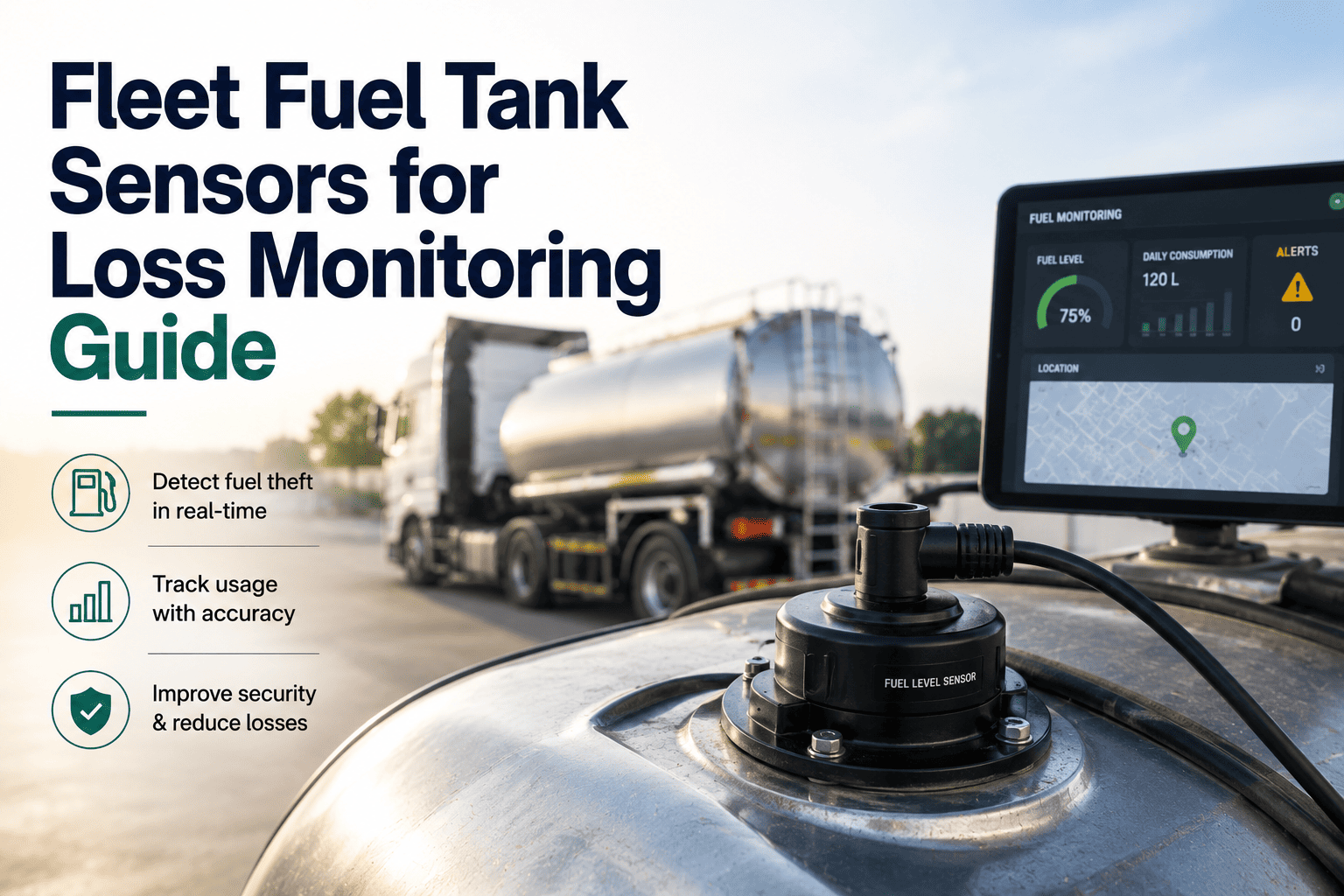
Fleet condition monitoring uses continuous sensor data — oil pressure, coolant temperature, tyre pressure, battery voltage, DTCs, vibration — to catch developing faults between scheduled services, long before a driver notices a warning light or a breakdown strands the vehicle on the roadside. For maintenance and reliability teams managing dozens or hundreds of assets, fleet sensor monitoring closes the blind spot that manual PM inspections and driver walk-arounds simply cannot cover: the hours, days and weeks when nobody is physically looking at the equipment. The payoff is measurable — condition-based fleet monitoring typically reduces unplanned downtime 25–40% and cuts roadside callout costs by a third — but only if alerts are structured, triaged and converted into scheduled work orders rather than ignored. OxMaint turns fleet vehicle condition monitoring into action by integrating sensor streams, threshold-based alerting and work-order automation in a single AI-powered CMMS. Ready to see it on your fleet? Start Free Trial or book a 30-minute demo today.
What if your fleet told you about a fault 14 days before it became a breakdown?
Fleet condition monitoring captures the sensor signals a driver misses — subtle drops in oil pressure, creeping coolant temps, intermittent DTCs — and converts them into prioritised work-order alerts inside OxMaint. Catch developing faults while they are still a $200 fix, not a $4,000 tow.
What fleet condition monitoring actually detects — and why manual checks miss it
A standard PM inspection covers 20–40 check-points in 15–30 minutes, but a telematics gateway streams 15–200+ data points per second. That gap is where fleet real time condition monitoring earns its keep.
Coolant temperature drifting 8–12°C above baseline over a week signals thermostat, fan-clutch or EGR cooler failure — long before a boil-over disables the vehicle 300 miles from base.
Oil or fuel pressure dropping 5–15% under identical load conditions flags pump wear, filter clogging or bearing erosion — a condition no driver can feel until the engine seizes.
Pending and history DTCs that never trigger a dashboard light still indicate intermittent sensor, injector or emissions-system faults that compound into roadside failures within days.
Accelerometer frequency shifts in drivelines, wheel-ends and HVAC compressors reveal bearing degradation and imbalance before a driver reports a noise or a vibration complaint.
Fleet condition monitoring system architecture: from sensor to scheduled work order
A fleet condition monitoring system only creates value when raw data flows through four stages — capture, analyse, alert and act. Break the chain at any stage and alerts become noise.
OBD-II/J1939 gateways, tyre-pressure monitors, accelerometer modules and telematics providers push live data into OxMaint via REST API or MQTT. No manual export, no CSV lag.
OxMaint builds a per-asset baseline for each parameter — load, ambient temp, duty cycle — then flags deviations that exceed the threshold band for sustained duration windows.
Each flagged anomaly is scored Critical, Warning or Watch and routed to the right technician via in-app notification, email or SMS — with the asset, parameter, reading and suggested action attached.
Critical and Warning alerts auto-create a work order in OxMaint — pre-filled with asset history, spare parts, labour estimates and priority — so the maintenance team moves from alert to action in minutes.
How to set alert thresholds that technicians actually trust
False alarms destroy a fleet monitoring sensors programme faster than any other factor. If technicians see more than 2–3 non-actionable alerts per asset per week, they start ignoring all of them — the classic alarm-fatigue death spiral.
| Sensor parameter | Watch threshold | Warning threshold | Critical threshold | Typical lead time to failure |
|---|---|---|---|---|
| Coolant temperature | +6°C above baseline | +10°C for 10+ min | +15°C or rapid spike | 7–14 days |
| Oil pressure | −5% under load | −10% for 5+ min | −15% or flickering | 3–10 days |
| Battery voltage | Below 12.4V resting | Below 12.1V or >14.8V charge | Below 11.8V under load | 5–14 days |
| Tyre pressure | −5% from target | −12% from target | −20% or rapid loss | 1–7 days |
| Pending DTCs (non-illuminated) | 1 pending code | 2+ pending or recurring | Confirmed active DTC | 5–21 days |
| DPF back-pressure | +10% above baseline | +25% sustained | +40% or derate triggered | 10–30 days |
Condition-based fleet monitoring vs time-based PM: what changes
Moving from calendar-based PM to condition-based fleet monitoring does not eliminate preventive maintenance — it sharpens it. You service what the data says needs servicing, and you stop over-servicing assets that are running within spec.
| Dimension | Time-based PM only | With fleet condition monitoring |
|---|---|---|
| Fault detection timing | At next scheduled service — or at breakdown | 3–21 days before failure, during operating hours |
| Unplanned downtime | 3–8% of fleet unavailable monthly | Reduced 25–40% within 6 months |
| Roadside callout cost | $1,500–$3,500 per event, frequent | Reduced 30–50% — most faults fixed in-yard |
| Over-maintenance | Services performed on schedule regardless of condition | PM intervals extended 15–30% on healthy assets |
| Technician trust in alerts | N/A — no alerts exist | High, when thresholds are tuned & triaged in a CMMS |
| Audit & compliance trail | Paper sheets, manual entry, gaps in history | Every alert, decision and work order logged automatically |
How OxMaint turns fleet sensor warnings into uptime
OxMaint is an AI-powered CMMS and EAM platform built for maintenance and reliability teams. It does not just display sensor data on a dashboard — it converts condition warnings into structured, prioritised, traceable maintenance action.
OxMaint ingests live telematics and sensor feeds via API and auto-generates a work order the moment a threshold is breached — pre-filled with asset history, parts list, labour estimate and priority level. No phone call, no clipboard, no delay.
OxMaint learns each asset's operating profile and adjusts thresholds for load, temperature and duty cycle — so a coolant spike climbing a grade in summer does not trigger the same alert as a genuine thermostat failure in flat terrain.
When a condition warning fires, OxMaint shows the full asset history — last 5 services, recurring DTCs, warranty status, spare parts on hand — so the technician knows what to inspect and what to order before the vehicle enters the bay.
OxMaint's analytics layer trends every monitored parameter over weeks and months, predicting which assets are on a degradation curve — so reliability teams can schedule interventions before the alert even fires.
See OxMaint condition monitoring on your live fleet data
Book a 30-minute demo and we will walk you through sensor integration, alert threshold tuning and automated work-order generation — using your fleet's actual asset profile and failure patterns.
Fleet condition monitoring & sensor warning — frequently asked questions
Fleet condition monitoring is the analysis layer on top of telematics. Telematics gateways collect and transmit sensor data — GPS, OBD-II, J1939, tyre pressure — but on their own they only display raw readings. Condition monitoring applies baselines, thresholds and duration logic to that data to flag developing faults and feed them into a CMMS like OxMaint as prioritised work orders.
By detecting anomalies 3–21 days before a component fails — thermal drift, pressure decay, intermittent DTCs, vibration signature shifts — sensor early warning lets maintenance teams schedule repairs during planned depot hours instead of reacting to roadside breakdowns. Fleets typically see a 25–40% reduction in unplanned downtime within the first 6 months of deployment.
The most common sensor inputs are engine coolant temperature, oil and fuel pressure, battery voltage, tyre pressure monitoring systems (TPMS), diagnostic trouble codes (DTCs) via OBD-II or J1939, DPF back-pressure and driveline vibration accelerometers. OxMaint integrates these via telematics API or direct MQTT feed — see how on a live demo at Book a Demo.
Effective false-alarm reduction requires three controls: per-asset baselines adjusted for load and ambient conditions, duration windows that require sustained deviation rather than momentary spikes, and severity tiering so only Critical and Warning alerts generate work orders. OxMaint's AI threshold tuning reduces non-actionable alerts by 60–80% compared to raw threshold monitoring.
Yes — OxMaint is a full CMMS and EAM platform that ingests sensor and telematics data via REST API or MQTT, auto-generates work orders from threshold breaches and logs every alert, decision and repair for audit compliance. Teams switching from spreadsheet-based or reactive maintenance are typically live in 2–4 weeks. Start at Start Free Trial to evaluate on your assets.
Stop finding faults at the roadside. Start catching them in the data.
Deploy fleet condition monitoring with OxMaint — sensor integration, AI-driven alert tuning, automated work orders and predictive analytics in one platform. Book a 30-minute demo and see your first early-warning alert mapped to a scheduled work order before the call ends.
Free 14-day trial · No credit card