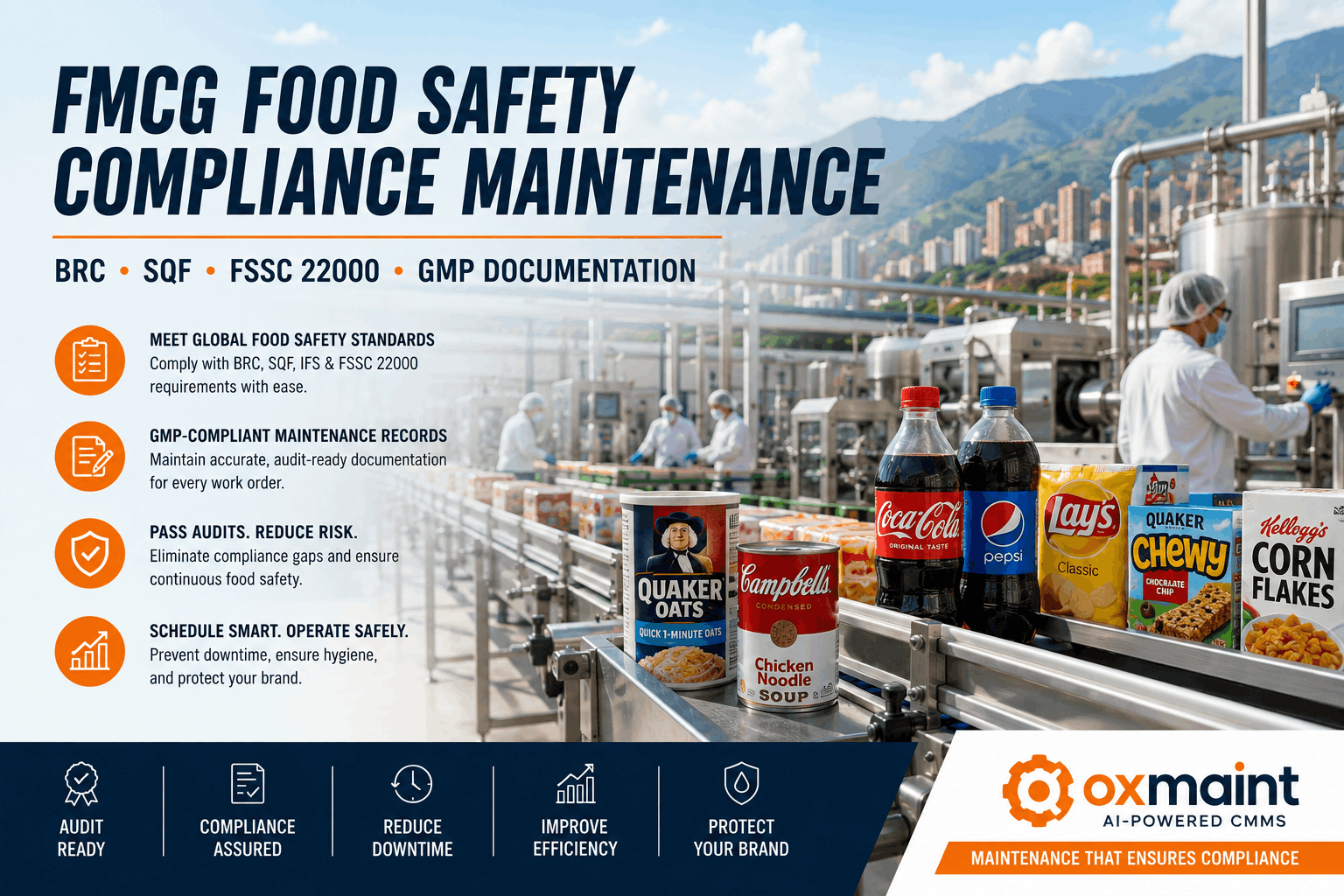
FSMA 204 Traceability: How FMCG Maintenance Records Support Food Traceability Compliance
By Jack Edwards on May 13, 2026
FSMA 204 requires food manufacturers to produce complete traceability records for FDA-listed foods within 24 hours of a request — not 24 days, not 24 weeks. The rule mandates Key Data Elements (KDEs) at each Critical Tracking Event (CTE) throughout the supply chain, from growing to receiving to processing to shipping. What most FMCG food manufacturers miss is that equipment maintenance records are directly implicated in traceability compliance. If a filling line is sanitized incorrectly, calibrated out of specification, or serviced by a contractor who brought contaminated tools from another facility, that event is a production traceability gap. FDA investigators examining a recall will ask for the equipment maintenance history of every asset that touched the batch in question. If your CMMS records do not link work orders to batch production runs, your traceability chain has an undefended gap. Start a free trial on Oxmaint and begin linking equipment maintenance records to food batch traceability workflows, or book a demo to see how FMCG plants are building FSMA 204-aligned CMMS records today.
Food Safety · FSMA 204 Compliance 2026
FSMA 204 Traceability: How FMCG Maintenance Records Support Food Traceability Compliance
FSMA 204 requires 24-hour traceability response. Learn how FMCG equipment maintenance records and digital asset tracking close the compliance gaps that FDA investigators find during recall investigations.
FDA response window under FSMA 204 — traceability records must be produced within 24 hours of FDA request
$500K+
average cost of a food product recall — traceability failures extend recall scope and dramatically increase cost
16
FDA food categories on the Food Traceability List (FTL) requiring FSMA 204 KDE and CTE records
2026
enforcement context — FDA continues advancing FSMA 204 with inspections targeting record completeness and response speed
What Is FSMA 204 and How It Affects FMCG Maintenance Operations
The FDA Food Safety Modernization Act Section 204 (FSMA 204) establishes mandatory traceability recordkeeping requirements for foods on the Food Traceability List — including leafy greens, fresh-cut produce, seafood, eggs, nut butter, and ready-to-eat foods. Covered facilities must record Key Data Elements (KDEs) at each Critical Tracking Event (CTE): growing, receiving, transforming (processing), creating (manufacturing), and shipping. The 24-hour FDA response requirement makes manual traceability systems impractical for any FMCG plant producing FTL-listed products at scale.
For FMCG maintenance teams, FSMA 204 creates two direct obligations. First, equipment assets that contact FTL food products — fillers, conveyors, slicers, blenders, pasteurizers — must have traceable maintenance histories that can be cross-referenced with batch production records during recall investigations. Second, sanitation and calibration records for these assets are KDE-adjacent data: FDA investigators use them to determine whether an equipment failure contributed to contamination. Maintenance records that are incomplete, delayed, or stored separately from production batch records create compliance gaps that investigators exploit. Start a free trial and connect your equipment maintenance records to FSMA 204 traceability workflows, or book a demo with an Oxmaint food safety specialist.
6 FSMA 204 Concepts That Require Equipment Maintenance Records
01
Critical Tracking Events (CTEs)
CTEs are the traceability points where food changes hands or undergoes a transformation. For FMCG processors, the transforming CTE requires documentation of every input ingredient, the process applied, and the equipment used — including its maintenance status.
02
Key Data Elements (KDEs)
KDEs are the specific data fields that must be captured at each CTE — lot code, quantity, date, location identifier, and for processors: the traceability lot code of every input ingredient. Equipment ID and maintenance status are FDA-relevant KDE context for contamination investigations.
03
Traceability Lot Code (TLC)
FMCG processors must assign and maintain Traceability Lot Codes for every batch of FTL product produced. Linking TLCs to the equipment assets involved in production creates the cross-reference needed for recall scope containment.
04
Sanitation as a Traceability Event
Equipment sanitation cycles that precede FTL product runs are de facto traceability events. A sanitation record that cannot be cross-referenced to the subsequent production batch leaves an undefended contamination pathway in every FDA recall investigation.
05
Calibration Records as Compliance Evidence
Temperature sensors, weight checkweighers, and metal detectors on FTL processing lines must have current calibration records. Out-of-calibration equipment that processed a recalled lot creates additional regulatory exposure beyond traceability failures.
06
24-Hour FDA Response Requirement
FSMA 204 requires covered facilities to provide complete traceability records within 24 hours of an FDA request. Manual paper-based or spreadsheet systems cannot reliably produce a complete batch-to-equipment cross-reference within this window.
Where FMCG Maintenance Creates Traceability Gaps Under FSMA 204
Maintenance Records Not Linked to Batch Records
Equipment work orders and sanitation records are stored in separate systems from production batch records. When FDA requests the maintenance history of a specific filling line during a recall investigation, assembling this cross-reference takes days — not hours.
Sanitation Completion Times Not Timestamped
Paper-based sanitation logs record completion but not the precise time the line was released to production. Without timestamped sanitation records, investigators cannot confirm whether adequate hold times were observed before FTL product runs began.
Contractor Maintenance Not in Production System
External technicians servicing equipment between production runs generate maintenance events that never enter the CMMS. When a recalled batch traces back to the days following a contractor service, investigators find an undocumented maintenance gap.
Calibration Records Stored Separately from Assets
Temperature probe and checkweigher calibration certificates are filed in quality departments with no link to the specific asset or the production runs it participated in. FDA auditors find these disconnects immediately during inspection preparation reviews.
A single recalled batch traced to poor equipment traceability records costs an average of $500,000 in direct recall expenses — before brand damage and customer losses are counted.
How Oxmaint Supports FSMA 204 Traceability for FMCG Plants
Oxmaint connects equipment maintenance activity directly to the production batch timeline — creating the cross-reference between CMMS work orders and FTL batch records that FSMA 204 investigations require. Every asset involved in FTL food production is registered with its traceability category, sanitation protocol, and calibration schedule. Work order completion is timestamped against the asset and linked to the production window, so an FDA request for the maintenance history of a specific line on a specific date returns a complete, downloadable record within minutes. Book a demo and see how Oxmaint builds FSMA 204-aligned maintenance records for FMCG food processing operations.
Asset-Level Maintenance History for FDA Requests
Every work order, sanitation record, and calibration entry is linked to the specific asset in Oxmaint's hierarchy. FDA requests for equipment history return a complete timestamped record in minutes, not days — meeting the 24-hour FSMA 204 response requirement.
Timestamped Sanitation and Line Release Records
Sanitation work orders in Oxmaint capture start time, completion time, technician ID, and chemical inputs used. Line release timestamps provide the documentation needed to confirm that adequate hold times were observed before FTL production runs began.
Calibration Schedule and Certificate Tracking
Temperature sensors, checkweighers, and metal detectors are registered in Oxmaint with calibration intervals and expiry alerts. Calibration certificates are uploaded and linked to the asset — so FDA auditors see both the schedule and the evidence in one place.
Contractor Work Orders with Traceability Tags
External technicians accessing FTL food processing equipment are assigned work orders in Oxmaint before entry. Every contractor-performed task is documented with scope, duration, parts used, and sign-off — closing the contractor maintenance gap in FDA investigations.
GMP-Compliant Inspection Forms
Pre-operational equipment inspections, HACCP critical control point checks, and allergen changeover verifications are captured in Oxmaint GMP-compliant digital forms — creating the inspection audit trail required for FSMA 204 and third-party food safety certifications.
Multi-Site Traceability Record Consolidation
For FMCG groups processing FTL foods across multiple facilities, Oxmaint consolidates equipment maintenance records in a single portfolio dashboard — enabling cross-site traceability requests to be fulfilled consistently within the FDA's 24-hour window.
Paper-Based vs. CMMS-Based FSMA 204 Maintenance Traceability
Traceability Requirement
Paper / Spreadsheet Records
Oxmaint CMMS Records
FDA 24-Hour Response
Manual file search takes 2–5 days; records often incomplete or misfiled
Asset maintenance history retrievable in minutes by equipment ID, date range, and event type
Sanitation Timestamping
Completion date only; precise time and technician ID not captured
Start time, end time, chemical inputs, and technician digital sign-off recorded per sanitation event
Calibration Evidence
Certificates in quality files; no link to asset or production run context
Calibration certificates uploaded and linked to asset with interval tracking and expiry alerts
Contractor Maintenance
Service reports in contractor's own format; rarely cross-referenced to batch records
Contractor work orders in CMMS format with scope, parts, and completion sign-off per asset visit
Pre-Op Inspections
Paper checklist filed separately; no link to equipment asset or production batch timeline
Digital inspection forms timestamped and linked to asset — searchable by date, line, or inspector
Recall Scope Containment
Broad recall scope due to inability to isolate batches from equipment maintenance events
Cross-reference between maintenance events and batch production windows narrows recall scope significantly
FSMA 204 Traceability ROI for FMCG Manufacturers
24 hr
FDA traceability response requirement — Oxmaint asset records fulfill requests in minutes, not days
$500K+
average direct cost of a food product recall — wider scope from traceability gaps multiplies this significantly
60–80%
narrower recall scope when equipment maintenance history can be cross-referenced to specific batch timelines
100%
of FDA FSMA 204 audits examine equipment maintenance and sanitation records for covered FTL food categories
FMCG plants without equipment maintenance records linked to batch production timelines face unnecessarily wide recall scopes — and FDA investigators know exactly where to look for the gaps.
Frequently Asked Questions
Which FMCG food products are covered by FSMA 204?
FSMA 204 applies to foods on the FDA's Food Traceability List (FTL), which includes leafy greens, fresh herbs, nut butter (peanut butter, tree nut butter), fresh-cut fruits and vegetables, ready-to-eat salads, shell eggs, finfish, smoked finfish, crustaceans, bivalve mollusks, tropical tree fruits, and certain fresh peppers, tomatoes, cucumbers, and melons. FMCG manufacturers processing or packing any FTL-listed food must maintain KDE records at each CTE and provide them to FDA within 24 hours of a request. Facilities that manufacture, process, pack, or hold FTL foods are subject to the rule.
How does equipment maintenance history relate to FSMA 204 compliance?
Although FSMA 204 does not specifically mandate equipment maintenance records, FDA recall investigations consistently examine maintenance history for equipment that contacted the recalled product. The Transforming CTE requires documentation of every input and process applied to FTL food — and the equipment performing that transformation is a material factor in contamination investigations. Plants that can cross-reference sanitation records, work order completions, and contractor visits against batch production timelines can demonstrate that no maintenance event was a contamination source, which narrows recall scope and reduces regulatory exposure significantly.
Does Oxmaint help with broader FSMA compliance beyond traceability recordkeeping?
Yes. Oxmaint supports several FSMA pillars beyond FSMA 204 traceability. For FSMA Preventive Controls (PCHF), Oxmaint PM scheduling enforces food safety monitoring procedures, sanitation controls, and allergen management protocols with timestamped completion records. For FSMA Foreign Supplier Verification, MRO and spare parts supplier documentation held in Oxmaint vendor profiles supports supply chain traceability. GMP-compliant inspection forms capture HACCP critical control point monitoring data, allergen changeover verifications, and equipment pre-operational checks that FDA investigators request during FSMA inspections.
How quickly can an FMCG plant implement FSMA 204-ready maintenance records in Oxmaint?
Most FMCG plants can register their FTL food processing assets, configure sanitation and calibration PM schedules, and begin capturing timestamped work order records within the first week of Oxmaint deployment. The food safety inspection form templates cover pre-operational checks, HACCP CCP monitoring, and allergen changeover verification out of the box. For plants with existing CMMS data, bulk asset import enables rapid setup. The critical step is linking each production asset to its applicable traceability category so that FDA record requests can be fulfilled by asset ID and date range without manual file searches.
Stop Leaving Traceability Gaps in Your FDA Audit Trail.
FSMA 204 gives FDA 24 hours to demand your records. Oxmaint gives you the asset-level maintenance history, timestamped sanitation records, and contractor work order trail that closes every traceability gap before an investigator finds it.
Asset-linked maintenance history retrievable within minutesTimestamped sanitation records with line release documentationGMP-compliant inspection forms for HACCP and allergen controls
No heavy implementation. Live in days. Used by FMCG food manufacturers building FSMA-ready digital maintenance records across multiple production facilities.

.png)