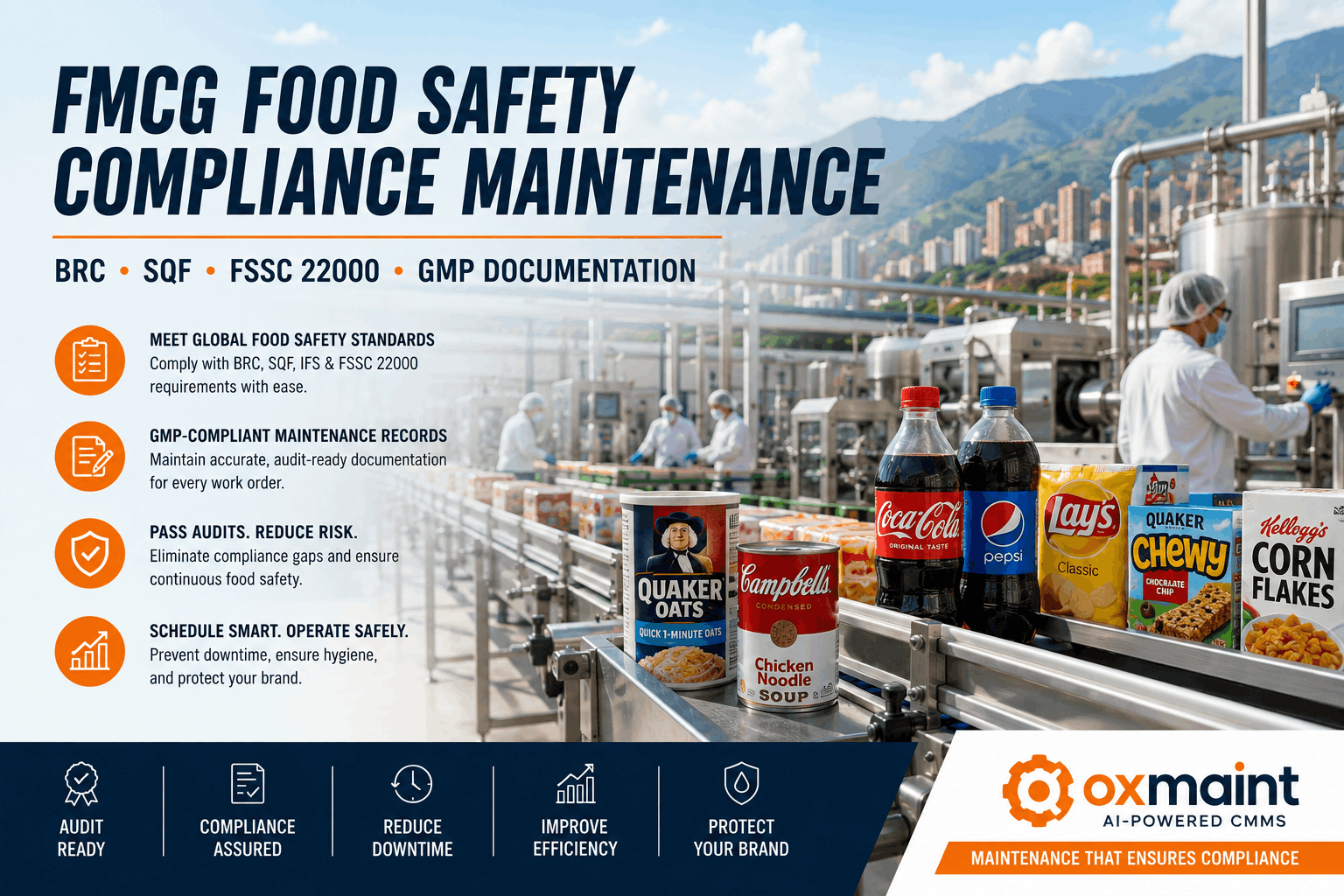
SQF Edition 9 raised the evidence bar for maintenance compliance in food manufacturing. Auditors arriving at your facility in the USA, UK, Canada, Australia, or UAE are no longer looking for maintained documentation — they are looking for documented evidence that your maintenance program systematically prevents food safety failures, not just equipment failures. The SQF Code's Food Safety Plan (Module 2) and Good Manufacturing Practices (Module 11) together create a comprehensive framework that demands structured, evidence-based maintenance: calibration program management, PM schedules aligned to food safety risk, corrective action documentation with root cause analysis, and systematic verification that maintenance activities are achieving their intended food safety outcomes. Facilities that run their SQF maintenance program on paper binders and spreadsheet trackers consistently accumulate the document control non-conformances and prerequisite program gaps that generate Major findings during SQF audits — and every Major finding is one step from certification suspension. start a free trial and build your SQF-compliant maintenance program in Oxmaint today, or book a demo to see the SQF maintenance compliance workflow.
Build an SQF-Ready Maintenance Program That Passes Every Time
Oxmaint structures your equipment PM schedules, calibration program, corrective actions, and verification records to exactly the evidence standard that SQF Edition 9 auditors assess — so your maintenance documentation never generates a non-conformance again.
SQF Edition 9 Maintenance Requirements: What the Code Actually Demands
SQF Edition 9 addresses maintenance requirements across multiple modules — each with specific documentation expectations that go beyond a general PM schedule. Understanding which SQF clauses apply to your maintenance program is the first step to building a program that delivers audit confidence rather than audit anxiety. start a free trial to configure Oxmaint's SQF maintenance workflows for your facility.
Site and Building Maintenance
Buildings, walls, floors, drains, ceilings, and pest exclusion structures must be maintained to prevent product contamination. Scheduled structural inspection PM tasks with documented findings and corrective action tracking are required evidence.
Equipment Suitability and Maintenance
All food contact equipment must be maintained in a clean, conditioned state that does not compromise food safety. PM schedules must document inspection frequency, maintenance tasks, and findings for every food-contact asset.
Calibration Program
Measuring and monitoring devices used in food safety applications must be calibrated at defined intervals with documented results. Out-of-calibration findings require documented assessment of product safety impact — a corrective action and investigation requirement that catches many facilities unprepared.
Corrective and Preventive Action
When maintenance-related food safety failures occur, SQF requires documented root cause analysis, immediate corrective action, preventive action to prevent recurrence, and verification that the corrective action was effective. Incomplete CAPA records are among the most common SQF Major findings.
Verification and Validation
The food safety plan — and its supporting maintenance prerequisite program — must be systematically verified. Maintenance records are primary verification evidence demonstrating that prerequisite programs are consistently implemented and effective at preventing hazard introduction.
Pest Management as Maintenance PRP
Pest monitoring device inspection schedules, structural exclusion PM tasks, bait station records, and corrective action documentation for pest activity findings are all maintenance-category requirements under SQF's pest management prerequisite program.
The 4 Most Common SQF Maintenance Audit Failures
Out-of-Calibration Instrument Without Impact Assessment
Finding a measuring device out of calibration is a non-conformance. Finding one out of calibration with no documented assessment of product safety impact for the period since last calibration is a Major non-conformance. SQF Clause 11.3 explicitly requires impact assessment — not just recalibration. Oxmaint generates automatic impact assessment work orders when calibration expiry is detected, creating the complete record SQF requires.
Corrective Actions Without Verified Root Cause
SQF Edition 9 tightened corrective action requirements — auditors now look for evidence that root cause was identified and verified as eliminated, not just that an immediate fix was applied. Paper-based corrective action forms frequently record the symptom ("equipment repaired") without the systemic root cause ("scheduled PM interval insufficient — revised from quarterly to monthly"). Oxmaint's CAPA workflow mandates root cause and preventive action fields before closure sign-off.
Structural Maintenance Defects Not Linked to Work Orders
Auditors who find a cracked floor coved base or a failed door seal during a facility walk check whether a maintenance work order exists for it. Finding no corresponding work order — because the defect was noted but not formally escalated — generates a non-conformance for inadequate maintenance management systems, separate from the physical defect itself. Every structural defect observation must generate a traceable work order.
PM Completion Records Not Retained or Accessible
SQF verification requires evidence that PM activities were completed as scheduled. Facilities that complete maintenance but cannot quickly produce the completion record — because the system is paper-based, records are filed offsite, or records lack technician sign-off — receive minor non-conformances for verification record management, even when the maintenance itself was performed correctly. Digital CMMS records with timestamps and signatures eliminate this entirely.
How Oxmaint Delivers an SQF Edition 9 Compliant Maintenance Program
Oxmaint covers every SQF maintenance requirement clause with structured workflows, digital documentation, and automated alerts — giving food manufacturing teams the evidence-based program that SQF auditors are trained to find and verify. book a demo to see the full SQF compliance workflow in Oxmaint.
Calibration Program with Impact Assessment
Scheduled calibration work orders with certificate storage, expiry alerts, and automatic impact assessment tasks when out-of-calibration findings occur — satisfying SQF's most commonly-cited calibration requirement in one workflow.
CAPA Workflow with Root Cause Verification
Structured corrective and preventive action workflows with mandatory root cause, preventive action, and effectiveness verification fields — generating the complete SQF CAPA evidence record for every maintenance-related food safety event.
Food Contact Equipment PM Schedules
Food-contact asset designation with risk-prioritized PM schedules — ensuring higher-risk equipment receives more frequent and thorough maintenance attention than the current OEM-only schedule approach that most facilities rely on.
Structural Defect Work Order Generation
Every structural defect observed during facility inspection rounds generates a linked work order in Oxmaint — creating the traceable maintenance management record that SQF auditors verify when they find structural deficiencies during walk-through assessment.
Verification Evidence Export
Generate SQF verification evidence packages — PM completion records, calibration histories, CAPA logs, and pest control records — by clause, date range, or asset in seconds. Auditors receive organized evidence without manual compilation under audit pressure.
Integrated Pest Management Documentation
Pest device asset register, inspection work orders, activity trend reports, and structural exclusion PM tasks managed in one system — producing the complete pest management prerequisite program evidence that SQF pest control clauses require.
SQF Audit Performance: Before and After CMMS Implementation
SQF Compliance Program ROI
Frequently Asked Questions
What maintenance records does an SQF Level 2 auditor typically review?
SQF Level 2 auditors typically request: equipment maintenance schedules demonstrating that all food-contact and food safety equipment is maintained at defined intervals; calibration records for all measuring devices used in food safety applications — including temperature instruments, checkweighers, and metal detectors — with calibration certificates and out-of-calibration impact assessments; corrective action records for all maintenance-related food safety events, showing root cause identification, corrective action, and effectiveness verification; pest control records including device inspection logs, activity trends, contractor service records, and structural exclusion maintenance tasks; and facility inspection records documenting the condition finding and maintenance response for all structural and infrastructure deficiencies identified during internal inspection rounds.
How does SQF Edition 9 differ from Edition 8 in maintenance requirements?
SQF Edition 9 introduced several significant changes to maintenance-related requirements: enhanced corrective action requirements now explicitly require root cause analysis and verification of effectiveness (previously implied, now required); calibration impact assessment for out-of-calibration findings is more explicitly required — Edition 9 makes the product safety assessment a documented requirement rather than an implied expectation; food safety culture requirements (Module 2.1) now expect evidence that maintenance personnel understand their food safety role, requiring training records and competency evidence for maintenance technicians on food safety prerequisites; and risk-based PM scheduling is more explicitly required, meaning facilities must demonstrate that their PM frequencies are set based on food safety risk assessment, not just OEM recommendations or historical practice.
Does Oxmaint support SQF multi-site certification management?
Yes. Oxmaint's multi-site platform supports SQF multi-site certification programs by maintaining site-specific asset registers, PM schedules, calibration programs, and compliance documentation independently for each certified facility, while providing portfolio-level visibility across all sites from one management interface. Corporate food safety and quality teams can monitor SQF compliance status — PM completion rates, calibration currency, open corrective actions — across all facilities simultaneously, identifying systemic gaps before they appear as audit findings. Site-level maintenance teams access only their facility's records and work orders, maintaining appropriate data segregation for independent site certification.
How should a food manufacturer prepare for an SQF recertification audit?
SQF recertification audit preparation should focus on: reviewing calibration certificate currency across all measuring devices in food safety applications — confirm all are within calibration period and any out-of-calibration events are fully documented with impact assessments and corrective actions; reviewing PM completion compliance — confirm all scheduled maintenance was completed on time in the audit period with signed digital records; reviewing corrective action records for completeness — confirm all CAPAs have documented root cause, preventive action, and effectiveness verification entries; preparing evidence packages organized by SQF clause — particularly Clauses 11.1, 11.2, 11.3, 11.4, 2.5, and 2.6; and conducting an internal audit simulation walk-through to identify structural deficiencies that generate work orders before the auditor finds them first. Oxmaint generates pre-organized SQF evidence packages for each clause in minutes.
SQF Edition 9 Compliance Starts with the Right Maintenance System
FMCG facilities across the USA, Canada, UK, and Australia use Oxmaint to maintain SQF-compliant PM programs, calibration management, CAPA workflows, and verification evidence — passing SQF audits without last-minute file hunting or documentation non-conformances.