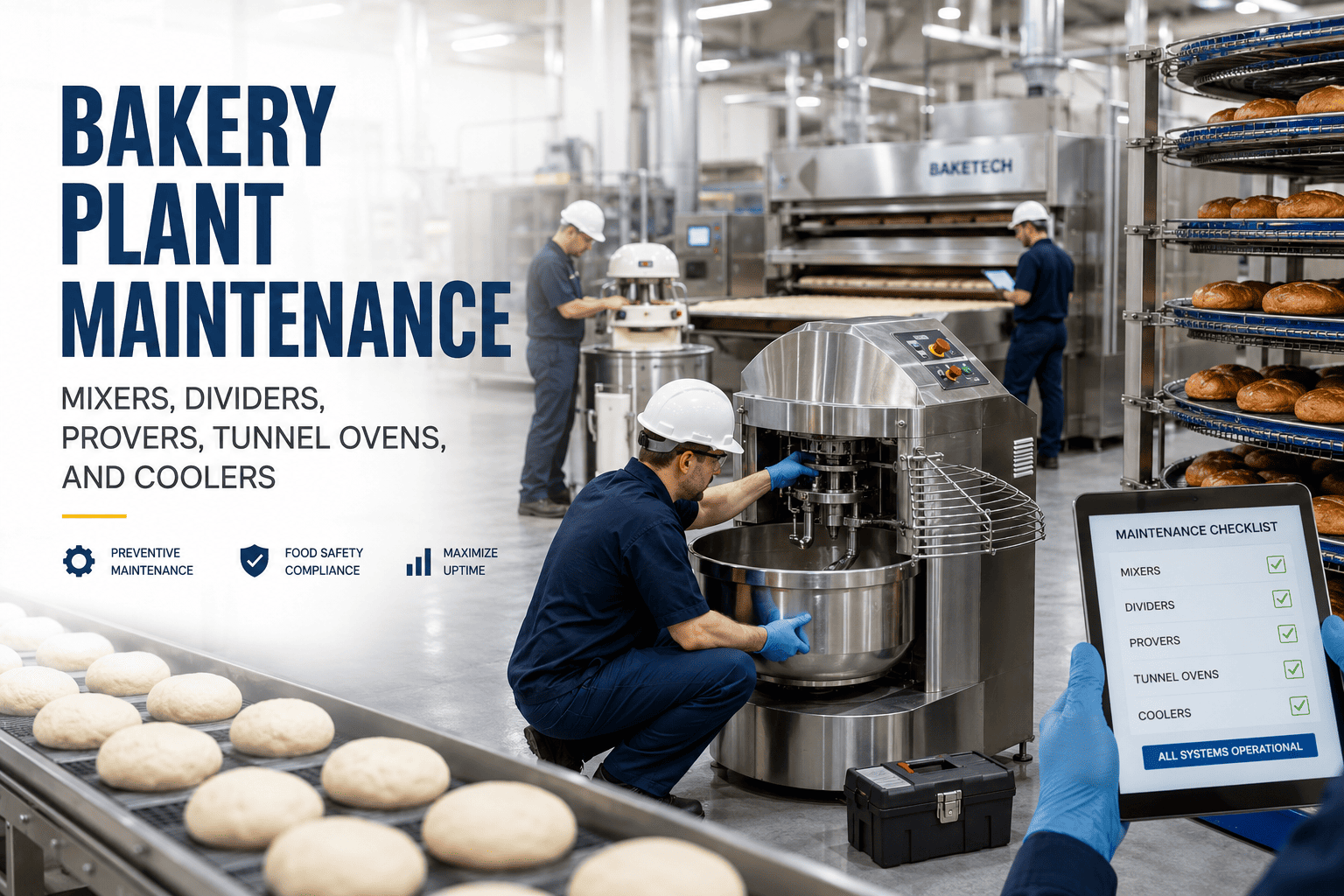
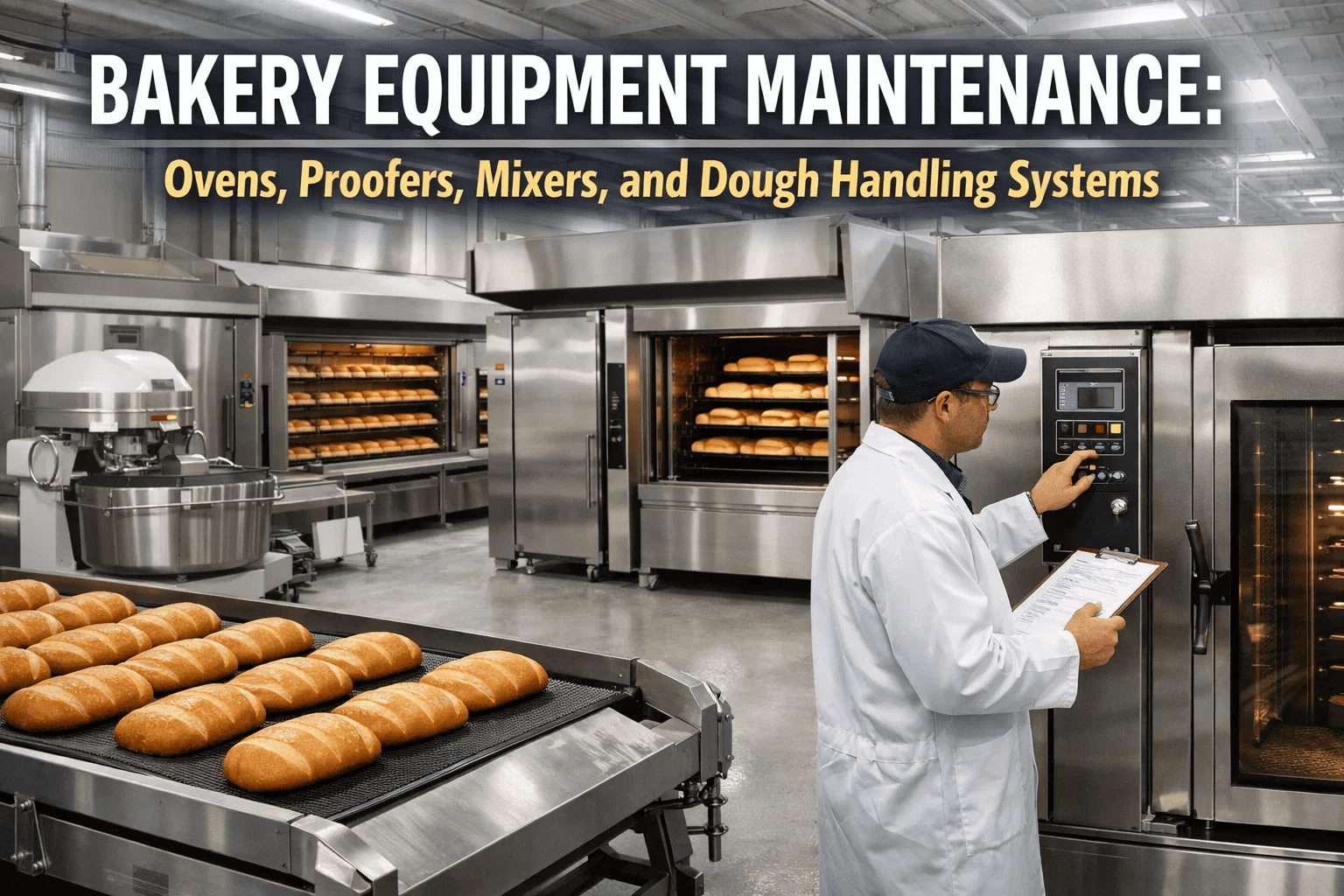
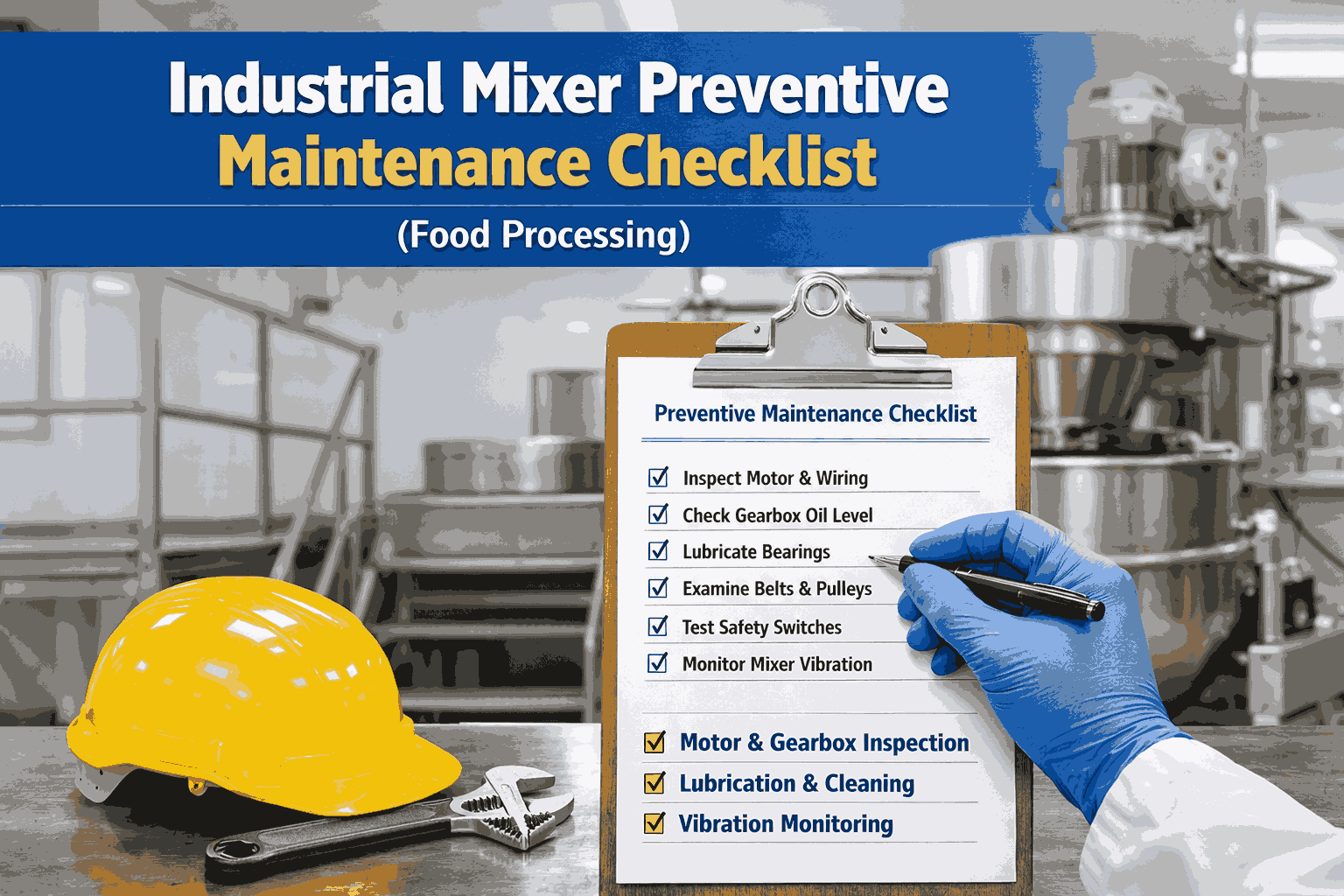
Every batch of bread, pastry, or confection that leaves a commercial bakery depends on equipment that is not just operational but optimally maintained. In a production environment where a single malfunctioning oven can halt an entire shift, where mixer bearing failure cascades into dough waste and missed delivery windows, and where proofer temperature drift quietly destroys product consistency, maintenance is not a support function — it is a core production discipline. This guide covers the five equipment categories that define bakery uptime: ovens, mixers, proofers, depositors, and cooling conveyors, with actionable preventive maintenance frameworks, sanitation standards, and CMMS-driven strategies for turning reactive breakdowns into predictable, manageable events. Sign up for OxMaint to centralise your bakery maintenance programme from day one.
Ready to eliminate unplanned bakery downtime?
OxMaint's CMMS platform gives bakery maintenance teams the tools to schedule preventive tasks, track asset health, manage work orders, and stay audit-ready — all from a single, intuitive interface built for food production environments.
Why Bakery Equipment Maintenance Demands a Dedicated Strategy
Commercial bakery environments impose conditions that accelerate equipment wear in ways that general food manufacturing maintenance programmes do not fully address. Heat cycling in deck and tunnel ovens creates thermal stress that degrades seals, door gaskets, and heating elements on timelines measured in months rather than years. The hygroscopic nature of flour and sugar means that residue accumulates in motor housings, on conveyor rollers, and inside proofer humidification systems, creating both mechanical risk and food safety hazard simultaneously. Fat-based products leave films on depositor valves and nozzles that harden into blockages if not removed on every production cycle.
The food safety dimension elevates the stakes considerably. A bearing failure in a non-food-contact mixer component is an operational problem. The same failure in a depositor head that introduces metal particulate into batter is a product recall and a regulatory crisis. Bakery maintenance programmes must therefore treat equipment reliability and food safety as inseparable objectives, with maintenance procedures designed to satisfy both engineering and food safety audit requirements simultaneously.
The economics are equally compelling. Industry data consistently shows that the cost of planned preventive maintenance runs at roughly 15 to 20 percent of the cost of reactive repair when total impact is measured, including secondary damage, production loss, labour premium for emergency response, and expedited parts procurement. Bakery operations running high-throughput lines on tight margins cannot absorb the unpredictability of a predominantly reactive maintenance approach. Teams using OxMaint's preventive maintenance scheduling consistently report significant reductions in emergency breakdown events within six months of structured programme implementation.
Industrial Oven Maintenance: Deck, Tunnel, and Rack Configurations
Commercial bakery ovens represent the highest-value asset in most production facilities and the failure point with the greatest single-event impact on output. Maintenance requirements differ meaningfully between deck ovens, tunnel ovens, and rack ovens, but all three share a common set of critical failure modes: heating element degradation, door seal deterioration, temperature control system drift, and combustion system fouling in gas-fired configurations.
Daily oven maintenance tasks should include visual inspection of door gaskets and hinges, removal of product residue from baking surfaces and cavities, and a simple temperature verification using a calibrated probe against the controller display. Gasket deterioration is one of the most common sources of energy waste in commercial bakeries; a damaged seal on a deck oven door can increase energy consumption by several percentage points while simultaneously compromising temperature uniformity in the chamber. Replacing gaskets on a scheduled basis rather than waiting for visible failure is a straightforward intervention with measurable energy and quality returns.
Weekly and monthly tasks should address burner cleaning and combustion analysis in gas-fired ovens, inspection of conveyor belts and drive systems in tunnel configurations, lubrication of door hinges and loading mechanisms, and calibration verification of thermocouple sensors and control systems. Tunnel oven conveyor belts in particular are subject to stretch, edge wear, and mesh deformation that progressively affects product bake uniformity and, if unaddressed, eventually requires full belt replacement — a costly and time-consuming intervention that scheduled inspection can defer significantly. Maintenance teams can book a walkthrough with OxMaint to see how oven asset histories and calibration records are managed within a single platform.
Annual deep maintenance should include full decarbonisation of oven chambers and flue systems, comprehensive combustion efficiency testing, electrical safety inspection of heating elements and control wiring, and pressure testing of steam injection systems in ovens with steam capability. Steam tube scaling in deck ovens is a particularly insidious maintenance gap; progressive scale buildup reduces steam output gradually, degrading crust quality in an incremental way that production teams often attribute to recipe variation before the root cause is identified.
Six Equipment Categories: Maintenance Essentials
Spiral and Planetary Mixers
Mixer maintenance centres on three systems: the gearbox, the bowl lift mechanism, and the agitator attachment interface. Gearbox oil sampling every six months provides early warning of wear metal contamination before bearing failure occurs. Bowl lift chains and screws require weekly lubrication with food-grade grease. Agitator attachment pins and bayonet fittings should be inspected each shift for deformation that could allow attachment release under load — a direct food safety and operator safety concern.
Proofers and Retarder-Proofers
Proofer reliability depends on three sub-systems: the humidification circuit, the refrigeration system in retarder-proofer combinations, and the control system. Humidification nozzles and water supply lines require weekly descaling in hard water areas to prevent blockage and uneven humidity distribution. Refrigeration coils in retarder units need quarterly cleaning to maintain efficiency. Temperature and humidity sensor calibration should be verified monthly against a reference instrument and documented for food safety audit purposes.
Depositors and Filling Machines
Depositors are among the most maintenance-intensive bakery assets per unit of output, because they operate at high cycle rates with direct product contact on every cycle. Valve seats, piston seals, and nozzle orifices all wear progressively, and even small dimensional changes translate directly into weight variation and product defects. Full teardown, inspection, and food-grade seal replacement should occur on a frequency calibrated to product throughput — typically every three to six months in high-volume operations.
Cooling Conveyors and Spiral Coolers
Cooling conveyor maintenance focuses on belt tension, roller alignment, and drive system condition. Misaligned belts track to one side progressively, causing edge wear that produces metal particulate — a food safety hazard that preventive inspection should eliminate. Spiral cooler fins and evaporator coils require quarterly cleaning to maintain cooling efficiency. Drive chain lubrication with food-grade chain oil should occur weekly, with chain elongation measured monthly using a calibrated gauge to predict replacement timing before failure.
Dough Sheeters and Dividers
Sheeter roller gaps require weekly calibration verification to maintain consistent dough sheet thickness. Roller bearings and pressure adjustment mechanisms should be lubricated with food-grade grease on a fortnightly schedule. Dough divider pistons and cut-off wires are high-wear items that require regular replacement on a usage-based schedule rather than a fixed calendar interval, making CMMS-based production counter integration essential for accurate replacement timing.
Packaging and Wrapping Machines
Bakery packaging equipment operates at the intersection of mechanical precision and food safety, with sealing jaws, film tension systems, and date coding mechanisms all requiring regular attention. Sealing jaw temperature calibration should be verified daily, as drift directly causes seal integrity failures and product returns. Film tracking alignment, cutter blade condition, and conveyor belt cleanliness should be addressed on weekly preventive routines, with full drive system inspection quarterly.
Bakery Sanitation Standards Integrated with Maintenance
In food production environments, sanitation and maintenance are not parallel programmes — they are deeply interdependent. A maintenance team that services equipment without understanding the sanitation requirements of each zone, and a sanitation team that cleans without awareness of the maintenance implications of cleaning methods and chemicals, will collectively produce a programme that satisfies neither objective fully. Integrating the two into a single asset management framework is one of the highest-leverage improvements available to bakery operations management.
The practical integration starts with equipment design awareness. Maintenance procedures for food-contact equipment must use food-grade lubricants exclusively, with no substitution of industrial-grade alternatives regardless of availability pressures. Food-grade lubricants are formulated to resist water washout, withstand temperature extremes, and remain non-toxic in incidental product contact situations that are an unavoidable reality in baking environments. A comprehensive register of all lubrication points, specifying the approved product for each, is a minimum requirement for both maintenance programme integrity and food safety audit compliance.
Cleaning-in-place systems on depositors and filling machines require maintenance validation as well as operational verification. CIP nozzle condition, pump performance, and temperature sensor accuracy all degrade over time. A CIP cycle that is nominally running but delivering suboptimal pressure or temperature due to unaddressed maintenance deficiencies may pass a visual check while leaving biofilm accumulation in product contact surfaces. Periodic microbiological swab sampling correlated with CIP system performance data is the most reliable way to detect this class of failure before it becomes a food safety incident. OxMaint's work order system allows sanitation tasks and maintenance interventions to be tracked against the same asset record, providing the unified audit trail that regulatory inspections increasingly require.
Reactive vs Preventive Maintenance: The Bakery Comparison
| Maintenance Dimension | Reactive Approach | Preventive / CMMS-Driven Approach |
|---|---|---|
| Failure Detection | At point of breakdown; production already stopped | Early warning through inspection, condition monitoring, and wear indicators |
| Parts Availability | Emergency procurement; premium cost and lead time | Planned stock based on PM schedules and asset criticality analysis |
| Repair Cost | High; secondary damage common when primary failure propagates | Low; component replacement before failure prevents cascade damage |
| Food Safety Risk | Elevated; degraded seals, worn metal parts may contaminate product before failure | Managed; regular inspection of seals, wear parts, and food-contact surfaces |
| Energy Efficiency | Degraded; oven seals, burners, and refrigeration run inefficiently until failure | Optimised; calibration and seal maintenance maintain designed efficiency |
| Audit Readiness | Paper-based records; gaps common; difficult to demonstrate compliance history | Digital records with full asset history; compliance evidence always available |
| Production Planning | Unpredictable; maintenance windows unknown until equipment fails | Scheduled; maintenance windows planned around production calendar |
Building a Bakery Preventive Maintenance Schedule
A functional bakery preventive maintenance schedule is built around three inputs: manufacturer recommendations, operational experience with specific failure patterns in your facility, and criticality analysis that identifies which equipment failures have the greatest impact on production output and food safety. Manufacturer service intervals are the starting point but should not be treated as definitive, because they are typically based on standard operating conditions that may not reflect the thermal cycling, humidity exposure, and throughput intensity of your specific production environment.
Daily maintenance tasks should be executable by trained operators as part of shift start and end procedures. These include visual checks, lubrication of designated points, cleaning of product contact surfaces, and performance verification of critical parameters such as temperature, weight, and speed. The key discipline is ensuring that daily tasks are completed consistently, recorded accurately, and that anomalies are escalated through a clear process rather than normalised and ignored.
Weekly and monthly tasks should be assigned to dedicated maintenance technicians with the competence to perform mechanical and electrical work safely. These tasks include deeper cleaning, lubrication of less-accessible points, functional testing of safety systems, calibration verification, and inspection of high-wear components against defined acceptance criteria. The acceptance criteria are critical: a maintenance inspection that ends with a subjective impression of acceptable condition is far less reliable than one that measures specific parameters against defined limits and documents the result.
Quarterly and annual tasks should address overhauls of high-cycle components, comprehensive calibration of instrumentation, electrical safety testing, and structural inspection of equipment frames and mounting points. Annual planned shutdown periods, coordinated with production planning, allow major maintenance tasks that require extended access time to be completed without competing with throughput pressure. Teams that manage their schedules through OxMaint can generate maintenance calendars that integrate directly with production planning tools, ensuring that equipment downtime windows are protected rather than progressively eroded by scheduling pressure.
Food-Grade Lubrication: The Non-Negotiable Standard
One of the most consequential and frequently underestimated decisions in bakery maintenance programme design is the specification of lubricants for food production environments. The instinct to use whatever lubricant is available, or to standardise on a small number of general-purpose products to simplify the stores inventory, routinely introduces food safety risk that is invisible until an audit, an adverse analytical result, or worse, a consumer complaint exposes it.
Food-grade lubricants are classified under the H1, H2, and H3 categories defined by NSF International, with H1 being required for all applications where incidental food contact is possible. H1 lubricants must be formulated from approved base stocks and additive packages with no components that pose a toxicological risk at the trace levels that might reach product. In a bakery environment where flour dust and product aerosols are pervasive, virtually every lubrication point within the production area should be treated as a potential incidental contact point, making H1 the appropriate standard for the entire facility.
Beyond specification, the management of food-grade lubrication requires a rigorous programme covering approved product register documentation, lubrication point mapping for every asset, technician training on correct application quantities and methods, and regular audit of actual practice against procedure. Over-lubrication is as problematic as under-lubrication in food environments; excess lubricant migrates onto product contact surfaces and into product flow paths, creating contamination risk that correct application procedure prevents. A well-designed CMMS system should carry the approved lubricant specification against every lubrication task, eliminating the possibility of substitution through technician discretion or parts availability pressure.
CMMS for Bakery Equipment: What to Look for and How to Implement
A Computerised Maintenance Management System transforms bakery maintenance from a discipline dependent on individual knowledge and memory into a systematic, auditable programme that delivers consistent outcomes regardless of staff turnover or operational pressure. The business case for CMMS adoption in commercial bakery operations is well established: reduced breakdown frequency, lower total maintenance cost, improved food safety audit outcomes, and more accurate asset lifecycle data for capital planning.
The selection criteria for a bakery CMMS should prioritise several capabilities. Asset hierarchy management must accommodate the complexity of bakery production lines, where a single line comprises multiple interdependent assets each with their own maintenance requirements and spare parts holdings. Work order management should support both planned preventive tasks and reactive work requests from operators, with clear escalation paths and completion verification. Spare parts inventory integration reduces the risk of maintenance delays caused by unavailable components, and enables reorder point management based on actual consumption history.
Reporting and analytics capability is increasingly important as food safety audits require demonstrated evidence of maintenance programme effectiveness rather than simply records of tasks completed. A CMMS that can produce asset reliability trend data, mean time between failure analysis by equipment type, overdue maintenance reporting, and food safety compliance dashboards provides the intelligence layer that elevates maintenance from a cost centre to a demonstrable quality and safety function. Schedule a personalised demo with OxMaint to explore how the platform's reporting suite maps to BRC, SQF, and IFS audit requirements.
Implementation success depends heavily on data quality at the outset. A CMMS populated with incomplete asset records, vague task descriptions, and no calibrated PM frequencies will generate administrative burden without delivering operational value. The most successful bakery implementations begin with a structured asset register validation exercise, mapping every production asset, assigning criticality ratings, and defining clear PM task libraries before going live. This foundation work is time-consuming but is what determines whether the system becomes a genuinely operational tool or a compliance database that nobody actively uses.
Bakery Equipment Maintenance Frequency Reference
| Equipment | Daily / Per Shift | Weekly / Monthly | Quarterly / Annual |
|---|---|---|---|
| Deck / Tunnel Oven | Temperature check, door seal inspection, debris removal | Burner cleaning, conveyor belt inspection, calibration check | Full decarbonisation, combustion analysis, heating element test |
| Spiral / Planetary Mixer | Bowl and agitator clean, visual safety check | Bowl lift lubrication, attachment pin inspection | Gearbox oil sample, bearing inspection, full strip-clean |
| Proofer / Retarder-Proofer | Temperature and humidity verification | Nozzle descaling, door seal check | Refrigeration coil clean, sensor calibration, fan motor service |
| Depositor / Filler | Full teardown clean of product contact parts, seal inspection | Valve seat and piston seal measurement against wear limits | Full rebuild with new food-grade seals, dosing weight calibration |
| Cooling Conveyor | Belt tracking check, debris removal | Drive chain lubrication, roller alignment check | Chain elongation measurement, bearing replacement, belt inspection |
| Dough Sheeter | Roller clean, thickness gauge check | Roller gap calibration, bearing lubrication | Full roller inspection, drive belt tension, safety guard check |
Spare Parts Management for Bakery Production Lines
Spare parts availability is the single most common cause of extended downtime once a failure has been identified. A maintenance team with excellent diagnostic capability but no stock of the required replacement part faces an unavoidable wait measured in days in the best case and weeks for imported or specialist components. The discipline of spare parts management — determining what to hold, in what quantity, at what reorder point — is therefore as important to bakery uptime as the technical quality of maintenance work itself.
Parts criticality analysis should drive stocking decisions. Components that are subject to known wear rates, have long lead times, and whose failure stops production should be held in sufficient quantity to cover the replenishment cycle with a buffer for unexpected demand. Components that are readily available from local distributors, or whose failure does not stop production, can be managed on a just-in-time basis. The economic trade-off between holding cost and downtime risk is different for every component and every facility, making a systematic approach significantly more effective than intuitive stocking decisions made under production pressure.
CMMS integration with spare parts inventory transforms this discipline from a separate, often neglected function into a natural part of maintenance workflow. When a technician closes a work order recording that a specific seal was replaced, an integrated system can automatically decrement inventory, check the balance against the reorder point, and raise a purchase requisition without any additional administrative action. This automation eliminates the stock-out situations that arise when consumption data exists only in individual technicians' memories and is never systematically converted into replenishment action.
Build a World-Class Bakery Maintenance Programme
From oven calibration records to depositor seal replacement schedules, OxMaint gives your maintenance team a single platform to plan, execute, and prove every task — making your production line more reliable and your audits straightforward.
Frequently Asked Questions
How often should commercial bakery ovens be serviced?
Commercial bakery ovens require daily checks of door seals, temperature accuracy, and surface cleanliness; weekly burner and conveyor inspections; and a full service including combustion analysis, decarbonisation, and heating element testing annually or more frequently in high-throughput operations. Temperature sensor calibration should be verified monthly and documented for food safety audit purposes. The precise frequency should be calibrated to actual operating hours and observed wear rates rather than fixed solely to calendar intervals.
What lubricants should be used on bakery equipment?
All lubricants used in bakery production areas should meet NSF H1 classification, which certifies them as safe for incidental food contact. H1-rated greases and oils are available for all application types including gear oils, chain lubricants, bearing greases, and aerosol contact sprays. Industrial-grade lubricants should never be used in any location where migration to product contact surfaces is possible, which in a bakery environment effectively means the entire production area. A documented register of approved lubricants mapped to each application point is a requirement of most major food safety standards.
How can a CMMS improve bakery equipment maintenance?
A CMMS improves bakery maintenance in several ways: it automates PM scheduling based on calendar or production counter triggers, ensuring no tasks are missed under operational pressure; it provides a searchable asset history that supports fault diagnosis and informs capital replacement decisions; it integrates spare parts inventory management with work order completion to maintain accurate stock levels; and it generates the compliance documentation and audit trail that food safety standards require. Teams transitioning from paper-based systems typically report significant reductions in both breakdown frequency and audit preparation time within the first year of CMMS adoption.
What are the most common causes of depositor and filling machine failure?
The most frequent depositor failures in bakery operations are caused by seal wear leading to product leakage and dosing inaccuracy, valve seat erosion affecting fill consistency, and nozzle blockage from product residue that was not fully removed during cleaning. These failure modes are largely preventable through rigorous daily clean-down procedures, regular dimensional inspection of valve seats and piston clearances, and scheduled seal replacement based on throughput hours rather than waiting for visible leakage. Foreign body risk from worn metal components makes a disciplined inspection and replacement programme a food safety requirement as well as a reliability measure.
How should proofer maintenance be integrated with food safety requirements?
Proofer maintenance must address both the mechanical reliability of temperature and humidity control systems and the microbiological hygiene of the internal environment. The warm, humid conditions inside proofers create ideal growth conditions for mould and bacteria if cleaning and maintenance are inadequate. Maintenance procedures should include weekly descaling of humidification nozzles, monthly calibration verification of temperature and humidity sensors with documented results, quarterly inspection and cleaning of drainage systems, and regular sanitisation of interior surfaces with food-safe products appropriate for the materials used in the proofer construction.
What maintenance records are required for food safety audits in bakeries?
Food safety standards including BRC, SQF, IFS, and FSSC 22000 all require documented evidence of a structured preventive maintenance programme. Records typically required include a complete asset register with unique equipment identifiers; a documented PM schedule with defined frequencies for each task; completed work orders demonstrating that scheduled tasks were performed, by whom, and on what date; calibration records for temperature, weight, and other critical measurement instruments; and corrective action documentation for any equipment that failed inspection or breakdown. Digital records held in a CMMS are increasingly preferred by auditors over paper-based systems because they are searchable, tamper-evident, and accessible in real time during audit.
How do you calculate the right spare parts stock levels for a bakery?
Spare parts stocking decisions should be based on three factors: the criticality of the equipment whose failure the part would address, the lead time for replenishment from your supplier, and the historical or estimated consumption rate. Critical components on equipment whose failure stops production should be stocked at a level that covers the supplier lead time plus a safety buffer. Non-critical parts or those with short lead times can be managed on a just-in-time basis. A CMMS that records parts consumption against work orders provides the consumption history data needed to make these calculations accurately rather than relying on intuition, and can automate reorder point alerts to prevent stock-outs from occurring without being noticed.