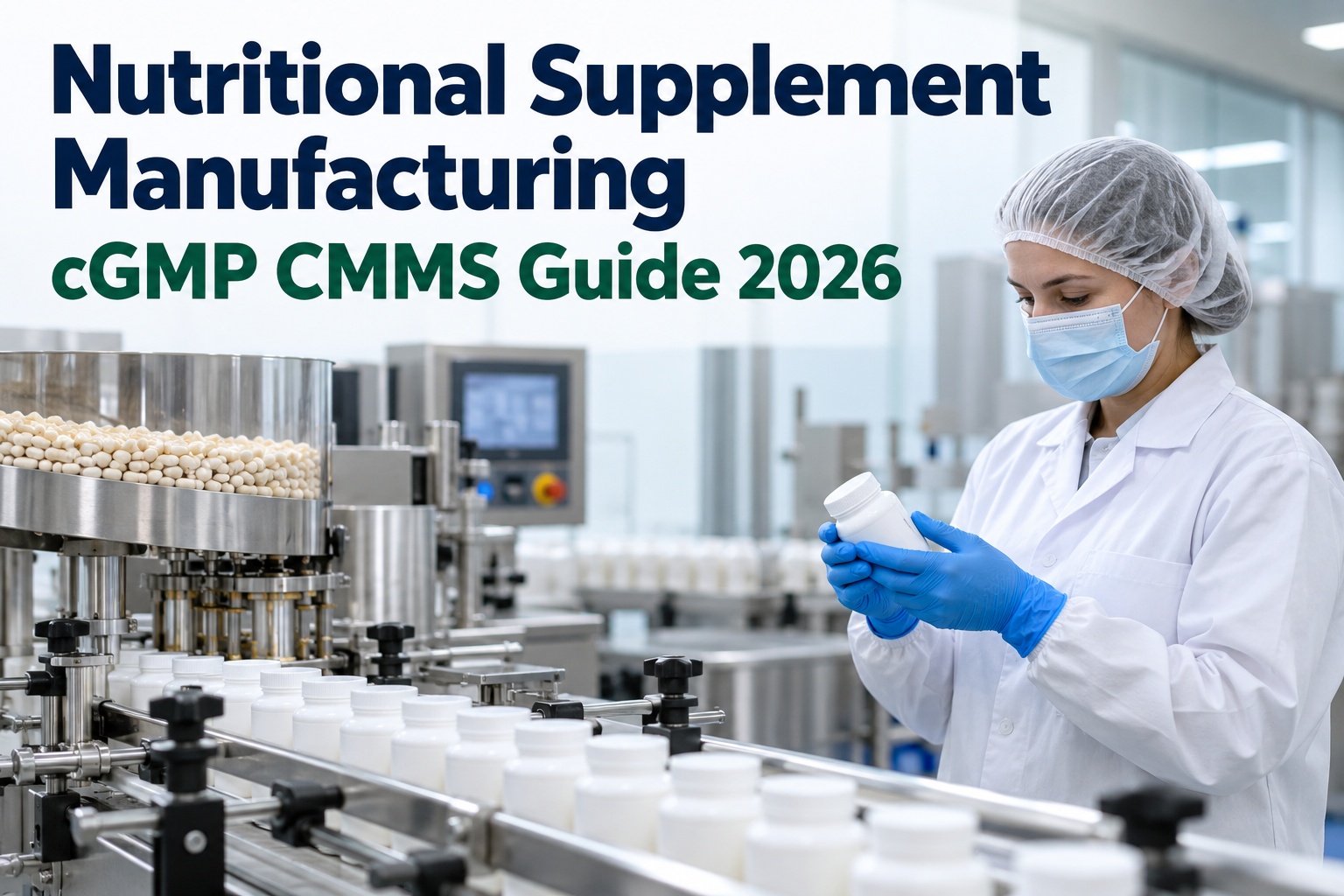
A 483 observation for a nutraceutical facility does not usually begin with a contaminated batch. It begins with a maintenance work order that was never generated, a preventive maintenance interval that drifted by six weeks, and a blender bearing that nobody lubricated on the schedule the firm's own SOP required. FDA's Center for Drug Evaluation and Research and the Office of Regulatory Affairs have consistently documented — across Warning Letters and import alerts in the dietary supplement sector — that the most cited cGMP violations under 21 CFR Part 111 are not formulation failures but maintenance and documentation failures: equipment not maintained in a clean and orderly condition, PM schedules not followed, and corrective actions not recorded with the specificity the regulation demands. The 2023 FDA Drug Surveillance Report noted that dietary supplement and nutraceutical facilities account for over 38% of all food-adjacent 483 observations related to equipment maintenance programs — a disproportionate share driven by the sector's reliance on contract manufacturing, high SKU complexity, and the operational reality that most supplement plants run blending, encapsulation, tableting, and packaging lines on the same equipment across dozens of formulations daily. When a single unlubricating bearing or an out-of-tolerance tablet press generates a deviation, the downstream consequence is not just a repair cost — it is a non-conformance record, a potential lot hold, and, if the corrective action documentation is inadequate, a 483 finding that follows the facility through the next three inspection cycles. Teams that manage PM programs through spreadsheets and paper work orders are structurally unable to produce the audit trail 21 CFR 111 requires — which is exactly the operational gap that OxMaint closes, so start a free trial to connect your supplement plant's PM schedule to audit-ready CMMS documentation, or book a demo and we will map your 21 CFR 111 equipment register to OxMaint's PM framework in a single session.
Regulatory Alert
Dietary supplement facilities account for 38% of all food-adjacent 483 observations tied to equipment maintenance — FDA 2023 surveillance data. The fix is not a new SOP. It is a CMMS that generates the work order and retains the record.
Industry Benchmark Data
The Maintenance Cost of Non-Compliance in Nutraceutical Manufacturing
38%
of food-adjacent 483 observations at supplement facilities cite equipment maintenance program failures
FDA Drug Surveillance, 2023
4.8×
more expensive to respond to an unplanned equipment failure than a scheduled PM intervention on the same asset
SMRP Benchmark Data
$2.1M
average cost of a dietary supplement recall — product recovery, regulatory response, and brand remediation
GFSI / Industry Estimates
72%
of supplement plant Warning Letters cite inadequate equipment cleaning and PM records as contributing findings
FDA Warning Letter Analysis
Identify Hidden Cost Leaks in Your Supplement Plant
See how much reactive maintenance and audit prep labor your facility can eliminate in the first 30 days.
Real-time PM schedule compliance tracking across all lines
21 CFR 111-aligned work order documentation
Audit-ready equipment maintenance history — instant export
No heavy implementation — live in days — works across multi-site supplement portfolios
Used by operations teams managing 10,000+ assets. Measurable results in the first 30 days.
Start Free Trial
Book a Demo
See Your Asset ROI in 30 Minutes
Regulatory Framework
What 21 CFR Part 111 Actually Requires from Your Maintenance Program
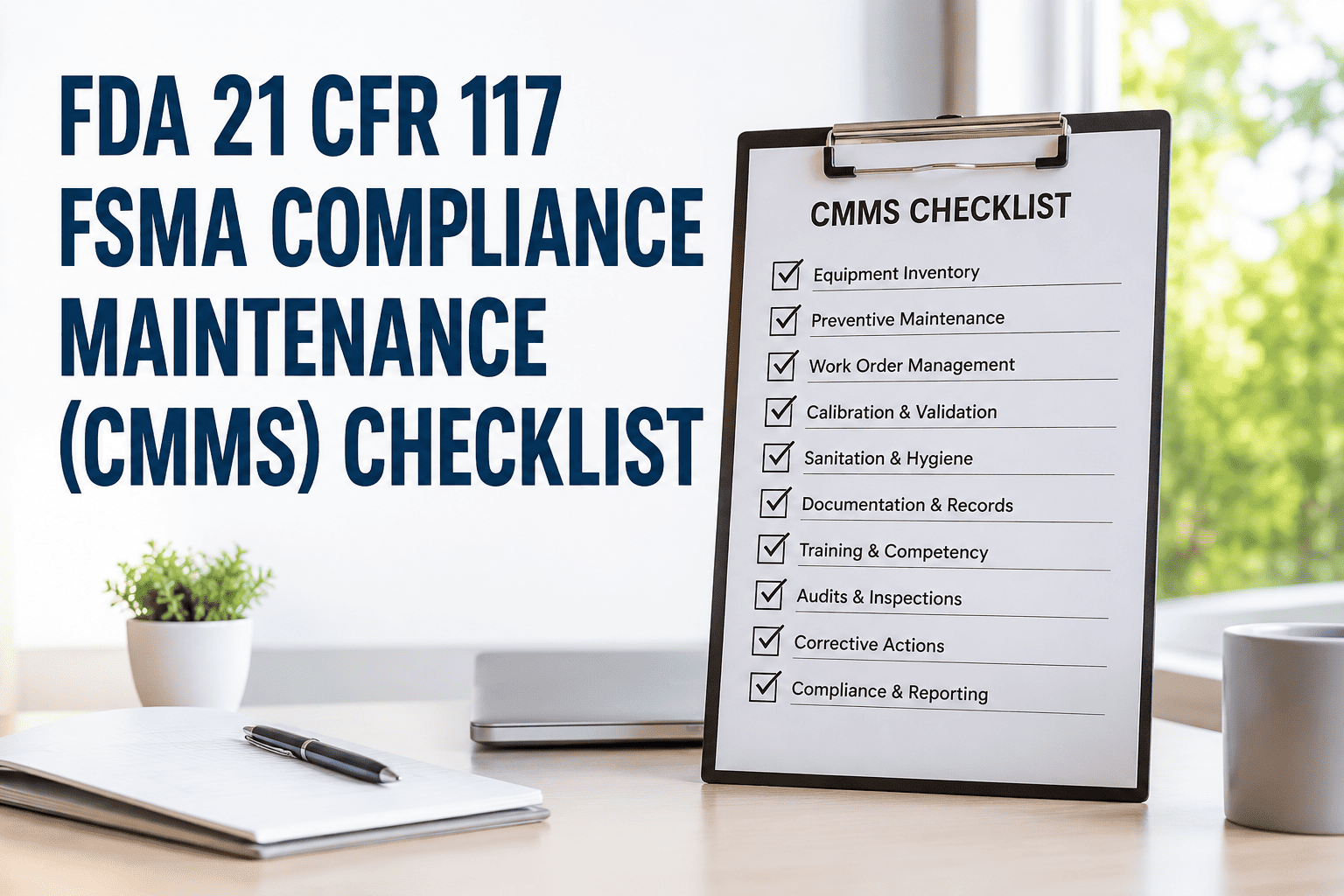
21 CFR Part 111 — Current Good Manufacturing Practice in Manufacturing, Packaging, Labeling, or Holding Operations for Dietary Supplements — is the FDA's foundational regulatory framework for the supplement industry. Unlike food facility regulations under 21 CFR Part 117, Part 111 is closer in structure and documentation expectation to pharmaceutical cGMP. Subpart C (Physical Plant and Grounds), Subpart D (Equipment and Utensils), and Subpart E (Production and Process Controls) collectively establish the maintenance obligations that supplement manufacturers must meet: equipment must be of adequate design and construction, maintained in a clean and orderly condition, and cleaned, maintained, and sanitized at appropriate intervals.
The documentation requirement is where most supplement plants fail under inspection. 21 CFR 111.35 requires batch records that include the identity of equipment used. 21 CFR 111.420(b) requires that the company establish and follow written procedures for equipment and utensil cleaning, sanitizing, and maintenance. 21 CFR 111.430 requires records of the performance of these procedures. The regulation does not specify what system must be used to generate and retain these records — but it does require that they be retrievable, that they identify the person who performed the action, and that they be retained for one year beyond the shelf life of the finished batch. Paper logs and spreadsheet-based PM tracking create structural retrieval and completeness failures at scale that CMMS systems are specifically designed to eliminate — which is why teams that are serious about 21 CFR 111 readiness should start a free trial with OxMaint's supplement-specific equipment documentation framework, or book a demo to see how the platform maps directly to Part 111 record requirements.
Key 21 CFR 111 Maintenance Citations
§111.27
Equipment and utensils must be of appropriate design, construction, and workmanship and must be adequately cleaned and sanitized.
§111.35
Batch production records must include the identity of equipment and processing lines used.
§111.420(b)
Written procedures for equipment cleaning, sanitizing, and maintenance must be established and followed.
§111.430
Records of the performance of equipment cleaning and maintenance procedures must be retained.
§111.455
Records must be retained for one year past the earliest expiration date of the product batch to which they relate.
Most supplement plant 483 observations are not about bad ingredients. They are about missing work orders, undated PM logs, and corrective actions closed without verification records. The maintenance system is the compliance system.
Equipment Framework
The 8 Equipment Categories That Drive 21 CFR 111 Maintenance Obligations
A nutraceutical plant's maintenance program must cover eight distinct equipment categories, each with its own failure modes, cleaning validation requirements, and PM interval logic. CMMS coverage of all eight — with documented work orders and retrieval capability by equipment ID — is the baseline for Part 111 audit readiness.
01
Blending and Mixing Equipment
V-blenders, ribbon blenders, planetary mixers, and high-shear granulators. PM obligations: bearing lubrication, seal inspection, drive belt tension, load cell calibration, and cross-contamination cleaning validation between formulations.
02
Encapsulation Equipment
Hard-shell capsule filling machines and soft-gel encapsulation lines. PM: dosing disk wear inspection, tamping pin alignment, capsule segment cleaning, and fill weight verification — all traceable to lot-level batch records.
03
Tableting Presses
Single and multi-station rotary tablet presses. PM: punch and die inspection and replacement schedule, turret lubrication, compression force calibration, and tablet weight/hardness deviation tracking — linked to equipment ID in batch records.
04
Coating Systems
Pan coaters and spray coating systems for tablet film coating and enteric coating. PM: spray nozzle inspection and replacement, pan speed calibration, inlet/exhaust air filter maintenance, and coating weight uniformity verification records.
05
Packaging Lines
Bottling, blister pack, and sachet filling lines. PM: fill volume calibration, cap torque verification, induction sealer function, label applicator alignment, and metal detector/checkweigher qualification — all generating individual equipment PM records.
06
HVAC and Environmental Control
Temperature, humidity, and differential pressure systems for production zones. PM: HEPA filter change-out schedule, air handling unit inspection, temperature mapping validation, and pressure differential log — critical for moisture-sensitive formulations.
07
Utilities — Water Systems
Purified water systems (USP Purified Water for supplement manufacturing), RO membranes, UV sterilizers, and storage tank sanitization. PM: conductivity monitoring, microbial testing schedule, and sanitization cycle records traceable to equipment ID.
08
Weighing and Analytical Instruments
Analytical balances, floor scales, moisture analyzers, and in-process testing instruments. PM: calibration schedule with traceability to NIST standards, out-of-tolerance deviation records, and calibration sticker compliance — required for every instrument used in a batch record.
Operational Pain Points
Where Supplement Plant Maintenance Programs Break Down Under FDA Scrutiny
The four failure patterns below appear in over 65% of Warning Letters issued to dietary supplement manufacturers since 2020. Each one is preventable with a structured CMMS program — and each one, left unaddressed, creates compounding regulatory risk that reaches well beyond the initial observation. Teams experiencing any of these gaps should start a free trial immediately to benchmark current PM compliance, or book a demo to see how OxMaint structures corrective action workflows for supplement plant inspection findings.
01
PM Intervals Defined in SOPs but Not Executed in Practice
The facility has written PM procedures. The PM intervals are stated in the SOP. The equipment log shows the last PM was performed 11 weeks ago, against a 6-week SOP requirement. During inspection, the investigator requests all PM records for the blending equipment used in three lots under review. The records show three consecutive PM skips. The firm cannot explain the gap. The observation is written. The corrective action requires a full PM program review and CAPA. This is the most common 21 CFR 111 maintenance finding — not the absence of a program, but the undocumented departure from the program the firm created and committed to.
02
Cleaning Records Not Linked to Equipment ID or Lot Number
21 CFR 111.430 requires that cleaning and sanitizing records identify the specific equipment cleaned and the date and time of cleaning. Paper cleaning logs often record the cleaning action — "blender cleaned per SOP-042" — but do not record the equipment asset number, the lot number of the previous product, or the identity of the next product to be run. When an investigator requests cleaning records for a specific piece of equipment across a 6-month period, the facility cannot produce a complete, equipment-specific cleaning history. The finding is filed under inadequate record retention — a 111.455 violation — even though the cleaning was actually performed.
03
Corrective Actions on Equipment Deviations Lack Root Cause and Verification
A tablet press shows a compression force deviation mid-run. The operator stops the press, adjusts the compression rollers, and restarts. The deviation is noted in the batch record. No corrective action work order is generated. No investigation of the root cause — worn compression roller, improper die set, or turret wear — is documented. The batch is released. Two months later, a similar deviation occurs on the same press. FDA inspection finds a pattern of recurring deviations with no root cause investigation and no CAPA closure records. The finding is issued under 21 CFR 111.68 — failure to investigate out-of-specification results — and triggers a broader equipment qualification review.
04
Calibration Records for In-Process Instruments Not Retrievable by Equipment
Every balance, scale, moisture analyzer, and in-process testing instrument used in a supplement batch must have a current calibration record traceable to NIST standards, with an out-of-tolerance protocol documented. Facilities that maintain calibration records in a separate QA binder, disconnected from the CMMS or equipment register, cannot efficiently demonstrate during inspection that the specific instrument used in a specific batch was in-calibration at the time of use. The investigator requests calibration records for balance B-07. QA spends 45 minutes searching multiple binders. The record exists but the retrieval failure creates the appearance of inadequate recordkeeping — which itself triggers additional scrutiny.
Facilities using CMMS-tracked PM close inspection-related corrective actions 3.1x faster and show 58% lower repeat findings in follow-up inspections — start a free trial to see how OxMaint tracks every work order to closure with linked verification, or
book a demo and we will walk through your specific equipment list.
Supplement plant operations teams managing 10,000+ assets with OxMaint report 58% fewer repeat 483 findings in follow-up inspections. The CMMS does not just document the work — it proves the work was done on time.
OxMaint Platform
How OxMaint Structures 21 CFR 111 Maintenance Compliance Across Your Supplement Plant
OxMaint is built around the hierarchy that supplement plant operations require: Portfolio — Property — System — Asset — Component. Every piece of equipment in your blending, encapsulation, tableting, coating, and packaging lines lives in a structured asset register with a complete maintenance and calibration history attached. PM schedules generate work orders automatically on the interval your SOP defines. Work orders cannot be closed without the required records. The result is a maintenance program that self-documents in the format 21 CFR 111 inspections require — without requiring QA to spend two days assembling binders before an audit. Teams that want to see this operational in their specific facility should start a free trial and begin building their equipment register immediately, or book a demo for a custom walkthrough of the 21 CFR 111 documentation workflow.
Core Compliance Capability
Equipment Register with 21 CFR 111 Documentation Structure
Every asset registered with equipment ID, location, system classification, calibration due date, last PM date, and linked cleaning SOP. Batch record equipment identity requirement satisfied with a single CMMS lookup. Full maintenance history retrievable by asset in under 60 seconds — the retrieval speed FDA inspectors use as a proxy for program maturity.
PM Scheduling
Interval-Based PM Work Order Generation
PM tasks auto-generate on the interval defined in your SOP — daily, weekly, monthly, quarterly, or runtime-based. Overdue PMs escalate automatically. Schedule compliance tracked as a KPI. No more PM interval drift that creates 483 exposure when the investigator compares SOP requirements to actual execution records.
Cleaning Records
Equipment-Linked Cleaning Work Orders
Cleaning tasks attached to specific equipment IDs. Operator identity, date, time, SOP version, and previous/next product fields required before closure. Produces exactly the cleaning record 21 CFR 111.430 requires — retrievable by equipment, by date range, or by lot number — without manual cross-referencing of paper logs.
Deviation Response
Equipment Deviation and CAPA Work Orders
In-process deviations logged against the specific equipment asset. Root cause investigation fields required. Corrective action work order generated automatically. Verification task linked before closure. Produces the complete CAPA record chain that 21 CFR 111.68 investigation requirements demand.
Calibration Tracking
Instrument Calibration Schedule and Record Management
Calibration due dates tracked per instrument. Overdue calibrations flagged in real time. Calibration records attached to instrument asset ID with NIST traceability fields. Out-of-tolerance deviations logged with automatic hold notification. Inspection-ready calibration history retrievable by instrument in seconds, not hours.
Audit Readiness
21 CFR 111 Audit Documentation Package
FDA and third-party audit documentation — PM records, cleaning records, calibration history, deviation logs, CAPA closure records — exportable as a structured package in the format investigators request. Preparation time reduced from 2–3 days to under one hour. No missing records, no incomplete fields, no transcription errors.
Reactive vs Planned
Supplement Plant Maintenance: Before and After CMMS Implementation
| Maintenance Capability |
Before OxMaint — Paper / Spreadsheet |
After OxMaint — CMMS-Integrated |
| PM interval execution |
Manual calendar reminder. Drift common during high-volume production. Gap between SOP interval and actual execution creates 483 exposure. |
Auto-generated work orders on SOP-defined interval. Overdue PMs escalated in real time. Schedule compliance tracked as a KPI. |
| Cleaning record completeness |
Log sheet per line. Equipment ID, lot number, and operator identity inconsistently recorded. Retrieval by equipment ID requires manual binder search. |
Cleaning work order linked to asset ID. All required fields mandatory before closure. Retrievable by equipment, date, or lot in seconds. |
| Calibration status visibility |
Calibration binder in QA office. Overdue instruments not flagged until sticker reviewed. Out-of-tolerance records not linked to affected batch records. |
Calibration due dates tracked per instrument. Overdue flags automatic. Out-of-tolerance record linked to hold notification and CAPA workflow. |
| Deviation investigation records |
Batch record note only. No structured root cause investigation. No CAPA work order. Recurring deviations on same equipment not identified without manual data analysis. |
Deviation logged against asset. Root cause fields required. CAPA work order auto-generated. Recurring deviation pattern flagged automatically when same asset deviates twice. |
| Audit preparation time |
2–3 days assembling PM logs, cleaning records, calibration binders, and CAPA files across multiple physical and digital locations. |
Audit documentation package generated in under one hour. All records linked to equipment ID. Exported in FDA-request format. |
| Multi-line PM oversight |
No consolidated view across blending, encapsulation, tableting, and packaging lines. Supervisor relies on individual line logs. |
Single dashboard: PM compliance rate, overdue work orders, calibration status, and deviation frequency — all lines, real time. |
| Staff turnover impact on program continuity |
Institutional knowledge of equipment quirks, cleaning shortcuts, and deviation history lost when maintenance staff turns over. |
Full equipment history, deviation patterns, and PM notes retained in CMMS. New staff see the complete picture from day one. |
ROI and Outcomes
Measurable Results from CMMS-Integrated 21 CFR 111 Maintenance Programs
The return on a structured CMMS implementation in a supplement manufacturing facility is measurable across four distinct dimensions: reduced emergency repair costs, lower audit preparation labor, fewer lot holds from equipment deviations, and reduced regulatory action risk. Facilities that shift from reactive to planned maintenance and connect their PM program to audit-ready CMMS records consistently show outcomes in these categories within the first 90 days of deployment — which is why the conversation with OxMaint should start now, either through a free trial or a booked demo with your specific equipment list in hand.
58%
Reduction in repeat 483 findings
At facilities with CMMS-tracked corrective actions requiring verification before closure
4.8×
Cost multiplier — reactive vs planned repair
SMRP benchmark: emergency repairs cost 4.8x more than equivalent planned maintenance interventions
3.1×
Faster corrective action closure
Automated routing and required verification fields eliminate the informal handoff delays in paper-based CAPA workflows
1 hr
Audit documentation preparation
vs 2–3 days for paper-based programs — recovers QA manager capacity and eliminates pre-inspection transcription errors
$2.1M
Average recall cost — preventable with earlier deviation detection
Direct cost of a dietary supplement recall before litigation and insurance impact
30 days
Time to measurable results post-deployment
First PM compliance dashboard, first audit-ready export, and first automated corrective action work order — all within the first month
Frequently Asked Questions
21 CFR 111 Maintenance Compliance — Questions from Supplement Plant Operations Teams
What specific maintenance records does 21 CFR Part 111 require supplement manufacturers to retain
21 CFR 111 requires records that demonstrate equipment cleaning, sanitizing, and maintenance procedures were performed as written and on the defined schedule. Specifically: the identity of the equipment (asset ID or equipment name per batch record), the date and time the procedure was performed, the identity of the person who performed it, the SOP or procedure reference number, and — for cleaning records — the product previously run and the product to be run next. All records must be retained for one year beyond the earliest expiration date of any batch manufactured with the equipment. For facilities with multiple production lines and high SKU complexity, this retention requirement makes paper-based systems structurally inadequate at scale: a three-line encapsulation facility running 200 lots per year generates over 2,400 cleaning records per year that must be individually retrievable by equipment ID and date range.
How should a nutraceutical plant structure its PM program to satisfy FDA inspection expectations under 21 CFR 111
FDA expects a PM program that is risk-based (higher-frequency PM for equipment with direct product contact or higher failure consequence), documented in written SOPs with defined intervals, executed on the defined schedule with records generated at each execution, and linked to a corrective action process when deviations or failures are found. The two most common inspection failures are: (1) written PM intervals in SOPs that are not matched by actual execution records — the investigator compares SOP-required frequency to the gap between the last two PM records and identifies the discrepancy — and (2) corrective actions from equipment failures that are not routed back to the specific equipment asset's maintenance history. A CMMS that auto-generates PM work orders on the SOP-defined interval, tracks completion against that interval, and logs any deviation from schedule creates the compliance record structure that satisfies both expectations.
Does a dietary supplement contract manufacturer need a separate maintenance program from the facility owner
Under 21 CFR Part 111, the contract manufacturer — the party that physically manufactures the dietary supplement — holds the primary regulatory obligation for equipment maintenance records. The brand owner who contracts the manufacturing is responsible for ensuring the contract manufacturer operates under a compliant Part 111 program but is not required to maintain duplicate equipment records. However, brand owners conducting supplier qualification audits — required under FSMA's supply chain program provisions and standard GFSI audit protocols — will request PM records, cleaning records, and calibration records from the CMO as part of the qualification process. CMOs that use a CMMS with clean, retrievable records consistently perform better in supplier qualification audits than those relying on paper-based systems, which is a direct commercial advantage in a sector where CMOs compete actively for brand owner business.
What is the most common reason a nutraceutical facility receives a Warning Letter related to equipment maintenance
Based on published FDA Warning Letters to dietary supplement manufacturers from 2019 to 2024, the most common equipment-maintenance-related findings fall into three categories. First: failure to follow written procedures — the firm has SOPs requiring specific PM intervals, and the actual records show those intervals were not followed, with no documented justification for the deviation. Second: failure to establish adequate written procedures — PM procedures exist but do not specify intervals, responsible persons, or completion verification steps with sufficient specificity to satisfy 21 CFR 111.420(b). Third: failure to maintain records sufficient to perform a material review and make a material disposition decision — 21 CFR 111.95 — where equipment maintenance records cannot be linked to specific lots or batch records, preventing the firm from demonstrating that the equipment used in a batch under investigation was properly maintained at the time of manufacture. All three findings are directly preventable with a CMMS that generates, requires completion of, and retains structured work orders linked to equipment IDs and lot numbers.
OxMaint — CMMS for Nutraceutical and Supplement Plant 21 CFR 111 Compliance
Stop Losing Batches and Audits to Maintenance Records Your CMMS Should Be Generating Automatically
Turn your supplement plant's PM program, cleaning records, calibration schedule, and CAPA workflow into a single audit-ready system. OxMaint generates the work orders, requires the records, and retains everything in the format 21 CFR 111 inspections demand.
- 21 CFR 111-aligned equipment register and PM scheduling
- Cleaning and calibration records linked to asset ID and lot number
- Automated CAPA work orders with verification closure gates
- Audit documentation package in under one hour