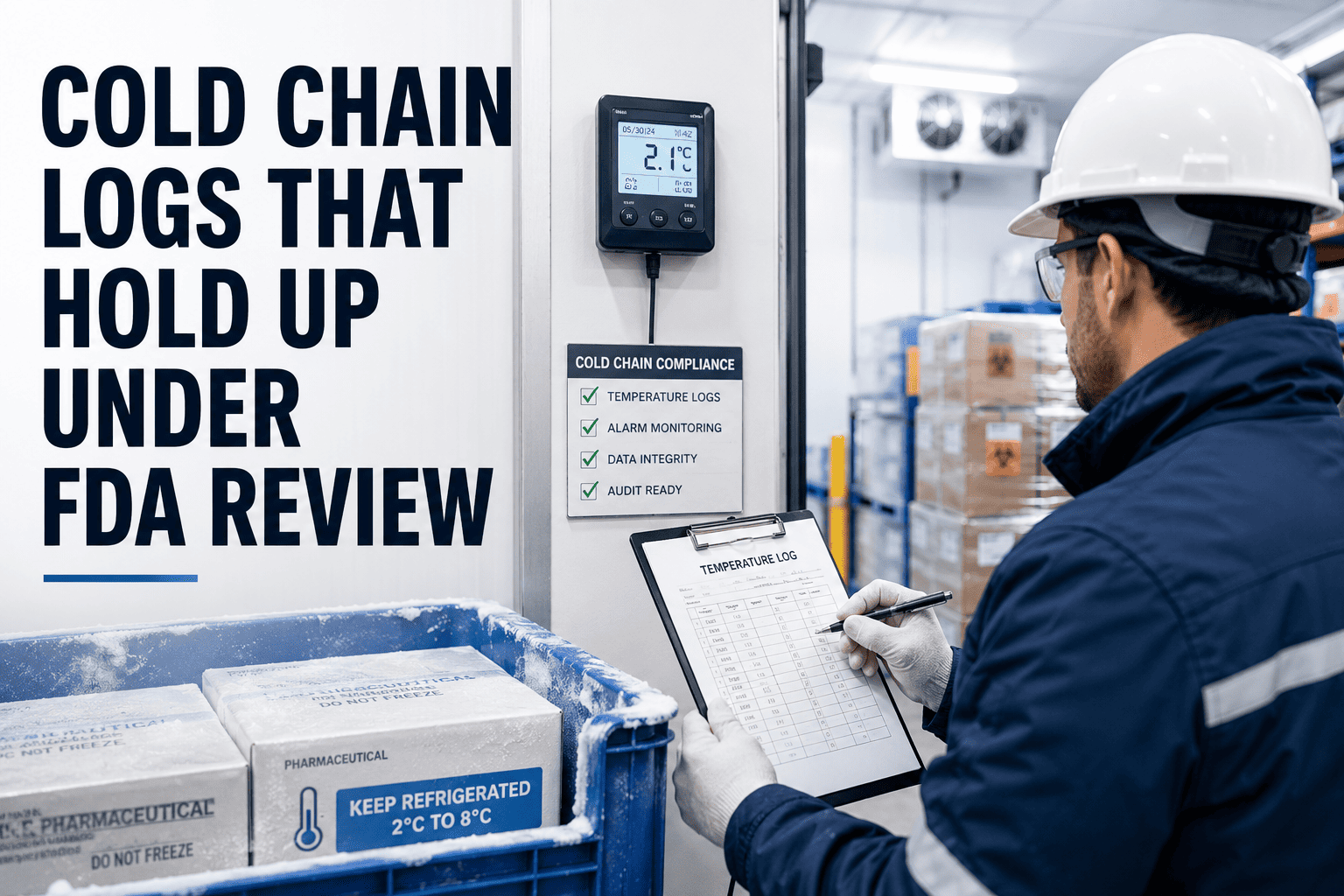
When FDA investigators request 12 months of cold chain records, the difference between a clean close-out and a Form 483 often comes down to whether your temperature logs are continuous, time-stamped, and reviewable within 24 hours. Paper charts and spreadsheet entries routinely fail modern FSMA review because gaps, initials, and corrective-action notes are difficult to reconstruct under audit pressure. A CMMS-driven cold chain documentation approach solves this by capturing every reading automatically, locking timestamps, and surfacing deviations the moment they happen. You can Start Free Trial to see exactly how audit-ready logs look before your next inspection.
Can your cold chain logs survive a 24-hour FDA record request?
FSMA traceability rules give investigators authority to review temperature records within 24 hours of a request. If your documentation lives in binders, clipboards, or disconnected spreadsheets, the clock is already working against you.
Five cold chain documentation gaps the FDA cites most
Roughly 60% of FDA cold chain citations trace back to record-keeping failures, not equipment failures. Here are the recurring gaps that turn a routine inspection into a written observation.
Missing or skipped readings
Manual logs show 30–40% of expected entries blank on weekends and shift changes. Investigators treat consecutive gaps as uncontrolled temperature exposure, not clerical error.
Round-stamped timestamps
When every reading carries an identical "2:00 PM" stamp across an 8-hour shift, reviewers assume backfilling. Continuous datalogger exports eliminate this suspicion instantly.
No deviation trend documentation
A single excursion is explainable. A pattern of micro-excursions over 90 days with no investigation note is a citation — investigators expect trend analysis, not just point-in-time checks.
Corrective actions with no follow-up
"Repositioned probe" written once, with no verification reading or sign-off, is the most common corrective-action defect. FDA reviewers want closed-loop evidence: action, verification, timestamp, operator.
Records that take days to assemble
If it takes three days to pull, scan, and organize a year of logs, you have already exceeded the 24-hour FSMA response window. The format itself is the failure.
What a defensible cold chain log actually contains
A CMMS-driven log satisfies four documentation pillars the FDA evaluates during every cold chain review. Each pillar below maps directly to a section of FSMA §204 and 21 CFR Part 11 expectations.
Continuous timestamp integrity
Automated readings every 5–15 minutes, each stamped with device ID, UTC and local time, and an uneditable hash. No human in the loop means no round-stamping, no backfilling, no gaps during shift change.
21 CFR Part 11 · §204.25Temperature trend documentation
Visual trend charts for any 90-day window, with excursions flagged in gold and investigation notes anchored to the exact reading that triggered them. Reviewers can see the full story in one view.
Trend Analysis · ISO 22000Closed-loop corrective action tracking
Every deviation auto-generates a work order with action taken, verification reading, operator sign-off, and close-out timestamp — all linked back to the originating log entry for one-click traceability.
CAPA · FSMA §204.3024-hour FDA review access
Filter any asset, date range, or deviation status and export a review-ready PDF in under 60 seconds. No scanning, no sorting, no reformatting — the system assembles the package the way investigators expect it.
FSMA Response · 24-hour SLAHow documentation approaches stack up under review
A regional cold storage operator with 42 monitored zones compared their existing paper-plus-spreadsheet process against a CMMS-driven log over a 90-day parallel run. The differences during a mock FDA audit were stark.
| Review Criterion | Paper + Spreadsheet | CMMS Cold Chain Log |
|---|---|---|
| Time to assemble 12 months of records | 3–5 business days | Under 60 seconds |
| Reading frequency | Every 2–4 hours, manual | Every 5–15 minutes, automated |
| Gap rate across shifts and weekends | 30–40% of entries missing | Effectively 0% (device-backed) |
| Timestamp integrity evidence | Operator initials only | UTC + local + device hash + chain of custody |
| Deviation trend visibility | Reconstructed manually after the fact | Live trend chart, excursion flags on entry |
| Corrective action traceability | One-line note, no verification | Closed-loop work order with sign-off and recheck |
| Mock audit result (42 zones, 90 days) | 11 simulated observations | 0 simulated observations |
A 180-asset cold chain, before and after CMMS
Consider a mid-size food distributor running 180 monitored cold chain points across three warehouses. Their annual documentation cost under paper-and-spreadsheet was $42,000 in labor, rework, and audit prep — before counting the cost of a single actual citation.
"The mock audit was the moment it clicked. Our QA lead pulled a full year of cold chain logs for 180 zones in under a minute. On paper, that would have been a week and three people. The FDA reviewer noticed the difference immediately."
Turn your next FDA review into a 60-second export
See how a CMMS cold chain log transforms 12 months of records into a single review-ready package — no scanning, no sorting, no scrambling.
FDA review questions, answered directly
What makes a cold chain log hold up under FDA review?
A defensible log is continuous, time-stamped automatically, deviation-tagged, and linked to closed-loop corrective actions. It must be exportable in a review-ready format within 24 hours. If reviewers can see the full temperature story — readings, trends, excursions, and responses — in one document, the log holds up.
How does a CMMS improve cold chain audit documentation?
A CMMS captures readings directly from monitoring devices, eliminates manual entry gaps, auto-generates work orders for excursions, and indexes everything by asset, date, and deviation status. You can Start Free Trial to test a 90-day mock audit against your current process before your next inspection.
What FSMA record requirements apply to cold chain logs?
FSMA §204 requires traceability records available within 24 hours of an FDA request, and 21 CFR Part 11 governs electronic record integrity. Together they demand time-stamped, tamper-evident, retrievable logs with audit trails — paper charts and spreadsheets rarely satisfy all three requirements simultaneously.
How long must cold chain temperature records be retained?
FSMA traceability records must be retained for two years, and many facilities keep them longer for liability protection. A CMMS stores digital logs indefinitely without physical storage costs, and any two-year window is filterable and exportable in under a minute.
Can a CMMS cold chain log replace paper charts entirely?
Yes — when the CMMS pulls readings directly from calibrated monitoring devices and maintains Part 11-compliant audit trails, the digital log is the record of record. Most facilities eliminate paper within 30–60 days of deployment. Book a Demo to see the migration path for your specific setup.
Your cold chain logs should be the strongest part of your next FDA review
Deploy a CMMS-driven documentation system that captures, trends, and exports every reading — built to satisfy FSMA and 21 CFR Part 11 from day one.
Free 14-day trial · No credit card