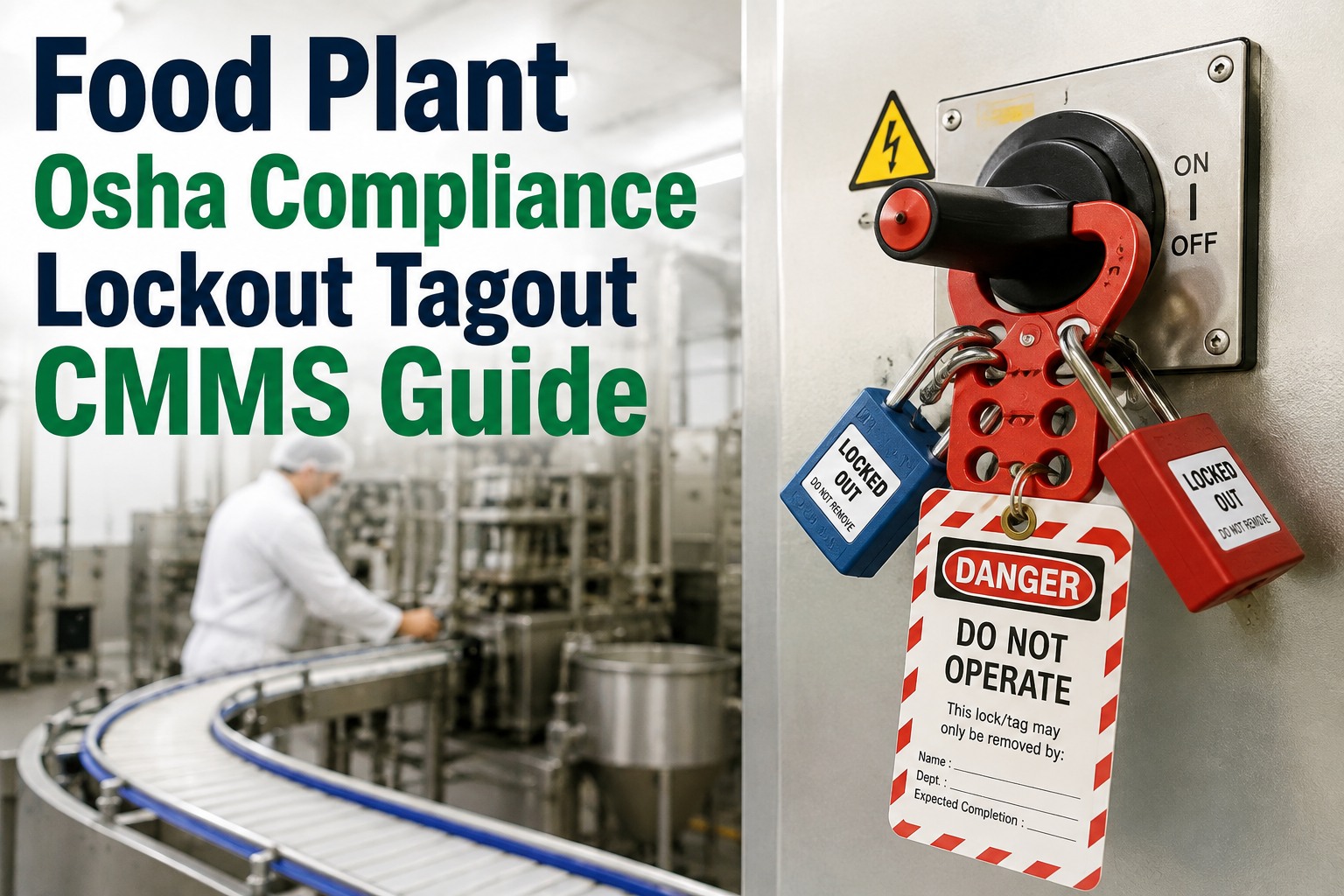
A poultry processing facility in Georgia had 180,000 pounds of anhydrous ammonia in its refrigeration system — legally requiring a full Process Safety Management programme under OSHA 29 CFR 1910.119. Their mechanical integrity inspection records were seven months behind schedule. Their leak detection calibration logs were missing for two systems. When OSHA arrived for a programmed inspection, the facility received three wilful citations with penalties exceeding $280,000. No leak had occurred. No employee had been injured. The violations were entirely documentation and programme management failures. OxMaint's compliance tracking module manages ammonia refrigeration PSM programmes — scheduling mechanical integrity inspections, tracking leak detector calibrations, and generating documentation that satisfies OSHA Process Safety Management requirements without a last-minute scramble. Ammonia refrigeration is one of the few maintenance domains where a paperwork failure carries the same penalty as an equipment failure. Book a demo to see how OxMaint manages your ammonia refrigeration compliance programme.
Compliance / Ammonia Refrigeration
Food Plant Ammonia Refrigeration System Maintenance and PSM Compliance
Ammonia refrigeration in food plants operates above 10,000 lb threshold quantities in most large facilities — triggering OSHA PSM and EPA RMP requirements. Mechanical integrity gaps are not just safety risks. They are regulatory exposure with five-figure penalties per violation.
10,000 lb
OSHA PSM threshold for anhydrous ammonia in food facilities
$280K+
Typical OSHA penalty exposure for PSM documentation failures
43%
Of PSM citations in food facilities relate to mechanical integrity gaps
18 mo
Typical inspection backlog at facilities without CMMS-driven PSM tracking
PSM Mechanical Integrity: What Food Plants Must Manage for Ammonia Systems
OSHA 1910.119 Mechanical Integrity requirements for covered process equipment create specific, non-negotiable documentation and inspection obligations. For ammonia refrigeration, these cover every pressure vessel, piping system, and safety device in the covered process.
01
Equipment Identification and Inspection Records
Every pressure vessel, heat exchanger, pump, and piping segment in the covered process must be individually identified with documented inspection history, acceptable limits, and qualified inspector records.
02
Inspection and Testing Frequency
Inspections must be performed at intervals consistent with applicable industry standards (IIAR 2, ASME, NBIC) and manufacturer recommendations. Deviations from standard intervals must be documented with technical justification.
03
Inspector Qualification Documentation
Inspectors must be trained and qualified. Training records must be maintained and accessible. OSHA inspectors will request qualification documentation during PSM audits — not having it is a citation.
04
Deficiency Correction Tracking
Equipment deficiencies identified during inspection must be corrected before further use or documented with an interim safety measure if immediate correction is not feasible. All corrections must be tracked to closure.
05
Quality Assurance for Replacement Parts
Replacement parts and materials must meet specifications appropriate for the covered process. Equipment used in ammonia service must meet applicable IIAR and ASME standards — and purchase records must reflect this.
06
Safety Device Inspection and Testing
Pressure relief valves, automatic shutoffs, emergency isolation valves, and leak detection devices are safety-critical items with specific test intervals. Skipping or delaying testing is a high-priority OSHA PSM finding.
Reactive vs. Compliant Ammonia Refrigeration Management
The gap between a facility that meets PSM Mechanical Integrity requirements and one that is exposed to citation is entirely programme management — not equipment reliability.
Reactive / Non-Compliant Approach
PSM-Compliant with CMMS
Inspection schedules maintained in spreadsheets; intervals tracked manually
Each pressure vessel and safety device has its own PM schedule in OxMaint; overdue items flagged automatically
Leak detector calibration dates tracked on paper in the machine room
Calibration intervals set per sensor type; work orders auto-generated at interval threshold
Deficiency records kept in inspection notebooks — not linked to corrective actions
Every deficiency generates a corrective action work order; closure tracked with technician sign-off
Relief valve test records in three different filing systems, some missing
All PRV test records stored in OxMaint with valve tag, test date, result, and inspector ID
PSM documentation assembled before audit — often incomplete
Audit-ready package generated in under 5 minutes with full inspection history by equipment ID
Replacement parts procurement not linked to equipment specifications
Parts linked to asset records with specification data; purchase orders tied to approved materials list
Ammonia Refrigeration Maintenance Schedule — Food Plant Reference
| Component / System |
Task |
Interval |
Standard Reference |
CMMS Tracking |
| Ammonia leak detectors |
Calibration verification |
Every 6 months |
IIAR 2 / OSHA PSM MI |
Calendar PM work order |
| Pressure relief valves |
Test and replace or certify |
Every 5 years (IIAR standard) |
IIAR 2, ASME Section VIII |
Calendar PM / equipment register |
| Pressure vessels |
External visual inspection |
Annually |
NBIC / OSHA PSM MI |
Annual PM work order with inspector record |
| Pressure vessels |
Internal inspection |
Per NBIC / risk-based |
NBIC NB-23 |
Equipment register with interval tracking |
| Evaporative condensers |
Basin cleaning, nozzle and fill inspection |
Semi-annually |
IIAR 2 / ASHRAE 188 |
Calendar PM work order |
| Refrigerant pumps |
Seal, bearing, and alignment check |
Quarterly |
Manufacturer / IIAR 2 |
Calendar PM work order |
| Oil separators and oil pots |
Oil change and level check |
Per manufacturer / oil analysis |
IIAR 2 / compressor OEM |
Oil analysis PM trigger |
| Emergency isolation valves |
Operational test |
Annually |
OSHA PSM MI / IIAR 2 |
Annual compliance work order |
How OxMaint Manages Ammonia Refrigeration PSM Compliance
OxMaint structures ammonia refrigeration maintenance the way PSM requires it — by individual equipment item, with qualified-person attribution, deficiency tracking to closure, and documentation that is always current, not assembled at audit time.
1
Covered Process Equipment Registry
Every pressure vessel, heat exchanger, pump, PRV, and safety device in the covered process registered individually — with equipment ID, tag number, location, installation date, applicable standard, and maximum allowable working pressure.
2
Inspection Schedule Per Equipment Item
Inspection intervals set individually per equipment type and applicable standard (IIAR, NBIC, ASME). OxMaint auto-generates MI inspection work orders at interval, with the required inspection checklist attached and inspector qualification linked.
3
Deficiency Capture and Corrective Action
Inspection findings log directly into the work order. Any deficiency automatically generates a linked corrective action work order — assigned, tracked to completion, and linked to the original inspection record for OSHA documentation.
4
Leak Detector and Safety Device Tracking
Ammonia leak detectors and safety devices have their own PM schedules with calibration certificates, test results, and next-due dates tracked separately from routine maintenance. Overdue items escalate automatically to the compliance manager.
5
Audit Package Generation
When OSHA or EPA arrives, OxMaint generates a complete mechanical integrity package — equipment list, inspection history by asset, deficiency log with corrective action closure, inspector qualification records, and PRV test certificates — in under five minutes.
PSM Compliance Impact: Results from Ammonia Refrigeration Operations
100%
MI Inspection Compliance
Facilities with CMMS-driven PSM programmes maintain no overdue mandatory inspections
92%
Reduction in PSM Citations
Mechanical integrity citation rate drops 92% when inspection records are CMMS-tracked
5 min
Audit Package Time
OxMaint generates complete OSHA PSM documentation packages in under five minutes
38%
Lower Ammonia Leak Frequency
Proactive valve and seal maintenance reduces uncontrolled release incidents
Frequently Asked Questions
How does OxMaint track PSM Mechanical Integrity inspections for ammonia pressure vessels?
Each pressure vessel in the covered process is registered as an individual asset in OxMaint with its unique tag number, applicable inspection standard (NBIC, ASME), rated MAWP, installation date, and last inspection record. Inspection intervals are configured per vessel type and applicable standard. OxMaint auto-generates inspection work orders at the required interval, links the appropriate inspection checklist, and escalates overdue items to the compliance manager. Every completed inspection is stored with inspector ID, completion date, findings, and digital signature.
Start a free trial to build your PSM equipment registry.
Does OxMaint support EPA Risk Management Plan requirements for ammonia refrigeration?
OxMaint supports the prevention programme documentation requirements of EPA RMP through structured inspection records, process hazard analysis tracking, and incident/near-miss logging. Facilities subject to RMP Program 2 or Program 3 can use OxMaint to maintain the maintenance schedule, inspection records, and accident history documentation required under 40 CFR Part 68.
Book a demo to walk through the RMP documentation workflow.
How should ammonia leak detector calibration be managed to meet PSM requirements?
Ammonia leak detectors are individual safety-critical devices requiring calibration at intervals consistent with manufacturer specifications and IIAR 2 recommendations — typically every 6 months or per manufacturer. In OxMaint, each detector is registered as an asset with its location, sensor type, and calibration interval. A PM work order is auto-generated at the calibration due date. Completion records include the calibration technician, gas standard used, before/after readings, pass/fail result, and calibration certificate upload.
Can OxMaint manage the relief valve inspection and replacement tracking required by IIAR?
Each pressure relief valve is registered in OxMaint with its tag number, set pressure, installation date, and 5-year IIAR inspection/replacement interval. The platform auto-generates PRV inspection work orders 60 days before due date — giving facilities time to procure replacement valves or schedule a certified testing company. Test certificates and replacement records are stored against the specific valve tag, creating the longitudinal PRV history that OSHA PSM auditors request by tag number during inspections.
Build Your Ammonia PSM Compliance Programme
One OSHA PSM Inspection Should Not Cost More Than Your Maintenance Budget. OxMaint Makes Sure It Never Does.
OxMaint manages your covered process equipment registry, automates MI inspection schedules per IIAR and NBIC requirements, tracks leak detector calibrations, links deficiencies to corrective actions, and generates complete OSHA PSM and EPA RMP documentation packages on demand — so your ammonia refrigeration programme is compliant every day, not just on audit day.