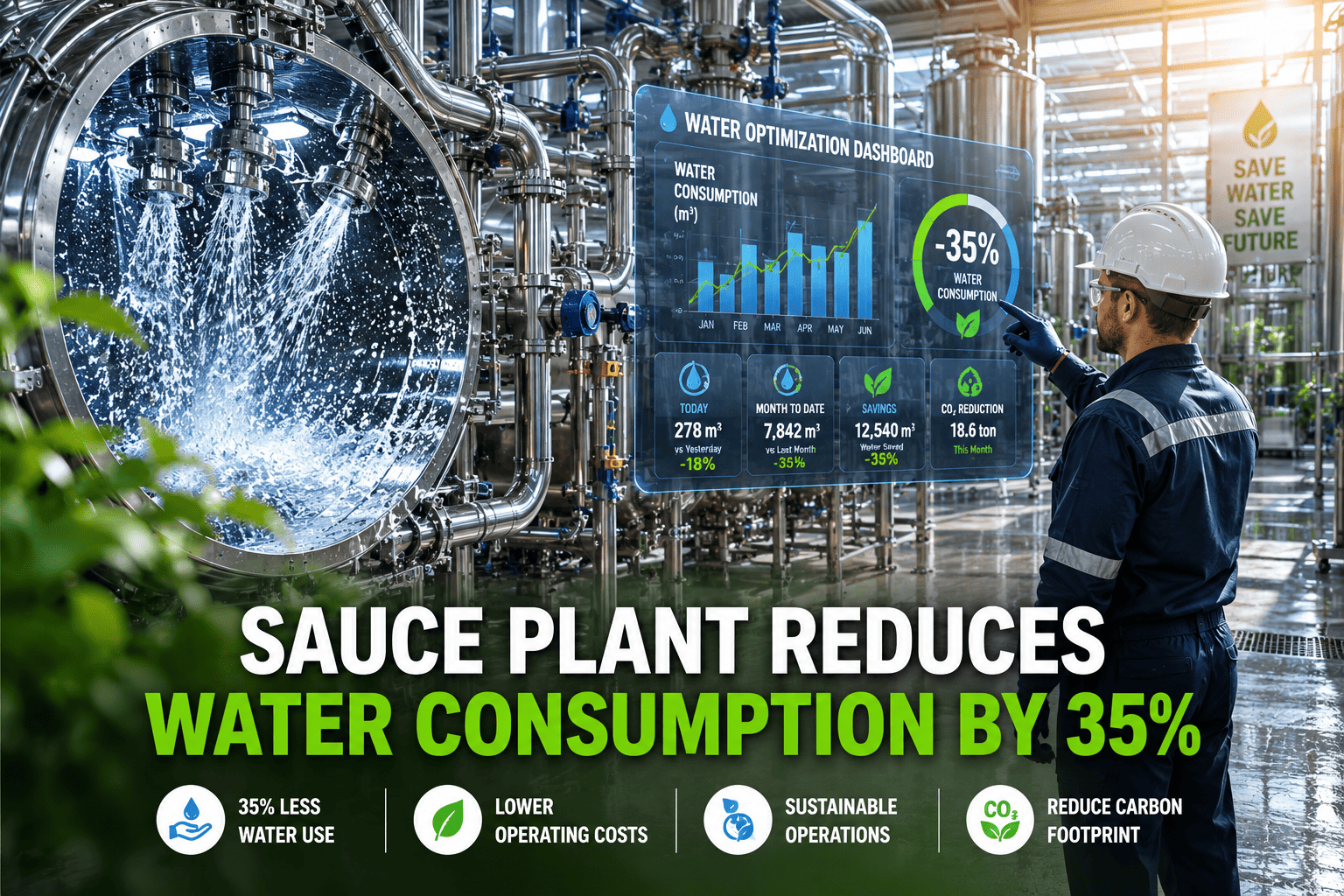
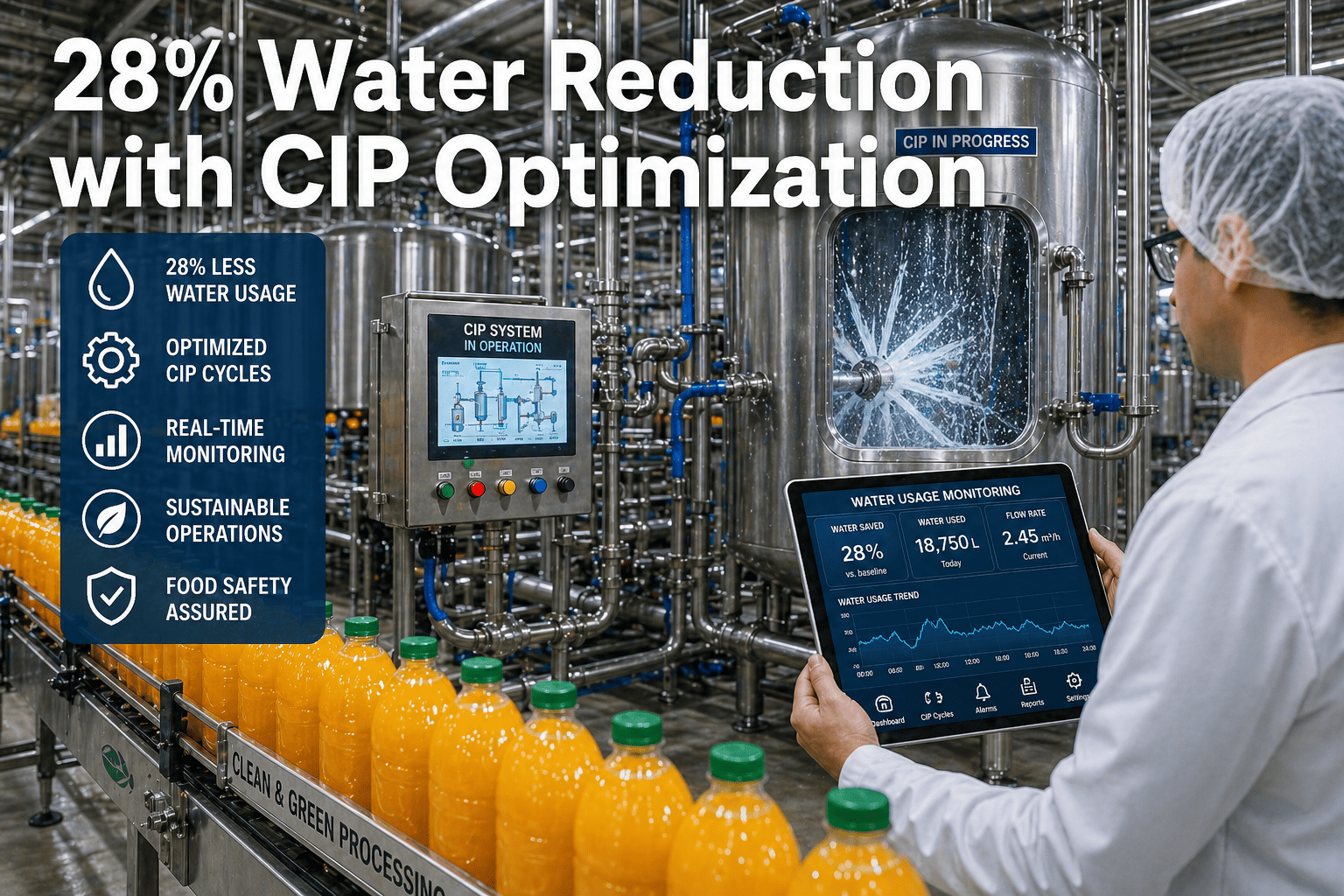
Sauce Plant Cuts Water Consumption by 35% with CIP Optimization
By Josh Turley on May 27, 2026
Sauce and condiment manufacturing is one of the most water-intensive food categories — a single ketchup or barbecue sauce plant can run 220-340 Clean-in-Place cycles per week across batch tanks, fillers, homogenizers, viscous-product transfer lines, and flavor changeover hoses. Each CIP cycle uses 800-2,400 liters of municipal water, and combined annual consumption at a mid-size facility routinely exceeds 75 million liters — most of it billed at industrial rates with sewage surcharges layered on top. For a multi-product sauce producer running 6 batch tanks and 4 high-speed filler lines across condiments, dressings, and specialty sauces, water represented the single fastest-growing utility cost on the P&L. After 9 months on OxMaint's CIP optimization platform, total water consumption dropped 35%, chemical spend dropped 28%, and the plant earned its first ESG sustainability badge from its largest retail customer. This case study walks through the baseline, the cycle-by-cycle protocol redesign, the sensor architecture that made it auditable, and how to apply the same framework with OxMaint CMMS.
SAUCE & CONDIMENT PLANT · CIP OPTIMIZATION · ESG CASE STUDY
Sauce and Condiment Plant Reduces Water Consumption by 35% with CIP Optimization
A multi-product sauce manufacturer running 6 batch tanks and 4 filler lines cut total water consumption by 35%, chemical spend by 28%, and earned its first ESG sustainability badge — using OxMaint's CIP cycle protocol engine and real-time water sensor integration.
How OxMaint Optimizes Every CIP Cycle — The Water Flow
A standard CIP cycle in sauce production runs five sequential stages, each consuming water in a defined pattern. OxMaint instruments every stage with sensor data and applies cycle-by-cycle optimization rules — recovering water at every step without compromising food safety or sanitation verification. Start a free trial to see the same flow on your batch tanks and fillers.
STAGE 01
Pre-Rinse
Before
560L
After
340L
Saves 220L
Recovered rinse water from previous cycle now reused for pre-rinse — sensor confirms turbidity within tolerance.
STAGE 02
Caustic Wash
Before
420L
After
300L
Saves 120L
Caustic solution recovered and reused across cycles. Conductivity sensor confirms strength before each cycle reuse.
STAGE 03
Intermediate Rinse
Before
380L
After
240L
Saves 140L
Sensor-triggered endpoint — rinse stops the moment conductivity returns to baseline rather than running fixed duration.
STAGE 04
Acid Wash
Before
320L
After
220L
Saves 100L
Acid solution reused like caustic — pH sensor verifies acid strength before each cycle. Tomato and vinegar residue management improved.
STAGE 05
Final Rinse
Before
480L
After
340L
Saves 140L
ATP swab confirms sanitation pass — final rinse endpoint set by sensor data, not fixed duration. Cycle closes with full audit log.
STAGE 06
Sanitizer Application
Before
240L
After
160L
Saves 80L
Sanitizer concentration sensor confirms dosing accuracy — eliminating overdose cycles that previously triggered extra final rinses.
PER-CYCLE WATER SAVING
800 liters
Multiplied by 280 weekly cycles = 224,000 liters saved per week, 11.6 million liters saved per year.
The Waste Layer OxMaint Made Visible
Most sauce plants run CIP cycles on time-based recipes inherited from equipment vendor manuals — protocols designed for guaranteed safety, not water efficiency. OxMaint exposes the gap between fixed-duration protocols and sensor-verified actual endpoints. Book a demo to see the waste audit applied to your plant — most operators are surprised at the visible savings.
Before OxMaint — Time-Based CIP
Rinse cycles ran for fixed duration regardless of when conductivity actually returned to baseline.
Caustic and acid solutions discharged to drain after every cycle instead of being recovered and reused.
No water meter visibility per cycle — total plant water bill rose 11% annually with no root-cause data.
Operators padded cycle times by 8-15% out of caution — protecting food safety with extra water cost.
Sewage surcharges spiked monthly with no link back to which line, tank, or product caused the excursion.
After OxMaint — Sensor-Verified CIP
Conductivity, turbidity, and pH sensors define exact cycle endpoints — rinses stop the moment they have done their job.
Caustic and acid solutions recovered to dedicated tanks and reused for 4-6 cycles before discharge.
Per-cycle water meter data feeds OxMaint dashboards — visible by line, tank, product, and operator shift.
Cycle duration set by sensor verification — eliminates operator padding while raising sanitation evidence quality.
Sewage discharge volume tied directly to cycle records — every utility excursion traceable to its source within minutes.
Run Sensor-Verified CIP on Your Sauce Plant
OxMaint instruments every CIP cycle — conductivity, turbidity, pH, ATP — and replaces fixed time-based protocols with sensor-defined endpoints that cut water, chemical, and sewage costs without compromising food safety.
The 6 OxMaint Levers That Delivered the 35% Reduction
The 35% water reduction did not come from a single optimization — it came from six concurrent levers running inside OxMaint, each contributing measurable savings. Removing any one of them would have dropped the total reduction below 25%.
01
Conductivity-Defined Rinse Endpoints
Contributes ~12% of total reduction
Inline conductivity sensors at drain points trigger rinse cycle termination the instant water returns to baseline — eliminating 6-12 minutes of unnecessary flow per cycle across pre-rinse, intermediate, and final stages.
02
Caustic and Acid Recovery
Contributes ~8% of total reduction
Cleaning solutions recovered to dedicated holding tanks and verified for strength via conductivity and pH sensors. Reused across 4-6 cycles before final discharge — cutting both water and chemical spend simultaneously.
03
Rinse Water Reuse Loop
Contributes ~7% of total reduction
Final rinse water from completed cycles captured and reused as pre-rinse on the next cycle — sensor confirms turbidity within tolerance before reuse, maintaining sanitation evidence quality.
04
Product-Specific Protocol Library
Contributes ~4% of total reduction
Ketchup, mustard, mayo, BBQ sauce, and salad dressing each have a tailored protocol based on viscosity and residue characteristics — no more one-size-fits-all cycles wasting water on lighter products.
05
Allergen-Aware Cycle Depth
Contributes ~2% of total reduction
Allergen matrix runs the transition automatically. Non-allergen-bearing transitions use shorter sanitation cycles; cross-allergen transitions still get full protocol depth — no blanket overkill.
06
Continuous Performance Tracking
Contributes ~2% of total reduction
Weekly water-per-cycle dashboards surface the worst-performing tank, line, and product. Plant team targets the bottom 10% each week — locking gains in and preventing protocol drift over time.
ESG and Sustainability Outcome
The water reduction story extends beyond utility cost. Sauce and condiment producers are under retailer pressure to deliver verified ESG metrics — and the largest retailers now require auditable per-unit water consumption data tied to specific products. OxMaint's ESG export feature generates that data automatically from CIP records, retiring spreadsheets and binders that previously consumed weeks of staff time per audit.
11.6M
Liters of municipal water saved per year
$1.2M
Total annual savings water + chemicals + sewage
28%
Reduction in caustic, acid, and sanitizer spend
First
ESG sustainability badge from largest retailer
We knew our CIP cycles were over-built for safety. We did not realize they were over-built by a third. OxMaint gave us the sensor data and the protocol engine to fix it without our food safety director losing sleep — and the ESG win came as a bonus we did not even target initially.
Director of Operations · Multi-Product Sauce & Condiment Manufacturer · 2025
Frequently Asked Questions — OxMaint CIP Optimization for Sauce and Condiment Plants
How does OxMaint reduce CIP water consumption without compromising food safety?
OxMaint replaces fixed-duration cycle protocols with sensor-verified endpoints. Inline conductivity, turbidity, pH, and ATP sensors confirm sanitation is complete before terminating each cycle — protecting food safety while eliminating the operator padding and over-built timing that wasted water in legacy time-based protocols.
Can OxMaint integrate with our existing CIP skid PLCs?
Yes. OxMaint integrates with major CIP skid PLCs and plant SCADA platforms via OPC and API connections. Conductivity, pH, temperature, and flow data stream directly from the skid into asset condition records and trigger cycle endpoint decisions in real time without operator intervention.
Does OxMaint support caustic and acid solution recovery workflows?
Yes. OxMaint manages dedicated recovery tank records, tracks solution strength via conductivity and pH sensors, and blocks cycle initiation if recovered solution fails strength verification. Solutions typically run 4-6 reuse cycles before discharge, cutting chemical spend 25-30% and reducing sewage discharge volume significantly.
Can OxMaint generate retailer-required ESG and sustainability evidence?
Yes. OxMaint exports auditable per-unit water consumption, per-product chemical spend, and per-cycle sewage discharge data tied directly to production records — meeting the verified ESG metrics that major retailers now require from food and beverage suppliers for sustainability scoring.
How long does it take to deploy OxMaint CIP optimization at a sauce plant?
Most sauce and condiment plants are live in days, not months. Baseline data collection runs for the first 4 weeks while existing protocols continue unchanged. Sensor-verified protocols then phase in line-by-line, with full plant rollout typically achieved in 8-12 weeks with no heavy implementation overhead.
What ROI should we expect from OxMaint CIP water optimization?
On a multi-product sauce plant with 6 batch tanks and 4 filler lines, the deployment delivered 35% water reduction, 28% chemical spend reduction, 22% cycle time reduction, and $1.2M in total annual savings — typically 8-15× platform cost in Year One, with ongoing recurring savings every subsequent year.
Cut Water Consumption by 35% on Your Sauce or Condiment Plant
Start running sensor-verified CIP protocols with OxMaint — free trial, no card required, live in days, not months. Deliver auditable ESG metrics your retailers actually accept.