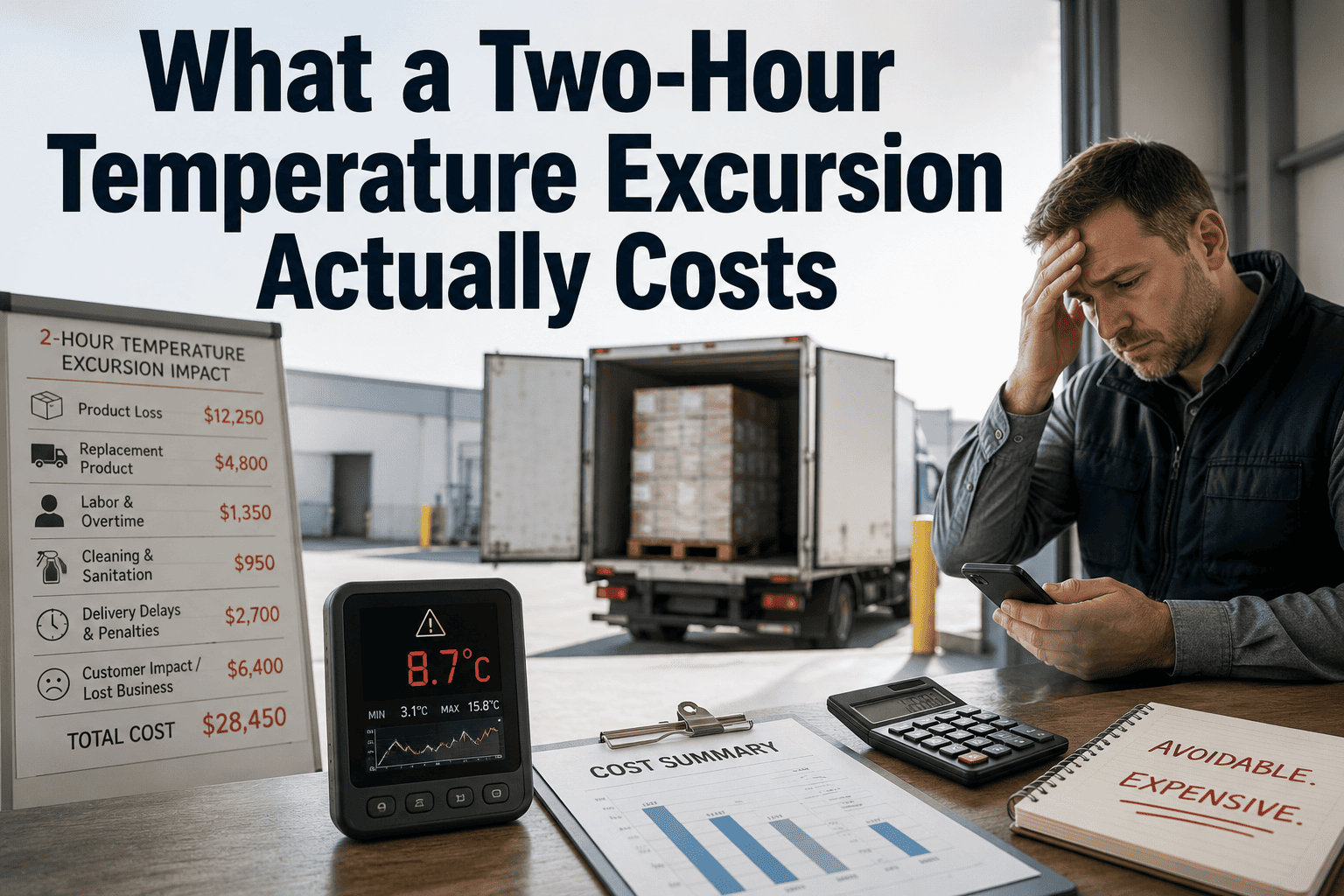
A two-hour temperature excursion on a fully loaded trailer of finished frozen product can quietly erase six figures from a food plant's quarterly margin — and the loss rarely shows up as a single line item. Product condemnation, disposition labor, recall exposure, regulatory documentation, and the brand-cost of a single social-media photo of thawed pallets all compound into one number that finance teams underestimate and operations teams feel too late. Building a defensible excursion cost model turns cold chain reliability from a "nice-to-have" maintenance program into a board-approved capital request with measurable ROI. This guide breaks down the real dollars, the formula behind them, and how a modern CMMS like Oxmaint turns that math into investment-grade justification.
A 2-hour excursion can cost more than the trailer, the dock door, and the monitoring system combined.
One delayed reefer alarm. One failed dock seal. One maintenance ticket marked "low priority." Multiply by a full trailer of frozen SKU at $0.85/unit and the financial impact moves from a maintenance problem to a CFO problem — fast. This guide gives plant teams the calculator that makes every cold chain upgrade defensible.
One Friday-night dock seal failure, modeled end-to-end
A Midwest frozen-meals plant loads a 53-foot reefer at 4:47 PM Friday with 1,850 cases of finished SKU at a landed cost of $28.40 per case. The dock seal has been flagged in the CMMS as "minor air leak — schedule." At 6:12 PM the reefer's return-air sensor hits 18°F. The trailer is logged but not inspected until Monday morning at 7:00 AM. Here is what those 2 hours actually cost.
1,850 cases × $28.40 landed = $52,540 in direct product value. Because the trailer never re-established −10°F core temperature and held above 10°F for over 6 hours, the entire load is condemned under the plant's HACCP critical-limit policy. One hundred percent of the trailer's value is written off.
Reefer reefer wash-out, denaturing, renderer pickup, and documented destruction per 21 CFR 117. The plant's contracted renderer charges $0.14/lb on 44,400 lb of condemned product, plus a $380 witnessed-destruction fee and $640 in internal QA labor for the deviation report.
A reportable deviation under FSMA preventive controls requires a corrective-action record, root-cause analysis, and verification of the dock-seal repair. Internal estimate: 14 hours of QA + maintenance supervisor time at a blended $74/hr, plus $900 in third-party lab hold-and-test on adjacent lots.
To protect the customer's DC fill rate, the plant runs a Saturday OT production line ($4,200 in premium labor) and books a spot-rate reefer from a broker at $3,850 — $2,100 above contract. Late-delivery penalty from the retailer: $1,500.
Before any recall, brand, or customer-churn cost is layered in, the hard-dollar impact of one Friday-night dock-seal failure on one trailer lands at $71,248. Three such events per year — a conservative figure for a mid-size frozen plant — is $213,744.
The excursion cost equation every plant should run quarterly
Most plants track downtime hours but never convert excursion events into dollars. The formula below is the one Oxmaint bakes into its CMMS cost-of-failure dashboard so maintenance directors can walk into a budget meeting with one number.
Where the $50K–$500K range actually comes from
Two excursions of identical duration can produce a 10× difference in total cost. The variables below — drawn from FSMA preventive-controls audits and reefer-telematics claims data — explain the spread and tell you which lever to pull first.
A trailer of $0.40 frozen vegetables condemns at ~$8K. A trailer of $6.80 premium seafood entrées condemns at ~$135K. The same 2-hour event, sixteen times the cost.
Every 15 minutes above the critical limit roughly doubles the condemned-volume percentage. A 15-minute CMMS-triggered response holds loss to 20%; a 4-hour blind window often means 100% condemnation.
A full 53-ft reefer at 44,000 lb exposes 4× the product of a half-load. Loading schedules that consolidate full trailers concentrate risk — and concentrate savings when reliability improves.
Big-box retailer supply agreements carry $1,500–$7,500 per late or rejected load, plus chargebacks for reefer-setpoint logs that can't be produced on demand. Three rejected loads can trigger a 90-day review.
A single photo of condensation on a thawed pallet, posted to a consumer platform, has driven measurable 3-month sales dips in two of the last five frozen-food recall events tracked by FDA. B is the term plants most often set to zero — and most often regret.
Cargo and recall insurance typically covers P × V but not D, R, or E — and only B if a formal recall is declared. Plants that rely on "insurance will cover it" routinely recover under 35% of true cost.
What a CMMS investment returns in year one
The table below models a 180-asset frozen plant currently absorbing 3 excursion events per year at a blended $71K each. Column two shows the same plant after a 6-month Oxmaint CMMS rollout with automated reefer monitoring, dock-door PM scheduling, and mobile deviation-response workflows.
| Cost & reliability metric | Before CMMS | With Oxmaint CMMS | Annual savings |
|---|---|---|---|
| Excursion events per year | 3 | 0.4 | 2.6 events avoided |
| Direct product condemnation | $157,620 | $21,016 | $136,604 |
| Disposition & regulatory labor | $27,474 | $3,663 | $23,811 |
| Expedited remake & freight | $28,650 | $3,820 | $24,830 |
| Mean detection-to-response time | 47 min | 6 min | 87% faster |
| Dock-seal PM compliance | 61% | 98% | +37 pts |
| Total annual cold-chain loss | $213,744 | $28,499 | $185,245 |
| Oxmaint CMMS annual subscription | — | $16,800 | 11.0× ROI |
We had three excursions in 2024 that we know about. After wiring reefer alarms into Oxmaint and auto-creating work orders on a 5°F drift, we went 11 months without a single condemned load. The CMMS paid for itself in the first quarter.
Stop guessing what an excursion costs. Start logging it.
Every minute without CMMS-tracked cold chain monitoring is a trailer you're self-insuring. Deploy Oxmaint in under 14 days and turn your next budget cycle into the one that finally funds reliability.
Excursion cost and CMMS — what plant teams ask first
Most frozen-food plants are live in 10–14 days. Oxmaint imports your asset register, PM schedules, and reefer alarm thresholds on day one; dock-door sensors and telematics integrations typically follow within the first week. You can begin logging excursion events and calculating cost-of-failure in your first full reporting cycle — start a free trial and run the numbers on your own data.
Yes. The TEC formula — product value, disposition, regulatory, expedited remake, and brand — applies identically to chilled and refrigerated loads. The critical-limit temperature and the time-to-condemnation curve differ, but the financial structure is the same. Oxmaint lets you configure per-SKU critical limits so the cost model respects each product's actual HACCP thresholds.
Detection-to-response latency. Cutting the window from a 47-minute blind period to a 6-minute CMMS-triggered response typically reduces condemned-volume percentage from near-100% to under 25% — which is why automated reefer-alarm-to-work-order workflows deliver more ROI than any single hardware upgrade. Book a demo and we'll model your current latency against the CMMS-driven benchmark.
Every excursion event auto-generates a deviation record with timestamped sensor data, the work order triggered, corrective actions taken, and a CAPA link. The record is exportable in the format FDA and third-party auditors expect, which is what collapses regulatory labor (the R term in the formula) from 14 hours to under 4.
It's realistic across the board. A single reefer of mid-value frozen SKU at a 40,000-lb load lands near $50K; premium seafood or ready-meal SKUs routinely push a full trailer past $250K, and multi-trailer events or retailer chargebacks reach the top of the range. Small plants feel the percentage impact on margin even more sharply than enterprise operations do.
Make the next one a near-miss, not a six-figure write-off.
Deploy Oxmaint CMMS, wire your reefer alarms into automated work orders, and turn cold chain reliability into the line item your CFO approves.
Free 14-day trial · No credit card