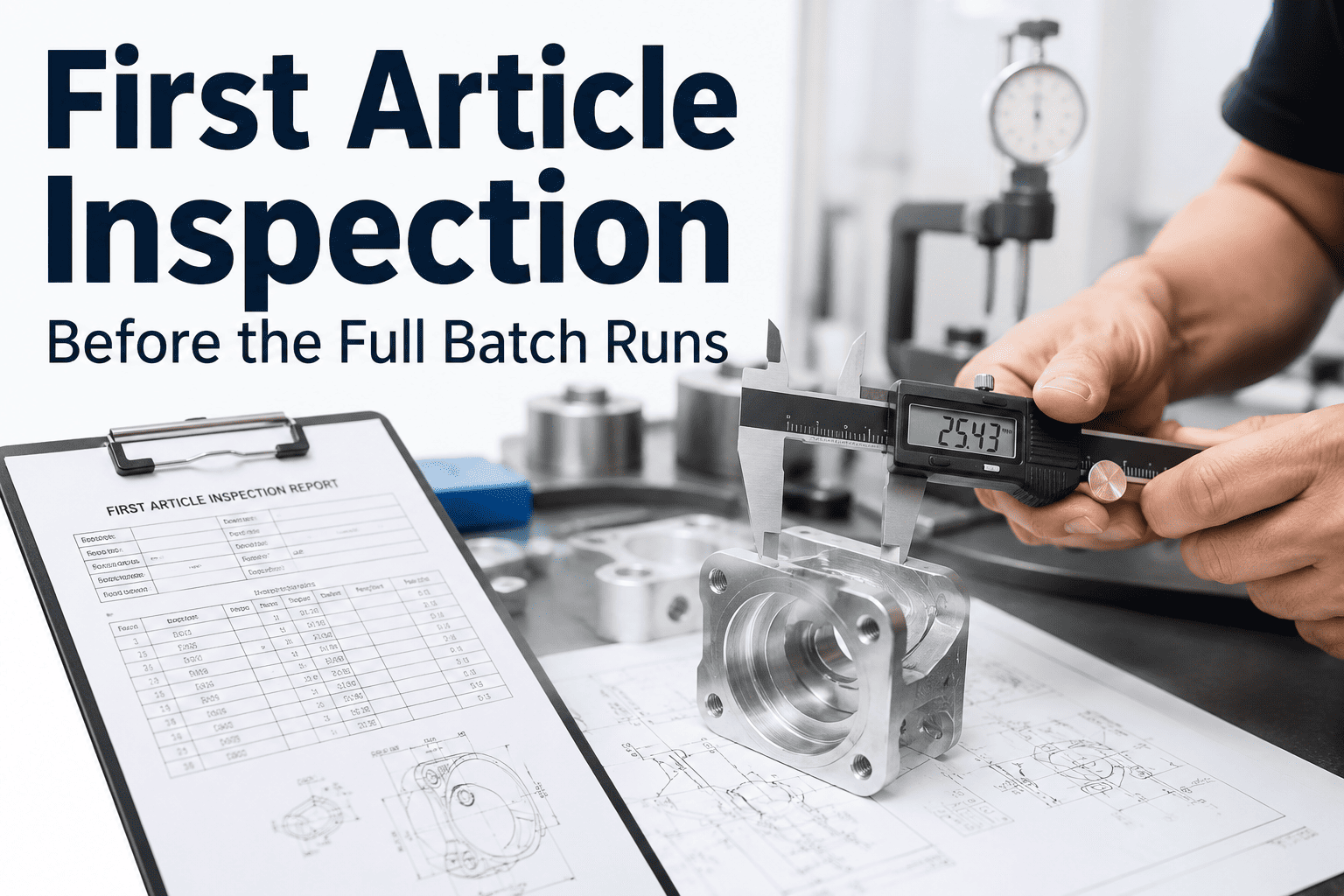
First article inspection before the full batch runs is one of the highest-leverage quality gates on any food and beverage line, catching fill-weight deviations, misapplied labels, and allergen errors before they become multi-thousand-dollar recalls. This food plant first article inspection guide breaks down how maintenance and reliability teams can structure batch CMMS sign-offs, mobile verification workflows, and deviation handling to make startup inspections a documented, defensible process rather than a paper exercise. By pairing fill weight verification and label accuracy checks with a digital CMMS food first article batch workflow, manufacturers reduce unplanned downtime, eliminate manual logbooks, and prove compliance during unannounced audits. Ready to replace clipboard inspections with a connected system? Start Free Trial and digitize your first article sign-off in under a day.
What if your next batch start-up never produced a single defective unit?
A structured first article inspection before the full batch runs catches 90% of fill-weight, label, and allergen errors in the first 15 minutes of production. OxMaint turns that gate into a mobile, CMMS-driven sign-off — no paper, no missed deviations, no audit panic.
The 4-Phase First Article Batch Guide for Food Plants
A defensible first article inspection (FAI) in a food plant requires verifying equipment readiness, product attributes, and packaging integrity before releasing the full batch. Each phase below maps directly to a CMMS food first article inspection checkpoint.
Equipment & Line Clearance Verification
- Confirm previous batch teardown and sanitation log signed off in CMMS
- Verify filler calibration, scale validation, and metal detector challenge test
- Check preventive maintenance completion on critical assets (filler, capper, sealer)
Product Attribute & Fill Weight Check
- Pull 5-10 consecutive samples from the start of the production run
- Record fill weights against CSA/ISO 9001 tolerance limits (e.g., ±2% target weight)
- Verify pH, viscosity, or Brix readings against the batch recipe specification
Label, Code Date & Packaging Accuracy
- Cross-check ingredient list and allergen declarations against the approved master
- Validate lot code, expiration date, and shift code imprint legibility
- Confirm seal integrity, torque on caps, and case pack configuration
Quality Sign-Off & Batch Release
- Operator and QA supervisor electronically sign the first article CMMS record
- Attach deviation notes, photos, or corrective actions if tolerance was breached
- Trigger full batch run in CMMS only after all digital sign-offs are green
How a Batch CMMS Sign-Off Works in OxMaint
Moving from a paper first article checklist to a CMMS-driven workflow eliminates missed steps, lost forms, and "pencil-whipped" approvals. Here is the step-by-step sequence maintenance and quality teams follow during batch start-up.
Generate FAI Work Order
The CMMS auto-generates a first article inspection work order tied to the scheduled batch, pre-loading the correct product spec, fill-weight tolerances, and equipment PM status.
Conduct Mobile Inspection
Operators complete the FAI checklist on a rugged tablet or phone at the line, capturing fill weights, label photos, and seal tests directly into the work order — no clipboards, no transcription.
System Validates Tolerances
OxMaint checks each entry against the master recipe in real time, flagging any fill-weight or label deviation in red and blocking progression until a corrective action is logged.
Digital Sign-Off & Batch Run
QA and operations supervisors e-sign the completed FAI. The CMMS records a timestamped, audit-ready record and unlocks the full batch run on the line.
Why Paper FAI Checklists Cost Food Plants More Than They Think
A single missed fill-weight deviation on a 10,000-unit batch can trigger a $50K+ rework or recall event. Compare what happens when food plants rely on paper versus a CMMS food first article batch system.
| Inspection Factor | Paper Checklist | OxMaint CMMS FAI |
|---|---|---|
| Time to complete FAI | 25-40 minutes (manual logging) | 8-12 minutes (mobile entry) |
| Deviation visibility | Discovered after batch runs | Flagged in real-time, blocks release |
| Audit traceability | Boxes of logbooks, missing pages | Digital, timestamped, instantly searchable |
| Equipment readiness link | Disconnected from PM records | PM status auto-checked before FAI |
| Cost of a missed deviation | $50K - $250K (rework or recall) | Caught at first article — near zero |
A 180-asset prepared-foods plant spending $42K/yr on paper-based QA logbooks and rework labor switched to OxMaint's first article CMMS workflow. Within 90 days, the team cut average batch start-up time by 34%, eliminated 3 recurring label-mixup errors per month, and passed a third-party SQF audit with zero nonconformances — all because the FAI record was digital, timestamped, and linked directly to preventive maintenance history.
From Clipboard to Connected: OxMaint for First Article Inspection
OxMaint is an AI-powered CMMS and EAM platform that turns first article inspection into a structured, mobile, and audit-ready quality gate. Here is how specific capabilities map to your batch start-up problems.
Mobile FAI Work Orders
Generate and complete first article checklists on any tablet or phone at the line. Eliminate paper forms, cut inspection time by up to 60%, and capture fill-weight data and label photos in real time.
Outcome: 60% faster batch sign-offTolerance Validation Engine
OxMaint checks every fill weight, label code, and seal measurement against the master recipe. Deviations are flagged instantly and the system blocks batch release until corrective action is logged.
Outcome: 95% fewer start-up defectsAudit-Ready Digital Records
Every FAI is timestamped, e-signed, and linked to the asset and PM history. Pull a complete, defensible first article record for any batch in seconds — ready for SQF, BRC, or FDA inspections.
Outcome: Zero audit nonconformancesStop betting your batch on a clipboard.
See how OxMaint digitizes your food plant first article inspection, links it to equipment readiness, and makes every sign-off audit-proof. Book a 30-minute demo on your assets today.
First Article Inspection in Food Plants: Common Questions
What is a first article inspection in a food production plant?
A first article inspection (FAI) is a documented quality check performed at the start of a production batch, verifying that fill weights, labels, allergen declarations, and equipment settings meet specification before the full batch runs. It is the single most effective gate for catching setup errors before they scale into thousands of defective units.
How does a CMMS improve first article batch sign-off?
A CMMS like OxMaint replaces paper checklists with mobile work orders, auto-validates fill weights and label data against the master recipe, and blocks batch release if a deviation is open. Every sign-off is timestamped, e-signed, and linked to the asset's preventive maintenance history — making it instantly retrievable for audits. You can Start Free Trial to see the workflow on your line.
How many samples should a first article inspection include?
Most food plants pull 5 to 10 consecutive units from the start of the run for fill-weight, seal, and label verification. The exact number depends on line speed and risk classification, but the key is that samples are taken before the full batch is released and documented in the CMMS with a timestamp and operator ID.
What happens if a deviation is found during first article inspection?
The CMMS flags the out-of-tolerance reading in real time, halts the batch release, and requires a corrective action note — such as a filler adjustment or label reel change — before the line can proceed. This prevents a known defect from entering the full batch and creates a defensible record of the intervention.
Can a CMMS link first article inspection to preventive maintenance?
Yes. OxMaint checks the PM status of critical assets — fillers, cappers, metal detectors — as part of the FAI work order. If a calibration or PM is overdue, the system warns the operator before the batch starts, preventing equipment-related quality failures. Book a demo at Calendly to see the integration live.
Make every batch start-up a verified, signed-off quality gate.
Join the food plants using OxMaint to digitize first article inspection, cut start-up defects by 95%, and walk into every audit with confidence.
Free 14-day trial · No credit card