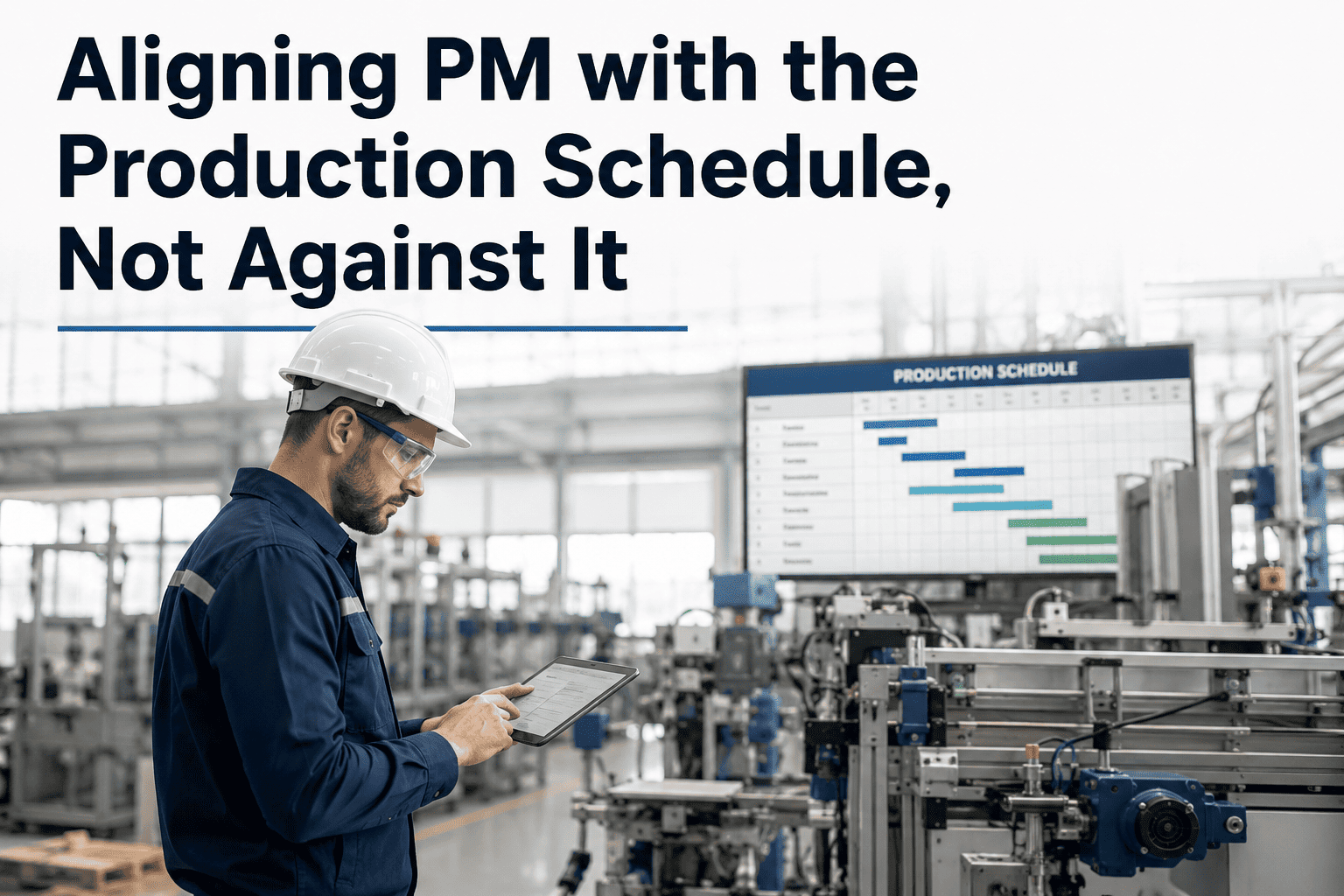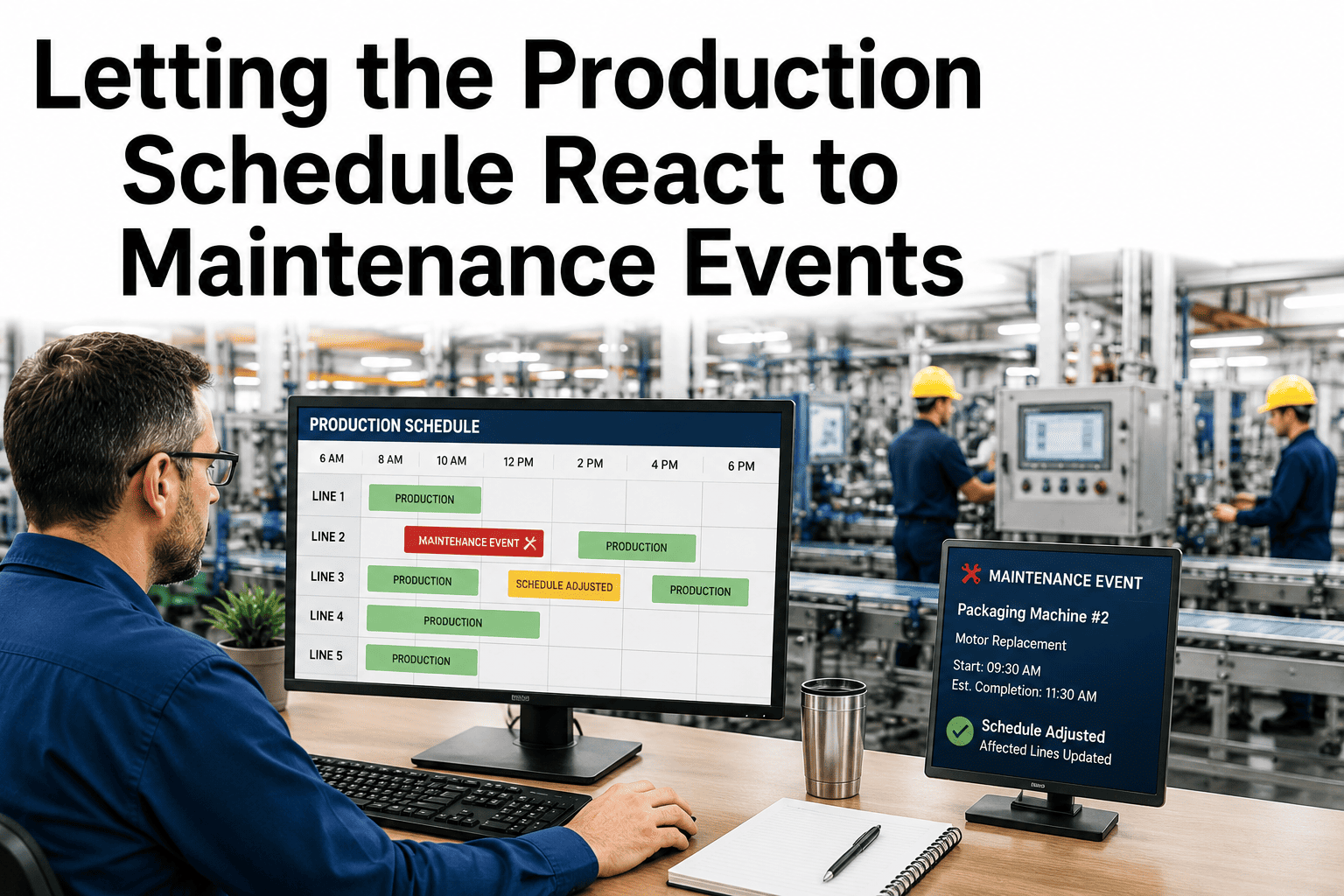
When a filler head drops out at 02:14 on a frozen-entraps line, the difference between a 38-minute recovery and a 4-hour scramble is whether the production schedule can hear the maintenance event the moment it is raised. In most food plants, the CMMS lives in one tab, the MES schedule in another, and the planners in a third building — so equipment reality arrives at the plan as a phone call, an email, or worse, a missed ship date. Letting the production schedule react to maintenance events means wiring work-order status, asset condition, and reliability forecasts directly into the planning board so it re-prioritizes, re-sequences, and re-balances in minutes, not shifts. Plants that build this loop typically cut unplanned downtime impact on the schedule by 25 to 40 percent within the first quarter of true integration. You can Start Free Trial to stand up the integration on a pilot line before reading the rest of this guide.
Can your plan board absorb a breakdown in under 5 minutes?
A maintenance event should arrive at the scheduler as a structured signal — asset, severity, ETA-to-run, alternate routing — not a phone call. The cost of a silent integration gap, on a single mid-volume line, averages $1,800 per hour of late discovery. Integration closes that gap in real time.
How a maintenance event becomes a schedule change
A reactive schedule needs four moves to happen in under 90 seconds: the event is raised, its severity is scored against active orders, capacity is re-balanced, and the revised plan is pushed back to operators. Below is the four-stream flow that a PMS-CMMS integration must support end-to-end.
Maintenance signal is raised and classified
A sensor trip, operator round, or PM check generates a work order in the CMMS. The integration layer tags it with asset ID, failure mode, and a severity tier (S1 line-down through S4 cosmetic) within 15 seconds.
Event scored against the live production schedule
The engine cross-references the affected asset with every active and queued order on that line — calculating missed-unit exposure, changeover ripple, and customer-ship risk in a single pass.
Plan re-balanced across alternate routings and buffers
Where alternate lines or WIP buffers exist, the scheduler shifts at-risk orders, re-orders the changeover queue to minimize loss, and re-allocates labor — all governed by user-set rules, not manual drag-and-drop.
Revised plan returns to the floor in minutes
The updated schedule is pushed to MES dashboards, operator HMI, and the CMMS so maintenance crews see exactly which slot the plant has reserved for the repair — closing the loop.
What "reactive" actually looks like — by the numbers
A connected schedule is measurable. These are the four operating metrics most food plants move within 90 days of going live with PMS-CMMS integration on a primary line.
A 180-asset frozen-entrée plant in the Midwest was spending roughly $42K per quarter on expedited freight and overtime caused by schedule shocks from unscheduled maintenance. After wiring their CMMS work-order feed into the planning board with a 90-second re-sequencing rule, expedited freight dropped 31 percent in the first quarter and on-time-to-case-fill rose from 94.1 to 97.6 percent — payback on the integration project inside 11 weeks.
The formula the scheduler runs when an event lands
When the integration scores a maintenance event against the live schedule, it isn't guessing. It runs a weighted priority function that balances customer impact, changeover economics, and recovery probability — and re-sequences accordingly.
| Severity Tier | Trigger | Scheduler Action | Target Loop Time |
|---|---|---|---|
| S1 — Line Down | Critical asset failure, zero throughput | Freeze active orders, invoke alternate routing, push maintenance slot immediately | < 60 sec |
| S2 — Degraded Run | Speed loss > 15% or repeat minor stops | Re-prioritize queue, pull PM forward, flag at-risk ship dates | < 2 min |
| S3 — PM Overdue | Planned maintenance window missed by > 24 hrs | Insert PM into next changeover slot, re-sequence downstream | < 5 min |
| S4 — Inspection Note | Operator round flags non-critical wear | Append to next planned stop, no active re-sequence | Batch / hourly |
Keeping the planning board honest with equipment reality
Integration is a one-time project; alignment is a daily discipline. The four practices below are what separates plants that hold their reactive-schedule gains from those that drift back to phone-call planning inside two quarters.
Run a 15-minute reliability-standup
Maintenance, planning, and operations review the last 24 hours of integrated events and the next 24 hours of scheduled risk. Plants that hold this standup daily catch 60 percent more S2 events before they become S1.
Govern the re-sequencing rules quarterly
The weights in the priority formula drift as product mix changes. Re-tune w1–w4 every quarter using the last 90 days of actual ship-risk and changeover data — never leave them at the vendor default.
Audit the maintenance ETA accuracy
If Meta is wrong by more than 20 percent, the scheduler over- or under-commits the line. Track actual-versus-estimated repair time per asset monthly and feed the variance back into the CMMS.
Publish a schedule-shock dashboard
A single weekly view of events triggered, loop closure time, and ship-dates saved keeps the program visible to leadership — and keeps the integration funded past year one.
Stop letting maintenance surprises rewrite your plan at 2 a.m.
Stand up a pilot integration on one line in under three weeks and watch your schedule start listening to your assets.
Five questions planners ask before going live
How long does a pilot PMS-CMMS integration take on a single food line?
A scoped pilot — one line, one CMMS feed, one planning board — typically goes live in 18 to 25 days. The bulk of that time is mapping asset IDs between systems and tuning the severity tiers; the integration itself is configuration, not custom code. You can Book a Demo to see a reference pilot scope before you commit.
What happens if the maintenance ETA turns out to be wrong?
The scheduler treats Meta as a probabilistic input, not a promise. If the repair overruns by more than the configured variance threshold, the engine re-fires the priority score and re-sequences again — so a bad estimate degrades gracefully instead of locking the plan into a wrong assumption.
Do we need to replace our existing CMMS or MES to make this work?
No. The integration layer sits between your current CMMS and your planning board using standard work-order and asset APIs. Most plants keep both systems in place; the value comes from the signal flow between them, not from ripping out either tool.
How does this handle food-safety holds and quality quarantines?
A quality or food-safety hold is treated as a special-class event that freezes the affected orders in place and blocks re-sequencing past the hold point. The scheduler will re-route around the quarantined WIP but will never re-allocate it — keeping SQF, BRC, and FSMA traceability intact.
What is the realistic payback window for a mid-size food plant?
Most 150- to 300-asset food plants see payback inside one quarter, driven primarily by reduced expedited freight and overtime. The Midwest frozen-entrée example in this guide hit payback in 11 weeks on a $42K-per-quarter baseline — your numbers depend on line volume and current schedule-shock frequency.
Give your schedule the maintenance signal it's been missing
Connect your CMMS to your planning board, tune the re-sequencing rules, and let the schedule react to reality — not to phone calls.
Free 14-day trial · No credit card