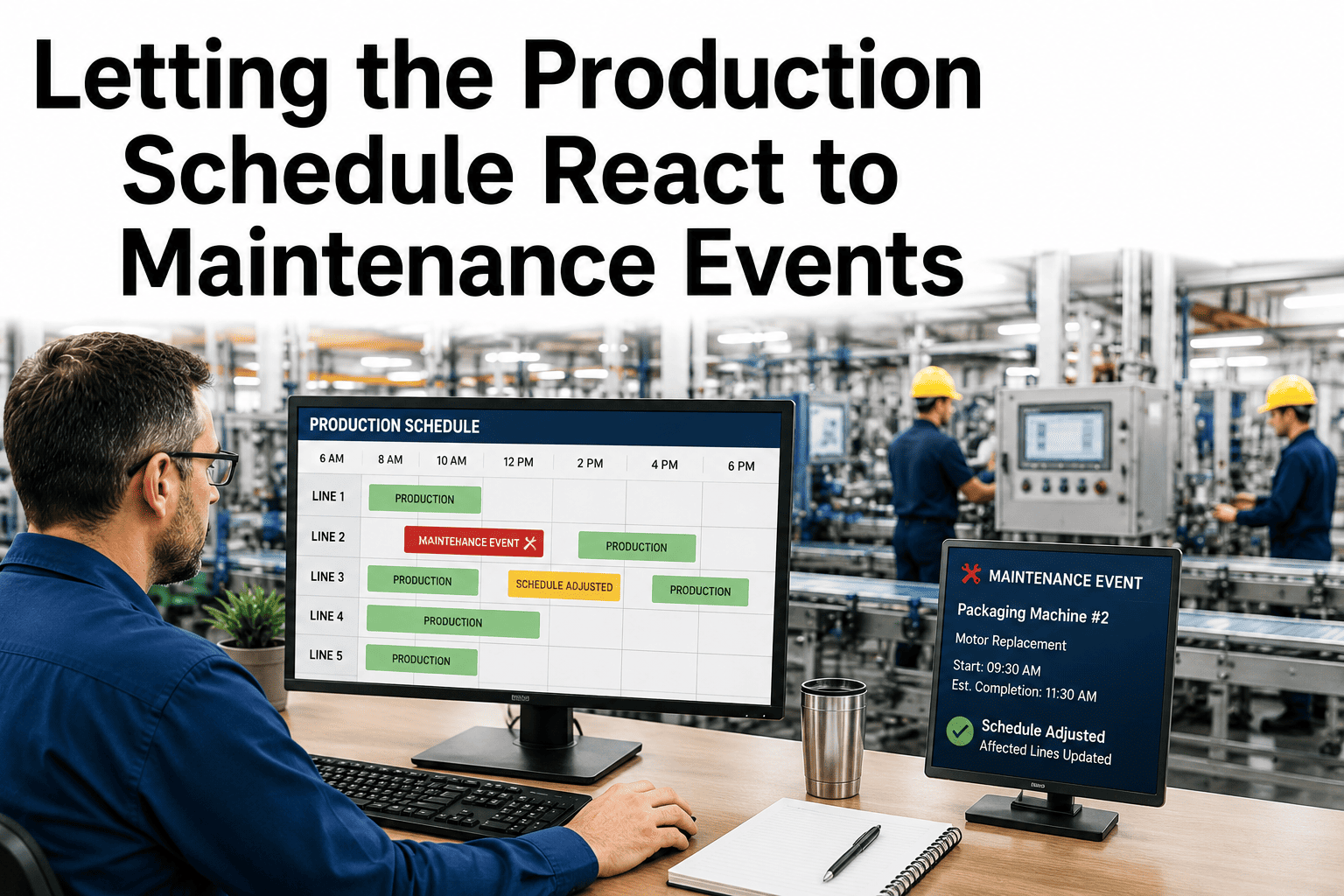
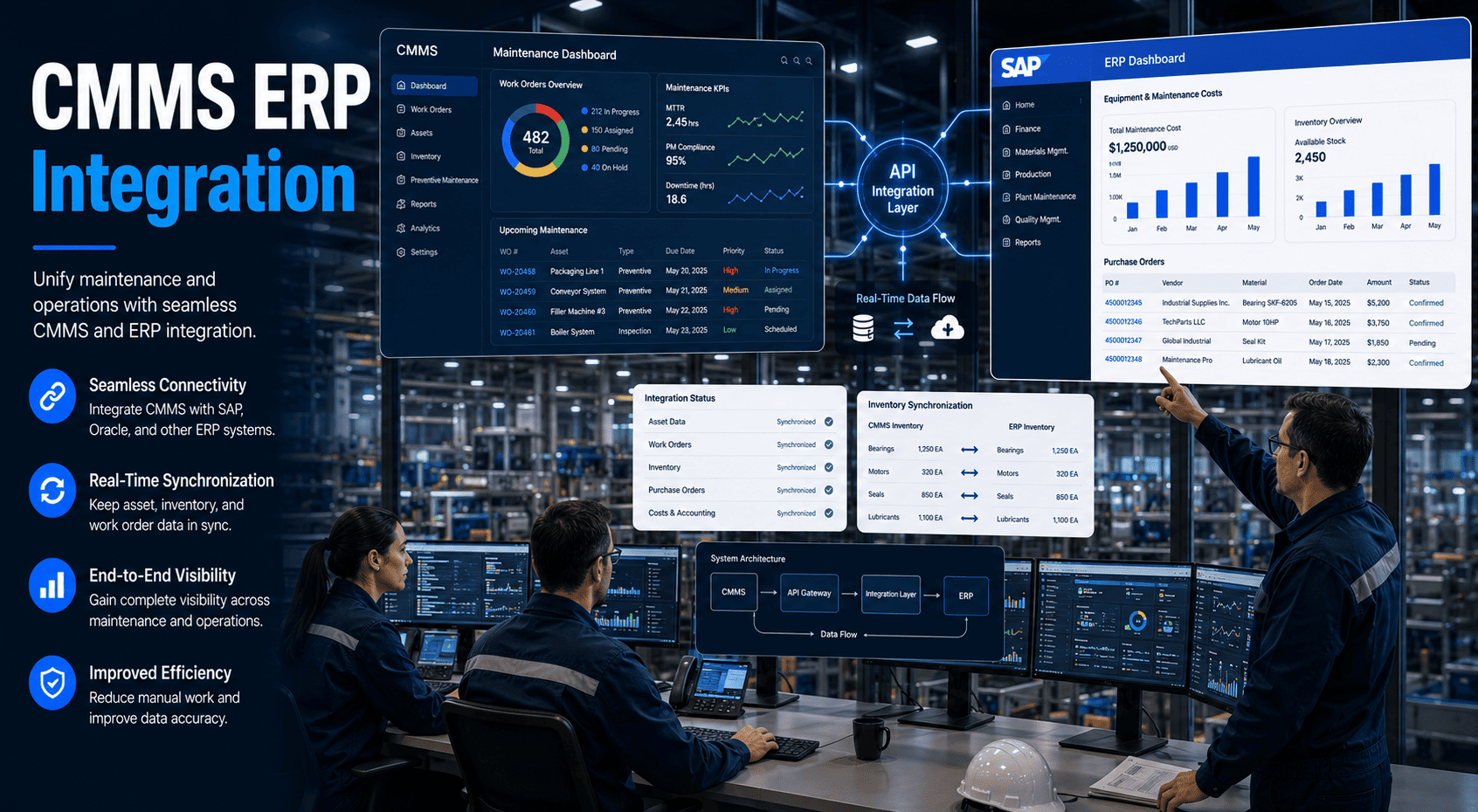
Food manufacturing operations run on two parallel systems that rarely speak to each other: the Enterprise Resource Planning (ERP) platform managing production schedules, inventory, procurement, and financials, and the Computerized Maintenance Management System (CMMS) governing asset health, preventive maintenance, and work orders. When these systems operate in isolation, the result is a costly information gap — production planners schedule runs without knowing equipment availability, maintenance teams complete critical repairs without visibility into downstream impact on output targets, and plant managers make strategic decisions from fragmented, time-delayed data. ERP and CMMS integration in food manufacturing closes that gap, creating a unified operational data layer that synchronizes asset performance with production planning in real time. Start integrating your maintenance and production workflows in Oxmaint and eliminate the data silos that are costing your facility efficiency and compliance coverage today.
Connect Your Maintenance and Production Systems
Oxmaint CMMS integrates with SAP, Oracle, and Microsoft Dynamics to give food manufacturers a single synchronized view of asset health, production capacity, and maintenance schedules — built for regulated food safety environments.
Why ERP and CMMS Integration Is a Strategic Priority in Food Manufacturing
The food manufacturing sector operates under simultaneous pressure from production efficiency demands, regulatory compliance requirements, and the relentless pace of consumer-driven supply chain expectations. In this environment, disconnected enterprise systems are not simply an IT inconvenience — they represent a measurable operational liability. A production line unexpectedly pulled for emergency maintenance that could have been scheduled during a planned downtime window costs far more than the repair itself; it costs the production slot, the ingredient batch already staged, the labor already deployed, and the customer order that misses its ship date.
ERP and CMMS integration addresses this liability by enabling bidirectional data exchange between the two systems most responsible for production output and asset availability. When work order data from the CMMS flows into the ERP's production planning module, schedulers gain accurate equipment availability windows. When production run data from the ERP flows into the CMMS, maintenance teams can align preventive maintenance scheduling to minimize conflict with high-priority production slots. The result is a manufacturing operation where maintenance is planned with production in mind and production is planned with asset health as a real variable — not an assumption.
Core Integration Points Between ERP and CMMS in Food Manufacturing
- Synchronize asset master data between ERP and CMMS so equipment records, cost centers, and location hierarchies remain consistent across both platforms
- Push asset acquisition data from ERP procurement module to CMMS upon purchase order completion to auto-create equipment records
- Reflect equipment disposals and transfers from ERP fixed asset module into CMMS asset register without manual re-entry
- Align equipment classification codes and plant hierarchy structures to support cross-system reporting on asset lifecycle costs
- Automatically post completed CMMS work order labor and material costs to ERP cost centers for accurate production cost accounting
- Trigger CMMS work orders from ERP production order completion events when equipment requires sanitation or changeover maintenance tasks
- Surface open CMMS work order status in ERP production scheduling dashboards to reflect real equipment availability constraints
- Link ERP purchase requisitions for spare parts directly to CMMS work orders requiring those parts for traceability and cost allocation
- Synchronize MRO spare parts inventory levels between CMMS storeroom management and ERP warehouse management modules in real time
- Auto-generate ERP purchase orders when CMMS spare parts consumption falls below reorder point thresholds defined in the maintenance program
- Allocate spare parts consumed on CMMS work orders against ERP cost centers to capture true maintenance cost of production assets
- Reconcile physical inventory counts across ERP and CMMS to eliminate discrepancies that lead to stockout-driven production delays
- Feed CMMS calibration records and equipment qualification data into ERP quality management modules to satisfy regulatory traceability requirements
- Align CMMS preventive maintenance completion records with ERP batch records to demonstrate equipment readiness at time of each production run
- Synchronize CMMS corrective action records with ERP non-conformance management workflows to close the loop on equipment-related quality events
- Generate consolidated compliance reports from integrated ERP and CMMS data sets for auditor review and regulatory submission
- Combine ERP OEE data with CMMS maintenance history to identify the specific asset failure modes most responsible for availability losses
- Correlate CMMS maintenance spend data with ERP production output records to calculate true cost-per-unit impact of maintenance program performance
- Use integrated data sets for capital planning decisions by projecting asset replacement needs against ERP budget cycle timelines
- Build predictive maintenance models using CMMS sensor and failure data enriched with ERP production load and run-hour information
SAP and Oracle ERP Integration with CMMS: Platform-Specific Considerations
The two dominant ERP platforms in large-scale food manufacturing — SAP S/4HANA and Oracle Cloud ERP — each offer native plant maintenance modules alongside integration APIs that allow external CMMS systems to exchange data through standardized interfaces. Organizations running SAP typically leverage the IDoc framework or SAP Integration Suite to establish data pipelines between SAP and a dedicated CMMS like Oxmaint, preserving the specialized maintenance workflow capabilities of the CMMS while feeding cost and inventory data back into the SAP financial and logistics backbone.
Oracle ERP Cloud integrations commonly use Oracle Integration Cloud (OIC) as the middleware layer, mapping CMMS work order objects to Oracle Maintenance Cloud data structures. For mid-market food manufacturers operating on Microsoft Dynamics 365, the Power Platform connector ecosystem provides accessible integration pathways that synchronize CMMS maintenance records with Dynamics 365 Finance and Operations without requiring custom API development. Regardless of the ERP platform, the underlying principle of food manufacturing ERP CMMS integration remains consistent: asset data, work order costs, spare parts consumption, and calibration records should flow between systems automatically, reducing manual re-entry and the data quality degradation that inevitably follows it.
ERP and CMMS Integration Comparison by Platform
| ERP Platform | Native Maintenance Module | Integration Mechanism | Key CMMS Data Exchange | Integration Complexity |
|---|---|---|---|---|
| SAP S/4HANA | SAP Plant Maintenance (PM) | SAP Integration Suite, IDoc, RFC | Equipment master, work orders, costs, MRO inventory | High — requires SAP Basis involvement |
| Oracle Cloud ERP | Oracle Maintenance Cloud | Oracle Integration Cloud (OIC), REST APIs | Asset records, purchase requisitions, cost allocation | Medium-High — OIC configuration required |
| Microsoft Dynamics 365 | D365 Asset Management | Power Platform, Azure Logic Apps, REST | Work order sync, inventory, financial posting | Medium — Power Platform accessible |
| Infor CloudSuite Food | Infor EAM (built-in) | Infor ION integration bus | Asset master, work orders, MRO, KPIs | Medium — ION bus simplifies sync |
| Epicor Kinetic | Epicor EAM | Epicor REST API, BPM workflows | Equipment records, labor costs, parts inventory | Low-Medium — modern REST-first architecture |
Industrial IoT Integration: Connecting CMMS with Real-Time Equipment Data
The third layer of the modern food manufacturing integration architecture sits below both the ERP and CMMS: the Industrial IoT (IIoT) sensor network that captures real-time operational data directly from production equipment. Vibration sensors on rotating machinery, current transformers on motor control centers, temperature transmitters on heat treatment systems, and flow meters on CIP circuits all generate continuous data streams that, when integrated with the CMMS, transform maintenance management from schedule-driven to condition-driven.
For food manufacturers, IIoT CMMS integration delivers its highest value in refrigeration system monitoring, conveyor and processing line condition monitoring, and CIP system verification. Each application reduces unplanned downtime while simultaneously strengthening the compliance documentation trail that food safety auditors and regulatory inspectors require. Explore how Oxmaint connects IIoT data to your maintenance workflows and start turning real-time sensor signals into scheduled, documented maintenance actions.
CMMS Integration Benefits Across Food Manufacturing Operational Domains
Digital Transformation in Food Manufacturing: Integration as the Foundation
Industry analysts consistently identify data integration as the foundational capability that determines the success or failure of digital transformation initiatives in food manufacturing. Advanced analytics, artificial intelligence, and predictive maintenance capabilities all depend on access to clean, complete, and current data — and that data can only be clean if the systems generating it are connected. A CMMS that operates as a standalone island cannot serve as the data foundation for meaningful operational intelligence regardless of how sophisticated its internal reporting capabilities may be.
Food manufacturers who complete ERP and CMMS integration consistently report improvements across four measurable dimensions: reduced unplanned downtime frequency, lower maintenance cost per unit of production, faster regulatory audit response times, and improved spare parts fill rates. These outcomes compound over time as the integrated data set matures, enabling progressively more sophisticated analytics that identify cost reduction opportunities invisible to facilities still operating on disconnected systems.
Measurable Outcomes of ERP and CMMS Integration in Food Manufacturing
| Operational Domain | Pre-Integration Challenge | Post-Integration Outcome | Key Performance Metric |
|---|---|---|---|
| Equipment Availability | Production schedules built without real-time maintenance visibility cause conflicts and reactive delays | Maintenance windows synchronized with production planning reduce schedule disruptions | Unplanned downtime reduction (target: 20–35%) |
| Maintenance Cost Accuracy | Manual cost tracking leads to inaccurate maintenance cost allocation across production lines | Automatic ERP cost posting from CMMS work orders delivers line-level cost accuracy | Cost allocation accuracy improvement (>95%) |
| MRO Inventory Performance | Disconnected spare parts data causes stockouts and excess inventory simultaneously | Real-time consumption sync with ERP enables dynamic reorder point management | Stockout frequency and carrying cost reduction |
| Compliance Documentation | Audit preparation requires manual assembly of records from multiple disconnected systems | Integrated data set enables on-demand compliance report generation across linked records | Audit preparation time reduction (50–70%) |
| Predictive Maintenance | Scheduled PM based on calendar time ignores actual equipment condition and production load | IIoT-CMMS-ERP integration enables condition-based scheduling aligned to production reality | PM labor efficiency and failure prevention rate |
Implementation Roadmap: Building Your ERP and CMMS Integration Strategy
Successful CMMS integration with ERP systems in food manufacturing follows a phased approach that prioritizes high-impact data exchanges before pursuing comprehensive integration. Phase one focuses on asset master synchronization and work order cost posting interfaces, delivering immediate financial and scheduling value. Phase two adds spare parts inventory synchronization, linking CMMS storeroom data to ERP warehouse management and triggering automated procurement workflows. Phase three introduces compliance data exchange, connecting CMMS calibration and PM completion records to ERP quality management and batch record systems.
The goal is an integration architecture maintainable by the organization's IT team without ongoing vendor dependency — one that evolves as both the ERP and CMMS platforms update and as new IIoT data sources come online. A CMMS with well-documented REST APIs, pre-built ERP connectors, and support for common integration middleware significantly reduces implementation risk and shortens time-to-value.
Turn Maintenance Data Into Production Intelligence
Oxmaint gives your facility the REST APIs, pre-built ERP connectors, and food safety compliance architecture needed to unify maintenance, production, and regulatory documentation into one operational platform.
Food Safety Compliance and Integrated Maintenance Documentation
Regulatory frameworks governing food manufacturing — including FSMA Preventive Controls, SQF Code Edition 9, BRC Global Standard for Food Safety, and USDA FSIS regulations — all require evidence that equipment used in food production is maintained in a condition that prevents food safety hazards. When ERP and CMMS systems are integrated, this documentation becomes both more complete and more easily retrievable.
The integration enables food manufacturers to produce — on demand — a comprehensive equipment history linking the asset record (from ERP), its complete maintenance history (from CMMS work orders), its calibration records, and every production batch it participated in into a single cross-referenced audit package. This capability, which requires hours of manual assembly in disconnected environments, becomes a matter of minutes in an integrated architecture — a decisive advantage during regulatory inspections and third-party audits.
Frequently Asked Questions
What is the difference between ERP plant maintenance modules and a dedicated CMMS?
ERP plant maintenance modules such as SAP PM or Oracle Asset Management are designed to capture maintenance costs and integrate with financial and procurement workflows within the ERP ecosystem. Dedicated CMMS platforms are purpose-built for maintenance technician workflows, offering mobile work order management, preventive maintenance scheduling, calibration tracking, inspection checklists, and food safety documentation capabilities that are typically more advanced than ERP PM modules. The optimal architecture for most food manufacturers combines both: a CMMS for day-to-day maintenance execution and documentation, integrated with the ERP for cost accounting, inventory management, and production planning data exchange.
How long does an ERP and CMMS integration project typically take in food manufacturing?
Integration timelines vary significantly based on ERP platform complexity, the scope of data exchanges required, and the availability of pre-built connectors. Asset master synchronization and work order cost posting interfaces can typically be deployed in 4–8 weeks using modern API-based approaches. Full integration including MRO inventory synchronization, compliance record linking, and production schedule data exchange may require 3–6 months. Organizations using CMMS platforms with pre-built ERP connectors and established integration middleware consistently achieve faster timelines than those requiring custom development.
Can small and mid-sized food manufacturers benefit from ERP and CMMS integration?
Yes. While the largest manufacturers with complex SAP or Oracle implementations often pursue comprehensive integration architectures, small and mid-sized manufacturers operating on Dynamics 365, Epicor, or cloud-based ERP solutions benefit significantly from even foundational integrations. The core value drivers — eliminating manual re-entry of work order costs, automating spare parts purchase requisitions, and connecting maintenance records to production batch documentation — apply at all facility scales. Cloud-based CMMS platforms with modern REST APIs have reduced integration cost and complexity to a point where mid-market food manufacturers can achieve full integration without enterprise-scale IT budgets.
How does CMMS integration support FSMA and food safety audit compliance?
FSMA Preventive Controls regulations require food manufacturers to implement and document preventive maintenance as a prerequisite program supporting the food safety plan. When CMMS data is integrated with the ERP's production and quality management systems, the facility can produce comprehensive documentation demonstrating that equipment was maintained and calibrated according to program requirements at the time of each production batch. This cross-system traceability — linking batch records to equipment maintenance histories — is exactly the evidence that FSMA auditors and FDA inspectors seek during facility assessments.
What data security considerations apply to ERP and CMMS integration in food manufacturing?
ERP and CMMS integration involves the exchange of operationally sensitive data including production schedules, asset configurations, maintenance cost structures, and supplier information. Integration architectures should employ encrypted API communication (TLS 1.2 minimum), role-based access controls that limit data exchange to defined fields and objects, audit logging of all integration transactions, and formal data governance policies. Vendor selection criteria for CMMS platforms should explicitly include integration security architecture review alongside functional capability assessment.