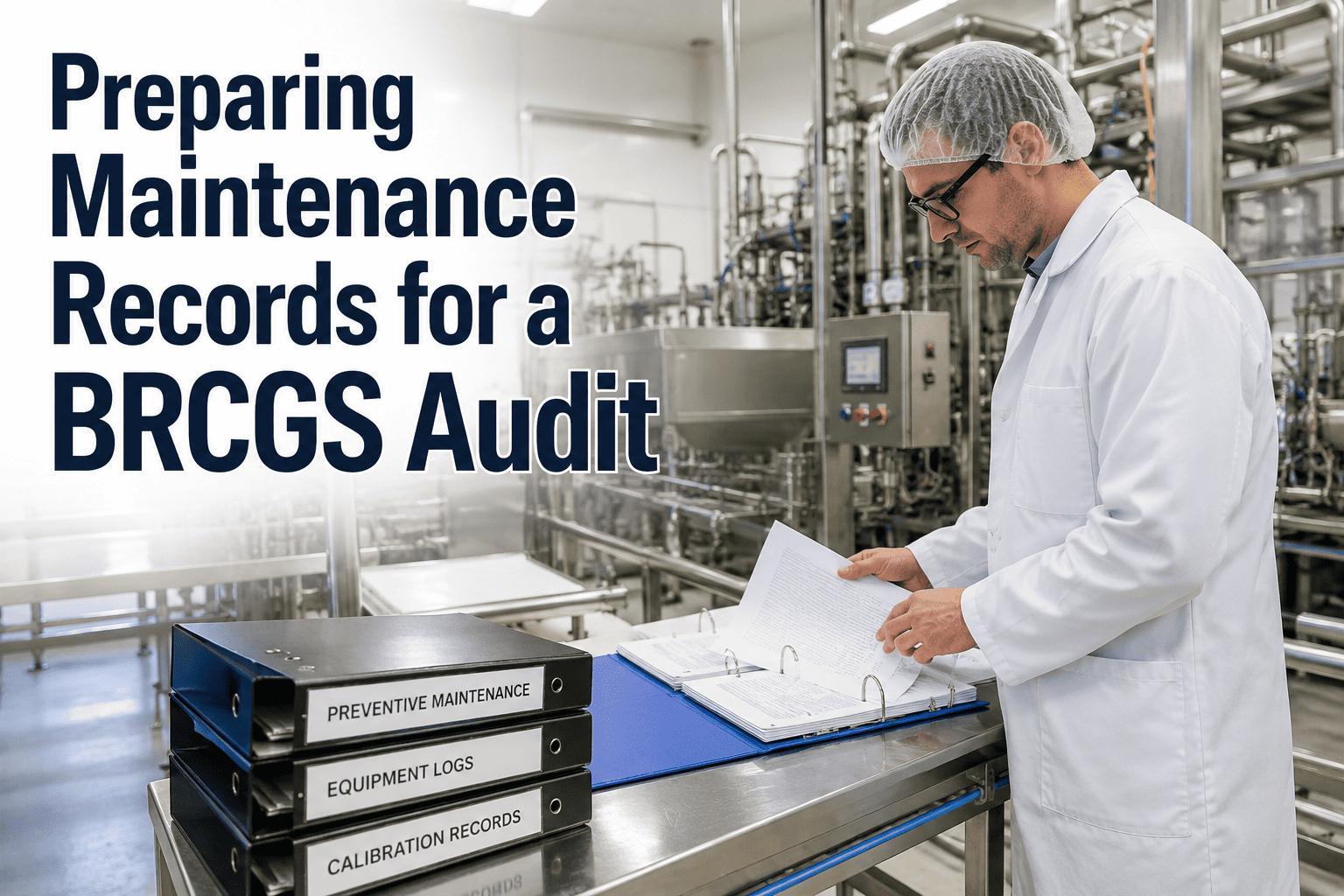
A dairy processing facility in Minnesota received 72 hours notice of a surprise FDA inspection following a competitor's recall in the same region. The quality manager knew their food safety program was solid, but when inspectors began requesting maintenance records for pasteurizers, CIP systems, and metal detectors, the scramble began. Some records existed on paper in the maintenance office. Others were trapped in an outdated CMMS that the current team barely knew how to query. Critical calibration certificates were filed in folders that no one could locate. After three days of inspectors waiting while staff searched for documentation, the facility received four observations, not for actual maintenance failures, but for inadequate record keeping and inability to demonstrate maintenance compliance. The remediation cost $180,000 in consultant fees, system upgrades, and staff overtime to rebuild records that should have been readily available.
Maintenance compliance in food and beverage manufacturing extends far beyond completing work orders. Regulatory agencies and certification auditors expect documented evidence that food safety equipment operates within validated parameters, that preventive maintenance occurs at required frequencies, that calibrations are traceable to standards, and that corrective actions address root causes. The difference between a clean audit and a findings-laden inspection often comes down not to what maintenance work was performed, but to how well that work was documented and how readily documentation can be retrieved.
Sign up to build audit-ready maintenance documentation or book a demo to see how structured compliance tools prepare your facility for any inspection.
Compliance Readiness
Food & Beverage Maintenance Audit and Compliance Readiness Guide
Build maintenance documentation systems that satisfy FDA inspectors, GFSI auditors, and customer quality teams without scrambling when they arrive.
Of Audit Findings Related to Documentation Gaps
Reduction in Findings with Structured CMMS
Of Plants Cannot Retrieve Records Within 24 Hours
4 hrs
target
Maximum Record Retrieval Time for Any Audit Request
Understanding Maintenance Compliance Requirements
Food and beverage maintenance compliance involves multiple overlapping frameworks. FDA regulations establish legal requirements. GFSI certification schemes add additional expectations. Customer audits may impose further specifications. Understanding which requirements apply to your facility and how they intersect is essential for building a compliance-ready maintenance program.
The common thread across all frameworks is documented evidence of systematic maintenance that protects food safety. Inspectors and auditors want to see that equipment affecting food safety receives appropriate preventive maintenance, that failures are investigated and corrected, that calibrations ensure measurement accuracy, and that records demonstrate consistent execution over time. The specifics vary by framework, but the underlying expectation of documented, systematic maintenance remains constant.
43%
of maintenance-related audit findings stem from documentation gaps rather than actual maintenance failures. Facilities that perform excellent maintenance work but document it poorly receive the same findings as facilities that simply do not maintain equipment. Documentation is not bureaucratic overhead; it is compliance evidence.
Maintenance compliance requirements generally fall into several categories: equipment-specific requirements for food safety critical equipment, calibration and verification requirements for measurement devices, preventive maintenance program requirements, corrective action and root cause analysis requirements, and record retention and accessibility requirements. Each category has specific documentation expectations that effective CMMS implementation should address.
Sign up for Oxmaint to implement maintenance documentation that satisfies all applicable compliance frameworks.
Regulatory and Certification Framework Requirements
Different regulatory bodies and certification schemes have specific maintenance documentation expectations. Understanding these requirements enables targeted compliance program development.
Key Requirements
Preventive controls for food safety hazards including equipment-related controls
Monitoring of preventive controls with documented procedures and records
Corrective actions when preventive controls are not properly implemented
Verification activities confirming preventive controls are consistently implemented
Record retention for minimum 2 years after preparation or use
Maintenance Documentation Focus
CCPs and preventive control equipment maintenance records, calibration records for monitoring devices, corrective action records for deviations, verification records showing system effectiveness.
Key Requirements
Module 11.2.15: Equipment maintenance and calibration programs
Documented preventive maintenance schedules for food safety equipment
Calibration procedures traceable to national/international standards
Temporary repairs documented with defined replacement timelines
Lubricants and maintenance chemicals must be food-grade where contact possible
Maintenance Documentation Focus
PM completion records with schedules, calibration certificates and verification records, equipment maintenance history, food-grade material documentation, temporary repair tracking.
Key Requirements
Section 4.7: Maintenance program covering all equipment
Documented maintenance schedule with evidence of completion
Hygiene and foreign body risk management during maintenance
Post-maintenance verification before equipment restart
Section 6.4: Calibration and measurement equipment control
Maintenance Documentation Focus
Comprehensive maintenance schedules, completion evidence, post-maintenance clearance records, calibration certificates with traceability, foreign material control during maintenance.
Key Requirements
ISO 22000 Clause 8: Operational planning and control including maintenance
PRP requirements for equipment maintenance (ISO/TS 22002-1)
Management system documentation and record control
Monitoring, measurement, analysis, and evaluation
Continual improvement requirements
Maintenance Documentation Focus
Documented maintenance procedures, maintenance records demonstrating system implementation, calibration management, corrective action and improvement records, management review inputs.
Key Requirements
29 CFR 1910.147: Lockout/tagout procedures and documentation
29 CFR 1910.119: Process safety management for applicable facilities
Equipment-specific inspection requirements (forklifts, pressure vessels, etc.)
Confined space entry procedures and permits
Hot work permit programs
Maintenance Documentation Focus
LOTO procedure documentation and training records, equipment inspection records, confined space permits, hot work permits, PSM mechanical integrity records where applicable.
Key Requirements
Retailer and food service company quality specifications
Specific equipment maintenance requirements for private label products
Documentation requirements exceeding regulatory minimums
Real-time or rapid access to maintenance records
Trend data and continuous improvement evidence
Maintenance Documentation Focus
Customer-specific requirements documentation, equipment-specific maintenance histories, real-time retrieval capability, trend analysis and improvement data, rapid response to information requests.
Build Audit-Ready Documentation Automatically
Oxmaint captures compliance documentation as technicians work, creating the audit trail regulators and certification bodies expect without adding documentation burden to maintenance teams.
Essential Maintenance Documentation for Compliance
Compliance-ready maintenance programs require specific documentation categories. Each category serves distinct audit purposes and has specific content requirements.
Purpose: Establish complete equipment inventory with criticality classification, food safety role, and baseline documentation.
Required Elements
Unique asset identification and naming convention
Equipment specifications and manufacturer information
Installation date and commissioning records
Criticality classification (food safety, production, support)
CCP or preventive control designation if applicable
Associated procedures and documentation links
Audit Relevance: Demonstrates systematic equipment management and provides foundation for all other maintenance documentation.
Purpose: Demonstrate systematic preventive maintenance with scheduled frequencies and documented completion.
Required Elements
PM schedules showing required frequencies by equipment
Work orders with completion timestamps and technician identification
Task checklists showing specific activities performed
Findings documented during PM activities
Parts and materials used
PM completion rate metrics and deferral documentation
Audit Relevance: Primary evidence of systematic maintenance program. Auditors typically review PM schedules, select equipment, and verify completion records match schedule.
Purpose: Demonstrate measurement accuracy and traceability for devices used in food safety monitoring and quality control.
Required Elements
Calibration schedules with required frequencies
Calibration certificates with traceability to national standards
As-found and as-left readings
Acceptance criteria and out-of-tolerance actions
Reference standard documentation and calibration status
Calibration provider qualifications if external
Audit Relevance: Critical for CCP monitoring devices. Auditors verify calibration currency, traceability chain, and impact assessment for out-of-tolerance findings.
Purpose: Document systematic response to equipment failures including root cause analysis and recurrence prevention.
Required Elements
Problem description with equipment identification
Immediate corrective actions taken
Root cause analysis documentation
Systemic corrective actions to prevent recurrence
Verification of effectiveness
Timeline and responsibility assignments
Audit Relevance: Demonstrates systematic problem-solving beyond symptom fixes. Required element for all GFSI schemes and FDA preventive controls.
Purpose: Provide complete maintenance history enabling trend analysis and demonstrating equipment care over time.
Required Elements
All work orders with completion status and dates
Work descriptions and findings
Labor time and personnel identification
Parts and materials consumed
Photos and supporting documentation
Linkage to related work orders and follow-up items
Audit Relevance: Supports trend analysis requests and demonstrates maintenance consistency. Auditors may request history for specific equipment over defined periods.
Purpose: Document safety controls applied during maintenance including LOTO, confined space, and hot work procedures.
Required Elements
Equipment-specific LOTO procedures
LOTO application and removal records
Confined space entry permits
Hot work permits
Safety training records for maintenance personnel
Incident reports and near-miss documentation
Audit Relevance: OSHA compliance requirement. Customer audits increasingly review safety program as indicator of overall management effectiveness.
Food Safety Equipment Compliance Focus Areas
Certain equipment categories receive heightened audit scrutiny due to their food safety role. These focus areas require particularly robust documentation.
Compliance Documentation Requirements
Verification test records at required frequencies (typically hourly minimum)
Test wand certification and traceability documentation
Reject system confirmation records
Calibration and sensitivity validation records
Failure investigation and corrective action records
Product disposition records when failures occur
Common Audit Findings
Verification frequency gaps, incomplete reject confirmation testing, missing calibration certificates, inadequate failure response documentation.
Compliance Documentation Requirements
Refrigeration system PM records
Temperature monitoring device calibration records
Pasteurizer and thermal process equipment maintenance
Alarm system functionality verification
Temperature deviation response documentation
Backup system testing records
Common Audit Findings
Temperature sensor calibration gaps, alarm functionality not verified, PM completion gaps on critical refrigeration, inadequate temperature deviation investigations.
Compliance Documentation Requirements
CIP system PM records including pump, valve, and instrumentation
Flow meter and conductivity sensor calibration
Temperature sensor calibration for CIP heating
Spray device inspection and maintenance records
CIP cycle validation maintenance
Chemical delivery system maintenance
Common Audit Findings
Spray ball inspection gaps, flow meter calibration overdue, incomplete CIP cycle verification after maintenance.
Compliance Documentation Requirements
Scale calibration records with traceability to certified weights
Checkweigher verification and calibration documentation
Fill equipment calibration and verification
Legal metrology compliance documentation where applicable
Daily verification check records
Out-of-tolerance response documentation
Common Audit Findings
Calibration frequency insufficient, test weight certification expired, inadequate documentation of out-of-tolerance actions.
Audit Preparation Checklist
Systematic audit preparation ensures documentation is accessible and maintenance programs are ready for scrutiny. This checklist addresses both scheduled and unannounced audit scenarios.
PM completion rates above 95% for food safety equipment
All calibrations current with certificates accessible
Work orders closed with complete documentation within 48 hours
Corrective actions completed and verified within defined timelines
Equipment master data accurate and current
Record retrieval tested quarterly (can access any record within 4 hours)
Trend reports available showing maintenance program performance
Training records current for maintenance personnel
Review previous audit findings and verify closure
Run PM completion reports and address any gaps
Verify all overdue calibrations are completed or scheduled
Close any aged work orders with proper documentation
Review corrective action status and expedite any delayed items
Prepare summary reports auditors typically request
Brief maintenance team on audit process and likely questions
Organize physical documentation that supplements electronic records
Designate maintenance representative available throughout audit
Provide auditor access to CMMS for self-service queries if appropriate
Respond to document requests promptly (target under 1 hour)
Document all requests and responses for post-audit reference
Clarify questions immediately rather than letting assumptions stand
Note any observations for immediate correction where possible
Prepare additional context or explanation for complex situations
Review all findings and observations immediately
Develop corrective action plans with specific timelines
Assign responsibility for each corrective action
Identify root causes for systemic findings
Implement process improvements to prevent recurrence
Document lessons learned for future audit preparation
Update procedures or training based on findings
Verify corrective action effectiveness before closure
Book a demo to see how Oxmaint provides audit preparation dashboards that highlight gaps before auditors find them.
Be Audit-Ready Every Day
Oxmaint maintains continuous compliance documentation so you are always ready for announced or surprise audits. Stop scrambling and start demonstrating maintenance excellence.
Frequently Asked Questions: Maintenance Compliance
How long must we retain maintenance records?
FDA FSMA requires retention for at least 2 years after preparation or use. GFSI certification schemes typically require 3 years of accessible records. Customer requirements may extend longer. Best practice is maintaining complete maintenance history for equipment lifetime plus retention period after disposal, enabling response to any inquiry about equipment that produced product still potentially in distribution.
What PM completion rate do auditors expect?
While no regulation specifies a required percentage, auditors expect evidence of systematic PM execution. Completion rates below 90% typically draw questions. For food safety equipment, rates below 95% often result in findings. More important than the overall number is the pattern: 100% completion on CCP equipment with lower rates on non-critical items is acceptable, but gaps on food safety equipment regardless of overall rate will generate concern.
Do we need electronic records or are paper records acceptable?
Regulations do not mandate electronic records. However, the retrieval speed and completeness expected during audits makes paper-based systems increasingly difficult to manage. Electronic CMMS enables rapid response to document requests and provides the reporting capability auditors expect. Many facilities use electronic systems for active records with paper backup for legal retention.
Sign up for Oxmaint to transition from paper to audit-ready electronic documentation.
How quickly should we be able to produce records during an audit?
Auditors expect reasonable response times, typically within hours, not days. Best practice is targeting 4-hour maximum for any record request and under 1 hour for commonly requested documents. Inability to produce records within the audit timeframe creates appearance of non-compliance even when records exist. Practice retrieval scenarios regularly to ensure capability.
What should we do if we discover compliance gaps before an audit?
Address gaps systematically before auditors find them. For missing documentation on completed work, attempt to reconstruct records from alternative sources (parts receipts, technician recollection, equipment condition). For incomplete PM work, complete the work and document the delayed completion honestly. Never fabricate records; auditors are experienced at identifying falsified documentation, and the consequences of discovered falsification far exceed the findings for honest gaps.
Transform Maintenance Documentation from Burden to Asset
Oxmaint builds compliance documentation automatically as maintenance work happens. Stop scrambling before audits and start demonstrating the maintenance excellence your facility delivers every day.