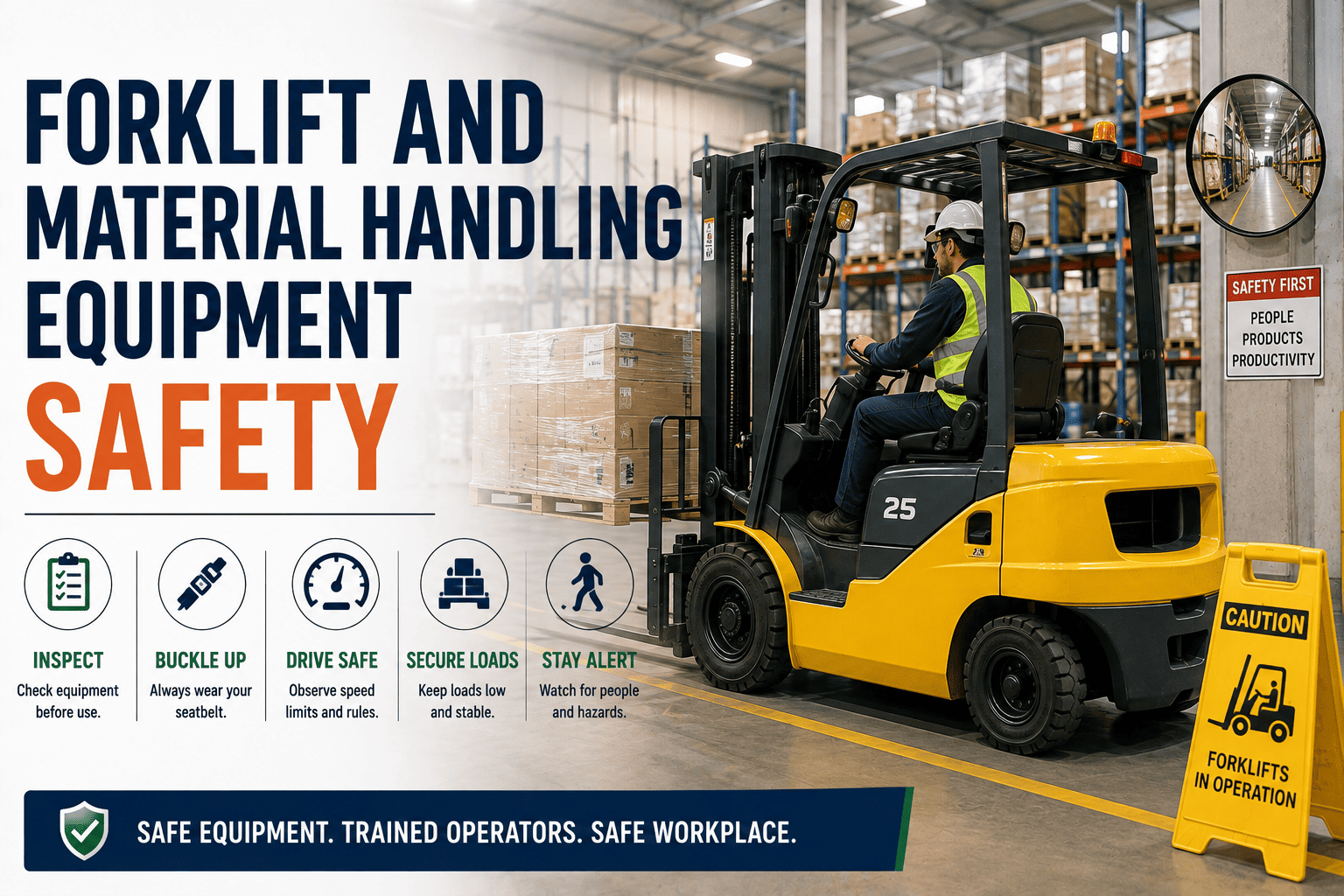
Food plants run on movement — pallets of raw ingredients arriving at dock doors, finished goods staged for distribution, ingredients flowing between processing lines. Powered industrial trucks (PITs) — forklifts, pallet jacks, reach trucks, order pickers — make that movement possible, and OSHA 29 CFR 1910.178 makes structured maintenance, operator certification, and pre-shift inspection non-negotiable. A single uninspected forklift in a food plant carries three simultaneous risks: a worker injury that triggers OSHA recordable reporting, a product contamination event if a hydraulic line fails near exposed product, and a GMP audit finding that can jeopardize SQF, BRCGS, or FSSC 22000 certification. Maintenance teams that treat PIT maintenance as a CMMS-driven program — scheduled PMs, pre-shift digital checklists, battery room compliance logs, and closed-loop corrective work orders — eliminate all three risks at once — start a free trial to build your food plant PIT program in Oxmaint, or book a demo to see how it maps to OSHA 1910.178.
OSHA 1910.178 · Food Plant PIT Compliance
Food Plant Forklift, Pallet Jack, and PIT Maintenance
OSHA 1910.178-aligned maintenance framework for food plants — pre-shift inspection, operator certification, battery room compliance, and CMMS documentation that survives GFSI and OSHA audits.
85
Forklift fatalities per year (OSHA)
34,900
Serious PIT injuries annually (OSHA)
4.8x
Emergency repair cost vs planned PM
1910.178
OSHA governing standard
What This Covers
01 · What Is PIT Maintenance
02 · Key Compliance Areas
03 · Pain Points
04 · Oxmaint Solutions
05 · Reactive vs Planned
06 · ROI Results
07 · FAQs
Section 01
What Is Food Plant PIT Maintenance Under OSHA 1910.178
OSHA 29 CFR 1910.178 — Powered Industrial Trucks — covers every motorized vehicle used to carry, push, pull, lift, or stack materials in a workplace. In a food plant, this includes counterbalanced forklifts, electric pallet jacks, reach trucks, order pickers, walkie stackers, and turret trucks. The standard establishes requirements in four areas: equipment design and capacity ratings, pre-shift inspection and reporting, operator training and certification, and safe operating procedures in specific environments — including food-grade facilities where battery charging areas and washdown zones create unique hazards.
What separates compliant food plant PIT programs from non-compliant ones is documentation. OSHA 1910.178(q)(7) requires that trucks found to be unsafe be removed from service immediately. Demonstrating compliance means showing inspectors a dated pre-shift inspection record for every truck, every shift — not a stack of unsigned paper forms in a binder, and not the operator's word that they checked it. GFSI schemes (SQF Edition 9, BRCGS Issue 9, FSSC 22000 v6) add a second layer: equipment that contacts or moves near food contact surfaces must be maintained to prevent contamination, with records available on demand during unannounced audits. Teams that start a free trial on Oxmaint eliminate the paper gap in days, or book a demo to see the inspection record structure.
Section 02
6 Key Compliance Areas Every Food Plant PIT Program Must Cover
01
Pre-Shift Inspection (1910.178q)
Every truck inspected before each shift. Deficiencies documented. Unsafe trucks removed from service. Records retained and available to OSHA inspectors on demand.
02
Operator Certification (1910.178l)
Every PIT operator trained and evaluated before unsupervised operation. Refresher training triggered by accidents, near-misses, or unsafe observation. Training records maintained per employee.
03
Battery Room Compliance (1910.178g)
Charging areas ventilated to prevent hydrogen accumulation. Eye wash stations within 10 seconds travel. No smoking, open flames, or sparking near batteries. Log-based inspection records.
04
Capacity and Load Ratings
Each truck operated at or below nameplate rated capacity. Load center compliance verified. Attachments reduce rated capacity — recalculation documented when non-standard attachments are used.
05
Scheduled PM Program
Manufacturer interval-based maintenance: hydraulic fluid, brake inspection, tire wear, horn, lights, forks for cracks and bend. PM completion tracked in CMMS with technician signature and next due date.
06
Corrective Work Order Closure
Deficiencies found on pre-shift or PM inspections generate corrective work orders. Out-of-service tag applied until repair verified. CMMS tracks open vs closed status for OSHA and GFSI audit readiness.
Most food plants lose 20–35% of PIT uptime to untracked deficiencies and reactive breakdowns — costing far more than a structured CMMS program.
Section 03
4 Pain Points That Put Food Plants at Risk
01
Paper Pre-Shift Forms With No Corrective Loop
Operators fill paper checklists, hand them to supervisors, and deficiencies sit in a binder unaddressed. OSHA inspectors and GFSI auditors ask for records — the inability to produce them is itself a finding. Plants switching to CMMS-based inspection close this gap immediately.
Start a free trial to go digital today.
02
Operator Certification Gaps
Food plants with high turnover frequently have uncertified operators on forklifts. OSHA 1910.178(l) requires certification before unsupervised operation — a single fatality investigation that reveals an uncertified operator triggers maximum-severity citations and personal liability.
03
Battery Room Hazards Uninspected
Electric PIT battery charging areas are required to have ventilation, eyewash, and no ignition sources. Many food plants have battery rooms set up years ago that have never been formally inspected. A hydrogen explosion or acid burn event results in multi-citation OSHA penalties and GFSI non-conformances.
04
No PM Schedule Tied to Manufacturer Intervals
PIT manufacturers specify maintenance intervals for hydraulic fluid, brakes, chains, and mast components. Plants that run to failure instead of following intervals face equipment failures mid-shift, product damage from dropped loads, and GFSI audit findings for lack of documented PM programs.
Section 04
How Oxmaint Solves Food Plant PIT Compliance
Mobile Pre-Shift Inspection
Operators complete digital pre-shift checklists on a smartphone. Failed items auto-generate corrective work orders. Timestamped records stored in cloud — ready for OSHA or GFSI audit the same day.
Operator Certification Tracker
Each operator record links to truck type certifications and expiry dates. Automated alerts when certifications approach expiry. Refresher training documentation attached directly to employee records.
PM Scheduling by Asset
Manufacturer PM intervals loaded per truck. Oxmaint auto-schedules upcoming PMs and escalates overdue work orders. Technician sign-off and next due date captured on every PM completion record.
Battery Room Inspection Logs
Structured battery room inspection checklist covers ventilation, eyewash station, signage, and ignition source controls. OSHA 1910.178(g) compliance evidence built into every inspection record.
Out-of-Service Tag Workflow
Unsafe trucks flagged in Oxmaint trigger an out-of-service status visible to all supervisors. No truck returns to service until a technician closes the corrective work order and records resolution details.
GFSI-Ready Audit Report
One-click report exports all PIT inspection records, PM history, corrective work orders, and operator certifications in audit-ready format. SQF, BRCGS, and FSSC 22000 auditors see complete compliance evidence instantly.
Teams managing 10,000+ assets rely on Oxmaint to stay audit-ready — start a free trial and see measurable results in the first 30 days, or book a demo to walk through your specific fleet structure.
Section 05
Reactive vs Planned: Food Plant PIT Maintenance Compared
| Area |
Reactive Approach |
Planned with Oxmaint |
| Pre-Shift Inspection |
Paper forms, missing records, no corrective loop |
Digital mobile checklist, auto work orders, cloud records |
| Operator Certification |
Spreadsheet tracking, expiry missed, uncertified operators |
Per-operator record, automated expiry alerts, audit export |
| Battery Room |
Informal walkarounds, no dated log, no corrective trail |
Structured inspection, OSHA 1910.178(g) checklist, linked WOs |
| PM Scheduling |
Run to failure, manufacturer intervals ignored |
Interval-based PMs auto-scheduled, overdue escalation |
| Deficiency Response |
Truck continues in service, risk accumulates |
Out-of-service status, locked until repair verified |
| OSHA Audit Readiness |
Records scattered, gaps found on inspection day |
One-click report, full history, no gaps |
| GFSI Audit Readiness |
Manual assembly of evidence, incomplete documentation |
Structured export, all evidence linked to asset records |
| Emergency Repair Cost |
4.8x higher than planned maintenance cost |
Preventive schedule reduces unplanned breakdown frequency |
Operations teams that shift from reactive to planned PIT maintenance report 30–40% fewer unplanned breakdowns within the first 6 months.
Section 06
ROI and Results: What Structured PIT Maintenance Delivers
40%
Reduction in unplanned downtime
Reported by facilities transitioning from reactive to PM-scheduled PIT programs (Flexco Industry Report)
4.8x
Emergency vs planned repair cost ratio
OSHA data on unplanned equipment failure cost relative to preventive maintenance programs
100%
Inspection record coverage
Digital CMMS systems eliminate the record gaps that paper-based programs systematically create over time
30 days
Time to measurable results
Oxmaint customers report audit-ready PIT records within 30 days of activating digital inspection workflows
Facilities managing structured CMMS-based PIT programs consistently report fewer OSHA citations, faster GFSI audit completion, and measurably lower total maintenance cost — start a free trial to build your program, or book a demo to see the ROI on your fleet size.
Section 07
Frequently Asked Questions
Does OSHA 1910.178 require a daily pre-shift inspection or just periodic inspection?
OSHA 1910.178(q)(7) requires that industrial trucks be examined before being placed in service, and again after each shift if the truck will be used in subsequent shifts. For food plants operating multiple shifts, this means every truck gets a documented pre-shift inspection at the start of each shift — not once per day. The inspection must be documented and deficiencies reported to the supervisor. Trucks found to be unsafe must be taken out of service until repaired. Oxmaint's mobile pre-shift checklist is structured for multi-shift food plants, capturing shift, truck ID, inspector name, and deficiency status in one digital record. Records are timestamped and retained automatically — no manual filing required.
What are the OSHA requirements for forklift operator certification in a food plant?
OSHA 1910.178(l) requires that forklift operators be trained and evaluated before operating a powered industrial truck without supervision. Training must cover truck-specific operation for each type the employee will operate, the hazards of the specific work environment (including food plant hazards like wet floors, cold storage areas, and traffic patterns near production lines), and safe operation procedures. Refresher training is required after an accident, near miss, unsafe observation by a supervisor, or when the operator will operate a different type of truck. Training records must document the date, trainer identity, and equipment types covered. Oxmaint's operator certification module stores all of this per employee with expiry alerts.
How does GFSI (SQF, BRCGS) treat forklift and PIT maintenance in food safety audits?
GFSI-recognized schemes treat equipment maintenance as a fundamental prerequisite program. SQF Edition 9 (element 11.7) and BRCGS Issue 9 (clause 4.7) both require documented preventive maintenance programs for all equipment, including material handling equipment. Auditors look for a scheduled PM program tied to manufacturer specifications, pre-use inspection records, corrective action evidence when deficiencies are found, and calibration records for weighing and measuring equipment on PITs. Unannounced GFSI audits require that all records be available immediately — a paper-based program that takes hours to assemble is a practical non-conformance even if the underlying work was done. Oxmaint produces a complete audit export in minutes.
What specific items must be covered in a food plant forklift pre-shift inspection checklist?
OSHA 1910.178(q)(7) does not prescribe a specific checklist format, but the inspection must cover the items specified in the truck manufacturer's maintenance manual. For food plant applications, a complete pre-shift inspection covers: fuel/battery level and charge status, hydraulic fluid level and leak check, forks for cracks, bends, and wear, tires for cuts and pressure, brakes and steering function, horn, lights, and warning devices, mast and carriage operation, overhead guard integrity, and seatbelt or restraint system. In wet areas and cold storage, special attention to anti-slip surfaces and ice buildup on forks is warranted. Oxmaint's pre-built food plant PIT inspection template covers all of these items with pass/fail fields and an open-ended deficiency notes field that auto-populates the corrective work order description.
Stop Reactive. Start Planned.
Stop Losing Budget and Audit Points to Untracked PIT Deficiencies
Turn every forklift, pallet jack, and PIT into a trackable, inspected, compliant asset with Oxmaint — live in days, not months.
- Real-time asset visibility across your full PIT fleet
- OSHA 1910.178-aligned pre-shift and PM inspection records
- 5–10 year CapEx forecasting for equipment replacement planning
Used by operations teams managing 10,000+ assets. No heavy implementation. Live in days.