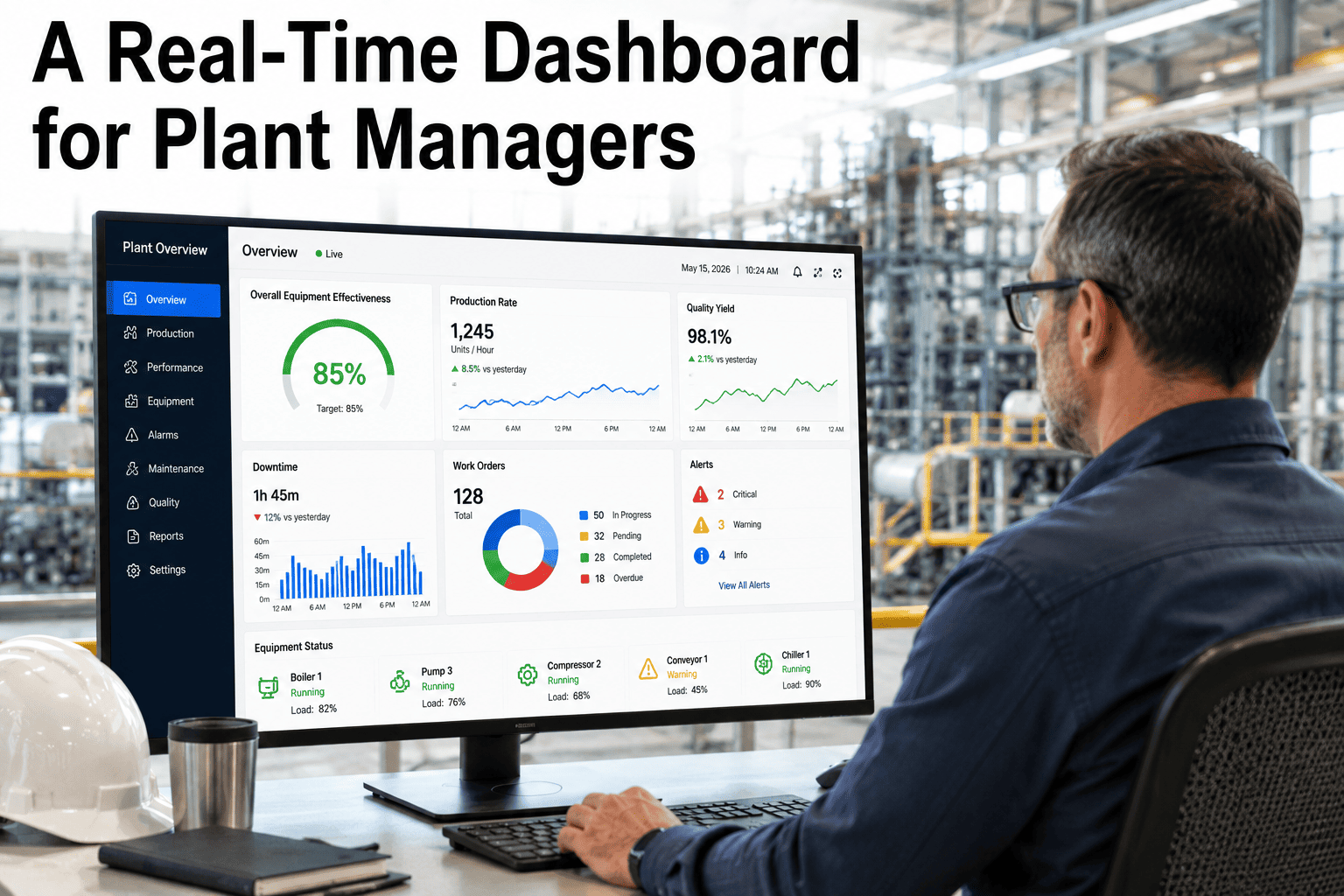
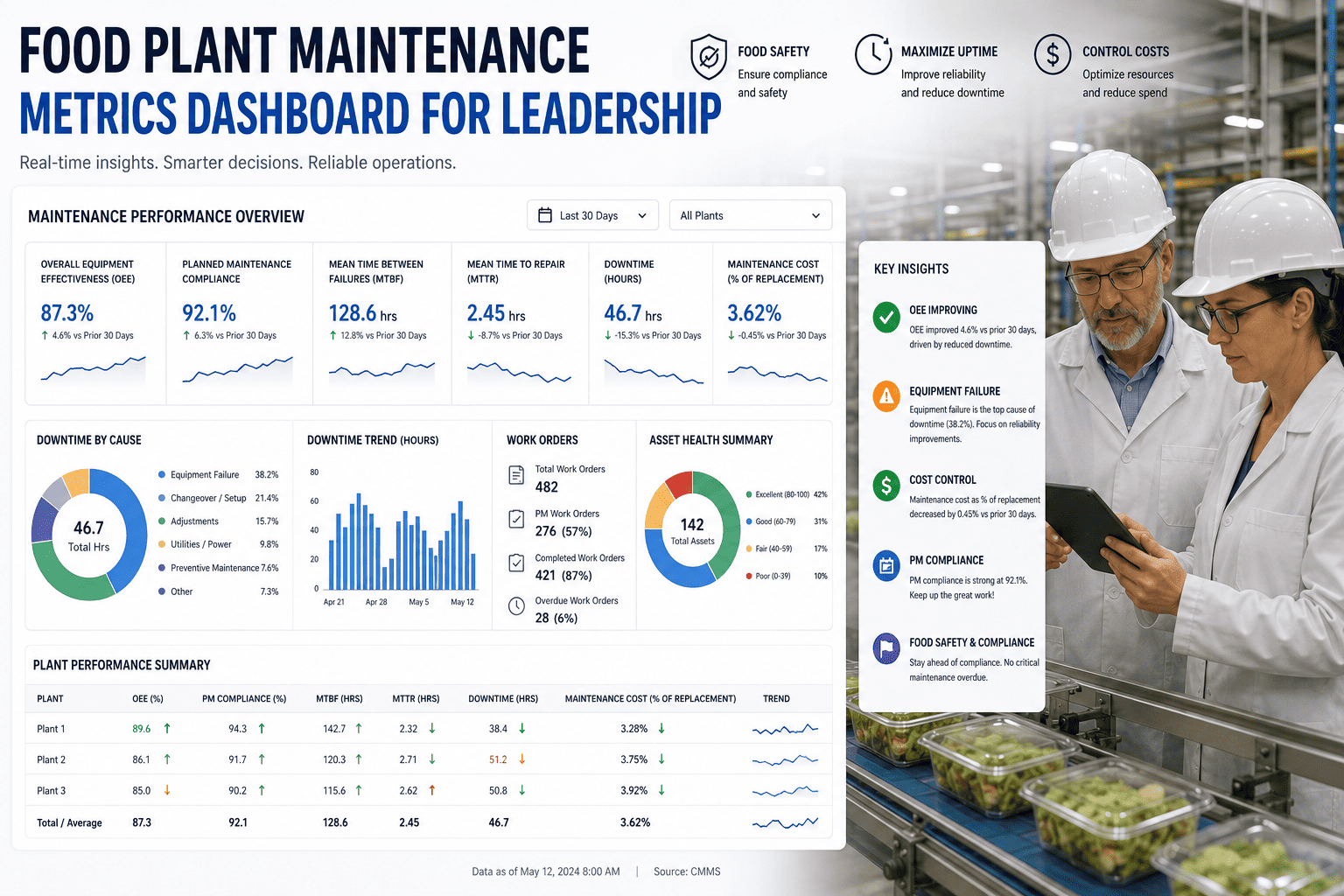
A beverage bottling plant in Georgia held monthly maintenance review meetings where the manager presented a 47-slide PowerPoint compiled from five different spreadsheets, the CMMS, and manual data collection from supervisors. By the time the data was assembled, analyzed, and formatted, it was already three weeks old. Decisions about equipment reliability, technician allocation, and PM program effectiveness were made on information that no longer reflected current reality. When the plant implemented a real-time maintenance KPI dashboard that pulled directly from their CMMS and production systems, the monthly PowerPoint disappeared. Instead, leadership accessed live metrics showing PM completion rates, equipment availability, and food safety equipment status whenever they needed it. Response to developing problems dropped from weeks to hours, and the maintenance manager recovered 15 hours monthly previously spent on report compilation.
Maintenance KPI dashboards transform data that already exists in your systems into actionable visibility. The information about PM completion, work order aging, equipment downtime, and maintenance costs sits in your CMMS and connected systems. Dashboards surface this information in formats that enable decisions: trend lines that reveal patterns, comparisons that highlight outliers, and alerts that demand attention before problems escalate. In food manufacturing, where equipment reliability directly impacts food safety compliance and production capacity, this visibility is not a convenience but a management necessity.
Sign up to access real-time maintenance dashboards or book a demo to see how dashboard visibility transforms maintenance decision-making.
Maintenance Analytics
Maintenance KPI Dashboards for Food Safety and Plant Reliability
Transform maintenance data into actionable visibility with dashboards designed for food manufacturing compliance and reliability management.
Of Plants Lack Real-Time Maintenance Visibility
Faster Problem Detection with Dashboard Monitoring
Reduction in Manual Report Generation Time
15 hrs
monthly
Average Time Saved on Report Compilation
Why Maintenance Dashboards Matter in Food Manufacturing
Food manufacturing maintenance operates under unique pressures that make real-time visibility essential. Production schedules are unforgiving, with equipment downtime directly impacting customer orders and potentially spoiling perishable product. Food safety equipment must operate within validated parameters, with failures creating compliance exposure and potential recall risk. Regulatory audits require rapid access to maintenance performance data. And continuous improvement demands trend analysis that manual reporting cannot efficiently provide.
Traditional maintenance reporting fails these requirements. Monthly reports compiled from spreadsheets show historical snapshots that are outdated before they are presented. Ad-hoc queries take hours to assemble and are rarely repeated consistently. Different people use different definitions, creating conflicting versions of metrics that should be straightforward. And the effort required to generate reports means they happen infrequently, missing the patterns that would be visible with continuous monitoring.
78%
of food manufacturing plants lack real-time visibility into maintenance performance. These plants rely on weekly or monthly reports that show problems only after they have already impacted production, compliance, or costs. Dashboard visibility transforms reactive discovery into proactive management.
Effective dashboards address these challenges by providing continuous visibility into the metrics that matter. PM completion rates are visible daily, not monthly. Work order backlogs surface before they become unmanageable. Equipment reliability trends appear as they develop. And food safety equipment status is always visible to those who need to know. This visibility enables intervention while problems are still manageable rather than after they have escalated into crises.
Sign up for Oxmaint to access dashboards that provide the maintenance visibility food manufacturing demands.
Essential Maintenance KPIs for Food Manufacturing
Effective dashboards focus on metrics that drive decisions rather than displaying every available data point. These KPI categories address the specific concerns of food manufacturing maintenance operations.
PM Completion Rate
Completed PMs / Scheduled PMs x 100
Target: Over 95% overall, 100% for food safety equipment
PM On-Time Completion
PMs completed by due date / Total scheduled PMs x 100
Target: Over 85% completed by original due date
PM Overdue Count
Number of PMs past due date
Target: Zero for Critical A equipment, under 5% total
Why It Matters: PM completion directly correlates with equipment reliability. Audit scrutiny focuses on PM compliance for food safety equipment. Declining PM completion predicts future reliability problems.
Equipment Availability
(Scheduled time - Downtime) / Scheduled time x 100
Target: Over 95% for critical production equipment
Mean Time Between Failures (MTBF)
Operating time / Number of failures
Target: Increasing trend over time by equipment
Mean Time To Repair (MTTR)
Total repair time / Number of repairs
Target: Under 4 hours for critical equipment
Why It Matters: Equipment reliability directly impacts production capacity and food safety. MTBF trends reveal whether maintenance programs are improving reliability. MTTR affects production schedule recovery.
Work Order Backlog
Total open work orders in labor weeks
Target: 2-4 weeks of planned work backlog
Emergency Work Ratio
Emergency WOs / Total WOs x 100
Target: Under 15% of total work orders
Work Order Aging
WOs open beyond SLA / Total open WOs x 100
Target: Under 10% aged beyond target completion
Why It Matters: Backlog size indicates resource adequacy. Emergency ratio reveals program maturity. Aging shows workflow effectiveness and scheduling capability.
CCP Equipment PM Compliance
CCP PMs completed on time / CCP PMs due x 100
Target: 100% on-time completion
Calibration Currency
Devices with current calibration / Total calibrated devices x 100
Target: 100% current at all times
Food Safety Equipment Failures
Count of CCP/food safety equipment failures per period
Target: Zero failures affecting product safety
Why It Matters: Food safety equipment maintenance is audit-critical. Any gaps in CCP PM compliance or calibration create regulatory exposure. These metrics should be visible to quality and food safety teams.
Maintenance Cost per Unit
Total maintenance cost / Production units
Target: Stable or declining trend over time
Planned vs. Unplanned Ratio
Planned maintenance cost / Total maintenance cost x 100
Target: Over 70% planned maintenance
Budget Variance
(Actual spend - Budget) / Budget x 100
Target: Within +/- 5% of budget
Why It Matters: Cost per unit normalizes for production volume. Planned ratio indicates program maturity. Budget variance enables proactive financial management rather than month-end surprises.
Wrench Time
Direct work time / Total available time x 100
Target: Over 50% direct maintenance work
Schedule Compliance
Scheduled work completed / Total scheduled work x 100
Target: Over 90% of scheduled work completed
Overtime Percentage
Overtime hours / Total hours x 100
Target: Under 10% of total labor hours
Why It Matters: Wrench time reveals how effectively maintenance capacity is used. Schedule compliance indicates planning quality. Overtime trends signal capacity issues or reactive workload.
See Your KPIs in Real Time
Oxmaint dashboards display the metrics that matter for food manufacturing maintenance, updated continuously from your work order data. Stop compiling reports and start making decisions.
Food Safety-Specific Dashboard Elements
Food manufacturing dashboards require specific elements addressing regulatory compliance and food safety equipment visibility that general maintenance dashboards may not include.
Visual display of all critical control point equipment with current maintenance status. At-a-glance visibility of which CCP equipment has current PM, approaching PM due dates, or overdue maintenance. Color-coded status with equipment name, last maintenance date, and next due date.
Use Case: Quality manager reviews board daily to verify all CCP equipment is maintenance-compliant. Immediate visibility of any gaps requiring escalation.
Dashboard tracking all calibrated devices with current status, last calibration date, next due date, and days until due. Alerts for upcoming calibrations and immediate flags for overdue items. Links to calibration certificates and records.
Use Case: Ensures no measurement device used for food safety monitoring operates with expired calibration. Audit preparation shows calibration compliance history.
Real-time log of any failures or anomalies on food safety equipment including metal detectors, temperature monitoring, pasteurizers, and CIP systems. Includes timestamp, equipment, issue description, response time, and resolution status.
Use Case: Immediate visibility to quality team when food safety equipment experiences issues. Documentation for investigation and corrective action. Trending to identify systemic problems.
Composite view of maintenance compliance elements auditors typically review: PM completion rates for food safety equipment, calibration currency, corrective action closure rates, and documentation completeness. Overall score with breakdown by category.
Use Case: Ongoing audit preparation rather than scrambling before announced audits. Management review of compliance status. Identification of gaps requiring attention before auditors find them.
Book a demo to see how Oxmaint dashboards provide food safety equipment visibility that keeps you audit-ready.
Dashboards Built for Food Manufacturing
Oxmaint provides pre-configured dashboards addressing food manufacturing compliance requirements alongside operational metrics. Start with proven layouts and customize for your specific needs.
Implementing Effective Dashboard Programs
Successful dashboard implementations require more than technology deployment. These practices ensure dashboards become embedded in management routines and drive actual improvement.
01
Start with Key Questions
Define the questions dashboards should answer before selecting metrics. What do managers need to know to make decisions? What problems do they need to catch early? What trends matter for continuous improvement? Metrics without clear purpose become ignored clutter.
02
Ensure Data Quality First
Dashboards displaying inaccurate data quickly lose credibility and get ignored. Before launching dashboards, verify work orders are being closed properly, time is being recorded accurately, and equipment identification is consistent. Address data quality issues before visibility amplifies them.
03
Define Targets and Thresholds
Metrics without targets are just numbers. Define what good looks like for each KPI. Set thresholds that trigger alerts when metrics move outside acceptable ranges. Review targets periodically as performance improves or conditions change.
04
Build Review Routines
Dashboards drive improvement when they become part of regular management routines. Daily supervisor huddles reviewing today's priorities. Weekly manager reviews of trends and exceptions. Monthly leadership review of performance against goals. Schedule dashboard reviews explicitly.
05
Act on What You See
Dashboards that reveal problems without triggering action become demotivating. When metrics show issues, investigate and act. Document actions taken in response to dashboard findings. Track whether actions improved the metrics. Dashboards should drive behavior change.
06
Evolve Based on Use
Initial dashboard designs rarely survive contact with actual use unchanged. Gather feedback from users about what helps and what is missing. Remove metrics nobody looks at. Add visualizations that support emerging questions. Dashboard effectiveness improves through iteration.
Dashboard Technology Considerations
Multiple technology options exist for implementing maintenance dashboards. The right choice depends on existing infrastructure, technical capabilities, and integration requirements.
Most modern CMMS platforms include built-in dashboard and reporting capabilities. These provide immediate access to maintenance data without additional integration.
Advantages
No additional integration required, data always current, vendor-maintained and updated, optimized for maintenance metrics.
Considerations
May not include data from other systems (ERP, production), customization options may be limited, functionality varies significantly by vendor.
BI tools like Power BI, Tableau, or Looker can connect to CMMS data and combine with other sources for comprehensive operational dashboards.
Advantages
Combine data from multiple sources, powerful visualization capabilities, enterprise-wide reporting consistency, sophisticated analytics features.
Considerations
Requires integration development, separate licensing costs, needs BI expertise to build and maintain, data latency depending on refresh schedule.
Excel or Google Sheets dashboards built from CMMS data exports. Common in organizations with limited technology resources or as interim solutions.
Advantages
No additional software cost, familiar tools, highly customizable, works with any data source that can export.
Considerations
Manual data refresh required, version control challenges, limited scalability, data security concerns with spreadsheet distribution.
Large-screen displays in maintenance areas showing real-time status. Increases visibility and creates accountability through transparency.
Advantages
High visibility to entire team, real-time awareness, creates positive pressure for performance, no individual login required.
Considerations
Hardware and installation costs, limited interaction capability, content must be appropriate for public display, requires network connectivity to display location.
Frequently Asked Questions: Maintenance KPI Dashboards
How many KPIs should a dashboard include?
Less is more for effective dashboards. Executive dashboards should focus on 5-7 headline KPIs with drill-down capability for detail. Operational dashboards for daily management can include more metrics but should still prioritize the most actionable measures. When dashboards include too many metrics, users either become overwhelmed or stop looking at them altogether. Start with essential KPIs and add others only if they drive specific decisions.
How often should dashboards update?
Update frequency should match decision-making cadence. Operational dashboards showing work order status benefit from real-time or near-real-time updates since supervisors make assignment decisions throughout the day. Metrics like PM completion rate or MTBF can update daily since the underlying data does not change moment-to-moment. Cost metrics may only need weekly updates to avoid distraction from normal variance.
How do we get people to actually use the dashboards?
Dashboard adoption requires making them part of standard work routines. Build dashboard review into existing meetings rather than creating new meetings. Make dashboards the single source for metrics discussed in reviews rather than accepting competing spreadsheets. Train users not just on how to access dashboards but on how to interpret and act on what they see. When leaders consistently reference dashboard data in discussions, others follow.
Sign up for Oxmaint to access dashboards designed for practical daily use.
What should we do when dashboard data looks wrong?
Investigate immediately rather than ignoring suspicious data. Dashboard data quality issues usually trace back to source data problems: work orders not closed properly, equipment not identified consistently, time not recorded accurately. Use data quality issues as opportunities to improve underlying processes. Document known data limitations and plans to address them. Never hide or manipulate data to make dashboards look better.
Should we share maintenance dashboards with production or quality teams?
Yes, selectively. Production benefits from visibility into maintenance backlog, scheduled work, and equipment status. Quality and food safety teams need visibility into CCP equipment maintenance compliance and calibration status. Sharing appropriate dashboards builds trust and enables coordination. Create audience-specific views that show relevant information without overwhelming non-maintenance users with operational detail they do not need.
Transform Data into Decisions
Oxmaint dashboards surface the maintenance insights that drive reliability and compliance in food manufacturing. Stop compiling reports and start managing performance with real-time visibility.