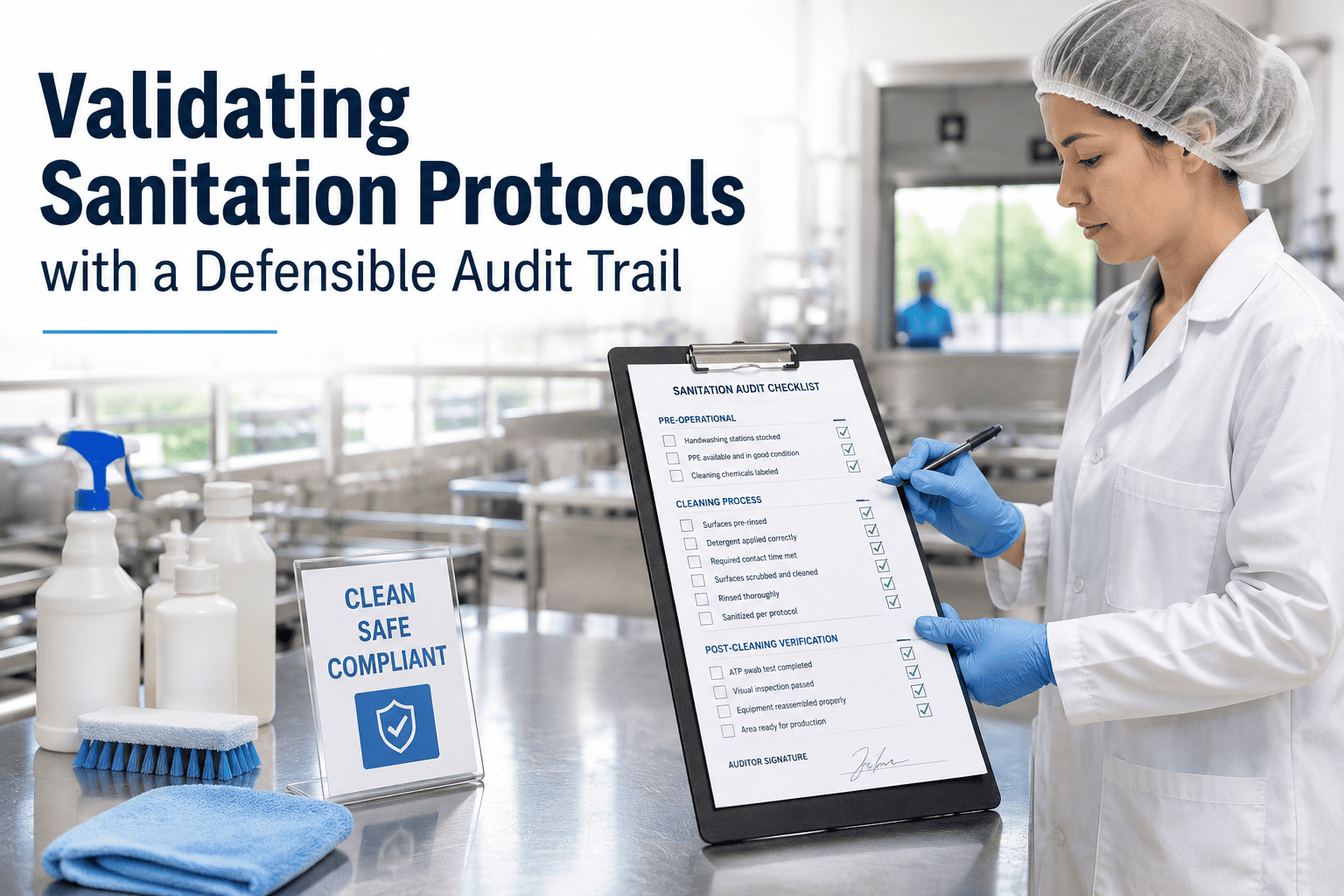
Sanitation validation is the line between a plant that walks through a surprise FDA inspection in three hours and one that burns a week pulling paper records from a binder. A defensible audit trail means every wash cycle, every CIP sensor reading, and every corrective action is timestamped, attributable, and reconstructable on demand — not assembled after the fact. This guide lays out the methodology, verification cadence, and CMMS architecture that keep sanitation validation continuously audit-ready. The fastest way to see it operating on your own asset register is to Start Free Trial and import a single line for free.
Can you reconstruct every wash cycle, sensor reading, and corrective action from the last 90 days — in under 15 minutes?
If the answer is no, your sanitation protocol is validated on paper but not in practice. A CMMS-backed audit trail turns each CIP event into a defensible, timestamped record that satisfies FDA 21 CFR Part 11, USDA-FSIS, and customer-audit expectations without scrambling.
Validation is a verb, not a binder — three phases that hold up under cross-examination
A defensible sanitation validation protocol follows IQ → OQ → PQ logic borrowed from equipment qualification, mapped onto wash cycles, chemistry, and contact time. Each phase produces a signed, timestamped artifact inside the CMMS — not a PDF filed in a cabinet.
Verify the wash system is built and calibrated to spec
Confirm spray-ball coverage, CIP supply-pump pressure (typically 2.5–4.0 bar at the farthest loop), detergent-conductivity probe range, and temperature-sensor accuracy against a NIST-traceable reference. A 0.5 °C drift at the HTST interloop is the difference between a validated cycle and a biological-risk event. Every reading is logged to the asset record in the CMMS, with the technician's electronic signature and a calibration certificate attachment.
Prove the cycle hits every critical parameter, every run
Run the worst-case soil load through the full CIP recipe and capture the time-temperature-concentration-conductivity (TTCC) curve for each step: pre-rinse ≥ 60 °C, caustic wash ≥ 75 °C for ≥ 10 min contact at 1.5–2.5% NaOH, acid rinse, sanitizer at label-specified ppm. The OQ report lives as a linked work order in the CMMS, with alarms set so any sub-threshold reading auto-triggers a deviation record before the cycle completes.
Confirm the result, not just the inputs, with microbiological and ATP evidence
Pair the mechanical TTCC record with post-wash swab results — ATP bioluminescence below 10 RLU on food-contact surfaces, environmental monitoring for Listeria spp. and Salmonella on Zone 1–2 sites per your sampling plan. PQ ties the lab result to the specific CIP work-order ID, so an auditor can trace a single ATP reading back to the exact pump pressure and detergent lot that produced it.
How often each verification actually has to happen
Validation is the starting line, not the finish. A defensible protocol specifies a verification cadence that re-confirms the validated state on a fixed schedule — and the CMMS schedules every one of them automatically.
A CIP sensor 1 °C off is a validated cycle that isn't — calibration discipline that holds up
Every reading your TTCC curve relies on is only as trustworthy as the last calibration sticker on the probe that produced it. The CMMS closes the loop by linking each calibration work order to the validation record that depends on it — if a probe falls out of tolerance, the affected validation window is flagged automatically.
| Critical CIP Sensor | Calibration Frequency | Tolerance | Audit-Trail Consequence if Drifted |
|---|---|---|---|
| Temperature (RTD, HTST interloop) | Every 90 days + after any fault | ± 0.5 °C | All PQ cycles in the drift window are flagged for re-swab |
| Conductivity (detergent dosing) | Monthly, NIST-traceable buffer | ± 2% of reading | Detergent concentration invalidated, chemistry lot broken |
| Flow (supply line, spray-ball coverage) | Quarterly, against certified reference | ± 3% of full scale | Coverage qualification voided until re-verified |
| Pressure (CIP return pump) | Semi-annual, deadweight tester | ± 0.1 bar | Cycle-time qualification suspect, re-run OQ |
| pH (caustic and acid steps) | Monthly, two-point buffer | ± 0.1 pH unit | Chemistry-step validation decoupled from TTCC record |
A 180-asset ready-to-eat plant spending roughly $42K per year on third-party sanitation labor discovered during a mock audit that 3 of 11 CIP temperature probes had drifted between 0.8 and 1.4 °C below their last calibration check. Because the CMMS linked each calibration record to its dependent validation window, the team identified 27 PQ cycles across 9 days that required re-swabbing — total rework cost $3,100, not the $48K recall exposure they would have carried into a real inspection. The lesson: calibration discipline is audit defense, not just maintenance hygiene.
When an excursion happens, the paper trail is the defense — not the excuse
A deviation is not a failure. An undocumented or half-documented deviation is. The CMMS enforces a four-step corrective-action loop on every TTCC alarm, every out-of-spec ATP swab, and every missed verification — and every step carries a timestamped electronic signature.
Detect & quarantine
The CMMS auto-creates a deviation work order the instant a CIP parameter exits tolerance or an ATP swab exceeds 10 RLU. The affected line is flagged "hold — not validated" in the system until release, blocking downstream production scheduling.
Investigate & document root cause
Technician records the suspected cause — probe drift, spray-ball fouling, depleted detergent lot, operator deviation — inside the same work order, with photo attachments and a mandatory 5-Why field. No work order closes without it.
Re-wash & re-verify
A full re-cleaning cycle runs under the validated recipe, with post-wash ATP and microbiological confirmation. The re-verification result links to the original deviation record, creating an unbroken chain from excursion to resolution.
Trend & prevent
Every deviation feeds a trend dashboard reviewed in the weekly sanitation meeting. Three deviations of the same type on the same asset inside 30 days auto-trigger a preventive-maintenance work order, not just another re-wash.
What a continuously audit-ready sanitation CMMS actually looks like
A defensible audit trail is not a feature you switch on — it is a structure you build. Five data relationships, configured once, turn every wash event into a self-documenting record that an FDA investigator or customer auditor can navigate without a plant escort.
Asset ↔ CIP recipe ↔ Validation report
Every sanitized asset (tank, line, filler) links to one or more validated CIP recipes, each carrying its current IQ/OQ/PQ report. An auditor clicking an asset sees the recipe, the report, and the last 90 days of cycle results in one view.
Work order ↔ Sensor calibration ↔ Deviation history
Each CIP work order carries the calibration status of every sensor that fed its TTCC curve at the moment of execution. If a probe later falls out of tolerance, every dependent work order is retroactively flagged.
Electronic signature ↔ 21 CFR Part 11 compliance
Every approval, override, and release is signed with a unique credential and timestamp. No shared logins, no backdated entries, no silent edits — the audit log is append-only and exportable in PDF or CSV on demand.
Trend dashboard ↔ Weekly review ↔ CAPA queue
ATP results, deviation counts, and calibration-status metrics roll up into a single dashboard reviewed at the weekly sanitation meeting. Action items flow directly into the CAPA queue — no spreadsheet hand-offs, no lost follow-ups.
Audit packet generator ↔ One-click export
Select any date range and any asset, and the CMMS compiles a complete audit packet — work orders, TTCC charts, calibration records, swab results, deviations, and CAPAs — into a single indexed PDF in under five minutes.
What an undefended sanitation trail actually costs a plant
The gap between a plant with a CMMS-backed validation trail and one running on paper is measured in recall exposure, audit labor, and customer-confidence loss — not in maintenance budget.
We walked a mock FDA audit in four hours instead of three days. The investigator asked for 90 days of CIP records on Tank 7 — we handed over a single indexed PDF before she finished her coffee. That is what a defensible audit trail buys you.
Turn your next sanitation audit into a five-minute export
Configure a CMMS-backed validation protocol on your real asset register this week — no migration, no credit card, no consultants required to start.
Five questions plant teams ask before moving off paper
How is sanitation validation different from sanitation verification?
Validation is the one-time, evidence-based proof that your CIP recipe and chemistry can consistently produce a clean surface under worst-case conditions — the IQ/OQ/PQ protocol. Verification is the routine, day-to-day confirmation that the validated recipe is still working: ATP swabs, chart reviews, and sensor checks. Validation sets the standard; verification proves you are still meeting it. A defensible CMMS holds both in the same asset record so an auditor never sees one without the other.
What makes a CMMS audit trail legally defensible under 21 CFR Part 11?
Three things: unique electronic signatures tied to individual user credentials (no shared logins), an append-only audit log that records who did what and when with no silent edits, and secure time-stamped records that cannot be backdated. The system must also produce a human-readable export on demand. To see the audit-log structure on a live instance, Start Free Trial and open any work order's history tab.
How often should CIP sensors be recalibrated to keep validation valid?
Temperature RTDs every 90 days or after any fault alarm; conductivity probes monthly against a NIST-traceable buffer; flow meters quarterly; pressure transmitters semi-annually; pH probes monthly with a two-point buffer. The cadence should be risk-based — a sensor on a Zone 1 food-contact CIP loop deserves tighter intervals than one on a non-contact utility loop. The CMMS auto-schedules each interval and blocks the dependent validation window if a calibration lapses.
What happens during an FDA inspection if our validation records are incomplete?
Investigators typically issue a Form 483 observation citing inadequate sanitation records, which becomes public record and is visible to your largest customers. If the gap is tied to a product already in commerce, it can escalate to a recall recommendation. The financial exposure runs from $10M upward for a recall, plus brand damage that persists for 12–18 months. Most of these outcomes trace back to documentation gaps, not cleaning failures — which is exactly what a CMMS-backed trail prevents. To pressure-test your readiness, Book a Demo and we will run a mock-records request against your asset register.
Can a CMMS retroactively flag validation cycles affected by a drifted sensor?
Yes — if the calibration work order and the CIP work order are linked through the asset record, which is the default structure. When a probe fails a calibration check, the CMMS identifies every CIP cycle that ran between the last passing calibration and the failed one, flags each as "validation suspect," and auto-creates re-swab work orders for the affected assets. This is the single most valuable audit-defense feature in the system, because it turns a hidden drift into a documented, managed correction.
Build a sanitation audit trail that defends itself
Import your asset list, link your CIP recipes, and generate your first defensible audit packet in under a week. Your next inspection starts whenever the investigator walks in — be ready.
Free 14-day trial · No credit card