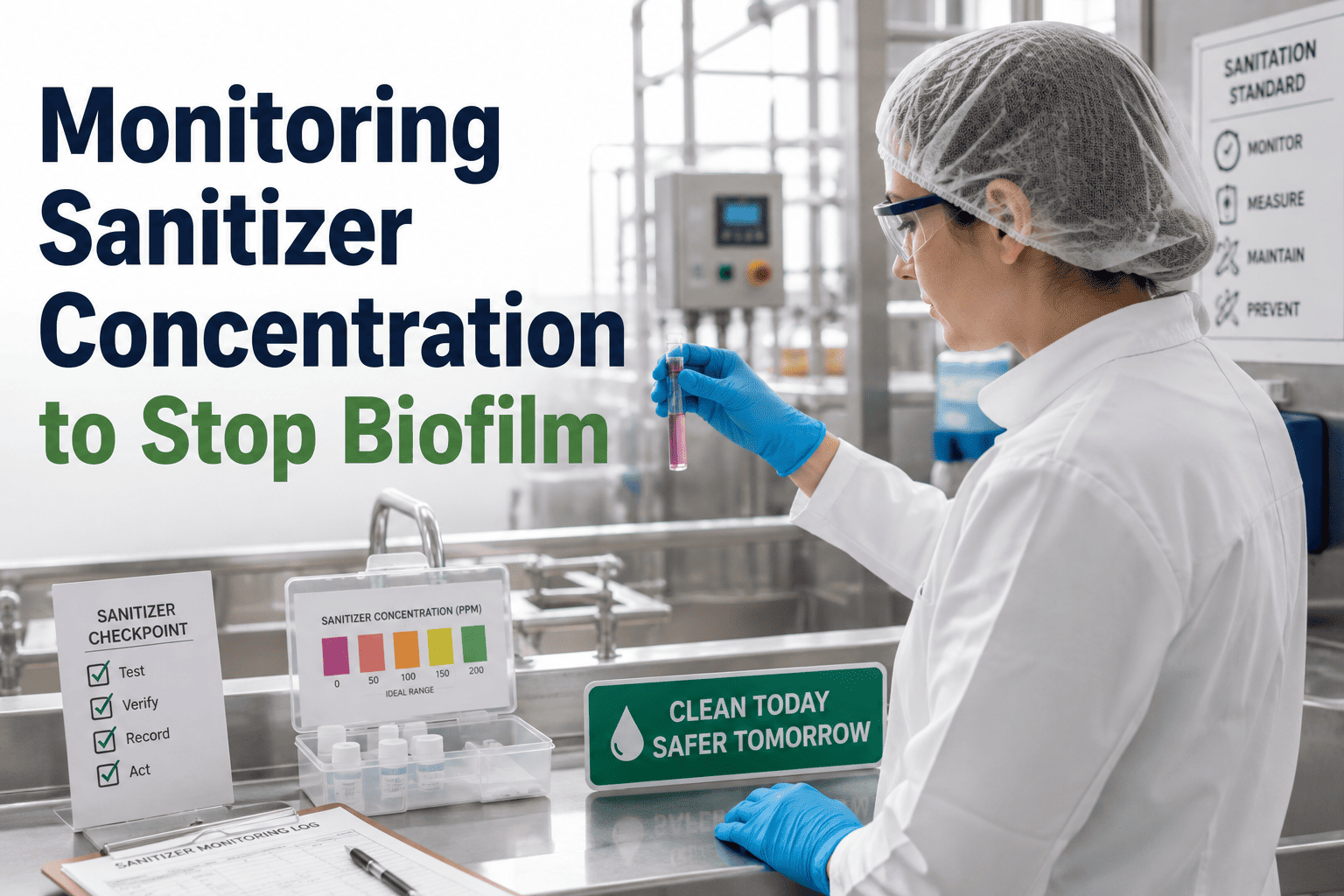
Sanitizer concentration drift is the single most common reason biofilm regrows inside a supposedly clean food plant — a quat delivery that lands 20 ppm below spec, a chlorine loop with a dosing pump that has slipped out of calibration, or peracetic acid that has been sitting in a heated day tank long enough to lose a third of its active strength. Each of those failures looks fine on a paper log; each one leaves a microscopic organic film that Listeria, Salmonella, and environmental flora colonize within hours. The fix is not more chemical — it is a disciplined, CMMS-driven monitoring program built around concentration verification, titration cadence, automated dosing preventive maintenance, and corrective-action records that survive an FDA or third-party audit. Run through the protocol below, then Start Free Trial to deploy the same workflow inside OXMaint.
Sanitizer Concentration Monitoring Guide · 2026
Is your sanitizer actually landing at 200 ppm — or just at 180 ppm on paper?
A 10% underdose is invisible on the daily checklist and devastating in a swab panel. Biofilm regrows in the gap between the spec sheet and the spray ball. This guide translates concentration drift into a CMMS-driven prevention program that keeps quats, chlorine, and peracetic acid within food-safety-defensible range.
The Drift Problem
Why a 200 ppm target delivered at 180 ppm still fails the audit
Sanitizer efficacy is logarithmic, not linear. A 10% underdose does not produce 10% less kill — it produces a surviving population that reattaches, secretes extracellular polymeric substances, and becomes 10–1,000× more tolerant to the next dose.
Verification Protocol
A tiered concentration verification protocol for every sanitizer class
Three verification tiers — operator, maintenance, and quality — must run in lockstep. Each tier owns a specific test, frequency, and CMMS trigger.
Operator Verification
- Quat test strips at every shift change on fogging and CIP final-rinse loops.
- Free-chlorine DPD colorimetric readout twice per shift on flume and chiller water.
- PAA titration kit reading at start-up and 4 hours into the run on the day tank.
- CMMS mobile form auto-flags any reading within 10% of the lower spec limit.
Maintenance Calibration
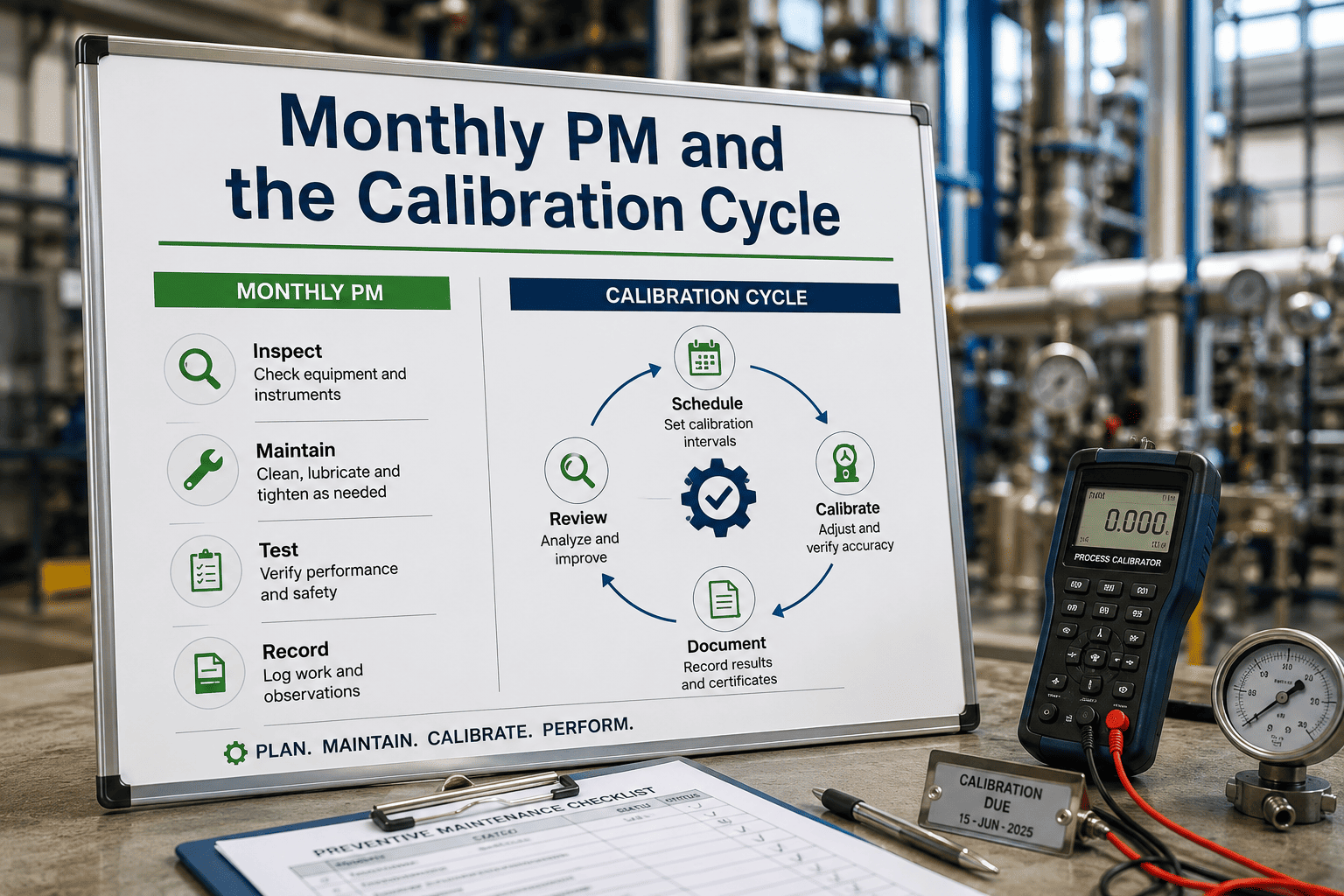
- Dosing pump stroke calibration verified against a graduated cylinder every 30 days.
- Conductivity probe cleaning and 2-point calibration on a 90-day preventive maintenance schedule.
- Injector nozzle inspection for venturi blockage at every filter change.
- Day tank temperature and level sensors validated against a NIST-traceable reference annually.
Quality Audit
- Independent lab titration of concentrate lot at receipt — reject if outside ±5% of label claim.
- ATP swab + environmental Listeria sponge pair on zone-1 surfaces weekly.
- Monthly trend review of every CMMS deviation log with root-cause closure.
- Annual third-party sanitizer-efficacy challenge study against the facility's actual biofilm isolates.
Dosing Drift by Source
Where concentration actually disappears between the drum and the surface
Drift is rarely one failure — it compounds across five points. This matrix shows the dominant drift source for each sanitizer class and the CMMS control that catches it.
| Sanitizer | Target Range | Dominant Drift Source | Drift Signature | CMMS Control |
|---|---|---|---|---|
| Quat (QAC) | 200 ppm | Pump stroke drift & water hardness quenching | Strip reads 160–180 ppm after 2 weeks | 30-day stroke calibration PM + daily strip log |
| Sodium Hypochlorite | 50–100 ppm free | Solution degradation in heated day tank | DPD drops 30% by mid-shift | Covered tank + auto-replenishment trigger |
| Peracetic Acid | 100–200 ppm | Headspace oxidation & wrong dilution ratio | Titration low, pH unchanged | Sealed day tank + ratio alarm in SCADA |
| Chlorine Dioxide | 1–5 ppm residual | Generator feed rate & precursor mix ratio | Residual oscillates ±40% | Inline amperometric probe + 7-day calibration |
| Iodophor | 12.5–25 ppm | Carrier depletion & organic load | Iodine color fades below visible threshold | Spectro verification + solution discard timer |
Worked Scenario
A 180-ppm delivery on a 200-ppm spec — what it actually costs
PLANT PROFILE
A mid-size RTE deli-meat facility runs a quat-based final spray on 14 chiller exit conveyors. The spec is 200 ppm; a recent audit found the average landing concentration was 182 ppm — a 9% drift that no operator had escalated because it still produced a "pass" on the color strip.
Over six weeks, environmental sponges turned positive for Listeria innocua on 3 of the 14 conveyors. The corrective action — chemical deep clean, 72 hours of downtime, and a root-cause investigation — cost an estimated $148,000 in lost production, contract sanitation, and consultant fees. The root cause: two dosing pumps had drifted 11% low since their last calibration, which was 94 days prior.
A CMMS-scheduled 30-day pump calibration PM would have caught the drift at day 30 — before biofilm established. The PM costs roughly $340 per cycle.
CMMS Program Build
The 5-step CMMS program that closes the biofilm gap
Each step is a managed object inside the CMMS — not a paper SOP. Together they create the closed loop that audit-ready plants rely on.
Asset-register every dosing point
Each pump, probe, injector, and day tank becomes a uniquely numbered asset with a sanitizer class, target concentration, and tolerance band attached to its record.
Schedule the PM cadence by chemical
Quat pumps calibrate every 30 days, PAA day tanks inspect every 14 days, conductivity probes calibrate every 90 days, and full system revalidation runs annually — all generated automatically.
Deploy mobile concentration logs
Operators enter strip, DPD, and titration readings on a mobile form that auto-routes any value within 10% of the lower limit into a corrective work order within seconds.
Trend and trigger
Readings feed a control chart per asset. Three consecutive readings trending toward the lower limit trigger an unscheduled pump inspection before a deviation occurs.
Close every deviation with a record
Every out-of-spec event carries a root-cause code, corrective action, and verification re-test — exportable as a single audit-ready PDF in the format FDA and GFSI auditors expect.
Payback Math
What a CMMS-driven sanitizer program returns in the first year
Annual Risk-Adjusted Avoidance
P(event) × Cost(event) − Program cost
0.35 × $148,000 − $8,200 = $43,600 net
Chemical Waste Reduction
(Overdose volume × $/gal) + (Scrap saved)
320 gal × $14.50 + 1,100 lb = $6,290 net
| Investment Line | Annual Cost | Avoidance / Savings Line | Annual Value |
|---|---|---|---|
| CMMS licenses (12 users) | $3,600 | Listeria event avoidance (35% probability) | $51,800 |
| Pump calibration labor | $2,400 | Chemical overuse reduction | $4,640 |
| Probe & test-kit consumables | $2,200 | Scrap & hold reduction | $1,650 |
| Total program cost | $8,200 | Total first-year value | $58,090 |
Payback: approximately 51 days at a single mid-size RTE facility. The payback shortens for multi-site operators running the same CMMS instance across plants.
Stop logging 180 ppm as a pass. Close the drift gap today.
Deploy the full sanitizer concentration monitoring program in OXMaint — asset register, PM cadence, mobile logs, and audit-ready deviation records in one platform.
Frequently Asked Questions
Sanitizer concentration monitoring, answered
How often should sanitizer concentration be verified in a food plant?
Operator verification should occur at every shift change for quats and free chlorine, and at start-up plus mid-shift for peracetic acid. Maintenance calibration of dosing pumps runs on a 30-day CMMS PM, while quality performs an independent lab titration on every concentrate lot at receipt and a full system revalidation annually. High-risk RTE facilities often tighten the cadence to 4-hour intervals on zone-1 surfaces during peak production.
What is the lowest acceptable quat concentration before biofilm risk rises?
For most food-contact quats labeled at 200 ppm, the practical floor is 190 ppm. Below that, kill efficacy drops non-linearly and sessile cells begin EPS secretion within hours. The CMMS should flag any reading below 195 ppm as a warning and any reading below 190 ppm as an automatic corrective work order. To see the exact trigger thresholds configured for your sanitizer class, Book a Demo and our food-safety team will walk you through the default rule set.
Why does peracetic acid lose strength in the day tank?
PAA is an equilibrium mixture of hydrogen peroxide and peracetic acid that degrades when exposed to heat, ultraviolet light, and headspace oxygen. A day tank held above 35°C with exposed headspace can lose 25–30% of its active PAA within 48 hours. The CMMS countermeasure is a sealed, low-headspace tank with auto-replenishment and a 14-day inspection PM that verifies concentration by titration rather than by label claim.
How does a CMMS improve sanitizer monitoring over a paper log?
A CMMS converts each reading into a managed data point that feeds trend charts, auto-triggers corrective work orders when values approach the lower spec limit, and ties every deviation to a root-cause code and verification re-test. Paper logs capture the number but rarely drive action until an audit finds the gap. The CMMS also schedules and tracks the calibration PMs that prevent drift in the first place — the step paper systems almost universally miss.
Can the same program handle chlorine dioxide and iodophor loops?
Yes. Each sanitizer class is configured as an asset profile with its own target range, tolerance band, verification method, and PM cadence. Chlorine dioxide uses an inline amperometric probe with a 7-day calibration cycle, while iodophor relies on spectroscopic verification and a solution-discard timer. The CMMS applies the right rule set per asset, so one platform governs every chemical in the plant without forcing a one-size-fits-all schedule.
Build your biofilm-defensible sanitizer program in OXMaint
Asset registers, PM cadences, mobile concentration logs, trend charts, and audit-ready deviation records — live in under a week, across every line and every sanitizer class.
Free 14-day trial · No credit card