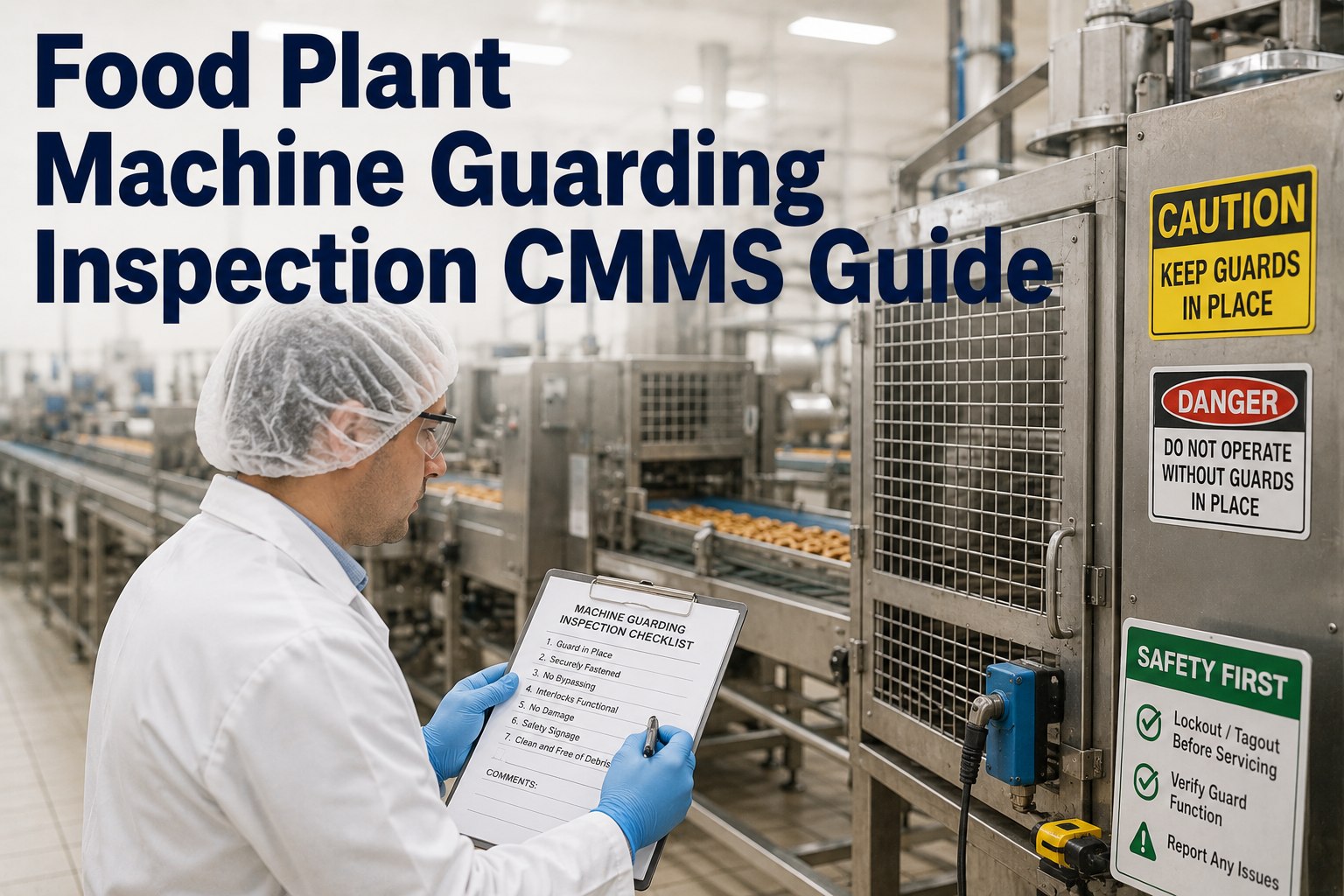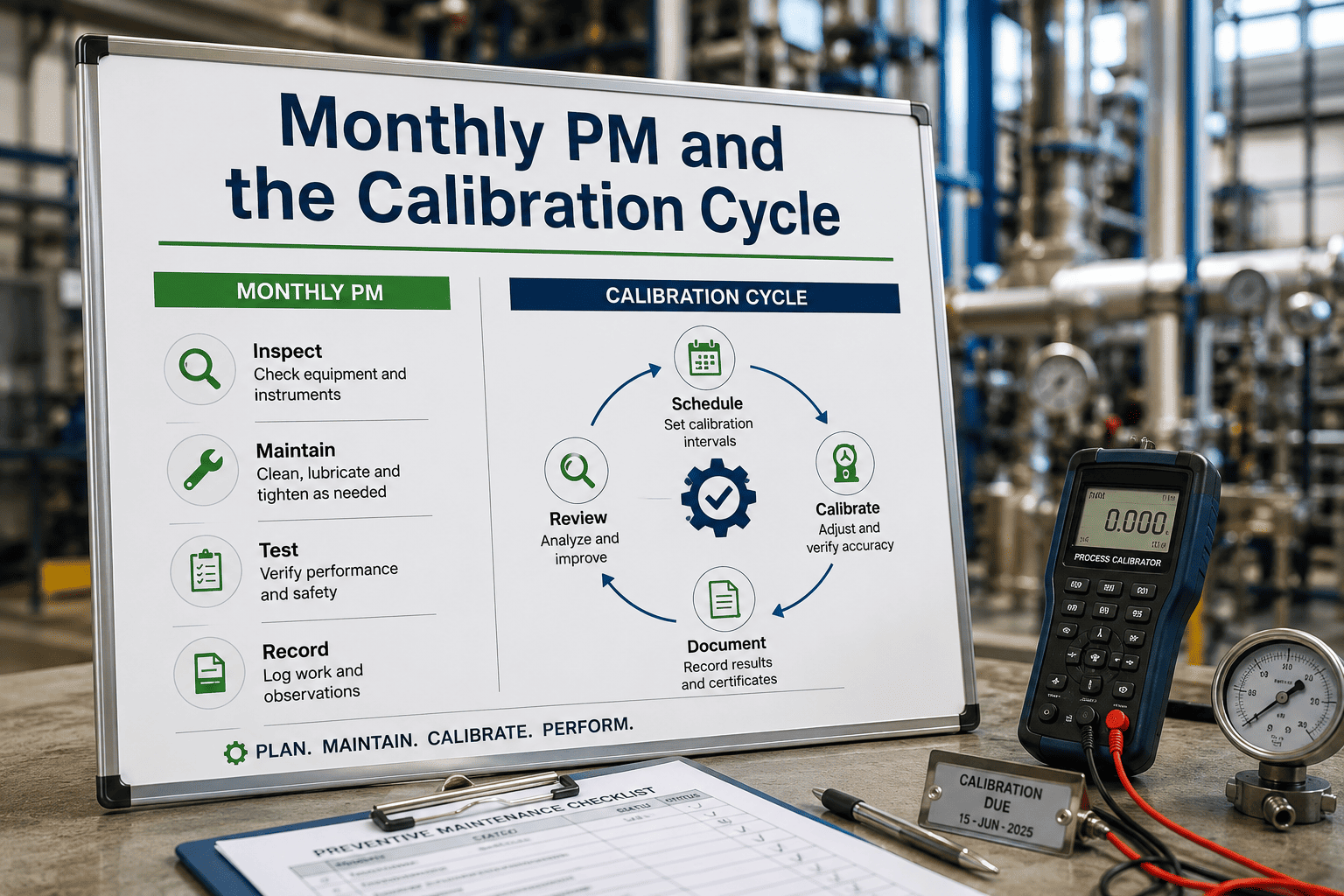
Monthly preventive maintenance is where a food plant's calibration discipline either holds together or quietly drifts — and in an HACCP-regulated environment, drift is the same thing as nonconformance. Across thermometers, pressure transmitters, flow meters, pH probes, and metal-detection coils, monthly PM is the cadence that catches calibration drift before it becomes a recalled lot, a failed audit, or a sanitation deviation. This guide walks through the calibration-integrated monthly PM cycle, the verification workflow, out-of-tolerance handling, and the CMMS scheduling layer that makes every measurement defensible from FDA 21 CFR Part 117 through SQF and BRC audits. Build it once in a system like Start Free Trial and the same checklist becomes repeatable across every line, every month.
Is your monthly PM cycle actually verifying calibration — or just signing off on it?
In food plants, an uncalibrated sensor isn't a maintenance issue. It's a food-safety event waiting for an auditor to find it. Monthly PM is the checkpoint where drift gets caught, documented, and corrected — before a single out-of-tolerance reading reaches a HACCP critical control point.
Why monthly is the make-or-break cadence for food-plant instrumentation
Quarterly calibration is too slow for a 24/7 line; weekly is too costly across hundreds of assets. Monthly sits in the sweet spot — tight enough to catch drift before a CCP is compromised, wide enough to be affordable. Here's what the data and the audit history actually show.
From scheduled trigger to verified, documented, audit-ready
A defensible monthly PM cycle isn't "check the probe and sign the sheet." It's a five-stage workflow that ties the CMMS trigger, the traceable standard, the verification reading, the deviation decision, and the audit record into one closed loop. Skip a stage and the whole calibration history becomes contestable.
Auto-generated work order fires on the 1st of each month
The CMMS raises a work order per asset class — RTD probes, pressure transmitters, flow meters, pH electrodes, metal-detector coils, checkweigher load cells. Each WO carries the asset's last-as-found reading, the acceptable tolerance band, the traceable standard to use, and the assigned technician. No spreadsheets, no sticky notes, no "I'll get to it next week."
Technician pulls the NIST-traceable reference standard
Every verification requires a reference standard whose own calibration certificate is current. The CMMS cross-checks the standard's calibration expiry date in real time — if the dry-block calibrator or reference thermometer is itself overdue, the system blocks the WO from closing and flags a parent-asset dependency. This is the stage most paper-based programs silently fail.
Three-point check captures the instrument's actual state before adjustment
The technician records readings at low, mid, and high points across the operating range — not just one point. As-found data is the legal record of what the instrument was telling the process. If a cooker probe was reading 71°C when the true temperature was 68°C, that 3°C offset has been silently undercooking product, and the as-found record is what determines the recall scope.
In-tolerance → close. Out-of-tolerance → quarantine and investigate.
If as-found readings fall inside the tolerance band, the technician adjusts (if needed), records as-left data, and closes the WO with a digital signature. If any point is out of tolerance, the CMMS automatically raises a deviation, quarantines product produced since the last passing verification, and notifies QA. This is where calibration compliance becomes food-safety compliance.
Closed WO becomes a tamper-evident calibration record
The closed work order — as-found, as-left, standard serial number, standard cert expiry, technician ID, timestamp, environmental conditions — is locked in the CMMS with a revision history. When an SQF or BRC auditor asks to see the last 12 months of calibration evidence for CCP-04, the answer is one filtered report, not three days of binder hunting.
What actually gets verified every 30 days
The monthly PM checklist isn't one list — it's a matrix of instrument classes, each with its own verification method, tolerance band, and reference standard. Below is the working checklist most food plants run, structured the way a CMMS schedules it: by asset class, not by line.
Temperature Probes (RTD / Thermocouple)
- Three-point verification against NIST-traceable dry-block calibrator (low/mid/high across operating range)
- Tolerance band ±1°C for cooking CCPs, ±0.5°C for cooling CCPs — confirm against HACCP plan
- Inspect probe sheath for corrosion, mineral buildup, and seal integrity
- Verify transmitter output signal stability (4–20 mA loop) at each calibration point
- Record as-found and as-left readings with standard serial + cert number
Metal Detector Coils
- Run ferrous, non-ferrous, and stainless-steel test wands at start, middle, and end of each production shift — monthly PM audits the shift logs
- Verify reject mechanism timing with worst-case product (largest pack, highest line speed)
- Inspect belt surface for metal contamination that could mask detections
- Confirm phase-angle sensitivity hasn't drifted from baseline benchmark
- Validate failure-mode alarm (stop belt, lockout) triggers on three consecutive failed tests
Pressure & Flow Instruments
- Pressure transmitter 5-point verification against certified deadweight tester or precision calibrator
- Flow meter (electromagnetic / Coriolis) verification via master meter comparison or gravimetric method
- Check impulse lines for blockage, condensation, or air entrapment
- Inspect process seals and diaphragms for fatigue, pitting, or product ingress
- Confirm HART/signal diagnostics read within manufacturer baseline
pH Meters & Checkweighers
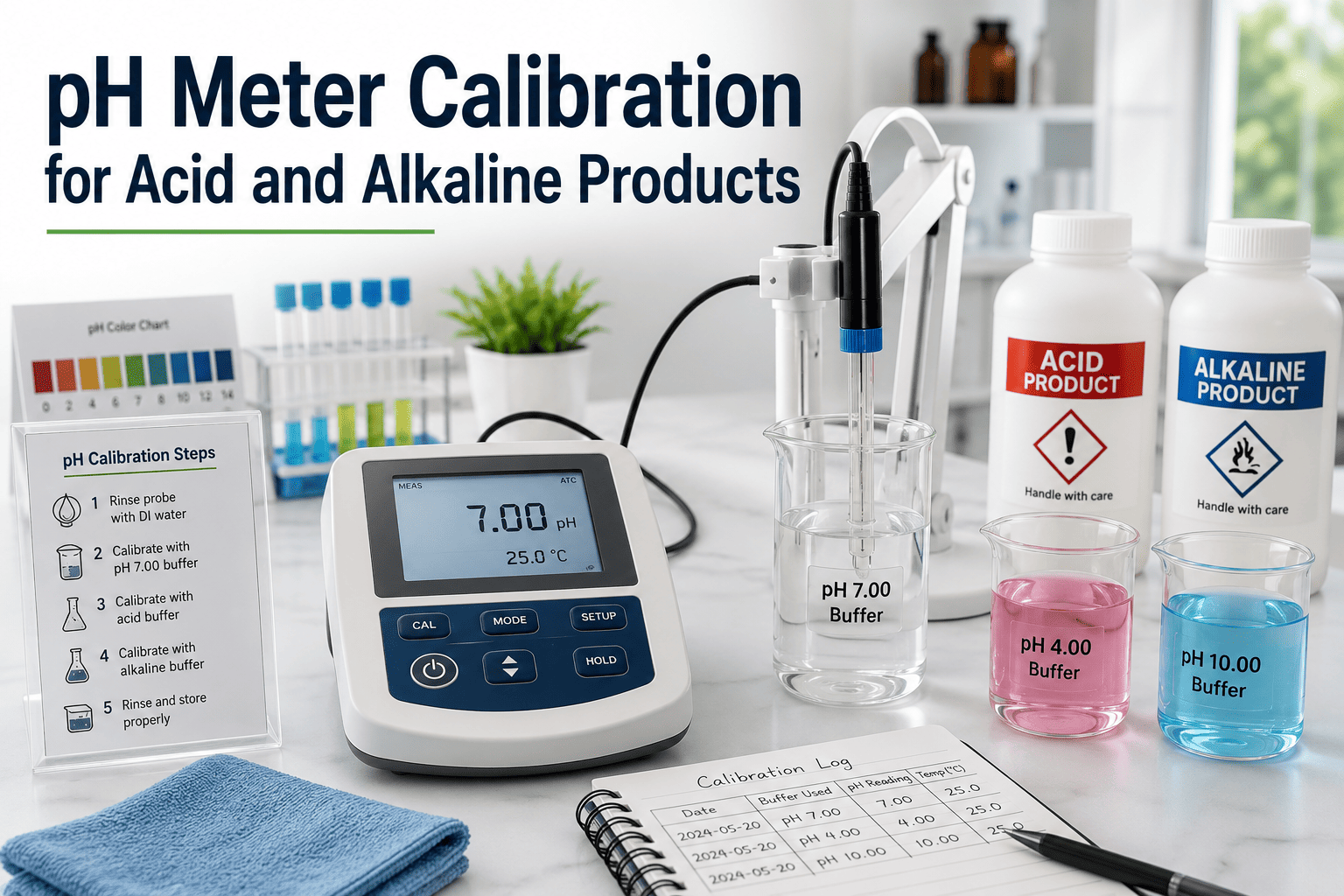
- pH electrode two-buffer calibration (pH 4.01 / 7.00 / 10.01) with slope verification — minimum 95% slope acceptance
- Replace electrode fill solution, clean junction, inspect glass bulb for etching
- Checkweigher linearity test with five certified test weights across the range
- Verify load cell zero return and span stability after 24-hour power cycle
- Audit reject diverter accuracy at target weight ±1 σ
What happens when a verification fails
An out-of-tolerance reading is the moment monthly PM earns its keep — or exposes a program as theater. The protocol below is what a CMMS-driven plant executes the minute an as-found reading falls outside the band. The goal: contain the risk, quantify the exposure, and close the gap before the next lot ships.
Quarantine
CMMS auto-flags all product produced between the last passing verification and the failed reading. Stock is placed on QA hold within minutes — not after someone finds a paper deviation log three days later.
Impact Assessment
QA calculates whether the drift magnitude could have pushed a CCP outside its critical limit. A probe 3°C low on a 74°C kill step is a potential undercook event; a probe 0.3°C low may be a documentation correction only.
Adjust & Re-verify
Technician adjusts the instrument, then runs a full as-left verification. If the instrument can't hold calibration within the same shift, it's tagged out and a spare is swapped in — the CMMS links the swap to the parent WO automatically.
Root Cause & Frequency Review
If the same asset drifts out of tolerance two months in a row, the CMMS escalates its PM frequency from monthly to bi-weekly. Drift patterns feed back into the reliability program — that's the difference between calibration and calibration management.
The compliance gap you can't see on a clipboard
Most food plants don't fail audits because they skipped calibrations — they fail because the paper record was incomplete, illegible, or missing the traceable-standard cross-reference. The table below maps where paper-based monthly PM breaks down and where a CMMS closes each gap.
| Monthly PM Dimension | Paper Log / Spreadsheet | CMMS-Driven Program |
|---|---|---|
| Scheduling trigger | Calendar reminder, manual entry, easily deferred | Auto-generated WO on fixed cadence, escalates if overdue by 48 hrs |
| Standard cross-reference | Technician must remember to check cert expiry — often skipped | System blocks WO closure if reference standard cert is expired |
| As-found data capture | Handwritten, often single-point, frequently illegible | Digital entry with mandatory 3-point capture, photo attachment |
| Out-of-tolerance response | Deviation raised manually, days later, QA notified by email | Auto-quarantine, auto-deviation, real-time QA notification |
| Audit retrieval time | 2–4 hours per asset, binders and shared drives | Under 30 seconds, filtered report with full revision history |
| Drift trend visibility | None — each month is a blank sheet | Cross-asset drift dashboard, auto-frequency escalation on repeat OOT |
| Audit finding rate | 1.4 calibration nonconformances per audit (industry avg.) | 0.2 or fewer — findings drop ~85% in first audit cycle |
A 180-asset plant, one year, two approaches
Consider a mid-size ready-meals plant with 180 calibrated instruments across four lines — cookers, chillers, fillers, metal detectors, checkweighers. Here's what 12 months of monthly PM looks like on paper versus on a CMMS, using real benchmark figures from 2024 food-plant maintenance data.
Stop signing off on calibrations you can't defend
Turn monthly PM into a closed-loop, audit-ready calibration program — every instrument, every reading, every deviation, automatically documented.
Monthly PM & calibration cycle — answered
Why is monthly the right PM cadence for food-plant calibration — not quarterly or weekly?
Monthly balances drift risk against labor cost. Industry data shows most RTD and thermocouple probes in food-plant conditions begin measurable drift at the 25–35 day mark, so quarterly leaves a 60-day blind spot. Weekly verification of 180+ instruments would consume 400+ labor hours a month. Monthly catches drift inside the window where correction is cheap and exposure is limited — typically 30 days of production, not 90.
What makes a calibration record "audit-defensible" under SQF, BRC, or FSMA?
An auditor needs five elements: the instrument ID, the as-found and as-left readings, the traceable reference standard serial number and its certificate expiry, the technician identity, and a timestamp. A CMMS like Start Free Trial captures all five automatically and locks the record with revision history — paper logs typically capture two or three and are contestable on the rest.
How should a plant handle an out-of-tolerance finding during monthly PM?
Immediately quarantine all product produced since the last passing verification, then run an impact assessment to determine whether the drift magnitude could have breached a CCP critical limit. Adjust or replace the instrument, re-verify, document as-left readings, and escalate the PM frequency if the same asset drifts out again the following month. The CMMS should automate the quarantine flag and QA notification — manual email chains cost hours the recall window doesn't have.
Can a CMMS verify the reference standard's own calibration status before allowing a PM to close?
Yes — and this is the single most overlooked control in paper-based programs. A CMMS cross-references the reference standard's calibration certificate expiry date in real time. If the dry-block calibrator or precision thermometer is itself overdue, the system blocks the work order from closing and raises a parent-asset dependency alert. This prevents the common audit failure of verifying instruments with an expired standard.
How long does it take to implement a CMMS-driven monthly calibration PM program?
For a 180-asset food plant, typical implementation is 3–4 weeks: asset import (2 days), tolerance band and standard mapping (5–7 days), work-order template configuration (3 days), and technician training (2 days). Most plants run their first fully CMMS-driven monthly cycle within 30 days of kickoff. You can see exactly how this maps to your asset list — Book a Demo and we'll walk through it.
Your next audit is one monthly cycle away
Build the calibration-integrated PM program that auditors respect and technicians actually follow. Start your free trial today or book a 30-minute walkthrough.
Free 14-day trial · No credit card