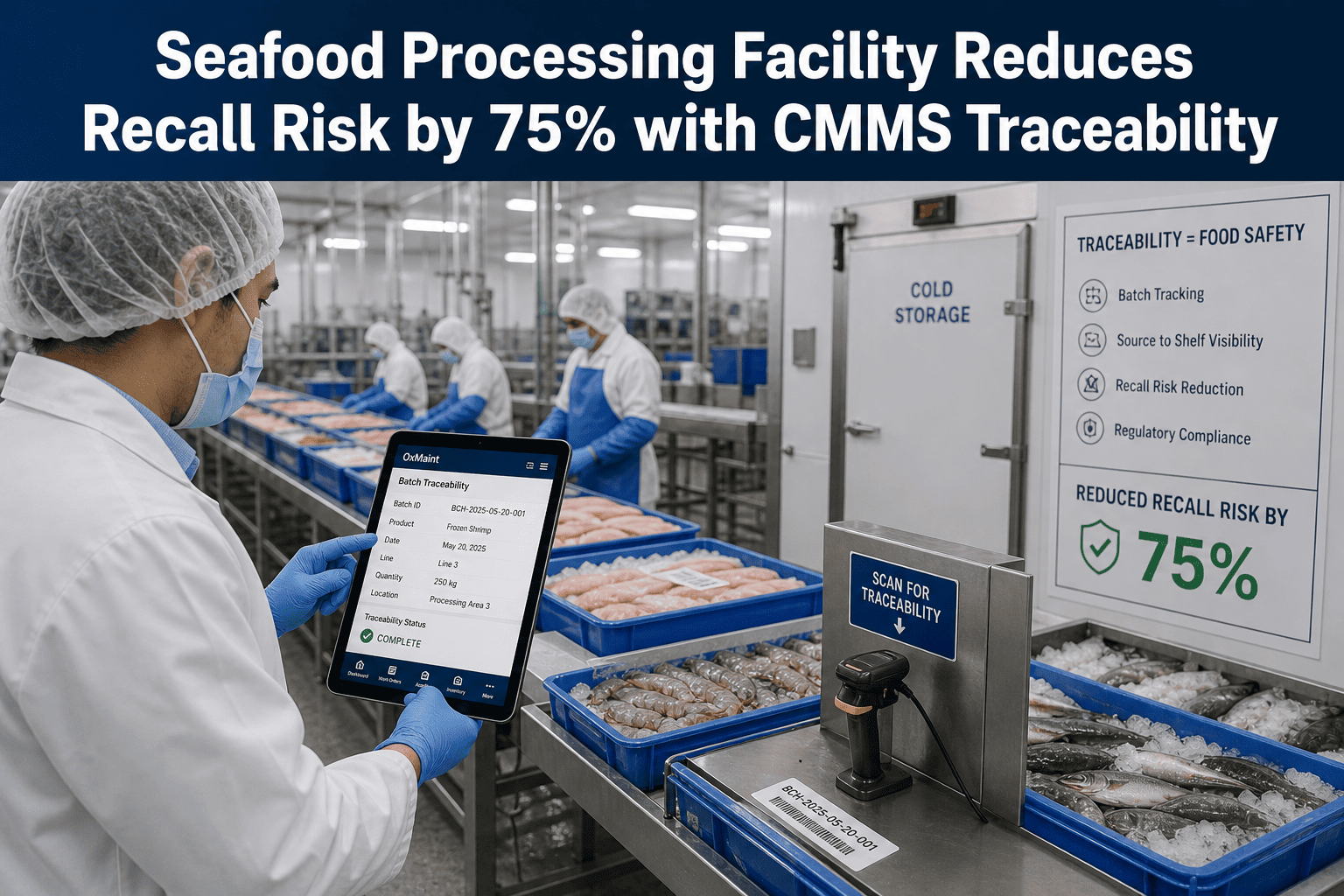
A seafood recall doesn't just cost money — it costs the trust that took years to build with retail buyers, food service distributors, and regulatory agencies. The average cost of a Class I food recall in the seafood industry now exceeds $10 million when you factor in product destruction, logistics, customer notification, and regulatory investigation. Yet 75% of recall triggers in seafood processing are preventable with proper traceability systems and corrective maintenance workflows. This case study details how a mid-size seafood processing facility reduced their recall risk by 75% in under 18 months — by replacing disconnected paper records with a unified CMMS traceability system through Oxmaint. Start a free trial and build your first batch traceability workflow today, or book a demo to see how seafood processors are eliminating recall exposure with digital equipment and batch records.
Case Study · Seafood Processing · Recall Prevention
Seafood Plant Cuts Recall Risk by 75% with CMMS Traceability
How a seafood processing facility used batch traceability, equipment tracking, and automated corrective action workflows to slash recall exposure — and pass their next FDA audit without a single traceability finding.
75%
Recall risk reduction achieved within 18 months of CMMS deployment
$10M+
Average cost of a Class I seafood recall including logistics and investigation
4 hours
Time to generate a full batch traceability report — down from 3 days
100%
Equipment-to-batch linkage on all production lines after implementation
The Problem
What Was Driving Recall Risk at This Facility
This facility processes fresh and frozen finfish, shellfish, and value-added seafood products across six production lines. They distribute to retail grocery chains, food service distributors, and direct to foodservice operators — a customer mix where a single recall event can trigger contract termination across multiple accounts simultaneously.
Their traceability system was a patchwork of paper batch records, a standalone temperature log at each refrigeration zone, and a maintenance work order system that ran completely separate from production records. When equipment touched product — a fillet conveyor, a glazing drum, a blast freezer — there was no documented link between the equipment's maintenance history and the product batches it processed.
When an FDA inspector asked them to trace a specific lot of halibut back to the equipment it was processed on and identify any maintenance events on that equipment within 72 hours of processing, it took the team 3 days to produce an incomplete answer. That was the moment the plant manager committed to a system change. Start a free trial and connect your equipment records to production batches, or book a demo to see how the Oxmaint traceability architecture works for seafood processing.
Pre-Implementation Traceability Gaps
No equipment-to-batch linkage — maintenance records existed in a separate system from production
Temperature deviations in blast freezers logged manually — 6-hour detection lag on excursions
Corrective actions for equipment faults not linked to the batches processed during the fault
Fillet conveyor hygiene verification records not retained beyond 30 days
No automated alert when a CCP equipment check was overdue or missed
Recall mock drill took 3 days — FDA FSMA requires 4-hour traceability capability
Risk Drivers
The Four Traceability Failures That Create Recall Exposure
01
Equipment Records Disconnected from Product Batches
When a fillet conveyor belt frays or a scale goes out of calibration, the question is not just "was it fixed?" — it's "which product batches were potentially affected?" Without a documented link between equipment events and production runs, a recall scope determination becomes guesswork. FSMA's traceability rule requires that food manufacturers can identify all food produced during any equipment fault event within 24 hours.
02
Temperature Excursions Detected Hours After They Begin
Seafood is unforgiving. A blast freezer that drifts 4°C above set-point for 6 hours — discovered only at the next manual temperature check — may have compromised a full production run. The product is already packaged and possibly already staged for shipment. Real-time equipment monitoring with automated alerts is the difference between a contained corrective action and a product recall.
03
Corrective Actions Not Linked to Affected Product
FDA investigators look for corrective action records that demonstrate the facility identified the scope of potentially affected product at the time of the non-conformance — not just that they fixed the equipment. A corrective action work order that says "repaired conveyor belt" with no reference to product batches processed during and after the fault represents a traceability gap that will be cited as a 483 observation.
04
CCP Equipment Checks Going Overdue Without Escalation
Metal detector verification, checkweigher calibration, and temperature monitoring validation are CCP-supporting checks in most seafood HACCP plans. When these checks go overdue — even by one shift — the product produced during that gap may need to be placed on hold pending verification. Without automated escalation, overdue CCP checks often go unnoticed until the next manual schedule review.
The Oxmaint Solution
How Oxmaint Built End-to-End Traceability for This Seafood Plant
01
Equipment-to-Batch Record Linkage
Every production line piece of equipment registered in Oxmaint. Work orders, inspections, and fault events on any equipment are tagged with the active production batch at time of event — creating a permanent bidirectional link between maintenance history and product history.
02
Real-Time Temperature Monitoring Integration
IoT sensors in blast freezers, refrigerated storage, and processing areas connected to Oxmaint. Breach alerts fire within minutes, automatically generating a work order and flagging all product batches in the affected zone for hold review — before product ships.
03
Corrective Action With Batch Scope Documentation
When a corrective action is raised, Oxmaint prompts for the production batch scope — which lots were processed during the fault window. This data is stored with the corrective action record, giving FDA investigators the complete picture without a multi-day manual search.
04
CCP Equipment Check Escalation
CCP-supporting equipment checks scheduled in Oxmaint with hard escalation rules. If a metal detector verification check goes overdue by more than one shift, the plant manager and QA lead receive an alert automatically — no manual schedule review required to catch a gap.
05
4-Hour Recall Mock Drill Capability
Oxmaint's batch traceability export generates a complete report — equipment used, maintenance events, temperature data, corrective actions, and lot disposition — in under 4 hours. FSMA traceability rule compliance is now a reporting function, not a multi-day investigation.
06
Long-Retention Record Archive
All hygiene verification records, equipment inspection logs, and temperature data retained in Oxmaint for the full FDA-required retention period — with no manual purging risk. Records are searchable by equipment, date, batch, or inspector in seconds.
Before vs. After
Traceability and Recall Readiness: Paper vs. Oxmaint
| Traceability Capability |
Paper / Disconnected Systems |
With Oxmaint CMMS |
| Batch-to-equipment linkage |
No link — separate systems, manual cross-reference |
Automatic bidirectional link at every event |
| Temperature excursion detection |
6+ hour lag — discovered at next manual check |
Real-time alert within minutes of breach |
| Corrective action scope documentation |
Equipment-only — no batch scope recorded |
Batch scope captured at corrective action creation |
| CCP equipment check overdue escalation |
Discovered at next manual schedule review |
Automated alert after one shift overdue |
| Recall mock drill time |
3 days — incomplete results |
Under 4 hours — full FSMA-compliant report |
| Recall risk exposure |
Unquantified — scope determination reactive |
75% reduction in recall risk events over 18 months |
A recall at your facility is not a question of if — it's a question of whether your traceability system can contain the scope in hours, not days. Start a free trial and build your first batch traceability workflow in Oxmaint today, or book a demo to see how seafood processors have cut recall exposure by 75%.
75%
Recall risk reduction in 18 months
Measured against pre-implementation recall event frequency and scope
4 hrs
Full batch traceability report time
Down from 3 days of manual cross-referencing across disconnected systems
0
Traceability 483 findings on next FDA audit
First clean traceability audit in facility history
6 min
Average temperature excursion alert time
Vs. 6+ hour average detection lag with manual checks
FAQ
Frequently Asked Questions
What FSMA traceability requirements apply to seafood processing facilities?
FDA's FSMA Food Traceability Rule (21 CFR Part 1, Subpart S) establishes enhanced traceability record requirements for foods on the Food Traceability List (FTL) — and finfish and shellfish are explicitly included. Under the rule, seafood processors must maintain Key Data Elements (KDEs) for Critical Tracking Events (CTEs) including transformation events (where raw product is converted to a processed product), shipping events, and receiving events. The rule requires that records be retrievable within 24 hours of an FDA request, and that facilities can identify the immediate previous source and immediate subsequent recipient of any traceable food within that window. FSMA also requires mock recall exercises to demonstrate traceability capability. Oxmaint supports this by maintaining the equipment-event-to-batch linkage and generating exportable traceability reports that map each lot through its production journey — meeting the KDE documentation requirements for CTE events.
How does Oxmaint connect equipment maintenance records to production batch records?
The linkage in Oxmaint is configured at the asset level. Each piece of production equipment — a fillet conveyor, a glazing drum, a blast freezer, a checkweigher — is registered as an asset in the system. When a work order, inspection, or fault event is created for that asset, the technician or system records the active production batch at the time of the event. This creates a bidirectional record: from the equipment side, you can see all batches processed on that equipment during or near a maintenance event; from the batch side, you can see all equipment events that occurred during that batch's production run. This bidirectional traceability is what enables a 4-hour mock recall — the data is already structured, not buried in separate paper systems.
Can Oxmaint integrate with existing temperature monitoring hardware already installed in the plant?
Yes. Oxmaint integrates with IoT temperature sensors and SCADA systems via API, and supports major industrial sensor protocols including Modbus and MQTT. For seafood processing environments — blast freezers, refrigerated storage, live tank systems, ice production — temperature data from existing hardware can feed directly into Oxmaint, triggering work orders on excursion and linking temperature event records to active batch records automatically. If your facility uses a standalone temperature monitoring system, Oxmaint can also ingest log file exports from common systems for batch record linkage purposes, even without a real-time API connection.
What kind of corrective action documentation does Oxmaint generate for FDA inspections?
When a corrective action is raised in Oxmaint — whether triggered by a temperature excursion, a CCP equipment failure, or a product quality event — the corrective action record captures: the triggering event description, the root cause analysis, the immediate corrective actions taken, the production batches in scope at the time of the event, the disposition decision for those batches (released, held, destroyed), the verification step confirming the corrective action was effective, and the sign-off by the responsible quality or operations manager. FDA investigators can request this package for any date range, any piece of equipment, or any specific batch — and Oxmaint generates the complete record set in a single export without manual compilation.
Recall Risk Reduction — Powered by Oxmaint
The Average Seafood Recall Costs $10M. Your Traceability System Should Cost a Fraction of That Risk.
Oxmaint gives seafood processors the batch traceability, equipment tracking, real-time temperature monitoring, and corrective action documentation they need to cut recall risk by 75% — and pass FDA audits with confidence instead of a three-day manual records search.