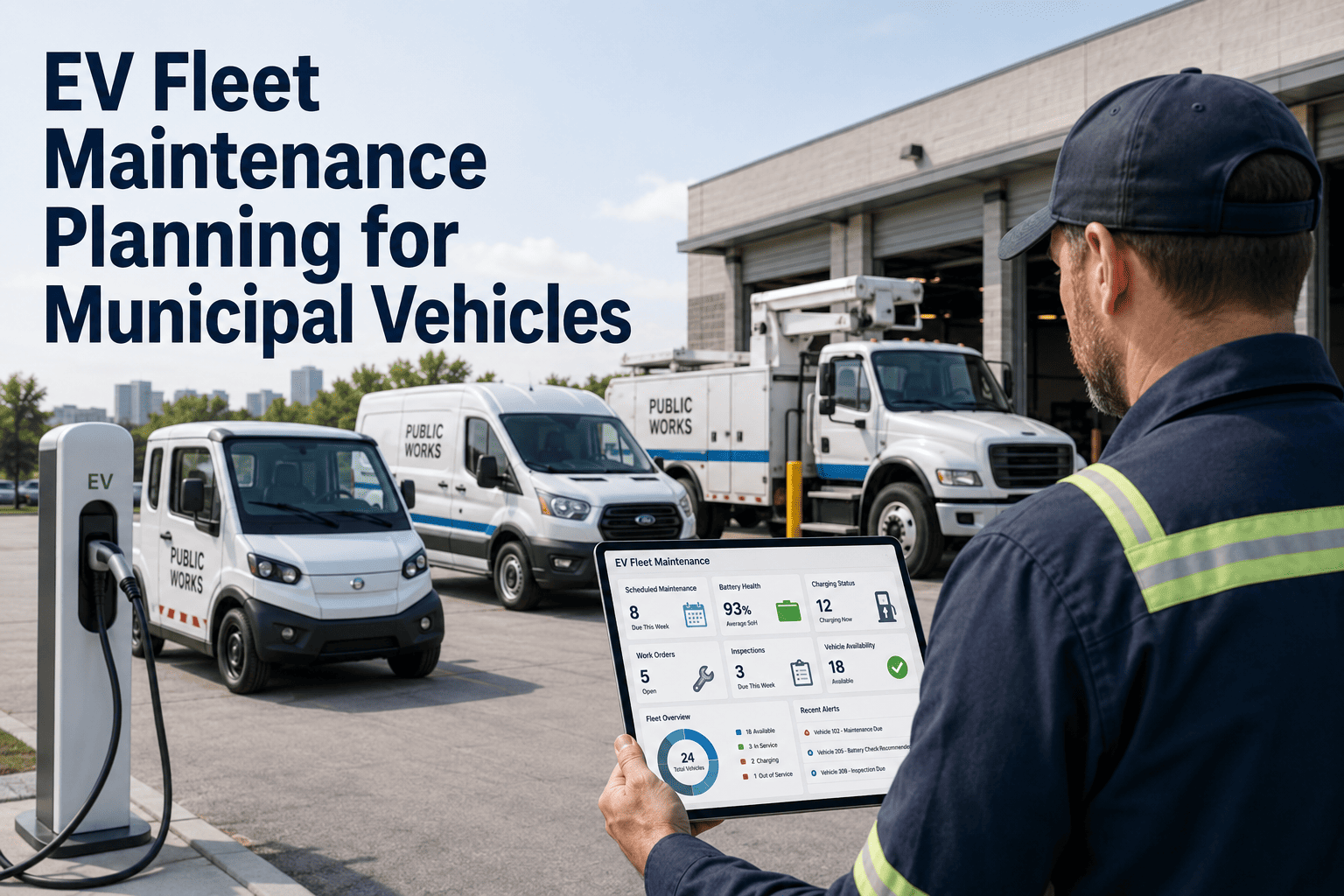
Municipal EV fleets are expanding rapidly — driven by state mandates, federal incentives, and sustainability commitments — but the maintenance frameworks many cities carry over from ICE fleets are poorly suited to battery-electric vehicles. Oil changes become battery health checks. Transmission service gives way to charger maintenance. New failure modes require new inspection protocols. Oxmaint's fleet maintenance software adapts to the reality of modern municipal EV operations, giving fleet managers the tools to plan EV inspections, manage charger uptime, track battery health, and control lifecycle costs across an evolving fleet.
Municipal EV Fleet Blog — 2026
EV Fleet Maintenance Planning for Municipal Vehicles
Plan EV inspections, charger maintenance, battery health checks, technician tasks, and lifecycle costs for modern municipal fleets — before your ICE playbook fails you.
Battery Health Monitoring
Charger PM Scheduling
Lifecycle Cost Tracking
OEM Interval Compliance
Range Planning
Why EV Maintenance Is Different — and Where Fleets Get It Wrong
Electric vehicles eliminate engine oil, spark plugs, timing belts, and exhaust systems — but they introduce an entirely new set of maintenance requirements that most municipal fleet managers are not trained for. The most dangerous assumption is that lower ICE maintenance translates to lower total maintenance burden. In practice, EV fleets require more disciplined data tracking, not less, because battery degradation and charger health are invisible without the right tools.
Engine oil, filter changes (every 5–7K miles)
replaced by
Coolant loop inspection, thermal management checks
Transmission fluid service
replaced by
Drive unit fluid check (some models, OEM-specified)
Spark plug replacement
replaced by
Battery health state-of-charge calibration
Exhaust system inspection
replaced by
Charging port, cable, and connector inspection
Alternator / belt inspection
replaced by
DC fast charger preventive maintenance
Fuel system service
replaced by
Battery pack condition and capacity trend analysis
The 5 EV Maintenance Pillars Every Municipal Fleet Needs
01
Battery Health Tracking
Monitor state of health (SoH) and state of charge (SoC) trends for each vehicle's battery pack. Degradation caught early extends pack life by 20–35% and prevents mid-shift range failures that sideline units unexpectedly.
02
Charger Preventive Maintenance
Level 2 and DC fast chargers require regular cable inspection, connector cleaning, firmware updates, and circuit testing. Unplanned charger outages during overnight charging can strand entire vehicle pools by morning shift.
03
OEM-Specified Service Intervals
EV manufacturers — Ford Pro, Stellantis, GM Fleet, BYD — publish their own service interval guides. These cover brake fluid, cabin air filters, thermal management coolant, and high-voltage safety inspections. Oxmaint configures these intervals per vehicle make and model.
04
Range & Operational Planning
Route assignments must align with vehicle charge levels and battery capacity at current SoH. Oxmaint's fleet analytics support range planning by tracking available range per vehicle against planned shift routes.
05
Lifecycle Cost Analysis
EV TCO comparisons against ICE vehicles require granular cost tracking: charging cost per mile, battery warranty claims, brake pad lifespan (extended by regen braking), and avoided fuel spend. Oxmaint builds per-vehicle cost profiles automatically.
EV Fleet Maintenance Checklist by Interval
| Interval |
Maintenance Task |
EV-Specific Consideration |
Oxmaint Trigger |
| Daily |
Visual inspection, tire pressure, charging port check |
Check charge level and estimated range for shift |
Digital shift checklist |
| Monthly |
Cabin air filter, wiper blades, brake inspection |
Brake wear slower due to regenerative braking — inspect, don't assume |
Calendar-based work order |
| 6 Months / 7,500 mi |
Tire rotation, battery thermal system check, coolant visual |
Thermal management failure is the top cause of premature battery degradation |
Mileage or calendar trigger |
| 12 Months / 15K mi |
Brake fluid, suspension, high-voltage safety inspection |
HV inspection requires certified EV technician — schedule lead time accordingly |
Mileage + calendar trigger |
| 2 Years |
Coolant loop replacement, battery health diagnostic |
OEM SoH thresholds: action required if capacity drops below 80% |
Calendar-based PM |
| As Needed |
Charger cable replacement, connector cleaning, firmware update |
Level 2 and DCFC maintenance often overlooked — critical for fleet charging reliability |
Condition-triggered work order |
EV Fleet Transition: What the Data Shows
23%
Lower maintenance cost per mile for municipal EVs vs. comparable ICE vehicles (excluding battery replacement)
68%
Of EV fleet managers report inadequate internal training for HV battery maintenance procedures
$18K
Average cost of premature battery replacement — typically preventable with proper thermal management and charging discipline
2031
Target year for 50% EV adoption in municipal fleets under current federal and state sustainability mandates
EV Fleet CMMS
Your ICE Maintenance Playbook Won't Work for EVs
Oxmaint gives municipal fleet managers EV-specific PM schedules, battery health tracking, charger maintenance workflows, and lifecycle cost analytics — built for the vehicles your fleet is transitioning to today.
Expert Review
The municipalities that are succeeding with EV fleet transitions are those that treated maintenance planning as a first-class requirement from day one — not an afterthought addressed after procurement. Battery thermal management, charger uptime, and OEM service interval compliance are not optional disciplines. The data from early adopter fleets is clear: organizations with structured digital maintenance programs for their EVs are experiencing 30–40% lower total lifecycle costs than those applying modified ICE maintenance practices. The investment in a CMMS configured for EV operations pays back within 12–18 months at almost any fleet size.
Municipal EV Fleet Operations Research
American Public Works Association & Fleet Management Weekly, 2025
Frequently Asked Questions
How does Oxmaint handle EV-specific PM intervals that differ from traditional fleet schedules?
Oxmaint supports fully configurable PM schedules per vehicle make and model. EV-specific intervals — including thermal system checks, HV battery diagnostics, and charger maintenance — are set up during onboarding based on OEM documentation for each vehicle in your fleet. As OEM guidance is updated, schedules are adjusted in the platform. This eliminates the risk of applying ICE-era maintenance intervals to vehicles with fundamentally different service requirements.
Book a demo to review EV schedule configuration for your specific fleet composition.
Can Oxmaint track battery health degradation over time and alert when capacity drops?
Yes. Technicians can log battery state-of-health readings during scheduled diagnostic inspections, and Oxmaint tracks these readings against each vehicle's baseline. When SoH falls below a configurable threshold — typically 80% of original capacity — the system generates an alert for fleet manager review. This gives agencies early warning before range limitations impact operational assignments and before warranty claim windows close. Battery health trends are visible in the fleet analytics dashboard alongside other vehicle performance metrics.
Does Oxmaint support charger maintenance scheduling as an asset class separate from vehicles?
Yes. Charging stations are configured as assets in Oxmaint — with their own inspection schedules, maintenance work orders, and service history. Level 2 EVSE and DC fast chargers each carry PM templates covering cable inspection, connector cleaning, display function, and firmware status. When a charger goes down, the fault is logged as a work order with urgency flags, ensuring the shop can prioritize repairs that would otherwise strand multiple vehicles.
Start a free trial to set up your charging infrastructure as a tracked asset class.
How does Oxmaint help justify EV fleet expansion to city councils and budget committees?
Oxmaint generates per-vehicle cost reports covering maintenance spend, charging cost, avoided fuel cost, and total cost of ownership — broken down by vehicle type and compared across fleet segments. These reports are formatted for export and are built on real operational data, not projections. Council presentations backed by 12–24 months of Oxmaint cost data consistently show EV TCO advantages that are difficult to argue with — making budget approval for fleet expansion significantly more straightforward than spreadsheet-based estimates.
Plan Your EV Fleet Maintenance Before Your Fleet Outpaces You
Oxmaint supports EV-specific PM schedules, battery health tracking, charger asset management, and lifecycle cost analytics — for municipal fleets at any stage of electrification.