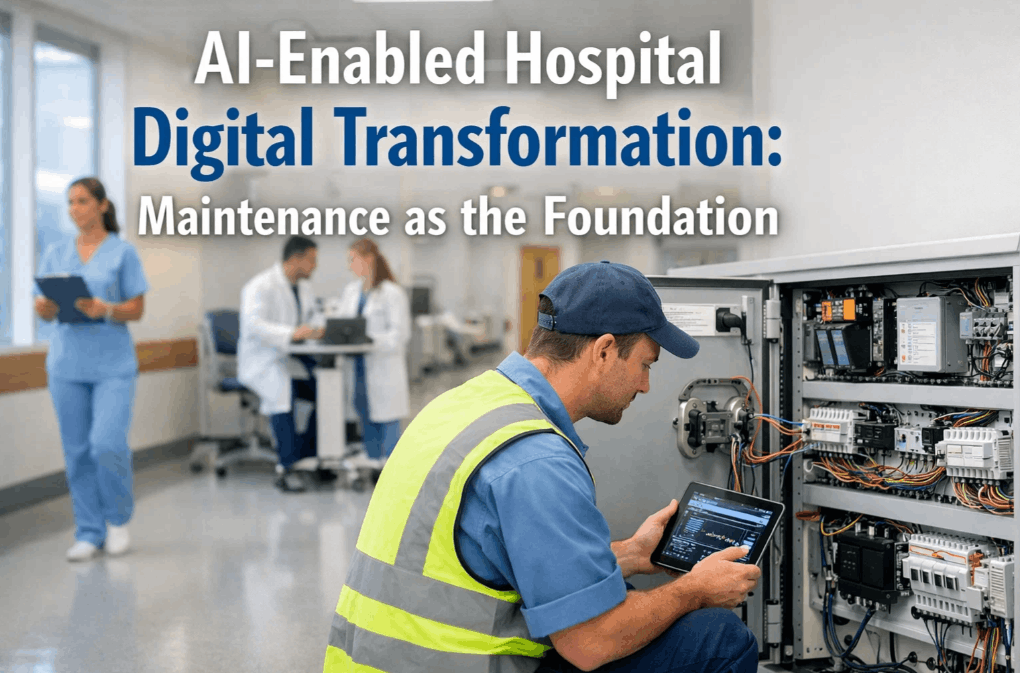
Hospitals are no longer just places of care — they are complex digital ecosystems where thousands of interconnected devices, infrastructure systems, and clinical workflows must operate in perfect synchrony. As AI reshapes every layer of healthcare delivery, one truth has emerged that many transformation leaders overlook: digital transformation without a smart maintenance foundation is a house of cards. The hospitals winning this race are not those with the most AI tools — they are the ones that have embedded AI-driven maintenance intelligence into the very core of their infrastructure strategy. If your organization is serious about building a future-ready digital hospital, sign up for OxMaint and see how leading health systems are making maintenance the cornerstone of their AI transformation.
Discover how AI-powered maintenance management accelerates hospital digital transformation from the ground up.
The Digital Hospital Paradox: Advanced Technology, Fragile Foundations
Modern hospitals are deploying AI diagnostics, robotic surgical systems, smart ICU monitoring, and cloud-based EHR platforms at an unprecedented pace. Yet according to industry surveys, a significant share of healthcare IT leaders report that unplanned equipment downtime regularly disrupts these advanced capabilities. The paradox is stark: hospitals invest millions in cutting-edge technology while the foundational infrastructure that keeps those systems running — HVAC controls, power systems, medical equipment, building automation — is managed through spreadsheets, paper logs, and reactive break-fix protocols.
This is not a resources problem. It is a strategy problem. Digital transformation in healthcare has historically been framed around patient-facing technologies: telemedicine portals, AI triage tools, predictive analytics dashboards. Maintenance and asset management were treated as back-office concerns, disconnected from the transformation agenda. The hospitals that have broken through this paradigm understand that AI-enabled maintenance is not a support function — it is a strategic enabler that determines whether every other digital investment actually delivers value.
Why Maintenance Is the Foundation of AI Hospital Strategy
Consider what happens when an MRI system experiences unplanned downtime in a hospital deploying AI-assisted radiology workflows. The AI diagnostic tool is rendered useless. Patient scheduling cascades into chaos. Revenue evaporates. The clinical team's trust in the digital infrastructure erodes. A single maintenance failure does not just interrupt one system — it destabilizes the entire digital value chain built on top of that physical asset.
AI-enabled maintenance management changes this equation fundamentally. By integrating sensor data, machine learning models, and workflow automation into a unified platform, hospitals gain the ability to predict equipment failures before they occur, automate compliance documentation, and optimize asset lifecycles across every department. The result is a resilient digital backbone that makes every other AI investment more reliable, more scalable, and more defensible to healthcare boards and regulators.
The Five Pillars of AI-Driven Hospital Maintenance Transformation
Building maintenance as a strategic foundation requires more than deploying software — it requires rethinking how asset intelligence, operational data, and clinical workflows intersect. Here are the five pillars that define a mature AI-enabled hospital maintenance strategy.
Unified Asset Intelligence Platform
AI transformation begins with visibility. A unified asset intelligence platform consolidates all hospital equipment — from imaging systems and ventilators to elevators and chillers — into a single digital registry. Each asset carries a real-time health score derived from sensor telemetry, maintenance history, and usage patterns. This eliminates the fragmented visibility that plagues traditional facilities management and gives hospital leadership a single source of truth for every physical asset in the building.
Predictive Failure Detection with Machine Learning
Traditional scheduled maintenance is a blunt instrument — it services equipment whether it needs it or not, and it misses failures that develop between scheduled windows. AI-driven predictive maintenance uses machine learning models trained on equipment sensor streams to detect anomaly signatures weeks before clinical symptoms appear. Vibration pattern deviations in imaging system gantries, thermal drift in autoclave chambers, pressure fluctuations in medical gas distribution — each of these signals can be identified and acted upon before failure occurs.
Automated Compliance and Regulatory Documentation
Healthcare is one of the most heavily regulated industries in the world, and equipment compliance documentation is a constant operational burden. The Joint Commission, CMS Conditions of Participation, NFPA 99, and state health department requirements all demand extensive, audit-ready records of maintenance activities. AI-driven CMMS platforms automate this documentation layer entirely — generating work orders, logging completion, linking to calibration certificates, and assembling inspection packages without manual effort. This transforms compliance from a reactive scramble into a continuous, automated process.
Intelligent Workforce and Resource Optimization
Hospital maintenance teams are consistently stretched — managing more assets with constrained staffing while navigating increasingly complex regulatory requirements. AI optimization layers help maintenance directors allocate technician time based on predicted workload, equipment criticality, and skill matching. Automated work order routing, parts inventory forecasting, and contractor scheduling reduce the administrative overhead that consumes a disproportionate share of maintenance leadership bandwidth.
Integration with Clinical and Operational Digital Systems
The most powerful transformation occurs when AI maintenance systems communicate bidirectionally with clinical and operational platforms. When an AI maintenance alert about a HVAC system in the surgical suite triggers an automatic notification to OR scheduling, clinical leadership can proactively adjust the surgical calendar rather than discovering the issue mid-procedure. This cross-system intelligence transforms maintenance from an isolated back-office function into a real-time contributor to clinical safety and operational excellence.
AI Maintenance Across Critical Hospital Infrastructure Domains
Every department of a modern hospital relies on physical infrastructure that must perform to exact specifications. AI-driven maintenance delivers value across all of these domains simultaneously — creating a comprehensive resilience layer beneath the digital hospital.
MRI, CT, and PET scanners represent some of the highest-value and most maintenance-intensive assets in any hospital. AI monitoring of helium consumption trends in MRI systems, X-ray tube cycle counts, and detector calibration drift enables proactive interventions that prevent multi-day outages costing hundreds of thousands in lost revenue and delayed diagnoses.
Ventilators, infusion pumps, patient monitoring systems, and defibrillators require rigorous preventive maintenance to meet patient safety standards. AI-driven scheduling ensures no critical care device ever exceeds its maintenance interval, while real-time monitoring flags anomalies in device performance before they reach the bedside.
Autoclave systems and sterile processing equipment failures create immediate surgical backlog and infection risk. AI maintenance platforms track sterilization cycle logs, monitor chamber pressure and temperature trends, and automatically escalate anomalies to biomedical engineering — keeping surgical supply chains running without interruption.
HVAC, medical gas distribution, electrical infrastructure, and water systems define the physical environment in which every clinical process occurs. AI-driven building system maintenance ensures that operating room pressure differentials, isolation room air exchanges, and temperature-controlled storage environments consistently meet regulatory specifications.
Clinical laboratory analyzers and robotic sample processing systems require precision calibration and contamination control protocols. AI maintenance scheduling coordinates multi-instrument calibration cycles, tracks reagent and consumable inventory, and maintains the documentation infrastructure required for CAP and CLIA compliance.
Robotic surgical systems, laparoscopic towers, and advanced OR equipment require meticulous maintenance programs that coordinate OEM service requirements with internal biomedical engineering workflows. AI platforms manage the complex multi-vendor maintenance landscape of the modern operating room with integrated scheduling and documentation.
Building the AI Maintenance Transformation Roadmap
Transitioning from reactive maintenance to an AI-driven intelligent maintenance infrastructure does not happen overnight. Successful hospital transformation programs follow a phased roadmap that delivers early value while building toward full AI integration. Here is the strategic sequence that leading health systems have used to make this transition successfully.
| Phase | Focus Area | Key Deliverables | Timeline |
|---|---|---|---|
| Phase 1 | Digital Asset Registry | Unified asset database, QR tagging, baseline condition documentation | Months 1–3 |
| Phase 2 | CMMS Implementation | Automated work order management, PM scheduling, compliance documentation | Months 2–5 |
| Phase 3 | IoT Sensor Integration | Real-time equipment telemetry, condition monitoring dashboards, alert workflows | Months 4–9 |
| Phase 4 | AI Predictive Analytics | Failure prediction models, maintenance optimization algorithms, risk scoring | Months 7–14 |
| Phase 5 | Cross-System Integration | Clinical EHR linkage, OR scheduling integration, enterprise BI reporting | Months 12–18 |
The Compliance Dividend: How AI Maintenance Transforms Regulatory Readiness
One of the most immediate and measurable returns on AI maintenance investment is the transformation of regulatory compliance from a periodic crisis into a continuous operational state. Healthcare organizations face overlapping compliance requirements from The Joint Commission, DNV, CMS, state health departments, and specialty accreditation bodies. Each of these frameworks demands extensive documentation of equipment maintenance, calibration, and corrective actions — documentation that traditional maintenance programs struggle to generate consistently.
AI-driven CMMS platforms like OxMaint create an unbroken chain of documentation for every asset in the hospital. Work orders are generated automatically based on manufacturer schedules and regulatory requirements. Completion is logged with technician identification, timestamps, and outcome records. Calibration certificates are linked directly to asset histories. When an accreditation survey is scheduled — or arrives unannounced — the hospital's maintenance team can generate a comprehensive compliance report for any asset, any department, or any time period in minutes rather than days.
This compliance dividend extends beyond survey readiness. It reduces the risk of CMS Conditions of Participation citations, supports Joint Commission Environment of Care standards, and creates the documentation infrastructure required for insurance and risk management purposes. Hospitals that book a demo with OxMaint consistently report that the compliance automation alone justifies the investment within the first year of deployment.
See how OxMaint's AI-powered CMMS builds continuous compliance readiness and predictive maintenance intelligence for hospitals at every stage of digital transformation.
Measuring Transformation: Key Performance Indicators for AI Hospital Maintenance
Hospital executives and board members rightly demand clear return-on-investment metrics for every digital transformation initiative. AI-driven maintenance delivers measurable outcomes across financial, operational, and clinical quality dimensions. Establishing the right KPIs from the outset ensures that the value of maintenance transformation is visible and defensible throughout the organization.
Frequently Asked Questions
Everything hospital leaders and transformation teams need to know about AI-driven maintenance strategy — answered clearly.
AI-enabled hospital digital transformation refers to the comprehensive integration of artificial intelligence technologies across hospital operations, clinical workflows, and infrastructure management. While patient-facing AI applications like diagnostic imaging analysis and predictive clinical analytics receive significant attention, the most strategically important AI deployments are those that build a resilient, intelligent operational foundation — including AI-driven maintenance management, predictive asset monitoring, and automated compliance documentation systems.
Every advanced digital capability in a hospital — AI diagnostics, robotic surgery, smart monitoring systems — depends on physical infrastructure performing reliably. Equipment failures cascade across digital workflows, disrupting clinical operations and undermining confidence in the transformation investment. AI-driven maintenance management eliminates this vulnerability by predicting and preventing failures before they occur, creating the stable operational foundation on which all other digital capabilities can safely scale.
A modern AI-enabled CMMS serves as the operational intelligence layer for hospital asset management. It automates preventive maintenance scheduling, routes work orders to qualified technicians, tracks calibration and compliance documentation, integrates with IoT sensor streams for real-time condition monitoring, and generates the audit-ready reports required by healthcare regulatory bodies. When integrated with clinical and operational systems, a CMMS becomes a central node in the hospital's digital transformation architecture — connecting asset performance data to clinical scheduling, financial planning, and risk management.
AI maintenance management platforms address compliance requirements from The Joint Commission Environment of Care standards, CMS Conditions of Participation, NFPA 99 medical gas and electrical system requirements, CAP and CLIA laboratory accreditation standards, and state health department licensure requirements. The common thread across all of these frameworks is documentation — AI CMMS platforms automate the creation, organization, and retrieval of maintenance records that inspectors and accreditation surveyors require.
Implementation timelines depend on hospital size, existing asset management maturity, and integration complexity. Most health systems achieve foundational CMMS deployment — including asset registry, automated PM scheduling, and compliance documentation — within three to six months. Full AI predictive analytics capabilities with IoT sensor integration typically reach operational maturity within twelve to eighteen months of initial deployment, delivering measurable downtime reduction and cost optimization outcomes throughout the rollout process.
Yes. OxMaint is built for multi-site health system deployment, supporting enterprise-wide asset visibility, centralized compliance documentation, and facility-specific maintenance scheduling simultaneously. Health system leadership gains portfolio-level dashboards showing maintenance performance, compliance status, and risk exposure across every facility, while individual hospital teams manage day-to-day operations within their specific environment. This architecture supports both centralized and decentralized maintenance management models.