A clinical analyzer that has drifted out of calibration doesn't stop working it keeps returning results, they just aren't true anymore. Every patient sample run since the last valid verification is now in question, and in a lab that means potentially wrong values on real people's charts. That's why CLIA doesn't leave calibration verification to memory: it must happen at least every six months, and again whenever a reagent lot changes, a critical part is replaced, or controls drift — with the records kept for two years. Miss a due date or a trigger and it's not just a citation, it's patient results you can't fully stand behind. OxMaint AI tracks every analyzer's calibration-verification schedule and trigger events, so a lab proves its results are valid — and never learns it's overdue from an inspector.
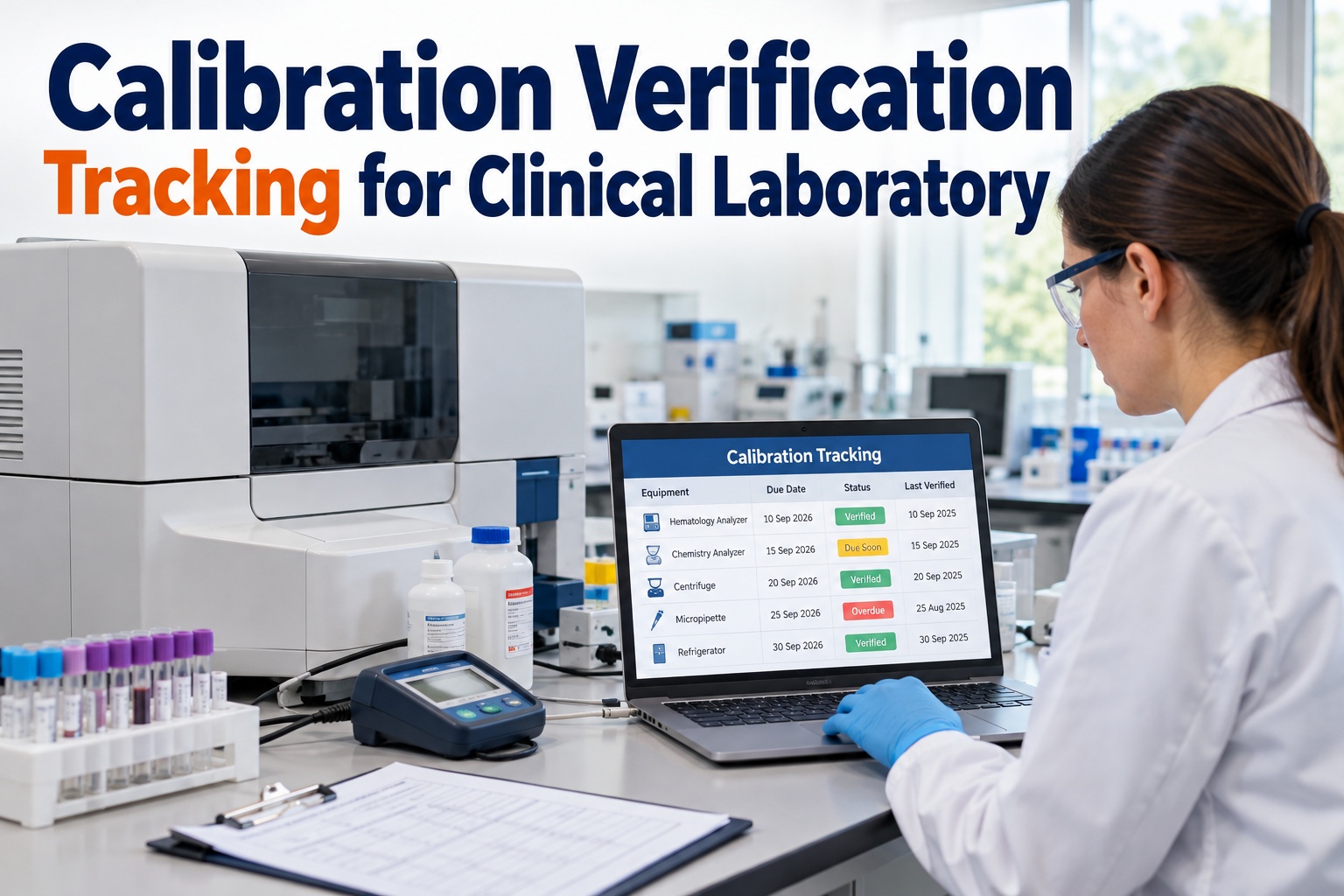
Calibration Verification Tracking for Clinical Laboratory
Under CLIA, calibration verification is what proves an analyzer still reports true results across its full reportable range — required at least every six months and after specific trigger events, documented and retained. The failure mode is quiet: a lab drifts months past due, or misses a lot-change trigger, and only finds out at inspection. A laboratory CMMS puts every instrument's verification on a tracked schedule, captures each trigger, and keeps the record survey-ready. OxMaint AI gives lab directors that control across every analyzer.
Calibration vs. Calibration Verification
The two are easy to conflate, but CLIA treats them as distinct steps — and it's verification that keeps a lab compliant between calibrations. Start free and track both on every analyzer in OxMaint AI.
The Four Triggers: When Verification Can't Wait for Six Months
The six-month clock is the floor, not the whole rule. Four events demand calibration verification whenever they happen — and each is easy to let slip in a busy lab. Book a demo to see OxMaint AI capture every trigger automatically.
Verifying Across the Reportable Range
Calibration verification isn't a single measurement — it confirms the analyzer reads true from the bottom of its reportable range to the top. That means assaying known materials at three points, so accuracy is proven where patient values actually land. Start free and record every level against the instrument in OxMaint AI.
Each point's result and its pass or fail is captured against the instrument, so the reportable range is defensible on paper, not just in practice. Book a demo of multi-point verification records in OxMaint AI.
The Overdue Verification Isn't the Real Cost. The Results You Ran Under It Are.
When an analyzer drifts months past its verification date, the citation is the smallest problem. Every patient result reported in that window rests on calibration nobody confirmed. A tracked schedule with advance warning is what keeps a lab from ever having to ask which results it can still trust.
Verification Cadence by Analyzer Class
The six-month minimum is the CLIA floor, but most instrument classes run tighter cycles tied to their QC and PM rhythm. A laboratory CMMS carries the right cadence per class. Start free and set each analyzer's schedule in OxMaint AI.
| Analyzer class | Typical verification rhythm | Alongside |
|---|---|---|
| Chemistry analyzers | Monthly calibration verification | Daily QC, weekly optical/mechanical PM |
| Hematology analyzers | Monthly linearity & verification | Daily startup QC, weekly fluidics cleaning |
| Blood gas analyzers | Cassette-change verification | Mandatory QC cycles through the day |
| Coagulation analyzers | Lot-specific verification | Daily two-level QC, reagent temp checks |
| Centrifuges | Quarterly RPM verification | Calibrated tachometer, rotor lifecycle tracking |
Whatever the class, the rule is the same: verification on a schedule, plus every trigger, with the record kept. Book a demo to load your analyzer schedules into OxMaint AI.
What the Record Has to Show
A calibration-verification record isn't complete because the test was run — it's complete because it can be produced, in full, when a surveyor asks. CLIA requires two-year retention for every verification. Start free and keep every verification survey-ready in OxMaint AI.
How OxMaint AI Tracks Calibration Verification
Scheduling, trigger capture, multi-point results, and retention all live in one laboratory CMMS — so the whole verification program runs from a single record. Start free and turn calibration verification into a managed program.
Frequently Asked Questions
Prove Every Result Rests on Verified Calibration.
A clinical result is only as trustworthy as the calibration behind it — and CLIA expects you to prove that calibration is still true, on schedule and after every trigger. OxMaint AI tracks each analyzer's verification, captures the triggers, records results across the range, and keeps the two-year archive, so your lab stands behind every value it reports.