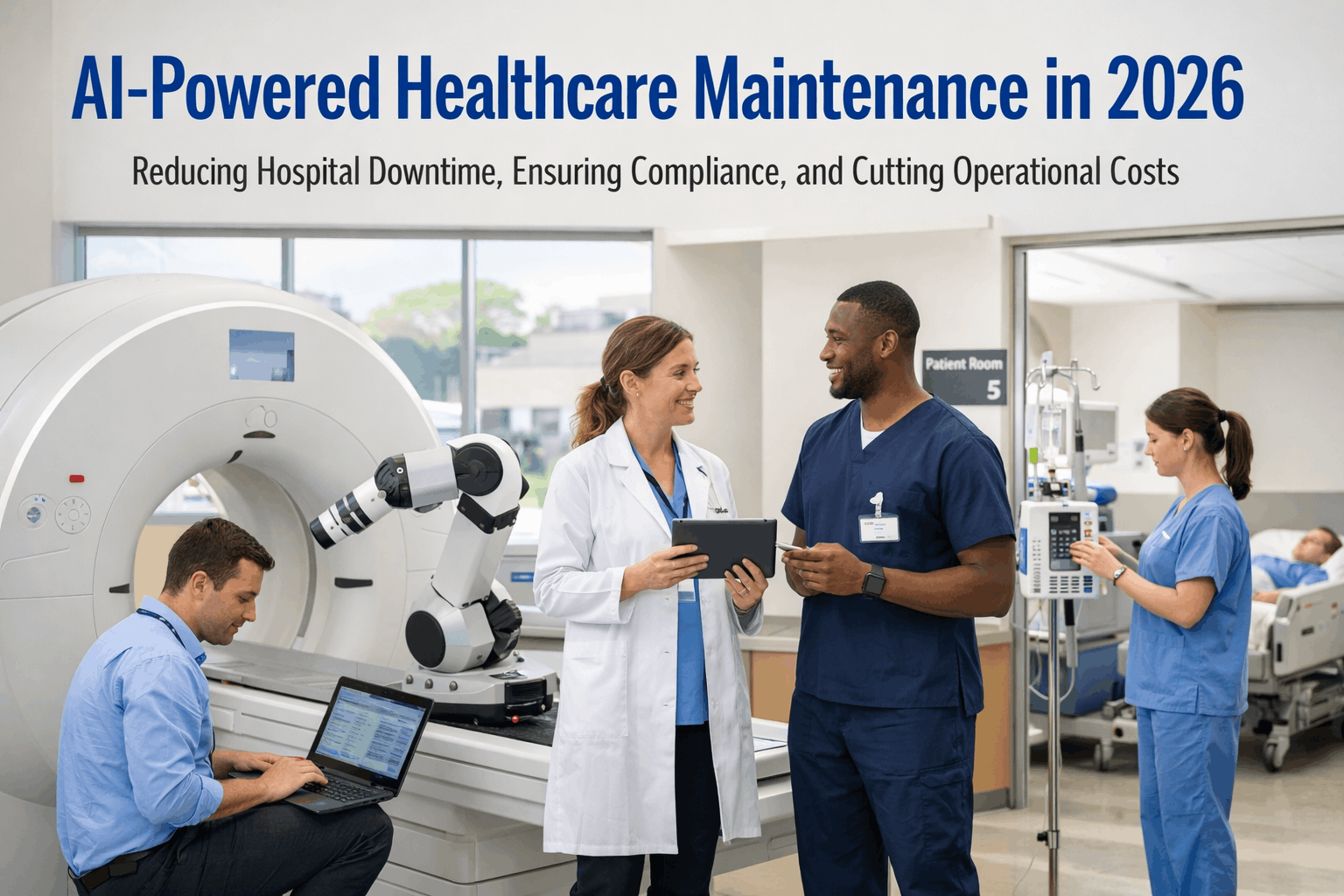
Every hospital administrator has faced the dreaded call: a critical piece of equipment just went down. Whether it is an MRI scanner, a CT unit, or a ventilator in the ICU, the financial consequences begin the moment the machine stops working. Research shows that a medium-sized hospital can lose nearly $300,000 annually from imaging system outages alone, while a single MRI machine offline costs between $10,000 and $15,000 per day in lost revenue. When you multiply this across an entire facility with dozens of high-value assets, the numbers become staggering. This blog breaks down the real economics of hospital equipment downtime — providing the financial models, data points, and strategic insights that healthcare executives need to quantify risk, justify maintenance investments, and protect their bottom line. If you are ready to take control of your equipment uptime, sign up for OxMaint or book a demo to see how AI-powered maintenance management works in practice.
Understanding the True Financial Scale of Hospital Downtime
Hospital equipment downtime is not just an operational inconvenience — it is a measurable financial event with cascading consequences. The direct revenue loss from a machine sitting idle is only the tip of the iceberg. When a piece of diagnostic or critical care equipment fails, the total economic impact includes emergency repair costs, idle staff wages, patient rescheduling expenses, overtime to clear backlogs, potential regulatory penalties, and long-term damage to patient loyalty and institutional reputation.
Studies indicate that approximately 37 percent of a hospital system's total revenue is derived from imaging services. This means that when your radiology department experiences even a few hours of downtime, the financial hit is disproportionately large compared to other service lines. Annual per-bed revenues attributable to imaging alone average around $370,000, translating to roughly $190 per bed per hour. For a 200-bed facility, a single 3.5-hour outage can result in revenue losses exceeding $130,000. On the lower end, industry analyses estimate imaging downtime costs at approximately $15,800 per hour of lost revenue.
These are not hypothetical figures — they represent the daily reality for hospitals that have not invested in proactive maintenance strategies. If your facility is still relying on reactive repairs, the financial exposure is significant and growing. Discover how signing up for OxMaint can help you build a data-driven maintenance program that protects your revenue streams.
Equipment-Level Revenue Loss: A Comparative Model
Not all equipment downtime carries the same financial weight. Understanding the revenue impact at the individual asset level allows hospital financial teams to prioritize maintenance spending where it matters most. Below is a comparative revenue loss model based on published industry data and research findings.
The Cascade Effect: How One Failure Drains Multiple Revenue Streams
The biggest mistake in hospital financial modeling is treating equipment downtime as an isolated event. In reality, every equipment failure triggers a cascade of financial consequences that extend far beyond the repair bill. Understanding this cascade is essential for building accurate revenue impact models.
Immediate Revenue Loss
The machine stops generating billable procedures. For imaging equipment, this means canceled scans. For ICU equipment, it means bed capacity reduction or patient transfers. The clock starts ticking immediately on lost revenue.
Staff Idle Time and Redeployment
Technologists, nurses, radiologists, and schedulers cannot perform their primary functions. Hospitals pay full wages for staff who cannot be productive, and redeploying them to other tasks is rarely efficient. The labor cost continues with zero return.
Emergency Repair Premiums
Unplanned repairs carry premium pricing — often 3 to 5 times the cost of planned maintenance. Parts may need to be rush-ordered, specialized technicians flown in, and temporary rental equipment secured at inflated rates.
Backlog and Overtime Costs
Once the equipment is restored, the facility must work through a backlog of postponed procedures. This typically requires overtime shifts, further increasing labor costs while departments scramble to return to normal throughput.
Patient Attrition and Reputation Damage
Patients who experience cancellations or long delays may seek care elsewhere. Research shows that 43 percent of healthcare organizations report a 10 percent revenue decrease from poor patient retention. A reputation for unreliable service compounds losses over time.
Regulatory and Compliance Exposure
Equipment failures can trigger compliance audits and regulatory scrutiny. OSHA penalties for serious violations can reach over $16,500 per incident, while willful violations can exceed $165,000. Inadequate maintenance documentation amplifies the risk.
When you model the full cascade, the true cost of a single equipment failure event is typically 5 to 10 times greater than the visible repair expense alone. Hospital CFOs who only track repair invoices are dramatically underestimating their actual financial exposure. To start building complete visibility into your maintenance costs, book a demo with OxMaint and see how our analytics dashboard captures the full picture.
The ICU Factor: When Downtime Becomes Life-Threatening
While imaging equipment downtime primarily impacts revenue and throughput, ICU equipment failure introduces a dimension that goes beyond economics: patient mortality risk. Intensive care units represent one of the largest clinical cost centers in any hospital, and mechanical ventilation is a significant driver of those costs. Research across 253 U.S. hospitals found that the average total ICU cost for mechanically ventilated patients was $31,574, compared to $12,931 for non-ventilated patients — a difference of nearly $19,000 per patient admission.
The daily cost structure reveals even more detail. On the first day of ICU admission, ventilated patients cost approximately $10,800 compared to $6,667 for non-ventilated patients. After stabilization by day three, ventilated patients still cost roughly $3,968 daily versus $3,184 for those not on mechanical ventilation — a consistent daily premium of about $1,500 attributable to ventilation alone.
When ventilator equipment fails in the ICU, the consequences are immediate and potentially fatal. Unlike an MRI that can wait for repair, a ventilator must be replaced within minutes. Hospitals that maintain aging backup equipment face a compounding risk: staff unfamiliarity with older models has been documented as a direct cause of adverse patient events. The financial exposure from a single ventilator-related adverse event — including extended ICU stays, additional interventions, and potential litigation — can dwarf the cost of proactive maintenance programs many times over. Hospitals managing complex ICU fleets can sign up for OxMaint to centralize equipment tracking and ensure every asset is maintained, documented, and ready when it matters most.
Building a Financial Model for Predictive Maintenance ROI
The shift from reactive to predictive maintenance is ultimately a financial decision — and one that becomes straightforward once you model the numbers correctly. Here is a framework hospital financial teams can use to calculate the return on investment for predictive maintenance technology.
Want to run these numbers with your own facility data? Book a demo with OxMaint and our team will walk you through a customized ROI analysis for your hospital.
Why Downtime Costs Are Rising — Not Falling
Despite advances in equipment reliability, the actual cost of hospital downtime is increasing year over year. Several structural forces are driving this trend upward.
Modern MRI, CT, and ICU systems are more sophisticated than ever. Greater complexity means more potential failure points, longer repair cycles, and higher parts costs. A single X-ray tube replacement for a premium CT scanner can exceed $200,000.
Industry surveys indicate that 55 percent of maintenance professionals cite rising parts costs as the primary driver of higher downtime expenses. Supply chain constraints for specialized medical components continue to extend repair timelines and inflate costs.
Many hospitals operate diagnostic and critical care equipment well beyond its intended lifespan. Older assets fail more frequently and unpredictably, while finding qualified technicians and compatible parts becomes increasingly difficult and expensive.
With hospital turnover rates averaging 18 percent and burnout affecting the majority of healthcare workers, facilities have less capacity to absorb the operational disruption caused by equipment failures. Fewer staff means every hour of downtime creates a proportionally larger backlog.
These trends make the case for proactive maintenance investment stronger every year. Hospitals that delay the transition to predictive maintenance are not maintaining the status quo — they are falling further behind as costs accelerate. Take the first step toward controlling these rising costs by signing up for OxMaint today.
Frequently Asked Questions
How much revenue does a hospital lose per day when an MRI machine is down
Hospitals typically lose $10,000 to $15,000 per day in direct revenue when an MRI is offline. Annual MRI downtime costs range from $60,000 to $120,000 or more depending on scan volume.
What is the total cost of imaging system downtime for a medium-sized hospital
A 200-bed hospital can lose nearly $300,000 annually from imaging outages. A single 3.5-hour incident costs between $55,000 and $130,000, since imaging generates roughly 37 percent of total hospital revenue.
How does ICU ventilator downtime differ financially from imaging equipment downtime
ICU ventilator failure introduces immediate patient safety risks on top of financial losses. Ventilated patients cost $31,574 per stay versus $12,931 for non-ventilated, and a single adverse event from equipment failure can result in litigation costs that dwarf imaging revenue losses.
What is the ROI of switching from reactive to predictive maintenance in hospitals
Predictive maintenance reduces downtime by 40 to 50 percent and cuts maintenance costs by 25 to 35 percent within the first year. Most hospitals report first-year ROI between 150 and 400 percent.
What are the hidden costs of hospital equipment downtime that most facilities overlook
Commonly missed costs include staff overtime for backlog clearance, patient attrition, regulatory penalties, rental equipment fees, and reputation damage. Total downtime costs typically exceed visible repair expenses by 5 to 10 times.
Why are hospital downtime costs increasing year over year
Rising parts costs (cited by 55 percent of maintenance professionals), growing equipment complexity, supply chain constraints, aging infrastructure, and workforce shortages are all driving downtime expenses higher each year.
How can OxMaint help hospitals reduce equipment downtime costs
OxMaint provides an AI-powered CMMS that centralizes asset tracking, automates work orders, enables predictive scheduling, and generates compliance reports — helping hospitals reduce unplanned downtime and protect revenue.
What hospital equipment should be prioritized for predictive maintenance investment
MRI scanners top the list due to high revenue impact, followed by CT scanners, ICU ventilators, HVAC systems, backup generators, and sterilization equipment — prioritized by revenue contribution, safety criticality, and failure frequency.


![]-(1)](./manage-post-2k26/uploads/]-(1).jpg)