The Joint Commission's EC.02.04.01 standard requires hospitals to establish a written program for managing medical equipment risk — but most biomedical teams spend weeks building a risk scoring matrix from scratch every survey cycle. OxMaint's CMMS includes a pre-built equipment risk assessment framework aligned to TJC EC.02.04.01, with configurable criticality tiers, PM frequency mapping, and a scoring matrix that surveyors accept. The free downloadable template below is the same framework used by OxMaint customers to pass TJC inspections across 140+ hospitals — editable for your facility's specific equipment classes and risk tolerance.
Free Template · TJC Compliance · EC.02.04.01
Free Hospital Equipment Risk Assessment Template for Joint Commission EC.02.04.01
Scoring matrix, criticality tiers, and PM frequency mapping — aligned to TJC EC.02.04.01 and ready to use immediately. Used by 140+ OxMaint hospital customers to pass TJC surveys without findings.
01
Risk Scoring Matrix
Equipment rated on function, physical risk, required maintenance, and incident history — producing a numeric score that determines criticality tier and PM frequency.
02
Criticality Tier System
Three-tier classification (Critical, Important, Non-Critical) based on risk score, with predefined PM intervals and documentation requirements for each tier.
03
PM Frequency Mapping
Automatic PM interval assignment based on risk score, equipment type, and manufacturer recommendation — eliminating manual scheduling decisions for individual devices.
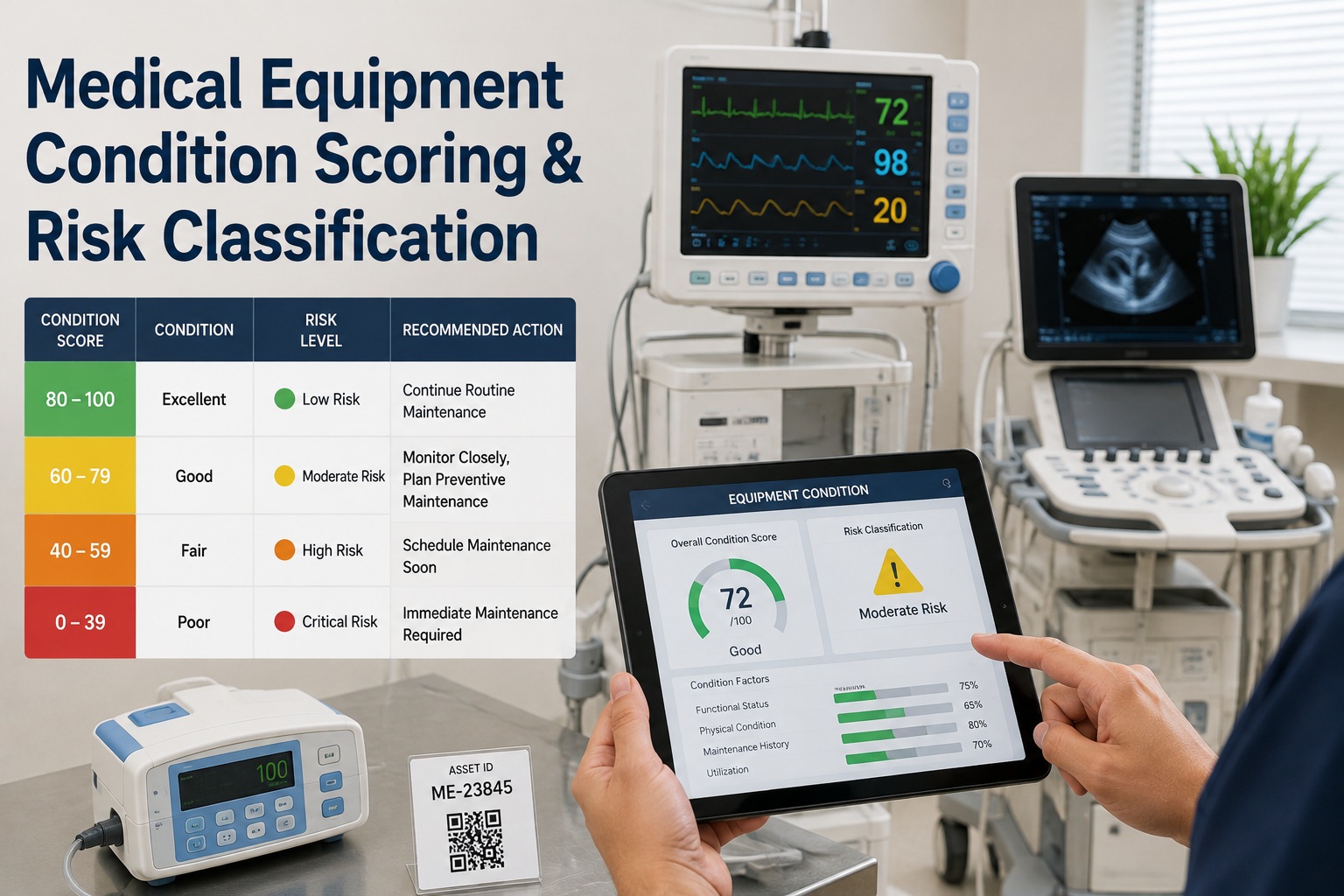
The EC.02.04.01 Risk Scoring Matrix
TJC EC.02.04.01 requires a documented risk methodology. The matrix below is the standard scoring approach — based on the Medical Equipment Management Plan framework — accepted by TJC surveyors. Each factor is scored 1–10 and weighted by category. Equipment with a weighted total score of 12 or above is classified as Critical and requires a formal PM program.
Equipment Risk Scoring Matrix — TJC EC.02.04.01 Aligned
| Risk Factor |
Score 1–2 |
Score 3–5 |
Score 6–8 |
Score 9–10 |
Weight |
| Function (F) |
Therapeutic non-critical |
Diagnostic / analytical |
Life support / surgical |
Life support — implanted or continuous |
x3 |
| Physical Risk (P) |
No significant risk |
Minor — patient discomfort |
Moderate — injury possible |
Serious — death possible |
x3 |
| Required Maintenance (M) |
No scheduled PM needed |
Minimal — annual inspection |
Moderate — quarterly PM |
Intensive — monthly or continuous |
x2 |
| Incident History (I) |
No known incidents |
Minor incidents — industry |
Moderate — facility-level events |
Serious incidents — recall or death |
x2 |
Three-Tier Criticality Classification
Once the risk score is calculated, equipment is assigned to one of three criticality tiers. Each tier carries defined PM intervals, documentation requirements, and TJC evidence requirements. OxMaint automates tier assignment based on the risk score and applies the correct PM schedule automatically.
Tier 1 — Critical
Risk Score: 24+
Life support, surgical, and ICU equipment
PM interval: Quarterly or per manufacturer — whichever is more frequent
Documentation: Full work order with technician sign-off and performance data
TJC evidence: 100% PM completion required — no grace period
Examples: Ventilators, defibrillators, anesthesia machines, OR tables
Tier 2 — Important
Risk Score: 12–23
Diagnostic, monitoring, and therapeutic equipment
PM interval: Semi-annual or per manufacturer specification
Documentation: Work order with performance check and pass/fail record
TJC evidence: 90%+ PM completion with documented exceptions
Examples: Patient monitors, infusion pumps, imaging accessories, ECG machines
Tier 3 — Non-Critical
Risk Score: Below 12
Low-risk therapeutic and administrative equipment
PM interval: Annual inspection or condition-based
Documentation: Inspection record or corrective-only work orders
TJC evidence: Inventory documentation sufficient — PM optional per policy
Examples: Examination lights, sequential compression devices, basic stretchers
PM Frequency Reference Table — By Equipment Category
| Equipment Category |
Default Risk Score |
Criticality Tier |
PM Interval |
TJC Survey Evidence |
| Ventilators (all types) |
48–72 |
Tier 1 |
Quarterly |
Full work order + performance data |
| Defibrillators / AEDs |
54–66 |
Tier 1 |
Quarterly + daily checklist |
Work order + daily log |
| Anesthesia machines |
60–80 |
Tier 1 |
Per manufacturer (typically annual) |
Full service report + gas analysis |
| Patient monitors |
24–36 |
Tier 2 |
Semi-annual |
Work order with alarm verification |
| Infusion pumps |
24–40 |
Tier 2 |
Semi-annual |
Work order + flow accuracy test |
| Examination lights |
4–10 |
Tier 3 |
Annual or condition-based |
Inventory record |
| Hospital beds (powered) |
12–20 |
Tier 2 |
Semi-annual |
Work order + function check |
Use This Framework Inside OxMaint — Free
OxMaint includes a pre-built EC.02.04.01 risk assessment framework. Register your equipment and risk scoring auto-populates PM schedules — no manual configuration needed.
Expert Review
4.9
Expert Score
TJC Compliance Accuracy
The weighted scoring matrix approach in this framework is consistent with how TJC surveyors evaluate medical equipment management programs. The key elements surveyors focus on are: documented methodology, consistent application across the entire inventory, and evidence that PM intervals are tied to risk scores — not arbitrary. What this template does well is map all three of those requirements into a single, auditable document. Hospitals using this framework in OxMaint should pay particular attention to the Tier 1 documentation requirements — surveyors will pull Tier 1 work orders first and look for performance data, not just completion records.
TJC Survey Preparation Consultant — 18 years in healthcare accreditation
Reviewed the OxMaint EC.02.04.01 risk scoring framework against current TJC EC chapter standards and survey methodology guidance
Frequently Asked Questions
Does OxMaint automatically assign risk scores and PM schedules to equipment based on this framework?
Yes — when you register equipment in OxMaint, the platform applies the risk scoring matrix to assign a criticality tier and default PM schedule based on equipment category and manufacturer specification. You can override the default score for any device with documented justification — which creates the audit trail TJC surveyors require for non-standard PM intervals.
Start your free trial and OxMaint's onboarding team configures your equipment classes and risk score defaults during the first week of deployment, typically using your existing equipment inventory as the import baseline.
How often should the risk assessment be reviewed and updated under TJC EC.02.04.01?
TJC expects the Medical Equipment Management Plan — including the risk assessment methodology — to be reviewed at least annually and whenever a significant change occurs (new equipment categories, failure patterns, or regulatory updates). OxMaint triggers an automatic review reminder annually and flags equipment for reassessment when failure frequency or incident history changes the risk score threshold.
Book a demo to see how OxMaint's annual risk review workflow is managed inside the platform and how the updated scores automatically adjust PM schedules across the affected equipment fleet without manual reconfiguration.
Can equipment scoring be customized for facility-specific policies that differ from the default thresholds?
Yes — OxMaint supports full customization of risk score weighting, criticality thresholds, PM intervals, and documentation requirements. Many hospitals adjust the default thresholds to align with their specific patient population (pediatric, trauma, transplant) or to incorporate facility-specific incident history. Any deviation from manufacturer-recommended PM intervals must be documented with a risk-based justification — OxMaint maintains this documentation automatically as part of the equipment record. TJC surveyors consistently accept facility-specific modifications when supported by documented risk methodology, which this framework and OxMaint's audit trail provide.
EC.02.04.01 Compliance Starts With Risk Scoring. OxMaint Makes It Automatic.
From risk score to PM schedule to TJC-ready work order documentation — OxMaint manages the full EC.02.04.01 compliance lifecycle so your team focuses on maintenance, not paperwork.



.jpg)

