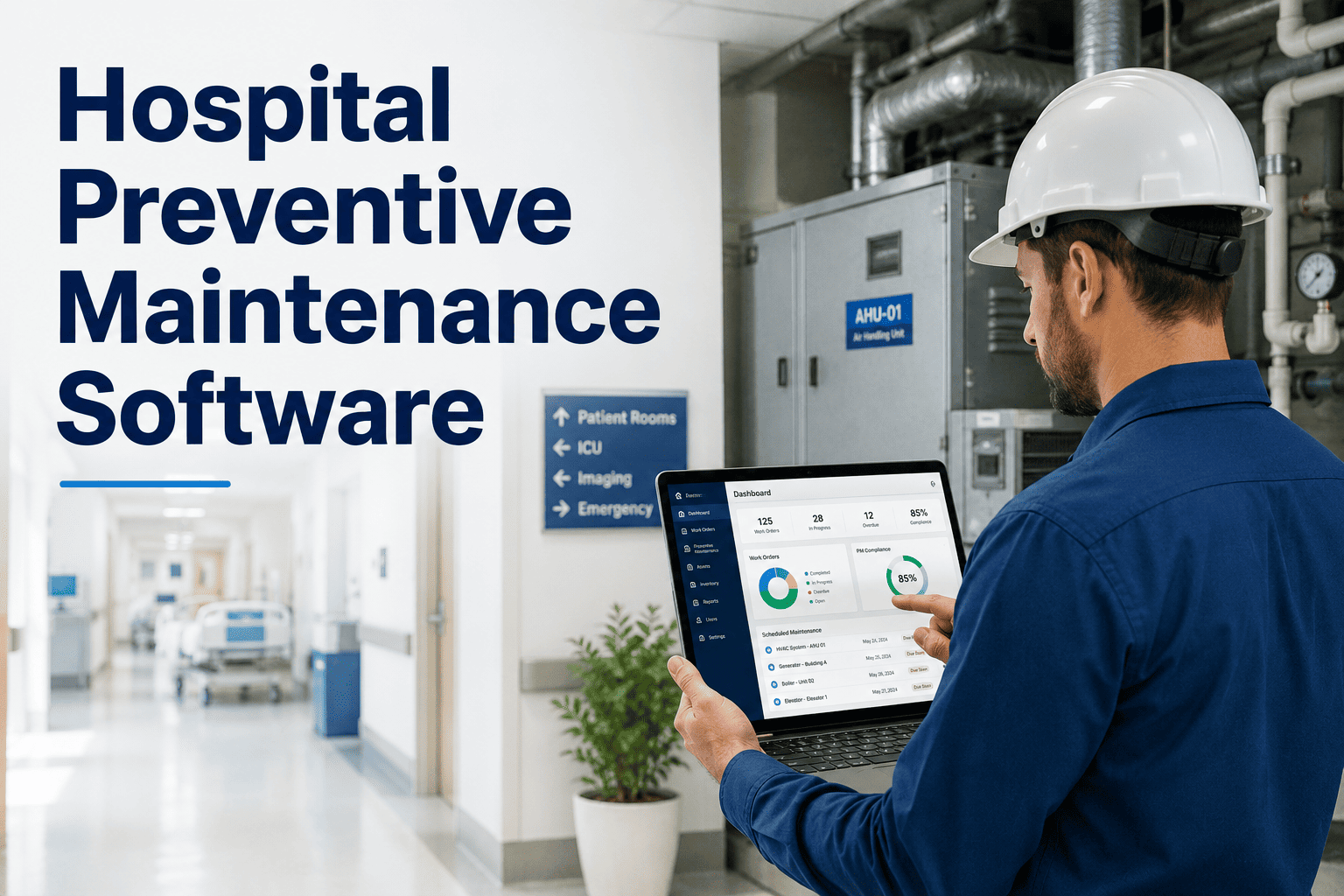
Running a hospital means running one of the most asset-intensive, compliance-critical, and safety-sensitive facilities on earth — where a missed PM on an infusion pump or a skipped HVAC inspection can escalate from a maintenance oversight to a patient safety incident within hours. Most hospital facilities teams already know what needs to be maintained; the problem is the system they use to track it. Spreadsheets miss due dates. Paper logs disappear before surveys. Reactive repair culture quietly drains budgets that should be funding equipment replacement. Hospital preventive maintenance software built for clinical environments automates PM schedules across medical equipment, HVAC, generators, fire systems, and utilities — so nothing falls through the cracks and every inspection produces an audit-ready record. For facilities teams ready to move from reactive to preventive, OxMaint.ai delivers compliance-ready PM workflows built specifically for hospital operations.
HOSPITAL PM SOFTWARE GUIDE 2026
Hospital Preventive Maintenance Software That Protects Patients and Passes Surveys
Automate PM schedules for clinical equipment, HVAC, emergency power, fire systems and utilities — with compliance records built into every work order.
THE REAL COST OF REACTIVE MAINTENANCE
What happens when PM slips in a hospital
01
Equipment Failure in Care Areas
A ventilator, infusion pump, or patient lift that missed its PM interval is a liability waiting to activate. Unplanned failures in clinical settings don't just cost repair time — they create patient safety incidents.
02
Survey Findings and Conditional Accreditation
EC.02.04.01 violations are among the top cited Joint Commission findings. One Midwest hospital paid $75,000 in fines plus a 90-day corrective plan for incomplete equipment inventory documentation in 2024.
03
Budget Bleed From Emergency Repairs
Emergency HVAC or generator repair always costs three to five times more than a scheduled PM visit. Hospitals relying on reactive workflows consistently overspend on capital repair budgets that should fund planned replacements.
04
Compliance Documentation Gaps
The maintenance happened. The record was never created. Paper logs, disconnected spreadsheets, and technician memory are not retrievable evidence during a survey. Accreditors require documented proof — not verbal confirmation.
WHAT GETS MAINTAINED
Every critical hospital system — one PM platform
A
Clinical Equipment
Ventilators, infusion pumps, defibrillators, patient monitors, surgical tables. PM intervals at 6-month maximum per EC.02.04 — risk-classified and auto-scheduled.
B
HVAC and Air Handling
Filter replacements, coil cleaning, pressure differentials in isolation rooms and ORs. Infection control compliance tied directly to HVAC PM records.
C
Emergency Generators
Monthly 30-minute load tests and annual 4-hour full-load tests per NFPA 110. Transfer time, load percentage, and runtime recorded at point of test — never reconstructed.
D
Fire Protection Systems
Sprinkler inspections, suppression system service, fire alarm panel tests, fire door integrity checks — all linked to building location with certificate currency tracked automatically.
E
Medical Gas Systems
Oxygen bulk systems, alarm panel checks, zone valve labeling, and piped gas inspections managed per NFPA 99 — quarterly and annual intervals enforced by the platform.
F
Utilities Infrastructure
Electrical distribution panels, plumbing, sterilization equipment, and water management systems — PM schedules built to EC.02.05 documentation requirements.
HOW IT WORKS
From asset inventory to audit-ready record — automatically
1
Build your asset inventory
Every piece of equipment and building system registered with risk classification, location, manufacturer PM intervals, and regulatory standard mapping. Import from existing spreadsheets or SAP — no rebuild from scratch.
2
PM schedules generate automatically
Based on asset criticality, manufacturer recommendations, and regulatory intervals, the platform generates work orders before due dates — not after failures. Technicians receive mobile assignments with pre-built checklists.
3
Field execution on mobile — offline capable
Technicians complete checklists, capture readings, and close work orders on mobile at point of work. Offline mode means data is never lost in low-connectivity mechanical rooms or remote wings.
4
Compliance records built in real time
Every completed work order automatically populates the compliance record. Survey-ready reports exportable on demand — no manual reconstruction before accreditor visits.
See OxMaint's hospital PM platform in 30 minutes
Book a live demo and walk through how automated PM schedules, compliance-mapped work orders, and mobile field execution work for your specific clinical environment — clinical equipment, HVAC, generators, and utilities in one platform.
DOCUMENTED OUTCOMES
What hospitals report after 12 months on OxMaint
94%
PM Compliance Rate
Hospitals move from reactive, paper-based workflows to 94%+ PM completion rates within 6 months of deployment — driven by automated scheduling and mobile execution.
38%
Reduction in Emergency Repairs
Consistent PM execution identifies deteriorating components before they fail. Emergency repair volume drops 38% on average in the first year as preventive work replaces reactive response.
Zero
Documentation Gaps at Survey
Because every PM produces a compliance record automatically, facilities teams enter Joint Commission surveys with complete, retrievable evidence — not gaps to explain.
30d
Full Deployment Timeline
Asset inventory, PM templates, and mobile work order access across your facility team — live in 30 days. No IT project. No shutdown. No implementation fees.
FEATURE CHECKLIST
What hospital PM software must include in 2026
| Capability |
What It Solves |
Without It |
| Risk-classified PM scheduling |
Life-supporting equipment gets the highest inspection frequency — intervals set by asset criticality and regulatory requirements, not convenience |
All assets treated the same; high-risk equipment not inspected at required frequency |
| Compliance-mapped checklists |
EC.02.04, NFPA 99, and NFPA 110 requirements built into the work order — technician completes the checklist, compliance record creates itself |
PM completed but not documented to standard — survey findings for process, not performance |
| Offline mobile execution |
Mechanical rooms, basement utilities, and remote wings often have no connectivity — offline mode keeps technicians working without data loss |
Mobile abandoned when connectivity fails; technicians revert to paper and transfer later — or don't |
| Automated escalation for overdue PM |
Platform alerts supervisor when inspection approaches or passes due date — prevents PM from being silently skipped in high-workload periods |
Overdue inspections discovered only when surveyor requests the log or equipment fails |
| Survey-ready export |
All compliance records exportable by standard, asset class, time period, or building — exactly what surveyors request, in the format they review |
Pre-survey sprint to manually compile records from spreadsheets, paper logs, and emails |
| CapEx forecasting from asset data |
Remaining useful life data from PM history generates equipment replacement forecast — CFO and facilities leadership plan capital needs years ahead, not in crisis |
CapEx requests submitted based on age and gut feel; reactive replacement spikes in emergency years |
FREQUENTLY ASKED QUESTIONS
What hospital facilities teams ask before deploying PM software
Your next Joint Commission survey starts with the PM record you create today.
OxMaint automates preventive maintenance scheduling, compliance documentation, and corrective action tracking across every clinical and facility system in your hospital — so your team maintains equipment and your records maintain themselves.


.jpg)
.jpg)


