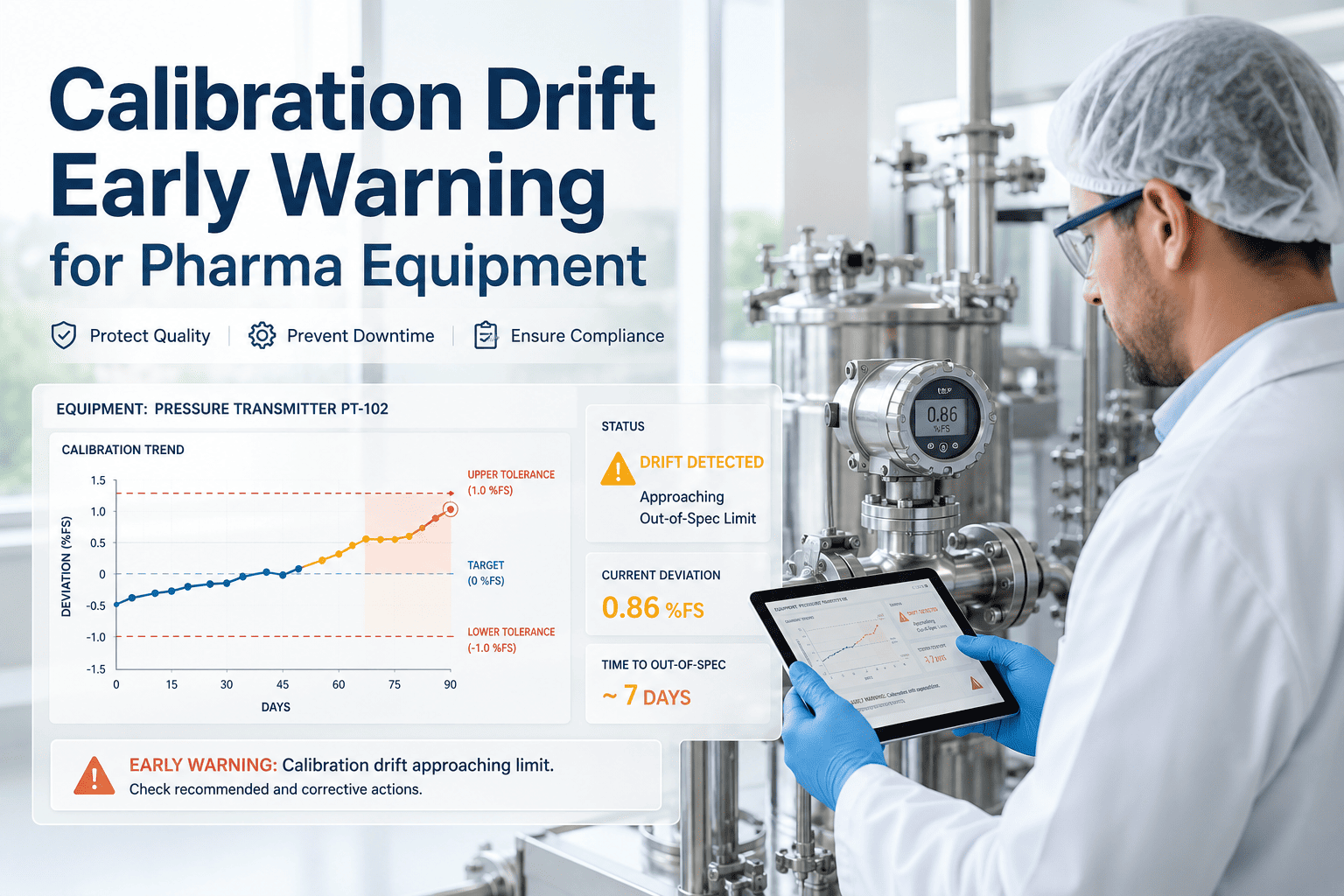
Calibration drift does not announce itself. An analytical balance, a temperature sensor, or an HPLC pressure transducer shifts gradually — reading 0.3% high, then 0.6%, then past the tolerance limit during a batch run that no one flags until a 483 observation lands. In 2024–2025 FDA inspections, calibration and equipment qualification deficiencies appeared in over 68% of warning letters issued to drug manufacturers — and in the majority of those cases, the records existed and the procedures were written. The failure was in real-time visibility: nobody saw the drift building before it became an out-of-tolerance event. Early warning systems work by defining alert thresholds inside the tolerance band — at 50%, 70%, or 80% of the limit — so your team receives an automated work order escalation before the instrument crosses the line that triggers a full OOT CAPA. OxMaint builds this three-tier tolerance architecture into every instrument asset record, with trend-based alerts and automated work order escalation configured to your GMP calibration program. Book a demo to see live drift monitoring on a pharma instrument fleet.
Calibration Drift Early Warning for Pharma Equipment
Detect drift before it becomes an OOT event. Trend alerts, configurable tolerance bands, and automated work order escalation — so your calibration program catches instrument problems weeks before a batch run is at risk.
Component wear, sensor fatigue, and reference element degradation accumulate over time. Progressive drift across three consecutive calibrations is the primary signal that an instrument is approaching end-of-life.
Temperature fluctuations, humidity, vibration, and electromagnetic interference all shift measurement baselines. Instruments near HVAC vents, process heat, or heavy machinery are highest risk.
Drops, impacts, or relocation of instruments cause immediate measurement shifts that may be subtle enough to miss without intermediate verification checks between scheduled calibration dates.
A drifted or expired reference standard contaminates every instrument calibrated against it during the affected period — creating a cascade OOT event that can expose months of production records.
Set your OOT limit and an alert threshold per instrument class — typically 75% of the tolerance band. OxMaint stores this alongside the instrument's asset record and references it against every calibration reading entered.
As-found readings are plotted against the tolerance band over consecutive calibration events. OxMaint tracks directional drift patterns — even when individual readings are still within tolerance — and flags instruments showing consistent movement toward the alert threshold.
When an as-found reading enters the alert band, OxMaint automatically generates a calibration investigation work order and notifies the QA supervisor. The work order is linked to the instrument's trend history so the technician has full context before intervening.
The investigation work order prompts the technician to document root cause — aging, environment, handling, reference standard — and recommend an interval adjustment. OxMaint updates the next calibration due date automatically based on the outcome.
Every reading, alert, work order, and interval change is stored in a single linked record per instrument — retrievable and printable for FDA inspection, ISO audit, or internal QA review without manual reconstruction from multiple systems.
| Instrument | Risk Level | Why Drift Matters |
|---|---|---|
| Analytical Balances | Critical | Dosage accuracy directly affected by drift — mg-level errors compound across batch runs |
| Temperature Sensors and Probes | Critical | Process temperature drift exposes batches to degradation risk without visible product change |
| HPLC Systems | Critical | Pump pressure drift and detector signal shift affect chromatographic accuracy and release testing |
| pH Meters | High | Electrode aging causes slope drift that accumulates invisibly between scheduled recalibration dates |
| Pressure Transmitters | High | Drift in process pressure readings affects sterile filtration integrity and CIP validation |
| Environmental Monitoring Sensors | High | Room temperature and RH drift affects stability study validity and storage condition compliance |
| Capability | Calendar-Only Calibration | OxMaint Drift Early Warning |
|---|---|---|
| When drift is detected | At next scheduled calibration — may be weeks or months after drift began | Within current cycle — alert fires when reading enters alert band |
| Batch exposure window | Full interval since last calibration — potentially months of exposed production | Reduced to days — drift flagged before tolerance is breached |
| Audit question defensibility | Cannot prove instrument was performing between scheduled dates | Continuous trend record shows active oversight, not passive scheduling |
| Interval management | Fixed intervals regardless of actual drift behavior | Risk-based — intervals shortened for drifting instruments automatically |
| Work order trigger | Manual, only at scheduled calibration date | Automatic on alert threshold crossing — with trend evidence attached |
| OOT event prevention | No preventive capability — OOT discovered after the fact | Intervention before OOT — reduces full CAPA events significantly |
An instrument drifting toward its tolerance limit is not a future problem — it is happening in your current calibration cycle. OxMaint shows you where it is, alerts your team before it crosses the line, and keeps the trend record that turns your next FDA audit from a stress event into a confidence demonstration.