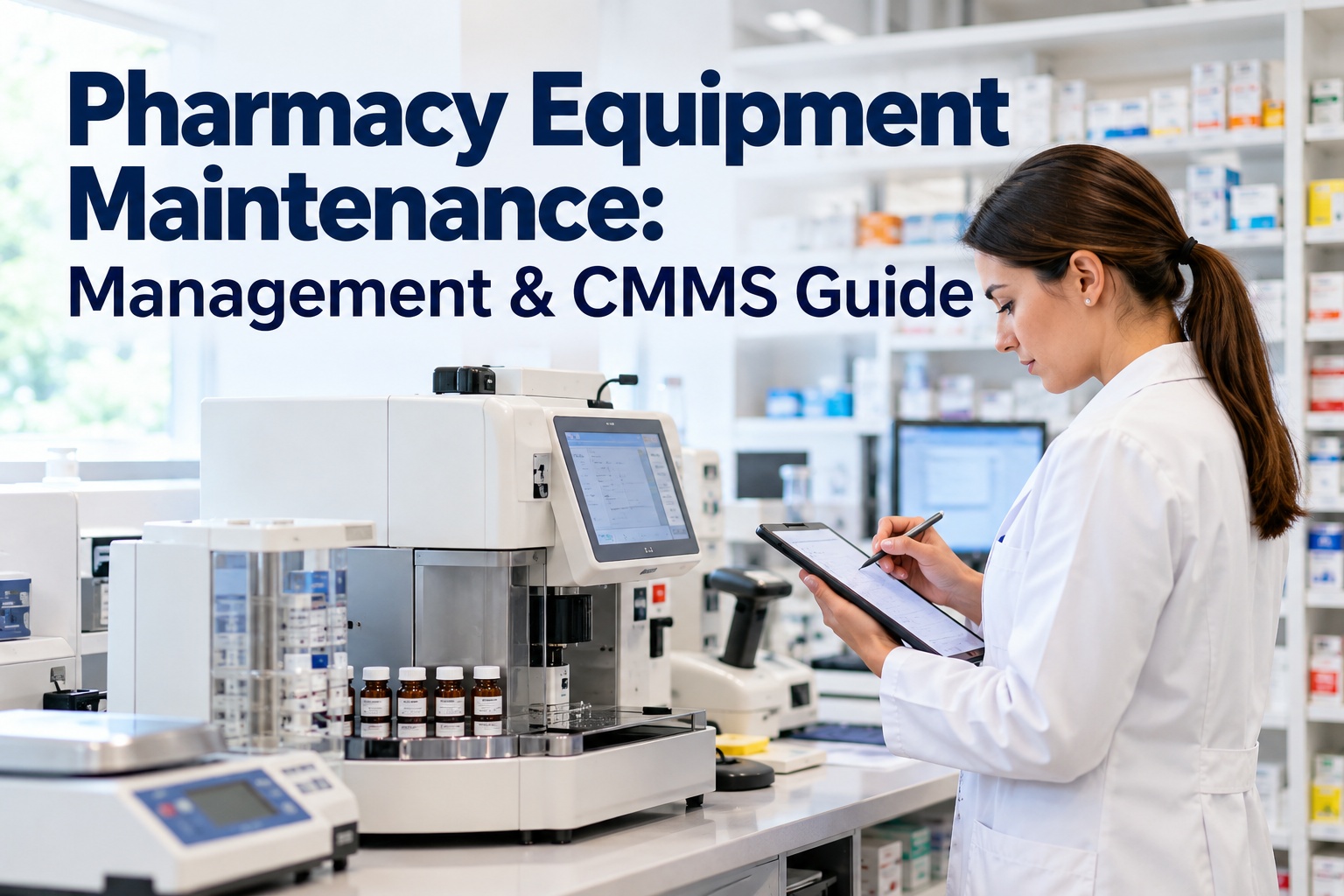
A hospital pharmacy runs on equipment that fails quietly and expensively: a laminar-flow hood that drifts out of certification, a medication refrigerator that slips below range overnight, a calibration certificate that lapsed three months ago and nobody noticed until a Board of Pharmacy inspector asked. Each is a compliance citation and a patient-safety risk waiting to surface. This guide covers how to manage pharmacy equipment maintenance across compounding controls, cold chain and calibration records, and how OXMAINT AI, the AI-powered healthcare CMMS, keeps every schedule, reading and record inspection-ready.
Pharmacy Equipment Maintenance: Management & CMMS Guide
A hood overdue for its six-month certification, a fridge excursion caught too late, a calibration certificate that expired unnoticed — in a pharmacy these are USP citations and compromised preparations, not routine tickets. OXMAINT AI, the AI-powered CMMS and maintenance management software, runs the whole equipment program: schedule certification and calibration by regulatory interval, log temperature and pressure continuously, turn an excursion alarm into a work order, and keep every record retrievable by asset for inspection.
Domain A — Compounding Controls & the Cleanroom
The primary engineering controls where sterile preparations are made are the most heavily regulated equipment in the pharmacy — and the most consequential to let drift. Each sits inside a classified ISO zone, and each carries a mandatory six-month certification. OXMAINT AI tracks every control and its due dates. Book a demo to see PEC tracking in OXMAINT AI.
These controls live inside a pressure cascade across three ISO classes — cleanest at the work zone, stepping out to the ante room. Hold the cascade and contamination stays out; lose it and the preparation is at risk. Start free and monitor your cleanroom cascade in OXMAINT AI.
Under USP 800, hazardous-drug compounding inverts part of this — a negative-pressure buffer room vented to the exterior with a pressure differential of at least 0.02″ water column — so the cascade pulls contamination inward instead of pushing it out. The CMMS logs the differential and alarms any out-of-specification reading.
Domain B — The Cold Chain
Medication storage is a maintenance problem disguised as a refrigerator. Each range has its own equipment, and a single overnight excursion can spoil a shelf of vaccines or biologics. OXMAINT AI watches the temperature continuously and turns an excursion into an immediate work order with the alarm data attached. Book a demo to see cold-chain monitoring in OXMAINT AI.
The Citation Isn’t the Broken Hood — It’s the Missing Record.
Documentation gaps are the leading Board of Pharmacy inspection trigger. A certification that happened but can't be produced, an excursion with no logged response — the equipment may be fine, and the finding still lands. OXMAINT AI keeps every log, certificate and corrective action retrievable by asset and certification date.
Domain C — Calibration & the Record That Proves It
Every sensor and balance in the pharmacy is only as trustworthy as its last calibration — and the certificate that proves it. Equipment qualification at install, requalification after repair, and as-found/as-left readings on every calibration are what satisfy an inspector. OXMAINT AI captures all of it against the asset. Start free and control calibration records in OXMAINT AI.
The Certification & Calibration Calendar
The whole program comes down to the right task at the right interval, every time. Miss one and the gap becomes a finding. OXMAINT AI schedules each by its regulatory basis and escalates anything overdue. Book a demo to automate the schedule in OXMAINT AI.
| Task | Frequency | Basis |
|---|---|---|
| PEC operational-state certification | Every 6 months | USP 797 mandatory |
| HEPA integrity (DOP/PAO) testing | Every 6 months + after filter change | USP 797 |
| Airflow velocity & ACPH, ISO particle count | Every 6 months | Certification requirement |
| Viable air & surface sampling | Monthly | Environmental monitoring |
| Temp / humidity / pressure logging | Continuous or twice daily | USP 797 |
| Temperature-sensor calibration | Annual | Accuracy verification |
| Alarm-system testing | Semi-annual | USP 800 |
| Annual temperature mapping | Annual | USP 800 qualification |
From Alarm to Work Order to Record
The value of running this in a CMMS is that an event never stops at a reading — it flows into action and documentation automatically. OXMAINT AI closes the loop from the sensor to the inspection-ready record. Start free and close the loop in OXMAINT AI.
How OXMAINT AI Holds the Program Together
Three equipment domains, several standards and a record for everything — that is a tracking problem a spreadsheet loses. Built into the CMMS, the program stays scheduled, logged and retrievable. Book a demo to see the pharmacy program in OXMAINT AI.
Our hood certifications, fridge logs and calibration certificates lived in three different places, and the gaps only showed up when an inspector asked for something we couldn't find fast. Putting the whole pharmacy on one system changed the posture entirely — the six-month certifications schedule themselves, an overnight excursion raises a work order with the data already attached, and every certificate is one search away under its asset. We stopped discovering lapses during inspections and started catching them weeks ahead.
Frequently Asked Questions
Keep Every Pharmacy Asset Certified, Logged and Ready.
Run pharmacy equipment maintenance on the OXMAINT AI maintenance management software — six-month PEC certification and HEPA testing, continuous cold-chain monitoring with excursion-to-work-order automation, calibration certificate control with as-found/as-left capture, and every record retrievable by asset for inspection. Manage the equipment by the calendar the regulators use.