-in-healthcare-maintenance-prevent-equipment-failure-&-downtime.png)
Root cause analysis is the discipline of not accepting "it broke" as an answer. In healthcare maintenance, equipment failure is never truly random — every unplanned downtime event has a traceable origin, and every origin left unaddressed becomes the next failure waiting to happen. When a ventilator alarms unexpectedly at 2 AM, when an MRI scanner goes offline during peak scheduling, or when an autoclave fails mid-cycle before a surgical case, the immediate fix is only half the job. The other half — the part most maintenance teams skip — is understanding exactly why it happened and making sure it cannot happen the same way again. Root cause analysis (RCA) is the systematic methodology that makes that possible. Sign Up Free to see how OxMaint helps hospital maintenance teams close the loop between failure investigation and long-term equipment reliability.
Turn Every Failure Into a Future Prevention
OxMaint gives your hospital maintenance team the tools to document failures, run structured RCA workflows, and convert findings into corrective work orders — all in one platform built for healthcare environments.
What Is Root Cause Analysis in Healthcare Maintenance?
Root cause analysis is a structured investigative process used to identify the fundamental reason a failure occurred — not just the surface-level symptom, but the chain of contributing conditions that made failure possible. In healthcare maintenance, RCA is applied when equipment fails unexpectedly, when near-misses reveal hidden vulnerabilities in maintenance programs, or when recurring failures signal that existing corrective actions are not addressing the real problem.
The core principle of RCA is deceptively simple: every equipment failure has a cause, every cause has a cause, and following that chain far enough back reveals an actionable root — something that can be changed to prevent recurrence. A pump that overheated did not simply "break." It overheated because a bearing degraded. The bearing degraded because lubrication intervals were too long. The intervals were too long because the PM schedule had not been updated since the equipment was installed under different operating conditions. The root cause is not a mechanical failure — it is a maintenance planning gap.
Distinguishing RCA from basic troubleshooting is essential. Troubleshooting restores function. RCA prevents recurrence. Both are necessary, but only RCA eliminates the conditions that made failure possible in the first place. In a hospital environment where the same equipment is relied upon by multiple clinical teams across every shift, recurrence prevention is not optional — it is the operational standard. If you want to see how a structured RCA workflow fits inside a healthcare CMMS before committing to a full program, Book a Demo and we'll walk through it with your specific equipment environment in mind.
Why RCA Matters in Hospital Equipment Management
Patient Safety Implications
Equipment failures in healthcare do not occur in isolation from patient care. A degrading infusion pump, an unreliable patient monitor, or an autoclave with inconsistent sterilization performance all carry clinical consequences. RCA connects maintenance investigation directly to patient safety outcomes, ensuring that failure analysis is treated with the same rigor as clinical incident review.
Regulatory and Accreditation Compliance
The Joint Commission, DNV GL, and CMS all expect healthcare organizations to demonstrate systematic approaches to equipment failure analysis. Documented RCA processes — with findings, corrective actions, and follow-up verification — provide the evidence trail that surveyors look for when evaluating maintenance program maturity. Organizations without structured RCA processes are exposed during accreditation reviews in ways that go well beyond a single equipment issue. If your facility is preparing for an upcoming survey and needs to formalize its RCA documentation quickly, Book a Demo to see how OxMaint generates audit-ready records automatically from every failure investigation.
Maintenance Cost Reduction
Reactive maintenance is expensive. Emergency repair premiums, expedited parts shipping, clinical schedule disruptions, and overtime labor costs compound quickly when failures are allowed to recur. RCA breaks that cycle by identifying and correcting the conditions that produce repeated failures — shifting maintenance spend from emergency response toward planned, lower-cost interventions.
Equipment Lifespan Extension
Many premature asset replacements in healthcare result not from end-of-life obsolescence but from accumulated damage caused by unresolved failure conditions. When the root cause of degradation is identified and corrected — whether that is an installation deficiency, an inappropriate PM interval, or an operator misuse pattern — the underlying asset often has significantly more serviceable life remaining than a surface assessment would suggest.
The RCA Process: Step-by-Step for Hospital Maintenance Teams
A well-executed RCA in healthcare maintenance follows a defined sequence of steps. Each step builds on the last, and skipping steps — particularly in the pressure of a busy maintenance environment — is the most common reason RCA processes fail to prevent recurrence. Want to see how OxMaint structures each of these steps inside a live maintenance workflow? Book a Demo and our team will show you exactly how the process maps to your facility's equipment portfolio.
Define and Contain the Failure Event
Before investigating causes, clearly define what failed, when, where, and under what operating conditions. Document the failure mode precisely — not "the MRI was down" but "the cryocooler compressor failed to maintain helium pressure within operational range, triggering quench protection shutdown." Precise failure definition prevents the investigation from drifting toward symptoms rather than causes. If the failure created an immediate patient safety risk or clinical disruption, containment actions should be documented alongside the failure definition.
Gather Evidence and Maintenance History
Pull all available data relevant to the failure: work order history, PM completion records, calibration logs, operator incident reports, and any available sensor or monitoring data from before and during the failure event. Physical evidence from the failed component — wear patterns, thermal discoloration, corrosion, fracture characteristics — should be documented photographically before any repair work begins. Evidence gathered after repair is significantly less reliable for RCA purposes.
Apply a Structured Causal Analysis Method
With evidence assembled, use one or more structured RCA methodologies to trace the causal chain from failure symptom to root cause. This step is where the investigation moves from data collection to analytical reasoning. The methodology selected should match the complexity of the failure — simple, isolated failures may be fully addressed with a Five Whys analysis, while complex, multi-system failures benefit from Fault Tree Analysis or a fishbone diagram approach. The methodology is a thinking tool, not the outcome — what matters is following the causal chain to its actual origin.
Identify Contributing Factors and Root Causes
Most equipment failures in healthcare have more than one contributing cause. A single root cause — a maintenance program gap, an installation error, an operator training deficiency, or a parts quality issue — may be surrounded by contributing factors that either amplified the failure or delayed its detection. Document both: the root cause that must be corrected to prevent recurrence, and the contributing factors whose mitigation will reduce the probability and impact of future failures across the equipment population.
Develop and Implement Corrective Actions
Corrective actions must be specific, assigned, and time-bound. A finding of "PM intervals need to be updated" is not a corrective action — it is an observation. The corrective action is "revise PM task list for Model X ventilators to include bearing lubrication at 90-day intervals, assign to lead biomed technician, complete by [date], verify with follow-up inspection at next scheduled PM." Actions that address root causes require changes to maintenance programs, procedures, or organizational practices — not just repairs to the failed component.
Verify Effectiveness and Close the Loop
Corrective actions that are implemented but never verified are the single largest gap in most healthcare RCA programs. Define effectiveness metrics at the time corrective actions are assigned — for example, zero recurrence of the same failure mode on the same asset class within twelve months — and schedule a formal effectiveness review. If the corrective action did not prevent recurrence, the RCA must be reopened. Closing the loop between corrective action and outcome verification is what separates a functional RCA program from a documentation exercise.
Key RCA Methodologies for Healthcare Equipment Failure
Healthcare maintenance teams have access to several established RCA methodologies. Each has strengths suited to particular failure types and investigation contexts. Understanding when to apply which approach is a core competency for any biomedical or facilities engineer responsible for equipment reliability.
Five Whys Analysis
The most accessible RCA technique and the appropriate starting point for contained, well-defined failures. By repeatedly asking "why" in response to each causal answer, investigators follow the causal chain from symptom to root without requiring specialized analytical training. Five Whys is most effective for failures with a single dominant cause and a clear chronological sequence. It underperforms on complex, multi-system failures where multiple parallel causal chains converge.
Fault Tree Analysis (FTA)
A top-down, deductive methodology that maps all possible causal pathways that could produce a defined failure event. Fault trees use Boolean logic gates to represent AND conditions (multiple causes must be present simultaneously) and OR conditions (any one of several causes is sufficient). FTA is particularly valuable for life-safety equipment like medical gas systems, where understanding all possible failure pathways — not just the one that occurred — informs both corrective action and future risk assessment.
Fishbone (Ishikawa) Diagram
A structured brainstorming tool that organizes potential causes into standard categories — typically Equipment, Methods, Materials, Environment, People, and Measurement. The fishbone format prevents investigators from fixating on the most obvious cause and ensures that contributory factors across all relevant domains are systematically considered. Particularly effective in team-based RCA sessions where multiple disciplines — biomed, facilities, clinical, and supply chain — need to contribute findings in a structured format.
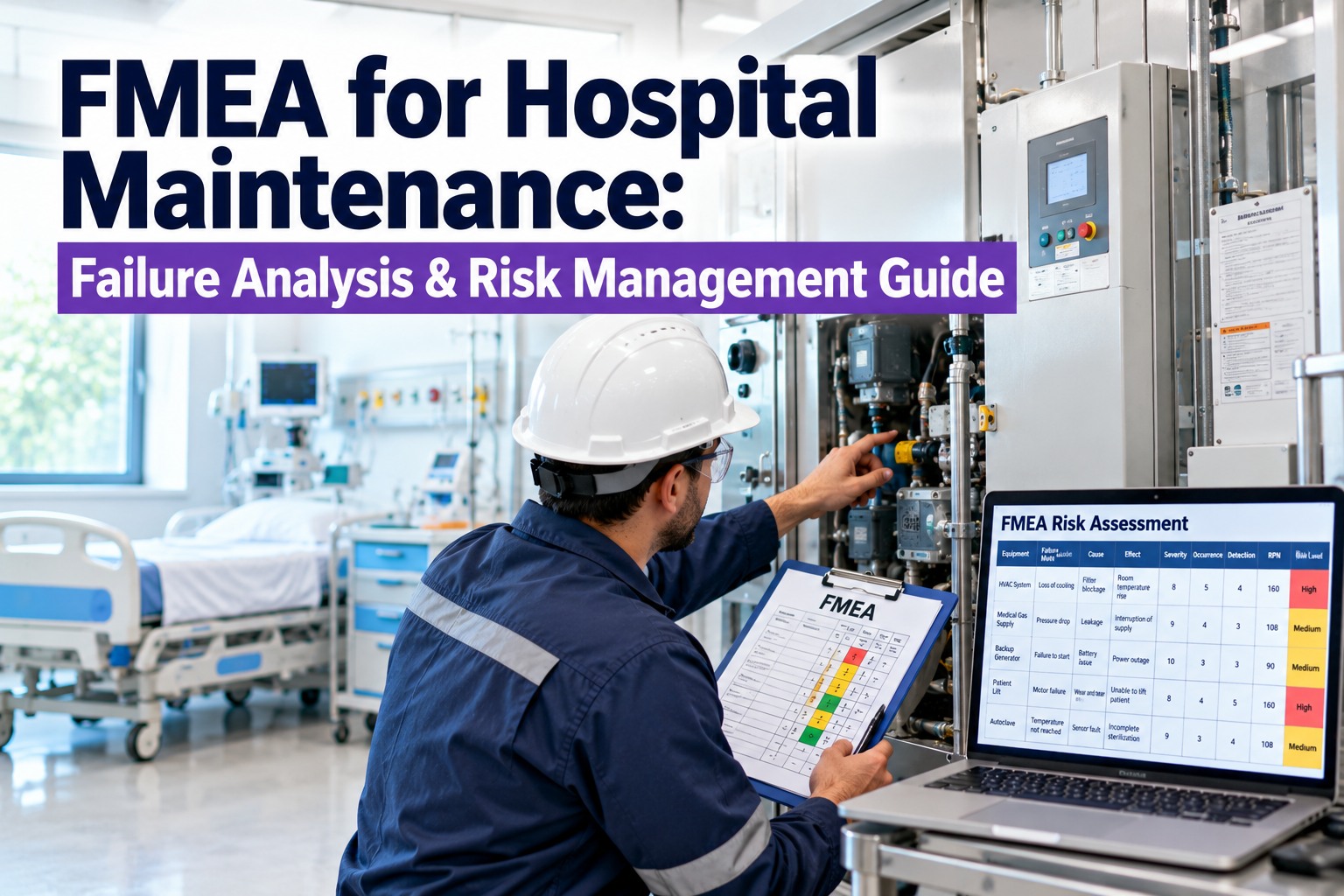
Failure Mode and Effects Analysis (FMEA)
A proactive methodology used both for RCA on known failures and for prospective risk assessment of equipment or processes before failure occurs. FMEA systematically identifies potential failure modes, their effects on function and patient safety, and their likelihood and detectability. Risk Priority Numbers (RPN) calculated from these assessments guide prioritization of corrective actions. FMEA integrates naturally with predictive maintenance programs and is a required analytical tool for many medical device regulatory submissions.
Common Equipment Failure Categories and Their Root Causes
Pattern recognition across RCA findings reveals that hospital equipment failures cluster around a defined set of recurring root cause categories. Understanding these patterns allows maintenance leaders to address systemic vulnerabilities before they produce the next failure event. If any of these failure categories look familiar in your own equipment history, that is a signal your RCA program needs a closer look — Book a Demo to explore how OxMaint helps you track failure patterns and close corrective action loops across your entire asset portfolio.
| Failure Category | Typical Root Causes | Common Contributing Factors | Corrective Action Direction |
|---|---|---|---|
| Mechanical Wear | Insufficient lubrication intervals; incorrect lubricant specification | High utilization rates not reflected in PM schedule; deferred maintenance | Revise PM intervals; update lubricant specifications; add condition monitoring |
| Electrical Failure | Thermal cycling fatigue; inadequate power quality protection | Aging infrastructure; improper grounding; voltage spike exposure | Surge protection installation; thermal imaging PM additions; infrastructure upgrade |
| Calibration Drift | Calibration intervals not matched to drift rate; environmental instability | Temperature/humidity fluctuations; reference standard degradation | Shorten calibration cycles; environmental controls review; reference standard audit |
| Contamination | Inadequate cleaning procedures; non-compliant cleaning agents | Staff training gaps; IFU not current; supply chain substitutions | IFU review; cleaning agent approval process; operator retraining |
| Software/Firmware | Delayed update deployment; update-PM process not integrated | IT-biomed coordination gaps; change management process absent | Establish joint IT-biomed update protocol; add firmware version to PM checklist |
| Operator-Induced | Training gaps; inadequate operator documentation; workflow pressure | High staff turnover; equipment model changes; inadequate onboarding | In-service training program; operator checklist revision; competency verification |
RCA Documentation Requirements for Compliance
In regulated healthcare environments, the quality of RCA documentation is as important as the quality of the investigation itself. Documentation that fails to meet regulatory standards exposes the organization to accreditation risk even when the underlying investigative work was thorough. Three documentation principles apply across all healthcare RCA programs.
First, the failure event must be documented with enough specificity to demonstrate that investigation was conducted on the actual failure, not a generic description of a failure category. Asset ID, failure date and time, operational context at time of failure, and the precise failure mode observed are minimum required elements. Second, the causal chain must be documented in a format that demonstrates logical progression from symptom to root — not a list of observations, but a structured argument connecting cause to effect at each step. Third, corrective actions must include assignment, timeline, and a defined verification method. Actions described in general terms without accountability are not corrective actions — they are intentions, and surveyors can tell the difference.
Organizations using a CMMS to manage RCA documentation benefit from automatic linkage between failure events, investigation records, corrective work orders, and asset history — creating an audit-ready trail without manual cross-referencing. Sign Up Free to explore how OxMaint structures RCA documentation within your CMMS workflow.
Building a Sustainable RCA Culture in Healthcare Maintenance
The greatest obstacle to effective RCA programs in healthcare is not analytical — it is cultural. Maintenance teams operating under constant reactive pressure default to restoring function and moving to the next ticket. The investigation step is skipped not because technicians lack capability, but because the organizational structure does not create space for it and leadership does not consistently signal its priority. Building that structure does not require a complete program overhaul — it starts with the right tools and a clear process. Book a Demo to see how OxMaint makes RCA workflows practical for teams running high-volume maintenance operations.
RCA programs succeed when department leaders visibly prioritize investigation over speed-to-repair on high-impact failures. This means protecting time for investigation, reviewing RCA findings in departmental meetings, and tracking corrective action completion as a key performance metric alongside response time and PM compliance.
Not every failure warrants a full five-step RCA. Define clear criteria for when formal investigation is required — equipment category, clinical impact, cost threshold, or recurrence frequency. A tiered system that requires full RCA for life-safety equipment failures and abbreviated investigation for lower-criticality events creates sustainable workload without compromising rigor where it matters most.
RCA findings that stay in a single work order record deliver a fraction of their potential value. Create structured mechanisms for sharing RCA outcomes across the maintenance team — brief rounds, shared finding libraries, or CMMS-based knowledge notes on asset records — so that lessons from one technician's investigation inform every technician's future work on similar equipment.
RCA programs improve over time when technician findings from corrective work orders feed back into failure analysis records. Whether a corrective action worked — or did not — is data that refines future investigation quality. Build feedback loops between completed work orders and RCA records into your CMMS workflow so that investigation outcomes accumulate into organizational learning rather than dissipating with each completed ticket.
RCA Integration with Predictive Maintenance Programs
Organizations that combine RCA with predictive maintenance IoT programs create a compounding reliability advantage. Predictive maintenance identifies equipment at risk before failure occurs; RCA ensures that failures which do occur — whether predicted or not — yield corrective insights that improve future predictions.
When an RCA investigation identifies that a specific failure mode was detectable with earlier sensor threshold adjustments, that finding directly improves the predictive model for that equipment class. When RCA reveals that a certain failure mode has no sensor precursor and requires physical inspection, that knowledge informs PM task design. The two disciplines are not competing — they are complementary layers of a mature reliability program, each informing and strengthening the other. To see how OxMaint brings both workflows into a single connected platform for healthcare teams, Book a Demo with our team and we will tailor the walkthrough to your facility's specific asset classes and maintenance structure.
OxMaint: RCA-Ready Healthcare CMMS
OxMaint connects failure investigation to corrective work orders, tracks RCA findings across your entire equipment portfolio, and generates the audit-ready documentation your compliance program requires. One platform for failure analysis and maintenance execution in healthcare.
Frequently Asked Questions
Troubleshooting identifies and corrects the immediate cause of a failure to restore function. RCA goes further, tracing the causal chain back to the underlying conditions — maintenance program gaps, installation errors, procedural deficiencies — that made failure possible in the first place. Troubleshooting fixes the current problem; RCA prevents the next one.
The Five Whys method works well for contained, clearly defined failures with a single dominant cause. Fault Tree Analysis is better suited for complex, multi-system failures involving life-safety equipment where all possible failure pathways need to be mapped. Fishbone diagrams support team-based investigations where multiple disciplines need to contribute findings in a structured format. Many organizations use a combination depending on failure complexity.
The Joint Commission requires RCA for sentinel events, which include equipment failures that result in unexpected patient harm. More broadly, the Environment of Care standards expect documented, systematic approaches to identifying and correcting maintenance deficiencies — which a structured RCA program directly supports. Organizations without formal RCA processes are exposed during surveys, particularly when surveyors identify recurring failures in work order history.
Compliant RCA documentation must include: specific failure event details (asset ID, date, failure mode), a structured causal chain analysis, identified root cause and contributing factors, corrective actions with owner assignment and completion timeline, and a defined effectiveness verification method. A CMMS that links failure events, investigation records, corrective work orders, and asset history into a single audit trail significantly reduces documentation burden.
Most healthcare maintenance programs use a tiered threshold system. Full formal RCA is typically required for life-safety equipment failures, any failure with patient impact, failures exceeding a defined cost threshold, and any failure that recurs within a defined period after a previous corrective action. Lower-criticality equipment may use an abbreviated investigation process. Defining these thresholds in writing — and applying them consistently — is what separates a functional program from reactive one-off investigations.
Yes, and this integration is one of the highest-value outcomes of a mature reliability program. RCA findings identify specific failure modes, their precursor signals, and the conditions that accelerate degradation — all of which directly inform sensor selection, alarm threshold calibration, and ML model training for predictive maintenance. Organizations that feed RCA findings into their predictive programs improve model accuracy over time and reduce both false alarms and missed failure predictions. Book a Demo to see how OxMaint connects RCA and predictive workflows.