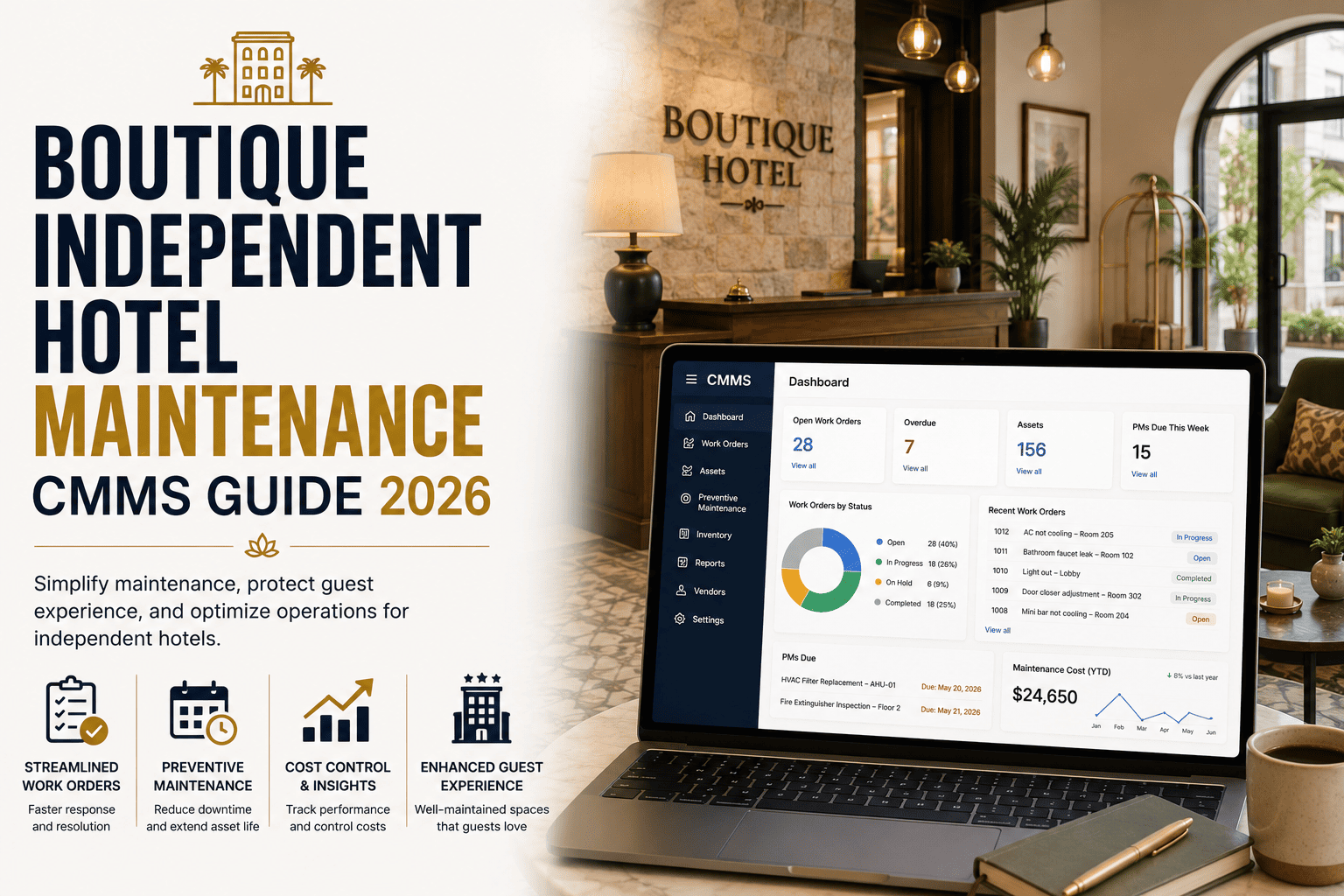
For a 40-room boutique hotel running on a single maintenance engineer and an overnight front-desk handoff, the difference between a four-star review and a refund often comes down to whether the dripping HVAC condensate pan was logged before the guest ever saw it. Independent properties don't need the 14-module enterprise suite designed for 800-room casino resorts — they need a right-sized CMMS that fits on a phone, deploys in an afternoon, and pays for itself by preventing one boiler failure per quarter. This 2026 guide walks a 3-to-8 technician team through system selection, a lean PM library, mobile-first workflow, and the 80/20 cost model that delivers enterprise-grade discipline at a fraction of the licensing burden. When you're ready to pilot it on your property, you can Start Free Trial and be live before the next turnover.
Can one engineer actually run maintenance for 40 rooms — without drowning in spreadsheets?
A right-sized CMMS gives a 3-to-8 person boutique team the same preventive-maintenance discipline as a 500-room property, at roughly 20% of the enterprise licensing cost. Here's the playbook small independent hotels are using in 2026.
What a boutique property actually needs (and what it doesn't)
Enterprise CMMS platforms average 11–14 active modules and $1,200+ per seat per year. A 40-room independent hotel uses four — work orders, PM scheduling, asset registry, and mobile intake — and pays $35–65 per technician per month. Anything beyond that is shelf-ware.
- 8–14 week implementation with external consultant
- Modules for capital planning, labor forecasting, multi-property rollups — all unused
- $1,200+/seat/yr licensing for a team of three
- Desktop-first interface; engineer logs work on a lobby PC at end of shift
- Compliance reporting built for ISO 55000 audits at 500+ asset plants
- Live in 1–3 days — self-onboarded by the Chief Engineer
- Four modules: work orders, PM, assets, mobile intake — nothing dormant
- $35–65/seat/mo, billed monthly, cancel anytime
- Mobile-first: technician photos a leaking valve from the guest floor in real time
- Inspection checklists tuned to 11 sec/room turnover pace
The lean PM library: 18 tasks that cover 90% of asset risk
A boutique hotel carries roughly 320 maintainable assets across 40 rooms — HVAC fan-coils, PTAC units, plumbing fixtures, kitchen equipment, and common-area systems. The temptation is to build a 90-task PM schedule. Resist it. Eighteen recurring PM tasks capture 90% of failure risk and keep a one-engineer team from spending Mondays in the system instead of on the floor.
- Pool chemistry log & filter pressure check
- Boiler pressure / temperature reading
- Lobby & corridor lighting audit
- Generator weekly test run (15 min)
- PTAC / fan-coil coil cleaning (rolling 1/4 of rooms)
- Kitchen hood & Ansul inspection
- Elevator machine-room visual + log
- Water heater anode & T&P valve check
- Guest-room preventive sweep (10 rooms, rotating)
- Fire-life-safety device spot test (10%)
- HVAC filter replacement (all units)
- Rooftop unit belt & pulley inspection
- Backflow preventer test
- Exterior building envelope walk
- Fire extinguisher tag audit
- Full FLS system certification (3rd party)
- Elevator annual certification
- Boiler / water heater descale & inspection
| Asset Class | Typical Count (40-rm) | PM Frequency | Failure Cost Avoided |
|---|---|---|---|
| HVAC (PTAC / fan-coil) | 42 units | Quarterly filter / monthly coil | $480 per off-season replacement |
| Plumbing fixtures | ~160 | Monthly room sweep | $2,200 per water-damage claim |
| Boiler / water heater | 2 | Weekly read / annual descale | $6,500+ per emergency replacement |
| Elevator | 1–2 | Monthly visual / annual cert | $3,000 per entrapment event |
| Generator | 1 | Weekly run / monthly load | $8,000+ per outage night (lost revenue + refunds) |
From guest complaint to closed ticket in under 4 minutes
A boutique CMMS lives or dies on the front desk's willingness to use it. If the night auditor has to open a laptop, log into a portal, and fill eight fields, the work order never gets created — and the next morning starts with a sticky note. Mobile-first intake collapses that handoff to a photo and a room number.
Photo + room number intake
The desk agent snaps a photo of the leaking shower, tags room 214, picks "Plumbing" from a 6-button menu. No login friction — a kiosk-mode tablet or PMS-integrated form feeds the CMMS queue directly.
Priority + assignment routing
The system applies rules: guest-room plumbing during stay = Priority 1, route to on-shift engineer, notify GM if open > 2 hours. No manual dispatch decision required.
Mobile close-out with evidence
The engineer opens the ticket on phone, sees the photo, walks to 214, replaces the cartridge, snaps an after photo, closes the ticket. Parts and 8 minutes of labor captured automatically.
Auto-notify front desk + guest
Desk agent gets a push notification that 214 is resolved. Optional guest SMS: "We've addressed the issue — apologies for the inconvenience." Review risk drops, resolution time is documented.
What a 40-room property should spend — and what it gets back
A three-technician boutique team on a $45/seat/mo CMMS spends $1,620/year on software. The same property averages $28,000/year in reactive maintenance, emergency vendor calls, and guest-refundable incidents tied to deferred PM. The payback math is not subtle.
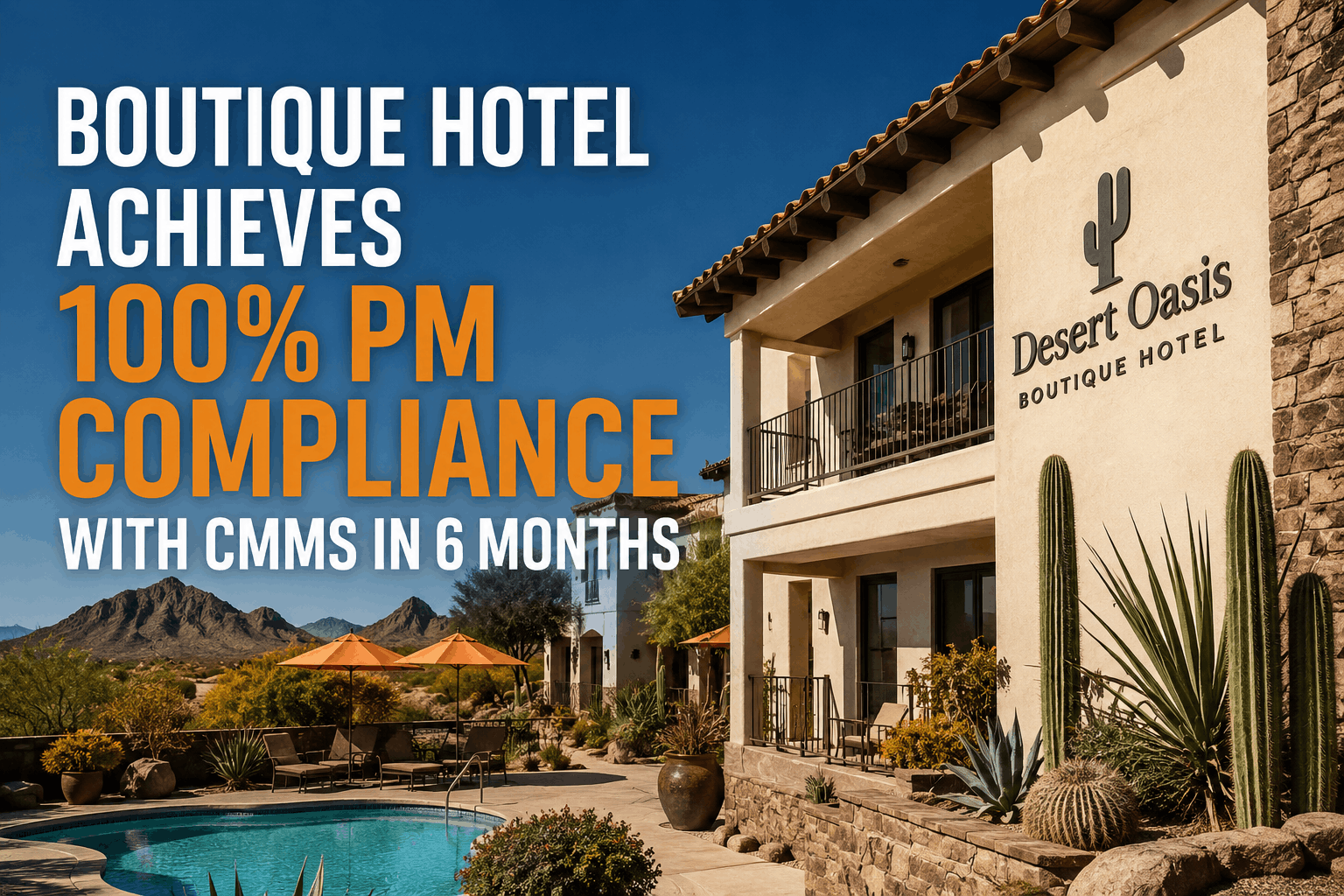
The 58-room independent in Asheville. One chief engineer, two technicians, 320 assets, zero CMMS before 2025. Replaced a Google Sheets work-order log with a boutique-right CMMS at $45/seat/mo. Within 90 days: reactive work orders dropped from 47/month to 29, average close time fell from 26 hours to 7, and one $4,200 boiler repair was caught during a monthly PM that would have been an emergency by November. Software cost: $135/mo. Documented savings in Q1 alone: $7,100.
Stop running maintenance on sticky notes and shared spreadsheets.
Deploy a boutique-right CMMS in an afternoon and have your full PM library live before the next turnover cycle.
Boutique hotel CMMS — what teams actually ask
We have one engineer. Is a CMMS overkill for a team that small?
No — a single-engineer property benefits most, because the CMMS becomes the institutional memory. When that engineer is on vacation or leaves, the PM schedule, asset history, and vendor contacts don't walk out the door. The system also lets the front desk and housekeeping submit requests without interrupting the engineer, which protects focus time for actual repairs.
How long does implementation take for a 40-to-60 room property?
A boutique-right CMMS should be live in 1 to 3 days. You import an asset list (often a spreadsheet the engineer already keeps), load the 18-task PM template, add 3–8 user accounts, and mount a tablet kiosk at the front desk. If a vendor quotes 6+ weeks of onboarding, you're buying an enterprise product dressed up for small properties. You can Book a Demo to see a realistic 48-hour rollout plan.
Does the CMMS integrate with our property management system (PMS)?
Most boutique CMMS platforms offer a lightweight PMS integration or a Zaptor/Opera-style webhook that pushes guest-room flags directly into the work-order queue. If your PMS is older or cloud-only, a kiosk-mode intake form at the front desk achieves 90% of the same outcome without any integration cost.
What does a realistic monthly budget look like for a 3-to-8 technician team?
Plan for $35 to $65 per technician per month, billed monthly with no annual lock-in. A three-person team lands around $135/month; an eight-person team around $360. Avoid platforms that require a $5,000+ implementation fee or a three-year contract — those are enterprise pricing models that don't match a 40-room property's economics.
Can we really run preventive maintenance on a one-engineer schedule?
Yes, if the PM library is disciplined. The 18-task lean schedule above is designed for a single engineer with two supporting technicians, totaling roughly 6 hours of PM labor per week. The CMMS auto-generates the daily task list, so the engineer walks in and sees exactly what's due — no planning time, no missed quarterly tasks. You can pilot the full template when you Start Free Trial.
Your 40 rooms deserve better than a shared Google Sheet.
Spin up a boutique-right CMMS today — full PM library, mobile intake, and asset registry live before tomorrow's check-ins.
Free 14-day trial · No credit card