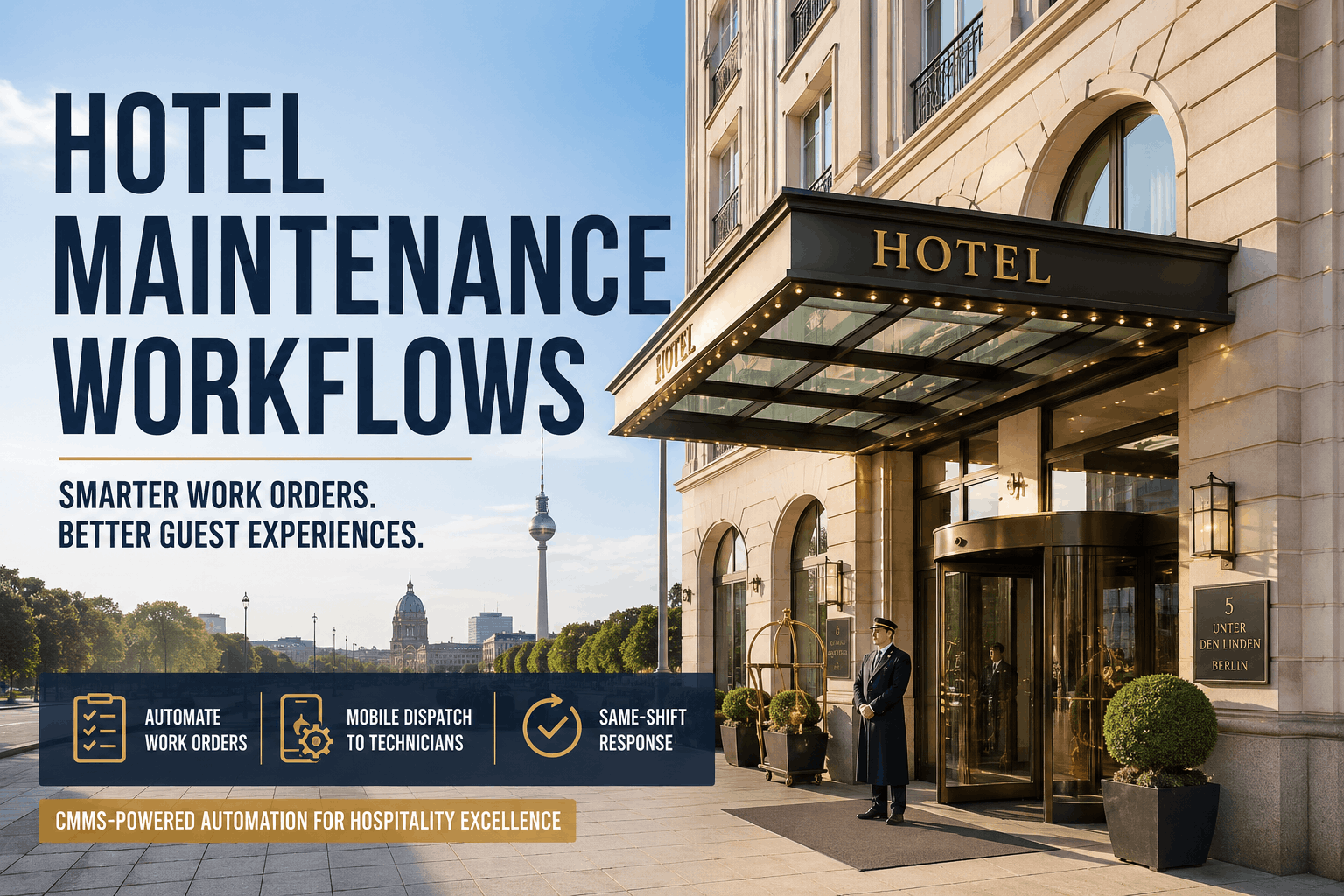
A Director of Engineering at a 260-room full-service hotel in Atlanta described her pre-CMMS reality in three words: "chaos with radios." Housekeeping reported faults verbally to the front desk, the front desk relayed them by radio, engineers diagnosed from the doorway, and a paper log that was supposed to capture everything was filled in sporadically at the end of a shift — if it was filled in at all. When the property moved to a digital work order system for hotels, average guest fault response time dropped from 51 minutes to 17 in the first 60 days. The radios are still there. They are just no longer the system.
Digital Work Order Management for Hotels: Complete Guide
How hotel engineering and operations teams are replacing paper logs, radio calls, and spreadsheets with automated digital work order systems — and the operational outcomes that follow within 90 days.
What Paper-Based Hotel Maintenance Systems Actually Cost
The argument for keeping informal maintenance coordination is always the same: "Our team knows what to do." The problem is not whether the work gets done. The problem is that without a hotel maintenance workflow software system, there is no record of what was done, no SLA attached to when it should have been done, and no data connecting repeated events on the same asset to an underlying fault that is costing money every time it recurs. Sign up for Oxmaint to start capturing every maintenance event as a structured digital work order.
The same HVAC unit in Room 318 was repaired four times in eight months. Each time, the engineer who responded had no record of the previous visits — so each repair started from scratch. The fifth event required a full unit replacement at emergency cost. With asset-linked digital work orders, the recurring pattern would have been visible after event two, enabling a planned replacement at scheduled cost instead of an emergency callout at 2 AM.
Without a timestamped work order system, response time is a story — not a measurement. When a GM asks "how fast do we respond to guest faults?", the answer from a radio-based team is always an estimate. When the same question is asked of a hotel running hospitality work order automation, the answer is a number: 17 minutes average, with all critical faults under 45 minutes in the last 30 days, and two SLA breaches flagged for review. One is a story. One is a program.
Brand standard audits from major flags require documented evidence of preventive maintenance completion for life safety systems, elevators, HVAC, and pool equipment. A hotel whose PM program lives in a shared calendar and a paper binder cannot produce this evidence on demand. A hotel running a hotel CMMS maintenance system generates the full compliance history report in under ten minutes — on the day of the audit, not after three days of manual compilation.
When a work order closes with no completion notes, no photo, and no parts log, it has not been completed — it has been dismissed. Digital work order systems that require completion evidence before closure create an accountability layer that paper-based programs cannot replicate. The closed work order is a documented maintenance record, not a checked box on a whiteboard that gets erased at shift change. Book a demo to see how Oxmaint enforces completion evidence on every work order.
How a Digital Hotel Work Order System Operates End-to-End
The lifecycle of a maintenance event in a properly configured hotel engineering workflow management system follows five defined steps — each one producing data that the next step uses. This is what distinguishes a digital work order system from a digital ticketing system: every step is linked, every output feeds the next, and the closed work order is richer than the opened one.
Request Intake
Guest QR code, front desk form, housekeeping mobile app, or PMS integration — every channel creates a timestamped work order automatically. No verbal relay. No sticky note.
Priority Classification
System assigns Critical, High, Standard, or Planned priority based on fault type and room status. SLA timer starts at submission. Escalation alert fires automatically if timer reaches threshold.
Skill-Matched Dispatch
Work order routes to the qualified available technician — not the nearest radio. Engineer receives a push notification on mobile and accepts or flags unavailability in one tap.
Completion with Evidence
Technician completes repair, logs parts used, adds completion notes, and uploads a photo before marking the work order closed. Closure is prevented until all required fields are filled.
Asset History Updated
Completed work order is stored against the specific asset. Second event on the same asset within 30 days triggers a recurring fault flag — auto-generating a root-cause inspection work order.
Core Capabilities of a Best-in-Class Hotel Digital Work Order Platform
When evaluating hotel maintenance request platform options, the capabilities below separate a genuine hospitality operations tool from a generic task manager wearing hotel vocabulary. Each one maps to a specific operational problem that informal maintenance coordination cannot solve. Sign up to explore every capability in Oxmaint — free to start.
Paper & Radio vs. Digital Hotel Work Order Software
The comparison below covers the operational dimensions that matter to hotel engineering directors, GMs, and VP Operations evaluating a transition from informal maintenance coordination to a structured hotel task tracking software platform.
| Operational Dimension | Radio & Paper | Oxmaint Digital System |
|---|---|---|
| Request intake | Verbal relay — no record at submission | Timestamped work order created at intake |
| Technician dispatch | First to answer radio, regardless of skill | Skill-matched auto-assignment with SLA timer |
| SLA enforcement | No timer — verbal estimate only | Auto-escalation before SLA breach |
| Recurring fault detection | Invisible without manual log review | Auto-flagged after 2 events on same asset |
| PM scheduling | Separate binder or calendar — easily skipped | Auto-generated in same queue as reactive |
| Completion verification | Verbal confirmation, whiteboard tick | Photo + notes required before closure |
| Brand audit reporting | Days of manual compilation | On-demand report in under 10 minutes |
| Asset cost visibility | Not available — no linked records | Top cost assets visible at 30 days of data |
| Benchmarks from hospitality operations management programs. Results vary by property configuration and team size. | ||
Swipe to view all columns on mobile
How Fast Does a Hotel Digital Work Order System Go Live?
The most common reason hotels delay digital transformation of their maintenance workflows is the assumption that implementation requires an IT project, a data migration, or months of configuration. For Oxmaint, a 100–300 room hotel is fully operational within 3–5 business days. Here is what each day covers.
Asset List Import
Upload your asset register — rooms, HVAC units, elevators, pool systems, fire suppression, back-of-house mechanical. Oxmaint's import template takes 30–60 minutes for a 200-room property. No IT resource required.
Priority Rules and SLA Configuration
Define your four priority levels, SLA response targets per level, and escalation rules. Configure technician profiles with skill assignments and shift schedules. Takes under two hours with an Oxmaint onboarding guide.
Team Mobile Onboarding
Engineers download the Oxmaint mobile app and complete a 45-minute onboarding session covering work order acceptance, completion with photo, and parts logging. Front desk team trained on intake portal for guest-reported faults.
PM Schedules and Go-Live
Build the first PM schedule for your five highest-risk asset categories. From Day 5, all reactive requests enter the system as digital work orders. PM work orders begin auto-generating. The engineering team has a single prioritised job list for the first time. Start your Day 1 setup in Oxmaint now — free.
The first thing I noticed after going live with Oxmaint was that I stopped hearing about problems from guests before I heard about them from my team. Within three weeks, the engineering department was in front of issues instead of behind them. By day 45, I ran my first asset cost report and found out that seven rooms were responsible for 31% of our entire engineering labour spend. I had no idea. The data was always there — we just had no way to see it until the work orders started linking to assets.
Frequently Asked Questions
What makes a digital hotel work order system different from a general helpdesk platform?
How does hotel maintenance workflow software handle multi-department request intake?
Can a hotel digital work order system integrate with existing Property Management Systems?
What hotel engineering KPIs improve first after implementing digital work orders?
Is Oxmaint suitable for independent hotels without a large IT team?
Stop Managing Maintenance by Radio. Start Managing It by Data.
Every maintenance event your hotel handles without a digital work order is an untracked cost, an unresolved guest risk, and a missing data point in your asset management program. Oxmaint gives your engineering team structured intake, auto-dispatch, asset history, PM scheduling, and compliance reporting — live in days, not months.