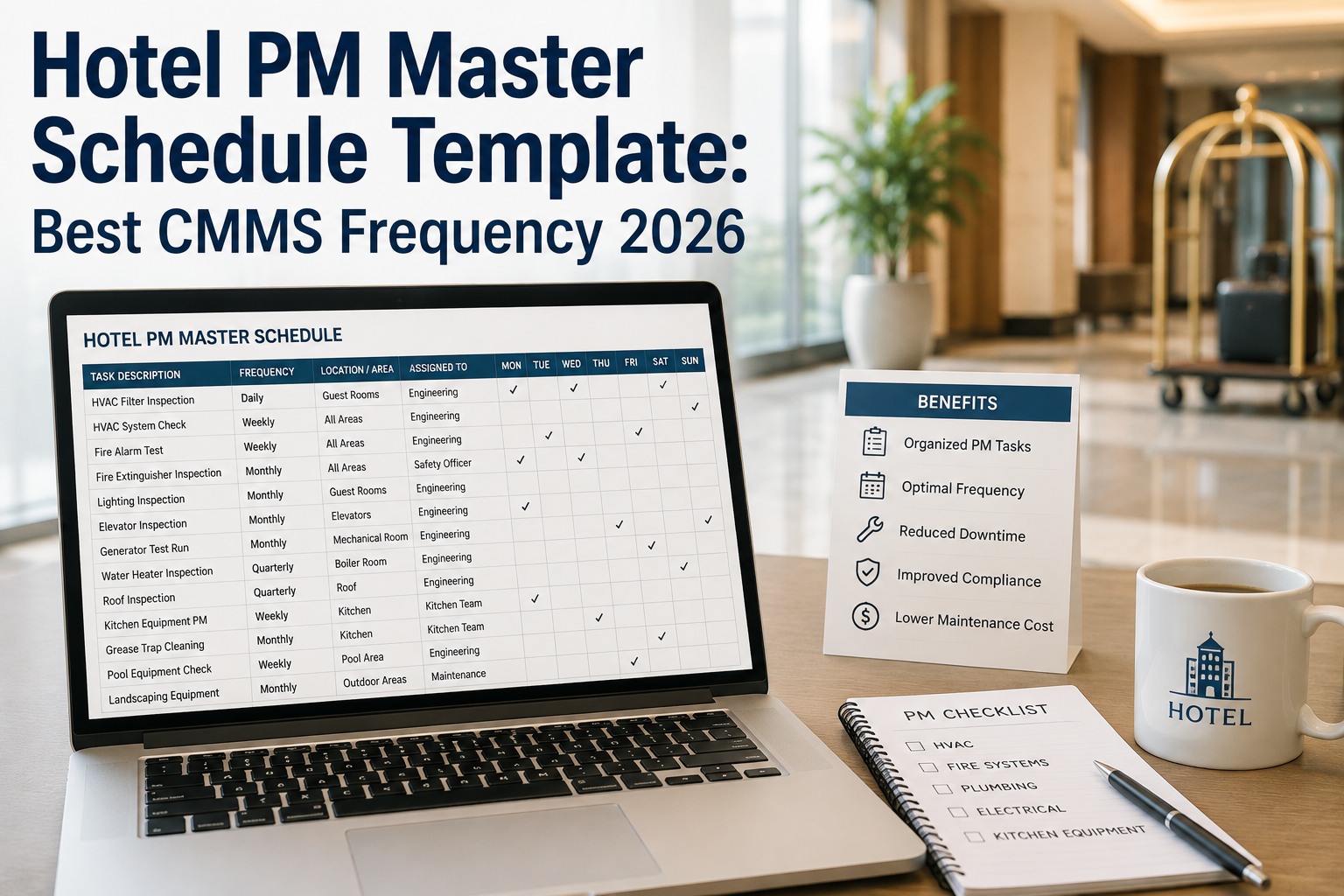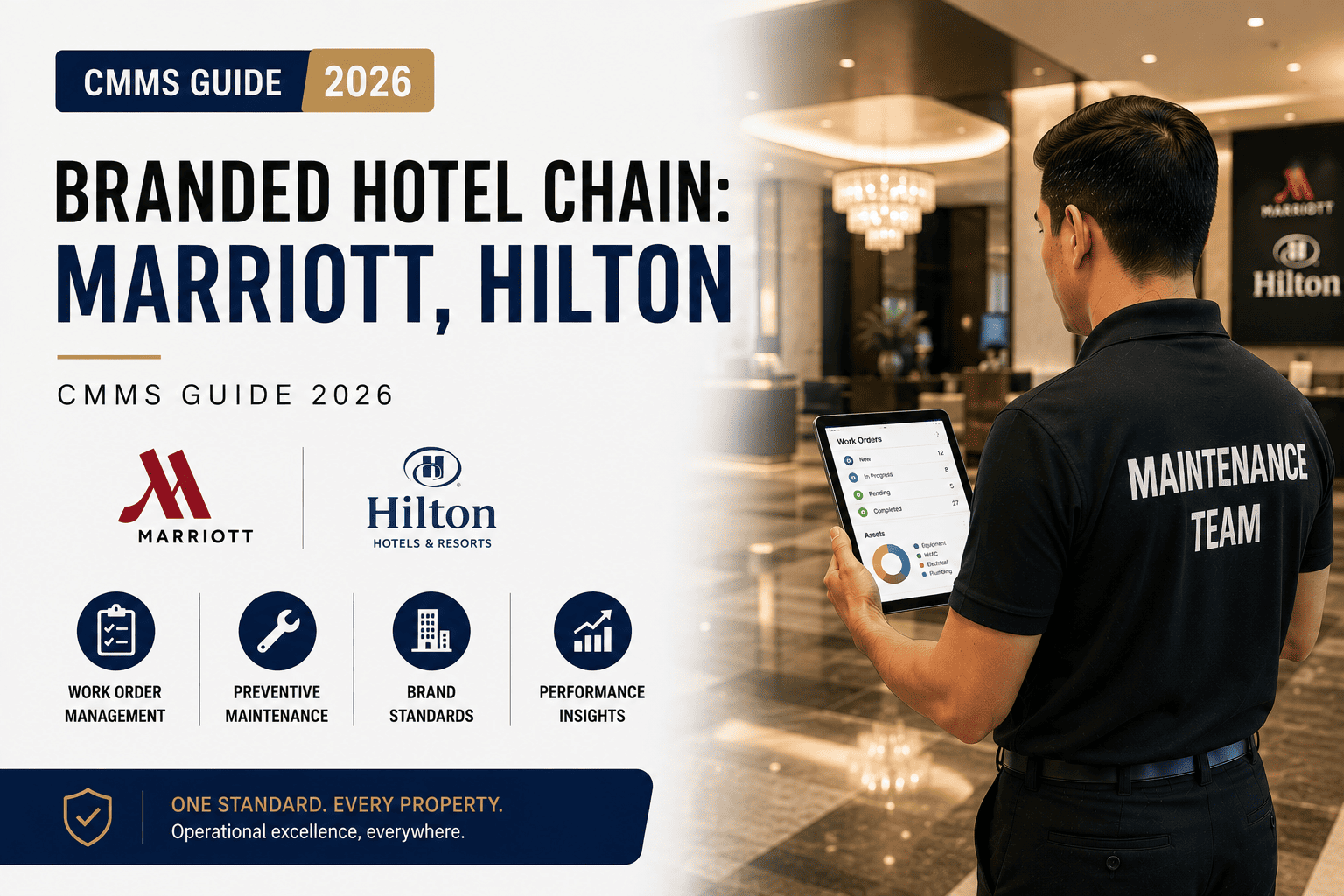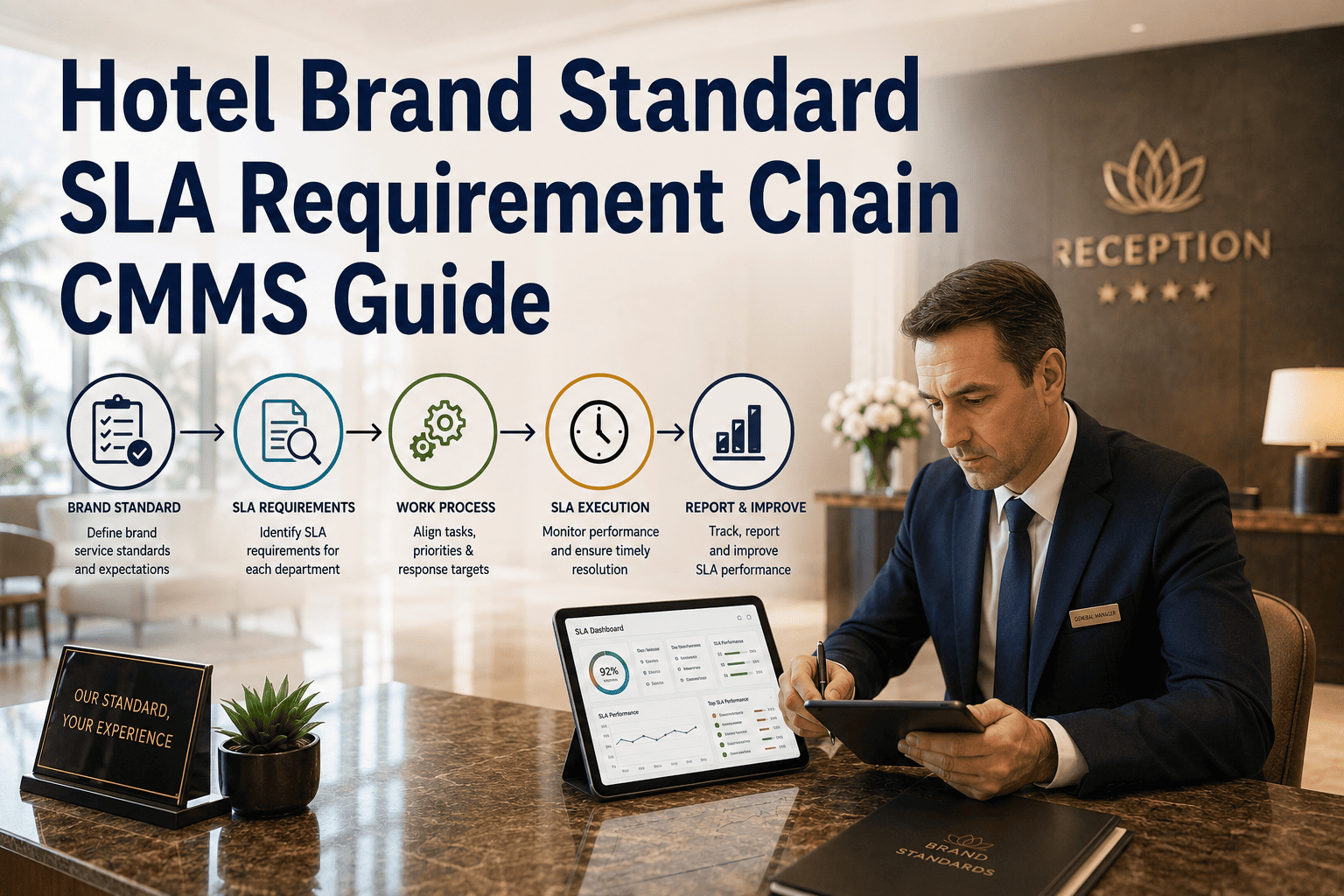
Brand-standard preventive maintenance is the operational contract every managed hotel property signs the moment it raises a franchisor flag — Marriott, Hilton, IHG, and Hyatt all publish prescriptive PM schedules that inspectors verify on walk-throughs, and a single missed guestroom fan-coil filter change can show up as a deduction on a quality audit. The hard part is not knowing the standard; it is replicating it identically across 200+ assets at 12 properties with different staff, climates, and aging curves. A CMMS-backed brand-standard PM template library solves this by turning each franchisor's brand-standard checklist into versioned, asset-class-specific templates that fire on the correct interval at every property. This guide walks through the template-by-asset-class design, brand-specific frequency requirements, version control, and the audit-ready CMMS structure that keeps compliance defensible — so you can Start Free Trial with confidence or book a walkthrough first.
Is every property in your portfolio running the exact same brand-standard PM — or just close enough to fail the next inspection?
Marriott, Hilton, IHG and Hyatt publish thousands of brand-mandated maintenance tasks. Without a centralized CMMS template library, each property interprets the standard differently — and inspectors find the gap. Centralize, version, and audit every PM template in one system.
Why brand-standard PMs are non-negotiable
Brand-standard PMs are not suggestions — they are the operational contract every managed property signs. A 350-room full-service Marriott averages roughly 1,200 mandated preventive maintenance tasks per year across guestrooms, BOH systems, life-safety, and exterior. Missing even 4% can trigger a brand-quality deduction worth $8,000–$15,000 per property at remediation, plus reputational risk on the next FLAG review.
A 12-property portfolio running 350 rooms each carries roughly 4,200 brand-PM tasks per year — and franchisor inspectors increasingly arrive with tablet-based checklists that pull historical completion data. Properties that cannot produce timestamped, technician-signed evidence within the audit window are scored as non-compliant regardless of whether the work was actually performed. The CMMS template library is what turns a paper binder of brand standards into a defensible, queryable record.
Designing PM templates by asset class
A brand standard is generic; assets are specific. The CMMS template library must fork each franchisor standard into asset-class-specific templates so a guestroom PTAC, a rooftop RTU, and a commercial kitchen reach-in cooler each inherit the correct task list, parts, and labor estimate.
Guestroom HVAC & Plumbing
PTAC/VTAC coil cleaning, filter swap, condensate line flush, shower cartridge inspection. Brand standard typically mandates quarterly guestroom cycle with 100% completion within 90 days.
Life-Safety & Fire Systems
Sprinkler test, fire pump churn, extinguisher inspection, emergency lighting, FA panel test. NFPA-aligned and brand-audited; missed life-safety PMs are the most common critical finding.
BOH Mechanical & Plant
Boiler combustion analysis, chiller refrigerant log, cooling tower treatment, AHU belt tension. Brand standards tie these to energy benchmarks and capital-reserve condition scores.
FF&E & Public Space
Lobby lighting cycle, elevator cab fixture check, corridor carpet extraction, fitness equipment torque. Drives the guest-visible brand-quality score more than any mechanical PM.
Kitchen & Laundry
Hood cleaning, walk-in coil defrost, dishwasher delime, dryer lint exhaust. Brand-flagged for health and fire audit; most franchisors require third-party documentation.
Exterior & Grounds
Parking-lot lighting, facade sealant, roof drain clear, signage illumination. First-impression brand cue; inspectors photograph exterior defects before entering.
Brand-specific frequency requirements at a glance
Each major franchisor encodes PM frequency differently — Marriott's MROP, Hilton's Property Optimization, IHG's standard, and Hyatt's preventive maintenance matrix. The CMMS template library must respect these exact cadences or the property is technically non-compliant even if the work is done.
| Brand | Standard Program | Guestroom Cycle | Life-Safety Cadence | Documentation Window |
|---|---|---|---|---|
| Marriott | MROP / Brand Standard | Quarterly (1/4 of rooms) | Monthly + Annual cert | 14 days post-inspection |
| Hilton | Property Optimization | Quarterly rotating | Monthly self-audit | 7 days on request |
| IHG | Brand Standard PM | 90-day room cycle | Monthly + quarterly | 10 days |
| Hyatt | Preventive Matrix | Quarterly + deep annual | Monthly churn/test | 14 days |
| Wyndham | Brand PM Schedule | Semi-annual minimum | Quarterly documented | 14 days |
A 180-room select-service Marriott property running the quarterly 1/4-cycle mandate must close roughly 45 guestrooms every 90 days with an average of 18 PM tasks each — about 810 documented task completions per quarter from a single template. When that template is centralized in the CMMS, every technician at every property receives the identical task list, photo-verification requirement, and parts kit; when it is not, each property runs its own interpretation and the portfolio compliance score drifts.
Template versioning keeps every property current
Franchisors revise brand standards 2–4 times per year — a guestroom coil-cleaning spec may move from "biannual" to "quarterly," or a new low-GWP refrigerant log may be added. A CMMS template library without version control is a compliance time bomb: properties silently run superseded templates and fail audits for tasks they never knew were added.
Centralized master template
One source of truth per asset class per brand. Changes are authored at portfolio level, reviewed, and published — never edited at the property level.
Forced re-publish window
When a brand standard updates, the master template is re-versioned and pushed to all properties. Open work orders inherit the prior version; new work orders adopt the latest.
Audit trail per task
Every completed PM carries the template version ID, technician signature, timestamp, and photo evidence — exportable as a single PDF for any inspector request.
Worked example. A 12-property portfolio discovered during a Q3 brand audit that 4 properties were still running the 2024 guestroom PTAC template — missing a new coil-verification photo step added in the January 2026 standard revision. The remediation: 312 guestrooms re-inspected in 6 days, $9,400 in overtime, and a scored deduction on two properties. With CMMS version control, the January revision would have auto-pushed to all 12 properties on publication date, and the audit would have shown 12/12 compliant.
The audit-ready library architecture
A defensible brand-standard PM library is not a folder of PDFs — it is a structured hierarchy: Brand → Asset Class → Asset → Template → Task → Evidence. Inspectors query by property, asset, or task; the CMMS returns the completed record in under 30 seconds. Here is what each layer must contain.
Brand layer
One parent node per franchisor (Marriott, Hilton, IHG, Hyatt). Holds the brand-standard source document, revision history, and the compliance scoring rubric used by that franchisor's inspectors.
Asset-class layer
Six canonical classes — guestroom, life-safety, BOH mechanical, FF&E, kitchen/laundry, exterior. Each class inherits the relevant brand-standard subset and cannot be edited at property level.
Template layer
The versioned PM template itself — task list, frequency, labor estimate, required parts, photo-proof flags. Versioned and timestamped; superseded versions remain queryable for historical audit.
Property-instance layer
Each property subscribes to the master template. The CMMS auto-generates work orders on the correct cadence, assigned to the correct technician, with the correct parts kit pre-staged.
Evidence layer
Completion record: technician signature, timestamp, photos, meter readings, parts consumed. This is what the inspector actually asks to see — and what most paper-based systems cannot produce in time.
Centralize every brand-standard PM template before the next inspection window opens.
Deploy a versioned, audit-ready CMMS template library across your portfolio in under 14 days. Every property, every asset class, every task — identical and defensible.
Brand-standard PM template library — answered
How does a CMMS template library improve brand-compliance scores?
It ensures every property runs the identical, current version of each franchisor-mandated PM task with timestamped, photo-backed evidence. Portfolios using a centralized template library typically lift brand-quality scores from the low-80s to 94–97% within two audit cycles, because inspector requests for documentation can be answered in minutes rather than days.
Can we map Marriott, Hilton, IHG, and Hyatt standards into one library?
Yes. The CMMS uses a Brand layer so each franchisor's standard lives in its own namespace, while shared asset-class templates (guestroom HVAC, life-safety, BOH) can be cloned and brand-specific tasks appended. Mixed-flag portfolios run a single library with per-brand compliance reporting. You can Book a Demo to see a multi-brand mapping live.
What happens when a franchisor updates the brand standard mid-year?
The master template is re-versioned at the portfolio level and pushed to every subscribed property. Open work orders finish on the prior version; all newly generated work orders adopt the revision. The version ID is stamped on every completion record so auditors can confirm the property was running the correct standard at the time of work.
How long does it take to deploy the template library across a portfolio?
A typical 8–15 property portfolio is live in 10–14 days: brand standards are imported, asset classes mapped, templates versioned, and property instances activated. Larger portfolios (40+ properties) take 3–4 weeks with phased rollout. Pre-built franchisor template packs for Marriott, Hilton, and IHG accelerate onboarding by roughly 60%.
What does an inspector see when they request PM records from the CMMS?
A filtered export by property, asset class, and date range — typically a PDF or shareable link showing each PM task, the version ID, technician signature, timestamp, photos, and parts consumed. Most CMMS deployments can produce this in under 30 seconds, compared to 2–5 days for properties relying on paper binders or standalone spreadsheets.
Make every property audit-ready — starting today.
Stand up a centralized, versioned brand-standard PM template library in your CMMS. Free 14-day trial, full franchisor template packs included, no credit card required.
Free 14-day trial · No credit card