The regional director arrived at the 248-room Marriott-flagged property on a Wednesday with no advance notice. The inspection lasted four hours. By 3 PM, the general manager had received a preliminary report citing 23 brand standard deficiencies — including guest room linen thread count below brand specification, lobby scent diffuser offline for an undetermined period, fitness center equipment out of service with no signage, and restaurant tabletop condition scored below the 85% threshold. The formal penalty notice arrived 10 days later: $38,000. The deficiencies had existed for weeks. Nobody had been systematically checking against the brand standard. Start your brand standard inspection program in Oxmaint free — every touchpoint tracked, every finding assigned, every audit ready before the regional director walks in.
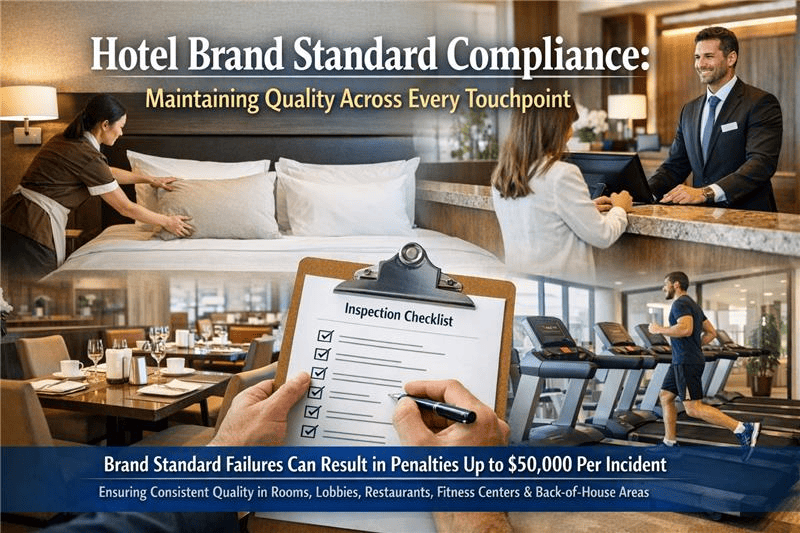
Hotel Brand Standard Compliance: Maintaining Quality Across Every Touchpoint
Brand standards are not suggestions. Every major hotel flag — Marriott, Hilton, Hyatt, IHG, Wyndham, Choice — enforces its brand standard through unannounced property improvement plan audits, quality assurance visits, and LQA mystery guest programs. Failure at any touchpoint produces a scored deficiency. Enough deficiencies produce a formal penalty. Enough penalties produce a flag removal notice. The hotels that consistently score above threshold are not exceptional — they inspect against the brand standard continuously, not reactively. Oxmaint builds that inspection program for you.
What Brand Standard Failures Actually Cost Hotel Owners
The $38,000 penalty in the opening case is not unusual. It is not even close to the maximum. Brand standard penalties are structured to be significant enough to compel compliance — and they scale with the severity and persistence of deficiencies. Understanding the full cost structure is the first step toward understanding why a digital inspection program is not an overhead expense — it is a risk management investment.
The 6 Brand Standard Inspection Zones — What Gets Scored in Every QA Audit
Every major hotel flag structures its quality assurance audit around the same six property zones. Understanding what gets scored in each zone — and why those specific elements are weighted most heavily — is the foundation of a preventive brand standard program. Load all six zones as inspection templates in Oxmaint free.
Guest Room Condition and Presentation
Guest rooms account for 35–45% of the total brand standard score in most QA frameworks — more than any other single zone. The scoring criteria cover furniture condition (no chips, tears, or worn finishes), linen thread count and condition, bedding presentation standards, lighting functionality (every bulb present and working), bathroom grout and caulk condition, HVAC function and guest control operation, and in-room technology (TV remote batteries, charging ports, clock radio). A guest room audit typically scores 40–60 individual line items — and a single deficient bulb or torn curtain liner counts against the score.
Lobby, Public Areas, and First Impressions
The lobby is the first physical touchpoint for every arriving guest and the primary photography subject in every guest review. Brand standards for lobby areas are detailed and specific — flooring condition (no chips, cracks, or worn areas in high-traffic zones), furniture arrangement matching the brand's approved layout, signature scent diffuser operational and at the specified level, lighting at the brand-specified color temperature, and front desk signage meeting current brand graphic standards. Many flags conduct their lobby inspection as the first zone scored, because a substandard lobby conditions the inspector's expectations for everything that follows.
Food and Beverage — Restaurant, Bar, and Breakfast Areas
Restaurant and F&B outlet scoring encompasses both physical condition and service delivery standards. Tabletop condition — no chips, cracks, or worn finishes on plates, glasses, or flatware — is weighted heavily because it directly affects guest perception of value. Menu design and pricing must meet current brand standards. Breakfast presentations for limited-service properties are evaluated against the brand's approved food safety and presentation protocols. A fitness center or pool bar operating with worn barstools, chipped glassware, or an outdated menu is a multi-deficiency scoring event even if the food quality is excellent.
Fitness Center and Pool Facilities
Fitness centers are among the most frequently deficient zones in brand standard audits — because they are often under-resourced relative to their scoring weight. Every piece of fitness equipment must be fully functional during inspection hours. A treadmill with an "Out of Order" sign posted with no work order and no estimated return date is a deficiency. An "Out of Order" sign with a visible work order reference number and a repair date is not — because it demonstrates the property is managing the issue. Pool areas are scored for chemical log currency, deck condition, and aquatic equipment operational status. Track fitness equipment as named assets in Oxmaint with work order history visible from any inspection.
Exterior, Curb Appeal, and Signage
The exterior inspection begins before the auditor enters the building. Parking lot condition, landscaping maintenance, exterior lighting functionality (every exterior fixture operational), brand signage illumination and condition, and entrance door and awning condition are all scored. A burned-out letter in a brand sign is a deficiency. Cracked concrete in the guest drop-off zone is a deficiency. Overgrown landscaping that partially obscures the brand signage is a deficiency. Brand standards for exterior presentation exist because the exterior sets guest expectations before any interior touchpoint — and low exterior scores correlate strongly with negative online review mentions of "tired" or "rundown" property appearance.
Back-of-House, Engineering, and Record-Keeping
Back-of-house scoring is the zone that most surprises hotel management teams — because auditors inspect areas that guests never see. Engineering room organization, preventive maintenance record completeness, life safety inspection documentation, and staff training record currency are all scored. A well-maintained property with no digital PM records scores lower on the BOH zone than a property with minor physical deficiencies but complete, current digital maintenance records. The audit logic is sound: a property that cannot demonstrate a systematic PM program is a property that is operating reactively — and reactive operations produce brand standard deficiencies at a predictable rate. See how Oxmaint provides audit-ready BOH records in under 5 minutes.
LQA Mystery Guest Programs: The Invisible Audit You Cannot Prepare For
Leading Quality Assurance (LQA) mystery guest programs are the brand standard enforcement mechanism that most hotel teams underestimate. Unlike the announced or semi-announced QA audit, an LQA inspector checks in as a regular guest — books a room through the brand reservation system, stays one or two nights, dines in the restaurant, uses the fitness center, and evaluates 300+ service and physical condition touchpoints without revealing their identity until checkout. The score is based entirely on what a real guest experiences — and the property receives no advance notice.
Covering the entire guest journey from reservation confirmation to checkout — including room condition, service delivery, F&B experience, fitness center, and response to a simulated service recovery scenario.
Properties below threshold receive additional unannounced visits. The score from LQA evaluations is weighted separately from the physical QA audit and combined into the brand's overall property score.
Properties below 85% on the LQA evaluation receive a formal notification and an action plan requirement. Three consecutive below-threshold LQA scores is typically sufficient to trigger a property improvement plan with defined capital expenditure requirements.
The critical insight about LQA programs is that they measure consistency — not peak performance. A hotel that delivers excellent service and condition 90% of the time and degrades on the 10% of arrivals that happen to be on an off-shift scores identically to a hotel that never reaches excellent. The only path to consistently high LQA scores is a system that maintains standards continuously — not one that prepares for inspection events. Oxmaint is built for continuous compliance — start free.
How Oxmaint Keeps Your Property in Brand Standard Compliance Between Every Audit
Your brand's specific QA checklist — updated when the brand releases a new generation — lives in Oxmaint as an active inspection template. Every inspection is conducted against the current checklist, not a printed copy from the last audit cycle. When Marriott or Hilton updates their brand standards, the template is updated before the next inspection cycle. Inspectors complete the checklist on mobile with photo documentation of every deficiency — creating a finding record that is assigned to a work order before the inspection is closed. Load your brand's checklist in Oxmaint free.
Every deficiency identified during an Oxmaint brand standard inspection generates a work order automatically — assigned to the responsible team, with a due date, priority level, and the photo of the finding attached. The connection between "finding identified" and "corrective action assigned" is immediate and documented. Hotels using paper-based inspection processes average 4.2 days between a finding being noted and a work order being created. Hotels using Oxmaint average under 2 hours. That gap — 4 days vs. 2 hours — is the difference between a deficiency that is corrected before the next guest checks in and one that accumulates until the auditor arrives. See finding-to-work-order in a live demo.
Oxmaint maintains the complete inspection history for every zone and every line item. When guest room zone 4B has been deficient in four consecutive monthly inspections, that pattern is visible in the inspection trend report before the QA auditor finds it. Properties that review their own Oxmaint inspection trends monthly identify persistent deficiency patterns and correct them proactively — rather than discovering them on the audit report. The inspection history becomes the property's own quality intelligence system, not just a compliance record. See trend reporting in Oxmaint — sign up free.
When the regional director arrives unannounced, the GM opens Oxmaint and exports the complete brand standard inspection history for the past 90 days — all six zones, all findings, all corrective actions taken, with dates and photo documentation. This export demonstrates a continuous inspection program, not a pre-audit scramble. QA auditors universally report that properties with documented self-inspection histories perform measurably better on formal audits — because the act of continuous self-inspection prevents the accumulation of deficiencies that auditors find. Book a demo to see the audit-ready export.
Before Oxmaint, we spent the week before every QA audit in crisis mode — running through rooms, fixing things we had missed, hoping nothing major showed up. We scored 81% on our last audit before implementing the program. After 6 months of continuous brand standard inspections in Oxmaint, we scored 93% on our next unannounced QA visit. The regional director asked what we had changed. The answer was simple: we inspect every week now, not once a year before she arrives.