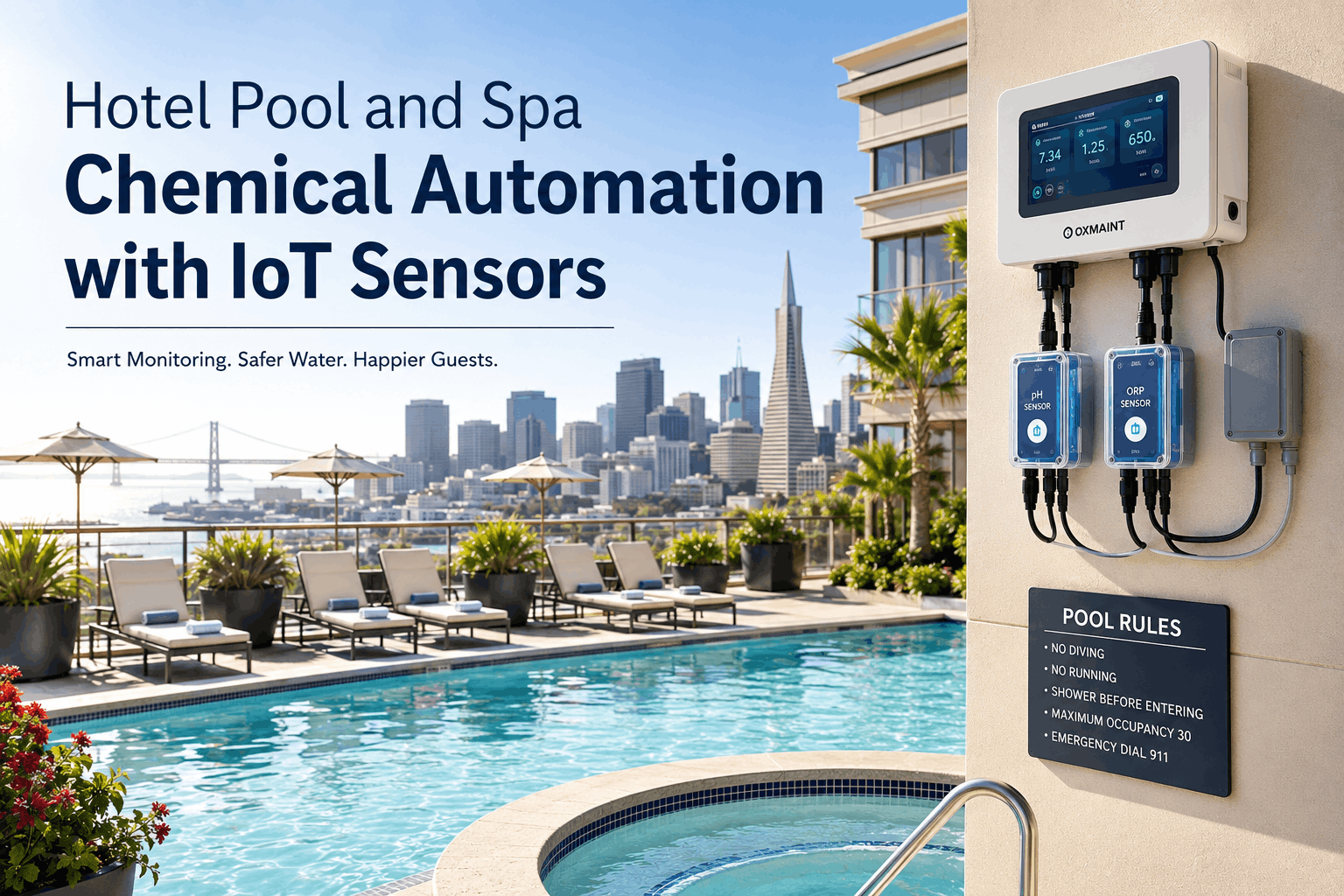
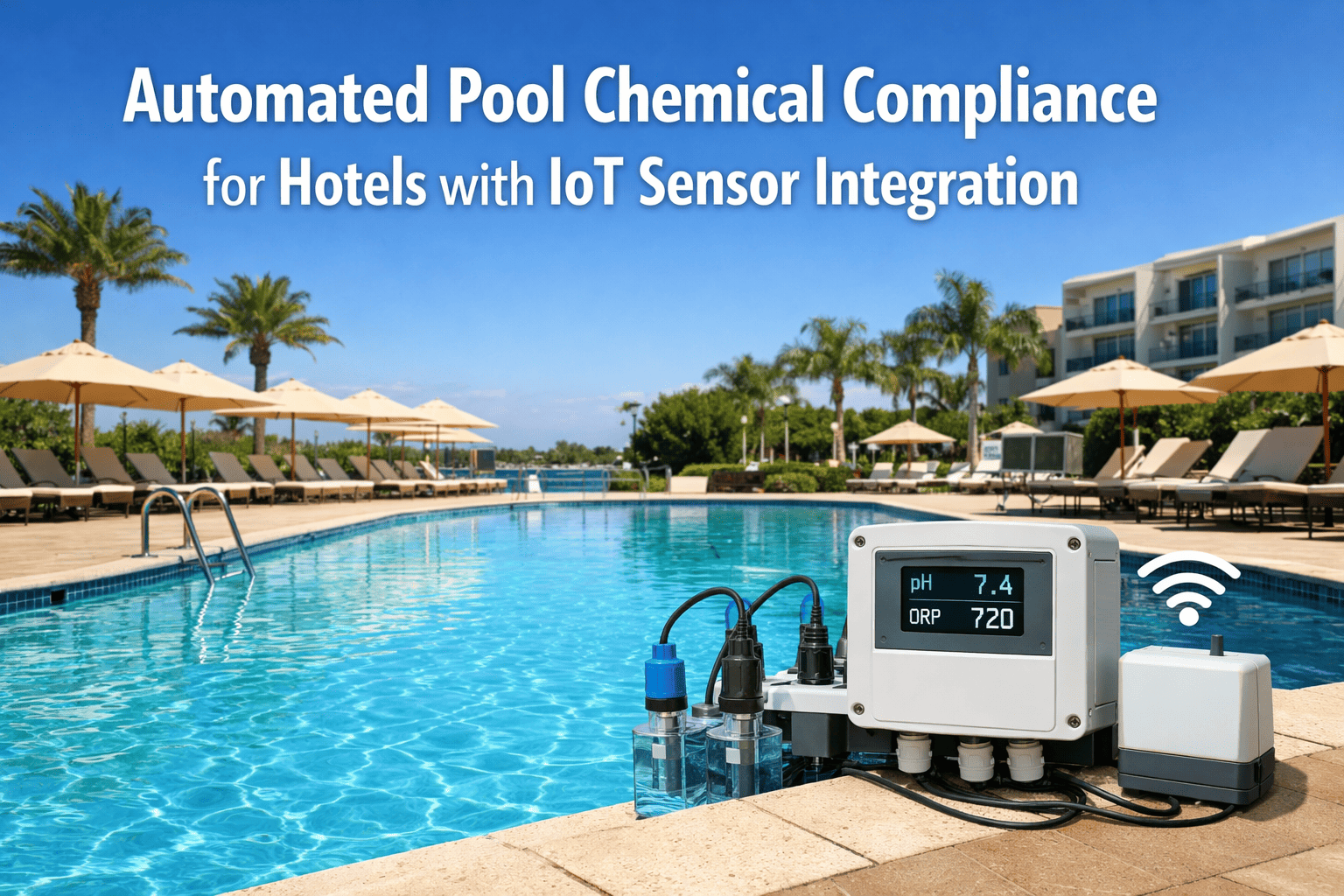
Hotel pools and spas operate under the highest regulatory scrutiny of any amenity. Health departments inspect water chemistry daily. A single out-of-range pH or chlorine reading can trigger immediate closure, mandatory retesting, and public notice. Yet most hotels still rely on manual chemical testing — a pool attendant dipping a test strip, comparing a color chart, and recording results on a paper log. The problem is not the intention; it is the method. Manual testing has documented error rates of 15-25% for pH and 20-30% for chlorine. Human color perception varies with lighting, fatigue, and individual vision differences. The result: health departments routinely find out-of-range water chemistry even when hotels believe they are testing correctly. IoT sensor automation eliminates manual testing error — continuous pH and chlorine monitoring, real-time alerts, and automated dosing systems that adjust chemistry before it drifts out of compliance.OxMaint's pool automation module integrates with IoT water quality sensors, logs every reading, triggers alerts at configurable thresholds, and generates health department-ready compliance reports.Book a demo to see how IoT sensors automate pool and spa water quality management.
Water Quality Intelligence
IoT Sensors + CMMS. Automate Pool Chemistry Compliance.
OxMaint integrates with IoT pH/chlorine sensors, logs every reading, alerts at configurable thresholds, and generates health department-ready compliance reports — all from one platform.
15-25%
manual pH testing error rate vs. <5% with IoT sensors
2-4 hrs
out-of-range chemistry detection window before IoT alert vs. next manual test
84%
reduction in health department violations with automated monitoring
What IoT Pool Chemical Automation Actually Delivers — and Why Manual Testing Fails
Manual chemical testing is fundamentally limited by human factors that no amount of training can eliminate. The same pool attendant at 8 AM in full daylight sees color differently than at 4 PM under overcast skies. Test strip color charts require subjective interpretation — one person's "acceptable" orange is another's "out-of-range" orange. The time lag between testing and adjustment is equally problematic: a test at 9 AM might show acceptable chemistry, but bather load at 2 PM drives pH up and chlorine down — conditions remain unsafe for hours until the next scheduled test. IoT sensors monitor continuously, detecting drift within minutes, not hours. Automated dosing systems respond immediately, adjusting chemistry before it leaves the acceptable range. The distinction matters enormously for guest safety: a pool with IoT monitoring has a fundamentally different compliance profile than a pool relying on manual testing alone.
pH
Test strip color comparison — 15-25% error rate
Continuous pH probe — ±0.1 accuracy, real-time reading
Free Chlorine
DPD test strip — 20-30% error, subjective reading
Amperometric sensor — ±0.05 ppm, 5-second update
Temperature
Liquid thermometer — ±2°F, manual reading
Digital RTD sensor — ±0.2°F, continuous logging
Oxidation Reduction Potential
Not measured manually
ORP sensor — sanitizer effectiveness direct measurement
Compliance records
Paper log — lost, illegible, incomplete
Digital timestamped log — audit-ready, tamper-proof
The 6 Water Quality Parameters IoT Sensors Monitor Continuously
Modern IoT pool monitoring systems detect six critical water quality parameters in real time. Each parameter has defined safe ranges, out-of-range consequences, and automated alert triggers. Understanding what is measurable — and the intervention required — allows facility managers to build automated compliance programs around objective, continuous data rather than subjective, intermittent manual testing.
pH — Acidity/Alkalinity Balance
Continuous pH probe ±0.1 accuracy, 5-second update interval
Safe range7.2–7.8 (pool), 7.2–7.8 (spa)
Alert triggerBelow 7.0 or above 8.0 — immediate notification
Low pH causes eye/skin irritation and equipment corrosion. High pH reduces chlorine effectiveness by 50-70%, creating unsafe conditions even with acceptable chlorine readings. Continuous monitoring prevents drift between manual tests.
±0.1 accuracy
Free Chlorine — Primary Sanitizer
Amperometric sensor ±0.05 ppm, 5-second update
Safe range1.0–3.0 ppm (pool), 3.0–5.0 ppm (spa)
Alert triggerBelow 1.0 ppm — immediate closure risk
Free chlorine is the primary defense against waterborne pathogens. Below 1.0 ppm, the pool is legally required to close in most jurisdictions. IoT sensors detect chlorine drop within 5 minutes of high bather load — automated feeders respond immediately.
5 sec update
Combined Chlorine — Chloramine Detection
Amperometric difference measurement
Safe rangeBelow 0.2 ppm (pool), below 0.2 ppm (spa)
Alert triggerAbove 0.4 ppm — guest irritation risk
Combined chlorine (chloramines) causes eye burning, respiratory irritation, and the "chlorine smell" guests associate with poor water quality. High combined chlorine indicates insufficient free chlorine for bather load — requires shock treatment.
0.2 ppm max
ORP — Oxidation Reduction Potential
Platinum electrode ORP sensor
Safe range650–750 mV (pool), 650–750 mV (spa)
Alert triggerBelow 650 mV — sanitizer effectiveness compromised
ORP measures chlorine's real-time killing power — it accounts for pH effects that free chlorine reading alone misses. At pH 8.0, chlorine is only 25% as effective as at pH 7.2, even with same free chlorine reading. ORP sensors detect this discrepancy.
650 mV min
Water Temperature
RTD temperature sensor ±0.2°F accuracy
Safe range78–84°F (pool), below 104°F (spa)
Alert triggerSpa above 104°F — safety closure risk
Spa temperatures above 104°F create hyperthermia risk, especially for elderly guests and pregnant women. Many state health codes require automatic spa shutdown at 104°F. IoT sensors can trigger pump shutoff and alert maintenance immediately.
104°F max
Total Dissolved Solids
Conductivity sensor, calculated TDS
Safe rangeBelow 1,500 ppm (pool), below 1,500 ppm (spa)
Alert triggerAbove 2,000 ppm — drain and refill required
High TDS reduces chlorine effectiveness and causes cloudy water. Standard treatment chemicals stop working properly above 2,500 ppm. Continuous TDS monitoring identifies when water replacement is needed before water quality visibly degrades.
1500 ppm
Health Department Compliance
Automated Water Quality Logs. Audit-Ready in Seconds.
OxMaint stores timestamped water chemistry readings from IoT sensors — pH, chlorine, ORP, temperature, TDS — and generates health department-compliant reports on demand. No more missing logs, no more illegible handwriting.
Manual Testing vs IoT Automation — The Compliance Gap
The operational difference between manual testing and IoT automation is dramatic across every metric that matters to health department compliance and guest safety. Data from OxMaint's hospitality customers across 1,200+ pools shows consistent improvement patterns: out-of-range chemistry detection improves from 2-4 hour delays to real-time alerts. Violation rates drop by 84% as continuous monitoring catches drifts before inspection. And health department audit preparation time decreases from 8-12 hours to under 5 minutes with automated digital logs.
Out-of-range detection delay
Health dept violation rate
Manual TestingIoT Automated Monitoring
Automated Dosing Systems: From Detection to Correction
IoT sensors detect water chemistry drift. Automated dosing systems correct it — without human intervention. When a pH sensor reads 7.9 (approaching the 8.0 alert threshold), the controller sends a signal to the chemical feeder, which adds pH reducer until the sensor reads 7.5. When free chlorine drops to 1.2 ppm (approaching the 1.0 closure threshold), the chlorine feeder adds sanitizer until the reading returns to 2.0 ppm. The system operates continuously, responding to bather load changes in real time. A pool that would drift from acceptable to out-of-range over 4 hours of heavy use is corrected within 10-15 minutes. The result: health department inspections find no violations because water chemistry never leaves the acceptable range.
pH
>7.8 or <7.2
pH reducer or increaser added until reading returns to 7.5 target
Free Chlorine (pool)
<1.5 ppm
Chlorine feeder activated until reading returns to 2.0 ppm target
Free Chlorine (spa)
<3.5 ppm
Chlorine or bromine feeder activated until reading returns to 4.0 ppm
ORP
<650 mV
Chlorine feeder activated regardless of free chlorine reading — accounts for pH effect
Temperature (spa)
>104°F
Heater shutoff + pump shutdown + maintenance alert — safety closure automated
How IoT Sensors Lower Liability and Improve Guest Safety
Liability exposure in hotel pools and spas extends beyond water quality to include drowning prevention, entrapment prevention, and chemical safety. IoT sensors address all three through continuous monitoring and automated alerting. Water quality sensors prevent the health code violations that trigger state investigations. Spa temperature sensors prevent hyperthermia incidents in elderly guests. Chemical feeder leak sensors prevent hazardous gas releases in pump rooms. And documented sensor logs create the audit trail that demonstrates due diligence in the event of any incident. A hotel that can produce 12 months of continuous water quality data with documented corrective actions has a fundamentally different legal exposure than a hotel with paper logs missing 30% of entries.
Health Code Violation Prevention
$5K–$25K fine avoided
Automated logs eliminate missing entries — the #1 citation reason. Continuous monitoring prevents out-of-range findings on inspection day.
Spa Hyperthermia Prevention
$50K–$500K claim avoided
IoT temperature sensors trigger automated spa shutdown at 104°F, preventing guest injury from excessive heat exposure.
Drowning Prevention
$1M+ claim avoided
Pool entry/exit sensors + underwater motion detection + lifeguard zone alerts — IoT extends beyond water chemistry.
Chemical Safety
$10K–$100K fine avoided
Leak sensors in chemical storage rooms detect chlorine gas releases before they reach hazardous levels.
Insurance Premium Impact
10-20% premium reduction
Insurers reward documented IoT monitoring programs with lower liability premiums — documented risk reduction.
Annual Savings Per Pool
$8K–$15K
Chemical waste reduction, labor savings, extended equipment life, and lower liability premiums combine for significant annual impact.
Total Risk Reduction Value: $35K–$85K per year for a 1-pool, 1-spa hotel with IoT water quality automation
IoT Sensor Types and Installation Requirements
Hotel pool and spa IoT systems use four primary sensor types, each requiring specific installation conditions. Understanding sensor placement, calibration frequency, and integration requirements ensures reliable operation. OxMaint integrates with all major IoT pool monitoring systems — ProMinent, Seko, Chemtrol, WECO, and others — pulling real-time data into a single compliance dashboard.
pH Probe
Hydrogen ion activity
Inline flow cell
Monthly buffer calibration
12-18 months
Amperometric Chlorine
Free chlorine ppm
Inline flow cell + 0.5 gpm flow
Monthly DPD comparison
12-24 months
ORP Probe
Oxidation reduction potential
Inline or submersion
Quarterly buffer calibration
18-24 months
Temperature RTD
Water temperature
Inline or submersion
Annual ice bath check
5+ years
Conductivity/TDS
Total dissolved solids
Inline flow cell
Quarterly standard check
2-3 years
Step 1
Sensor Selection & Placement
Install pH, chlorine, ORP, and temperature sensors in pump room flow cells — after filter, before chemical injection. Ensure minimum flow rate for accurate readings (0.5-1.0 gpm for chlorine sensors). Install controller with cellular or WiFi connectivity for remote monitoring.
Step 2
Controller Integration & Threshold Setup
Configure controller with pH and chlorine setpoints (pH 7.2–7.8, free chlorine 1.0–3.0 ppm). Set alert thresholds at 80% of violation limits (pH 7.9, chlorine 1.2 ppm) to enable proactive correction before out-of-range readings.
Step 3
OxMaint Integration & Compliance Dashboard
Connect controller to OxMaint via API. Real-time readings populate compliance dashboard. Configure automated alerts for maintenance staff when thresholds approach. Health department report generation configured.
Step 4
Calibration & Maintenance Schedule
Set monthly pH probe calibration reminders in Oxmaint. Configure weekly DPD chlorine verification tasks. Schedule quarterly ORP calibration. All calibration records stored in asset history for compliance audits.
Frequently Asked Questions — Hotel Pool Chemical Automation with IoT Sensors
How much does IoT pool chemical automation cost for a hotel pool and spa?
Typical installation cost for a single pool + spa: $8,000–15,000 including sensors, controller, chemical feeders, and installation. Monthly cloud monitoring subscription: $100–300. Annual operating savings: $8,000–15,000 from chemical reduction, labor savings, and avoided fines — typical payback 12-18 months.
Book a demo for site-specific ROI analysis.
Does IoT automation replace manual chemical testing entirely?
Most health departments still require periodic manual verification testing — typically weekly DPD chlorine comparison to validate sensor accuracy. Oxmaint tracks both sensor readings and manual verification tests in the same compliance log, creating a complete water quality record with documented calibration validation.
Start free to see the integrated log.What happens if the IoT system loses power or network connectivity?
Controllers maintain local data storage during outages, storing readings at configured intervals (typically every 5-15 minutes). When connectivity is restored, all stored readings sync to Oxmaint automatically. Health departments accept timestamped readings as valid compliance records as long as the reading interval meets required frequency (typically every 4 hours minimum).
Which IoT pool monitoring systems integrate with Oxmaint?
Oxmaint integrates with ProMinent DULCOnnect series, Seko Tekna series, Chemtrol PC series, WECO AquaRite series, and any controller with Modbus TCP or API output. Custom integration available for legacy systems.
Book a demo to confirm compatibility with your existing equipment.
How often do IoT pool sensors need calibration?
pH probes require monthly buffer calibration (4.0 and 7.0 buffers). Chlorine sensors require monthly DPD comparison verification — adjust sensor gain factor if deviation exceeds ±0.2 ppm. ORP probes require quarterly buffer calibration. All calibration records must be documented for health department audits — Oxmaint tracks calibration due dates and stores results.
What is the ROI timeline for IoT pool automation?
Most hotels see positive ROI within 12-18 months through three channels: chemical reduction (15-25% less chlorine and pH adjuster from precise dosing), labor savings (4-8 hours weekly eliminated from manual testing and chemical handling), and violation avoidance (average $5,000–15,000 per citation avoided).
Start free to calculate your pool's potential savings.
Pool & Spa Compliance Intelligence
Stop Worrying About Water Quality Violations. Automate Compliance with IoT + OxMaint.
$8–15K
annual savings per pool