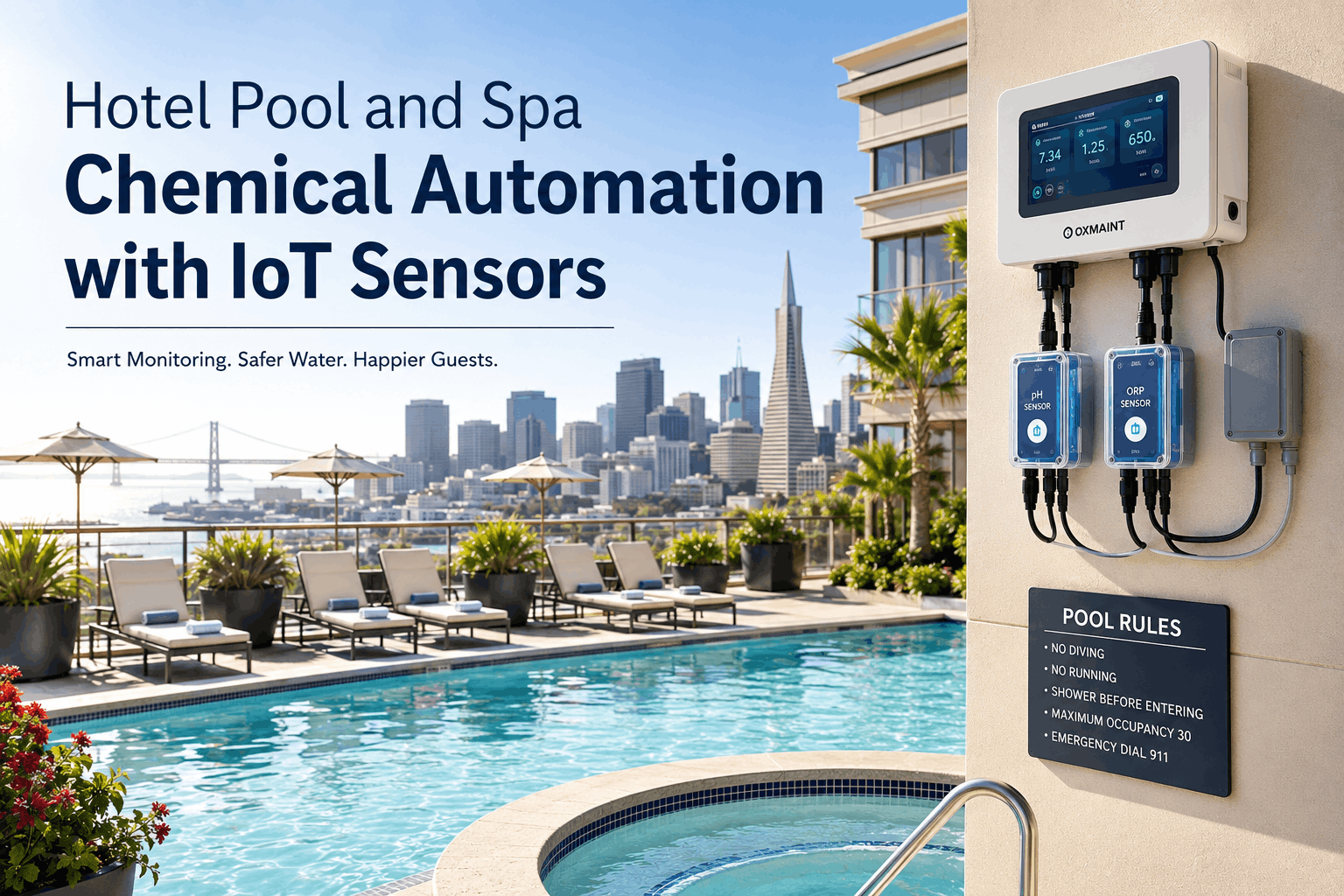
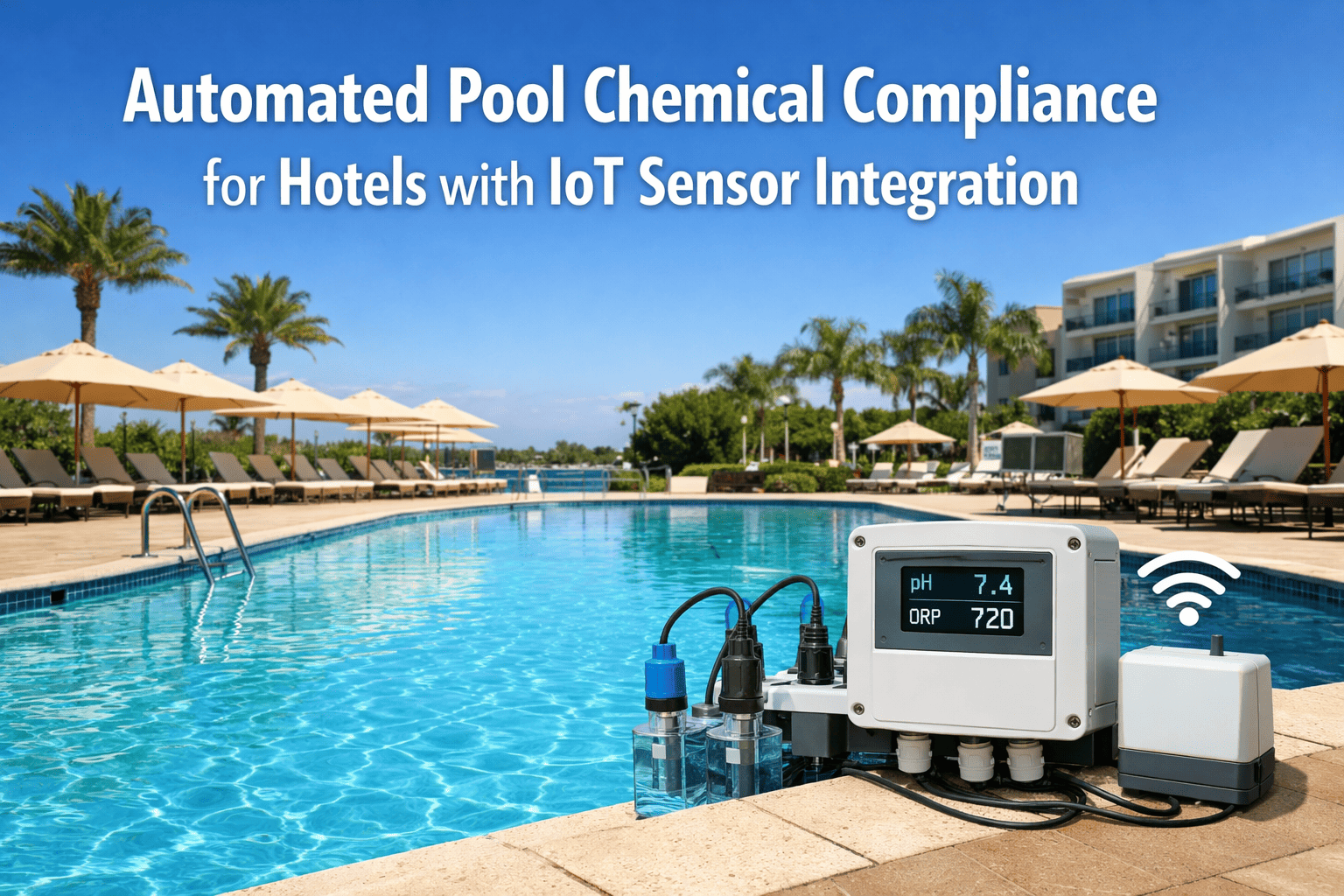
The health inspector arrived at 9:15 AM on a Tuesday—unannounced. At the 280-room beachfront resort, the pool maintenance technician had tested water chemistry at 7 AM and recorded compliant pH and chlorine readings on a paper log. By 9:15 a malfunctioning chemical feed pump had driven free chlorine to 14 ppm—nearly triple the safe maximum. The inspector's digital meter caught it instantly. Result: immediate pool closure during peak season, a $12,000 fine87 guest complaints in 48 hours, and a CDC report that triggered insurance review. The real damage: 340 one-star reviews referencing "closed pool" that suppressed bookings for the next four months. A $26 million legal settlement at another resort in 2024 for overchlorination burns on a toddler proved this isn't hypothetical—it's the single largest liability risk in hospitality aquatics. An IoT monitoring system reading that same pool every 60 seconds would have triggered an alert at 9:02 AM—13 minutes before the inspector arrived—giving staff time to shut down the feed pump and correct the imbalance before anyone was exposed.
79%
Of Public Pools Fail Health Inspections
According to CDC data, 78.9% of commercial pools have at least one health code violation during routine inspection, with 12.3% resulting in immediate closure. IoT continuous monitoring eliminates the blind spots between manual tests that cause the majority of violations.
IoT pool water quality monitoring replaces the 2-3 daily manual dip tests that leave 23+ hours of unmonitored chemistry with continuous, real-time sensor data streaming pH, chlorine, ORP, temperature, and turbidity readings every 60 seconds. When chemistry drifts out of compliance, alerts reach maintenance staff instantly—not hours later during the next scheduled test. Hotels that implement structured pool equipment maintenance tracking alongside IoT monitoring create a complete aquatic safety system that protects guests, prevents violations, and documents compliance automatically.
The Real Cost of Pool Chemistry Failures
What Hospitality Properties Risk Without Continuous Monitoring
$5K-50K+
Health department fines per violation—plus $1,000-$10,000/day in lost revenue during forced closure
$26M
Largest recent settlement for pool chemical burns—overchlorination that manual testing failed to detect
200-300 gal
Water lost daily per commercial pool from undetected leaks—IoT sensors catch leak patterns in hours
23+ hrs
Daily blind spot between manual tests—the window where chemistry drifts cause violations and injuries
6 Core Components of IoT Pool Monitoring
Modern IoT pool systems go far beyond pH and chlorine readings—they integrate chemical dosing automation, leak detection, equipment health tracking, and compliance documentation into a single platform. Properties using OXmaint's asset management platform for pool equipment maintenance create the complete aquatic safety ecosystem that passes every inspection.
IoT Pool Monitoring System Architecture
1. Multi-Parameter Sensors
Continuous measurement of pH, free chlorine, ORP, temperature, TDS, and turbidity every 60 seconds—eliminating gaps between manual tests.
2. Automated Chemical Dosing
AI-driven feed pumps adjust chlorine and acid dosing in real-time based on sensor readings, bather load, and weather conditions—preventing over/under-treatment.
3. Instant Alert System
Push notifications to staff when any parameter drifts out of compliance range—with escalation rules that notify management if not resolved within set timeframes.
4. Leak & Flow Detection
Monitors water flow rates and pressure patterns 24/7 to detect leaks before they escalate—saving up to 20% on water bills annually.
5. Compliance Documentation
Automatic timestamped logging of every reading creates inspection-ready records—replacing handwritten logs that inspectors increasingly distrust.
6. Equipment Health Monitoring
Tracks pump run-times, filter pressure differentials, heater cycles, and chemical feed rates to predict maintenance needs before equipment fails.
Setting Up IoT Pool Monitoring
Implementation Sequence
Follow these steps to deploy continuous pool water quality monitoring
01
Pool Equipment Inventory
Document all pumps, filters, heaters, chemical feeders, controllers, and safety equipment with model numbers, installation dates, and maintenance history per pool/spa.
02
Sensor Deployment
Install inline multi-parameter probes on return lines after filtration. Add flow sensors on main supply, leak detection on structure, and weather station for environmental correlation.
03
Alert & Threshold Configuration
Set compliance ranges per local health code (pH 7.2-7.8, free chlorine 1-10 ppm). Configure alert routing to pool technicians, engineering supervisors, and management by severity.
04
CMMS Integration
Connect IoT alerts to your maintenance platform to auto-generate work orders for sensor calibration, chemical supply replenishment, equipment repairs, and compliance tasks.
05
Staff Training & Verification
Train pool operators on dashboard interpretation, alert response protocols, and sensor maintenance. Run parallel manual/IoT testing for 2 weeks to validate accuracy.
Preventive Maintenance Schedule
IoT-Enhanced Pool Equipment PM Matrix
Equipment
Daily (IoT)
Weekly
Monthly
Annually
Water Chemistry Sensors
Auto-read every 60s
Calibration check
Probe cleaning
Full sensor replacement
Chemical Feed Pumps
Flow rate monitoring
Tubing inspection
Injection point cleaning
Pump rebuild/replace
Filtration System
Pressure differential
Backwash cycle
Media inspection
Media replacement
Circulation Pumps
Amp draw & flow rate
Strainer basket
Seal & gasket check
Motor service
Pool Heaters
Inlet/outlet temp delta
Ignition verification
Heat exchanger inspect
Full service & descale
Safety Drains & Covers
Flow sensor active
Visual inspection
Fastener check
VGBA compliance audit
OXmaint automatically generates work orders for each PM task, tracks completion rates, and flags overdue items before inspector visits.
Compliance & Safety Framework
Pool Compliance Requirements IoT Monitoring Satisfies
Health Department Codes
Free chlorine 1-10 ppm range
pH maintained 7.2-7.8
Cyanuric acid below 100 ppm
Turnover rate compliance
Daily testing documentation
24/7
continuous IoT monitoring vs. 2-3× daily manual
Brand & Liability Standards
Timestamped digital records
Automated dosing logs
Equipment maintenance proof
Incident response documentation
Insurance audit readiness
100%
audit-ready documentation at all times
Protect Guests, Prevent Closures, Pass Every Inspection
OXmaint tracks all pool equipment maintenance, compliance deadlines, chemical inventory, and sensor calibration schedules—creating the documentation backbone that keeps your aquatics program inspection-ready year-round.
Based on commercial pool management benchmarks and published data
75%
Fewer health code violations with continuous monitoring
30%
Chemical cost savings through precision dosing
20%
Reduction in water utility costs via leak detection
60%
Reduction in pool-related guest complaints
"In hospitality aquatics, the gap between a manual test and the next manual test is where every violation, every injury, and every lawsuit originates. IoT monitoring doesn't just add readings—it eliminates the blind spots that manual testing structurally cannot cover. The properties maintaining zero-violation records aren't testing more often—they're monitoring continuously."
— Aquatics Director, Multi-Property Resort Management Group
Implementation Timeline
Typical IoT Pool Monitoring Deployment Roadmap
Week 1
Assessment
Pool equipment inventory • Sensor placement planning • Health code review • Baseline chemistry logging
Dosing fine-tuning • Predictive alerts active • Compliance reporting automated
Don't Let a 13-Minute Gap Cost You $26 Million
OXmaint brings structure to pool equipment maintenance—automated PM scheduling, compliance tracking, sensor calibration reminders, work order management, and inspection-ready documentation that protects your property from violations and liability.
What does an IoT pool water quality monitoring system measure?
Modern IoT pool systems continuously monitor pH, free chlorine, ORP (oxidation-reduction potential), water temperature, TDS (total dissolved solids), turbidity, and flow rate. Advanced systems also track cyanuric acid levels, combined chlorine, and water level changes that indicate leaks. Readings are taken every 60 seconds and transmitted to a cloud dashboard accessible from any mobile device, with instant alerts when any parameter drifts outside compliance range.
How much does IoT pool monitoring cost for a hotel?
Multi-parameter sensor units typically cost $2,000-$8,000 per pool depending on parameters monitored. Gateway and connectivity hardware adds $500-$2,000 per property. Cloud platform subscriptions range $100-$500 monthly per pool. A hotel with two pools and a spa typically invests $10,000-$25,000 initially with $300-$1,500 monthly platform costs—recovered within 3-6 months through chemical savings, avoided violations, reduced labor, and prevented equipment damage alone.
Does IoT monitoring replace manual pool testing?
Most health codes still require daily manual testing as a compliance minimum, so IoT monitoring supplements rather than replaces manual checks. However, IoT systems dramatically reduce the risk between manual tests by providing 1,440 readings per day versus 2-3 manual tests. Many properties use IoT as the primary monitoring system with daily manual tests serving as sensor verification rather than the sole safety net. Inspectors increasingly view continuous digital logs as superior evidence of compliance.
What maintenance do IoT pool sensors require?
pH and ORP probes need weekly calibration checks and monthly cleaning to prevent biofilm buildup that affects accuracy. Chlorine sensors typically require quarterly reagent replacement. Flow sensors need annual inspection. Most sensor probes have a 12-24 month lifespan before replacement. A CMMS platform like OXmaint automates all sensor maintenance scheduling, tracks calibration records, and ensures probes are replaced before accuracy degrades—keeping your monitoring system as reliable as the day it was installed.