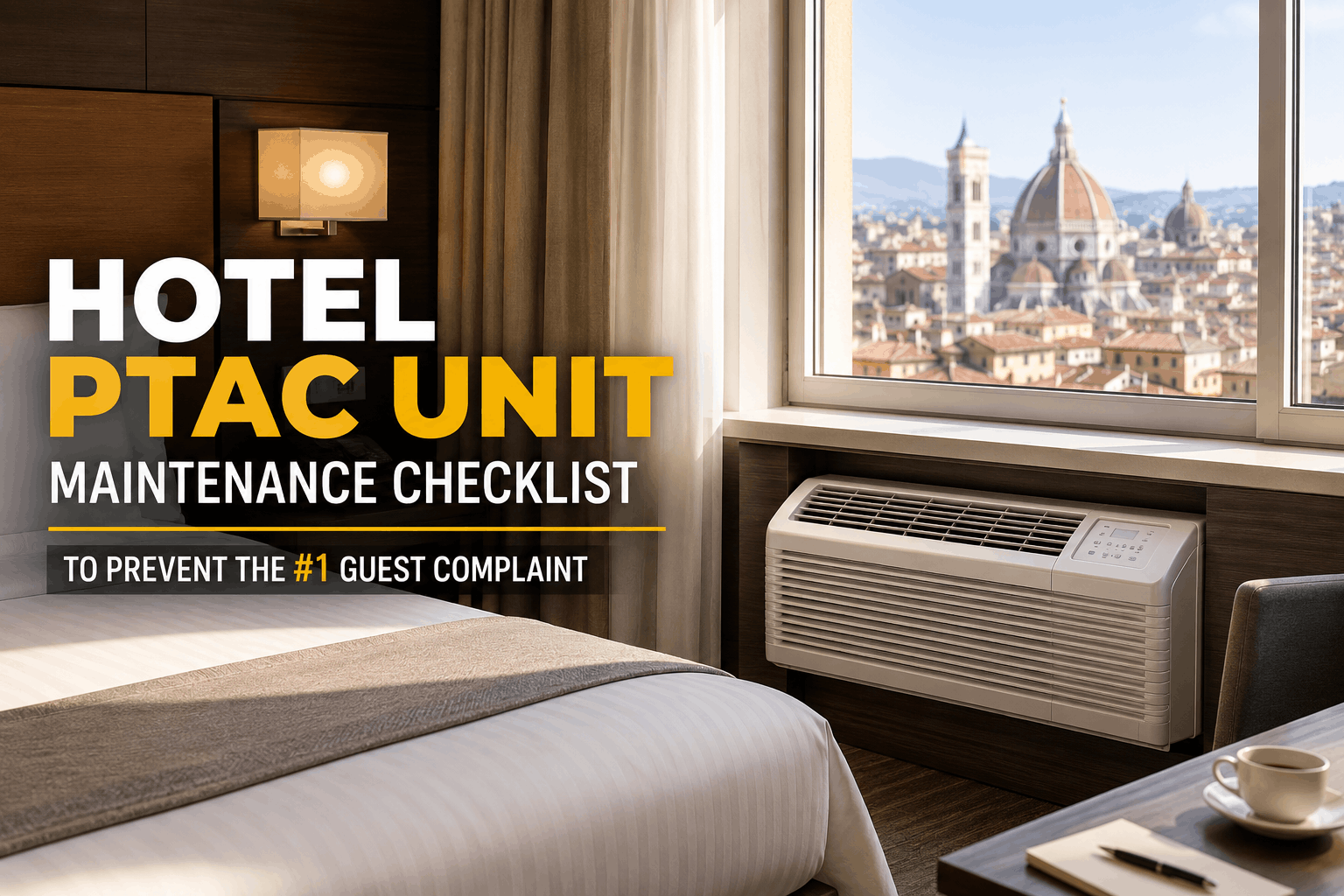
Hotel PTAC and In-Room HVAC Maintenance: Preventing the #1 Guest Complaint

By Peter Parker on February 26, 2026

hotel-ptac-in-room-hvac-maintenance-guest-complaint

Temperature-related complaints are among the top causes of guest dissatisfaction in hotels, accounting for 35-45% of all maintenance issues. With Oxmaint AI's predictive maintenance and asset management solutions, hotels can proactively address these challenges by streamlining their PTAC (Packaged Terminal Air Conditioner) and in-room HVAC maintenance. Our AI-driven platform helps reduce HVAC failures by 60%, minimize costly repairs, and improve energy efficiency by 15-20%—all while enhancing the guest experience. Through systematic maintenance, including 30-day filter cycles and early detection of potential failures, Oxmaint AI ensures that each guest room remains comfortable and temperature-controlled, reducing the risk of complaints and optimizing operational costs. Keep your hotel running smoothly and efficiently with Oxmaint AI’s tailored maintenance solutions for PTAC systems, ensuring your guests experience the best comfort throughout their stay. Hotels using Oxmaint to schedule and track PTAC maintenance cut temperature complaints by up to 85% — and prevent the most common 1-star review trigger in hospitality.

Guest Experience  ·  In-Room HVAC

Hotel PTAC and In-Room HVAC Maintenance: Preventing the #1 Guest Complaint

Temperature control is the single most frequently cited comfort issue in hotel reviews. 24% of all guest complaints are about room temperature — and nearly every one is preventable with a structured 30-day PTAC maintenance cycle.

24% of all hotel guest complaints relate to room temperature

60% fewer PTAC failures with 30-day filter replacement cycles

$1,500 average compressor failure cost vs. $5 filter replacement

15-20% lower energy costs with clean coils and calibrated thermostats
The Problem

Why Temperature Complaints Keep Happening

Most hotels know PTAC maintenance matters. The gap isn't knowledge — it's consistency. Without a digital system enforcing schedules, a room inspected on day one of Q1 may not be visited again until day 90 of Q2. That's 180 days between service cycles on equipment designed for 30-day intervals. In that window, real damage accumulates — clogged filters, overstressed compressors, mold in condensate pans, thermostat drift — all invisible until a guest calls the front desk at midnight.

01
Filter Neglect Is the Root Cause of 70% of PTAC Failures

A clogged filter restricts airflow by 40–50%, forcing the compressor to work 20% harder. Over weeks, this causes overheating, refrigerant pressure spikes, and eventual compressor failure. The fix costs $1,500–$3,000. The prevention costs $5 and 4 minutes. Industry experts recommend cleaning or replacing all PTAC filters on a 30-day cycle — rotating through 25% of rooms per week so no unit exceeds the window. Oxmaint automates this schedule so no room is ever missed.

02
Condensate Drain Pans Breed the Odors That Destroy Reviews

Untreated condensate pans accumulate standing water, algae, and mold. The result is a musty odor guests notice within minutes of entering the room — and always mention in their TripAdvisor review. Algaecide tablets installed during each annual deep-clean cost under $3 per unit and prevent the mold cycle entirely. Cleanup after a full mold contamination costs 10 times more than prevention and requires the room to go out of order.

03
Thermostat Drift Creates Rooms That Never Reach Set Temperature

Uncalibrated thermostats cause units to run continuously without achieving the guest's set temperature. The guest is uncomfortable and the unit is consuming excess energy — costing the property on both the satisfaction and the utility bill simultaneously. Thermostat calibration takes under 10 minutes per unit annually and eliminates this failure mode entirely. It's one of the most cost-effective maintenance tasks in the entire hotel and one of the most commonly skipped.

04
Noise Complaints Are Always a Maintenance Signal

Rattling, whistling, or hissing PTAC units appear in negative reviews almost as frequently as temperature failures. Noise is never a guest nuisance issue — it's always a mechanical signal. Loose panels, failing fan bearings, debris in the blower wheel, or a vibrating compressor mount are the causes. Each is preventable and inexpensive if caught during a scheduled inspection. Each becomes an emergency work order — and a negative review — if it isn't.

Maintenance Schedule

The PTAC Maintenance Timeline Every Property Needs

Effective PTAC maintenance is not a single annual event — it's a layered schedule of tasks at different frequencies. The properties that eliminate temperature complaints treat this timeline as non-negotiable, tracked digitally, and verified per-room. Sign in to Oxmaint to auto-generate this schedule across every room in your property today.

30DAY
Monthly Filter Service
01Remove and clean or replace air filter — rotate 25% of rooms per week
02Inspect intake and discharge grille for blockage — minimum 8-inch clearance required
03Listen for abnormal noise — rattles, whistles, or intermittent cycling
04Check thermostat setpoint accuracy — verify unit reaches set temperature within 15 minutes
90DAY
Quarterly Deep Inspection
01Clean evaporator coil with approved coil cleaner — check for ice formation or frost buildup
02Inspect condensate drain pan — flush drain line and treat with algaecide tablet
03Verify refrigerant line condition — check for oil stains indicating refrigerant leak
04Test all operating modes — heat, cool, fan-only, and auto cycling
05Inspect exterior gasket and sleeve seal — check for air infiltration around unit
365DAY
Annual Full-Unit Service
01Remove unit from sleeve — thoroughly clean base pan, coils, and blower wheel
02Install fresh algaecide pad in base of clean unit — prevents algae and mold cycle
03Clean condenser coil — pretreat and use low-pressure wash from inside out
04Calibrate thermostat — verify accuracy within 1°F across full temperature range
05Inspect and tighten all electrical connections — check capacitor and compressor start components
06Document unit age, model, and service history — flag units over 7 years for replacement budget planning
Before vs. After

What Structured PTAC Maintenance Actually Changes

These numbers are not theoretical — they reflect the measurable difference between reactive PTAC maintenance and properties running a structured digital PM program. The gap is consistent across property types and sizes.

Without Structured PTAC Program
Temperature complaints per 100 nights
8–12
Average filter cycle (actual)
90–180 days
PTAC unit lifespan
5–7 years
Emergency PTAC repairs per month
High frequency
Energy cost vs. optimized baseline
15–20% above
Mold/odor complaints
Recurring
VS
With Oxmaint PTAC Scheduling
Temperature complaints per 100 nights
Under 2
Average filter cycle (enforced)
28–32 days
PTAC unit lifespan
12–15 years
Emergency PTAC repairs per month
Near zero
Energy cost vs. optimized baseline
At target
Mold/odor complaints
Eliminated
Every PTAC service cycle tracked automatically. Every room. Every floor. No spreadsheets. No missed rooms. No midnight calls about broken AC. Sign in free — your first PTAC schedule is live today.
Failure Modes

The 6 PTAC Failures That Reach Your Review Page

Each of these failure modes appears in hotel reviews regularly. Each is preventable. The column on the right shows the specific maintenance task that eliminates it — and the cost comparison that makes the case for every GM conversation.

01
Unit Won't Cool Below 78°F
Cause: Clogged filter restricting airflow to evaporator coil
Fix cost: $5 filter + 4 min
Failure cost: $1,500–$3,000 compressor
Prevention: 30-day filter replacement schedule enforced per room
02
Musty Odor on Entry
Cause: Mold growth in condensate pan and evaporator coil
Fix cost: $3 algaecide tablet
Failure cost: $300–$500 mold remediation + OOO day
Prevention: Annual algaecide pad + quarterly drain flush
03
Unit Runs Constantly — Room Still Warm
Cause: Thermostat drift reading 3–5°F above actual room temperature
Fix cost: 10 min calibration
Failure cost: 15–20% excess energy + guest refund
Prevention: Annual thermostat calibration per unit
04
Rattling or Vibrating Noise
Cause: Loose panel, debris in blower, or failing fan bearing
Fix cost: $10–$40 part + 20 min
Failure cost: Bearing failure $200–$400 + 1-star review
Prevention: Quarterly vibration and noise check during inspection
05
Water Dripping Inside Room
Cause: Blocked condensate drain line — pan overflows into room
Fix cost: $0 — cleared with flush
Failure cost: $800–$2,000 water damage + OOO room
Prevention: Quarterly drain line flush and pan inspection
06
Unit Dead — No Response
Cause: Capacitor failure from years of compressor strain — often after clogged filter history
Fix cost: $40–$80 capacitor
Failure cost: $2,000–$4,000 full replacement if compressor gone
Prevention: Annual electrical inspection — capacitor check during full service
How Oxmaint Helps

From Untracked to Fully Automated — In One Day

The challenge in hotel PTAC maintenance isn't knowing what to do — every engineer knows filters need changing. The challenge is ensuring it actually happens across every room, every floor, every month, with proof. Oxmaint solves this with three core capabilities purpose-built for hotel engineering teams.

01
Room-Level PM Scheduling
Set up 30-day, 90-day, and 365-day PTAC maintenance cycles once — Oxmaint generates work orders per room, per floor, per task automatically. No room is missed. No cycle window is exceeded. Engineers receive mobile alerts so the rotation stays on schedule without manual tracking.
Auto-schedulePer-room trackingMobile alerts
02
Digital Service Records Per Unit
Every PTAC unit has its own asset record — service history, filter change dates, failure events, and age. When a room calls in repeatedly, you see the pattern instantly. When a unit approaches 7 years, the replacement budget conversation happens before the compressor fails at 2 AM — not after.
Asset historyFailure trendsReplacement planning
03
Completion Tracking with Proof
Engineers complete mobile checklists for each service visit — photo capture, task sign-off, and timestamp. Management sees real-time completion rates across all rooms. Brand audit inspections become a report pull, not a scramble. And accountability replaces the paper sign-off sheet that's easy to fake and impossible to trend.
Photo proofAudit-ready98% completion rate
"

We had 340 PTAC units and zero systematic tracking. Engineers were doing filters when they remembered, not on a schedule. The first month on Oxmaint we identified 47 units that hadn't been serviced in over 90 days. Within two months of getting on schedule, our temperature complaint rate dropped from 9 per 100 nights to under 2. Our GM asked what changed. The answer was simple: we started actually tracking it.
Chief Engineer  ·  340-Room Full-Service Hotel, Mid-Atlantic
Common Questions

PTAC Maintenance FAQs

How often should hotel PTAC filters be replaced?
Industry experts recommend a 30-day filter cycle for hotel PTAC units. The practical approach: keep 25% extra filters on hand and rotate through one quarter of all rooms per week. This way every unit is serviced monthly without requiring the entire property to be done at once. Rooms in high-dust or high-occupancy situations may need more frequent service. Oxmaint automates this rotation schedule so no room exceeds the 30-day window.
What causes the musty smell that guests complain about in hotel rooms?
Musty odors in hotel rooms are almost always caused by mold or bacteria growth in the PTAC condensate drain pan or on the evaporator coil. Standing water in the drain pan — which occurs when the drain line is blocked or slow — creates ideal conditions for mold within days. Prevention requires quarterly drain line flushing and annual algaecide pad installation. Mold remediation after a full contamination costs 10 times more than prevention and requires the room to go out of order.
How long should a hotel PTAC unit last?
A PTAC unit that receives reactive maintenance (filter changes only when problems appear) typically lasts 5–7 years. The same unit on a structured PM program — regular filter changes, quarterly coil cleaning, annual deep service — routinely reaches 12–15 years. The difference is approximately $800–$1,200 per unit in deferred capital expenditure. For a 200-room hotel that's $160,000–$240,000 in replacement costs that structured maintenance directly delays.
Can I track PTAC maintenance for hundreds of rooms in a spreadsheet?
Technically, yes — for a short time. In practice, spreadsheet tracking for more than 50 rooms breaks down within 60–90 days. Rooms get missed, dates drift, and there is no accountability for incomplete tasks. The fundamental problem is that a spreadsheet records what should happen, not what actually happened per room, per date, per engineer. Oxmaint tracks actual completion per room — with timestamps and photo proof — for properties of any size, at no cost to start.
What is the most cost-effective PTAC maintenance task?
Monthly filter replacement is the single highest-return maintenance task in hotel engineering. A $5 filter prevents the most common PTAC failure mode (compressor strain from restricted airflow), reduces energy consumption by 15–20%, and eliminates the most frequent guest comfort complaint in one action. For a 200-room property, the monthly cost of a complete filter program is under $1,000. A single compressor replacement costs more than a full year of that program. Book a demo to see how Oxmaint tracks filter cycles across every room.
No Credit Card Required

Every Room. Every Filter. Every 30 Days. Automatically.

Stop managing PTAC maintenance with sticky notes and memory. Oxmaint schedules every filter cycle, coil service, and annual deep-clean across your entire property — and shows you proof of completion per room, per engineer, per date.


Share This Story, Choose Your Platform!