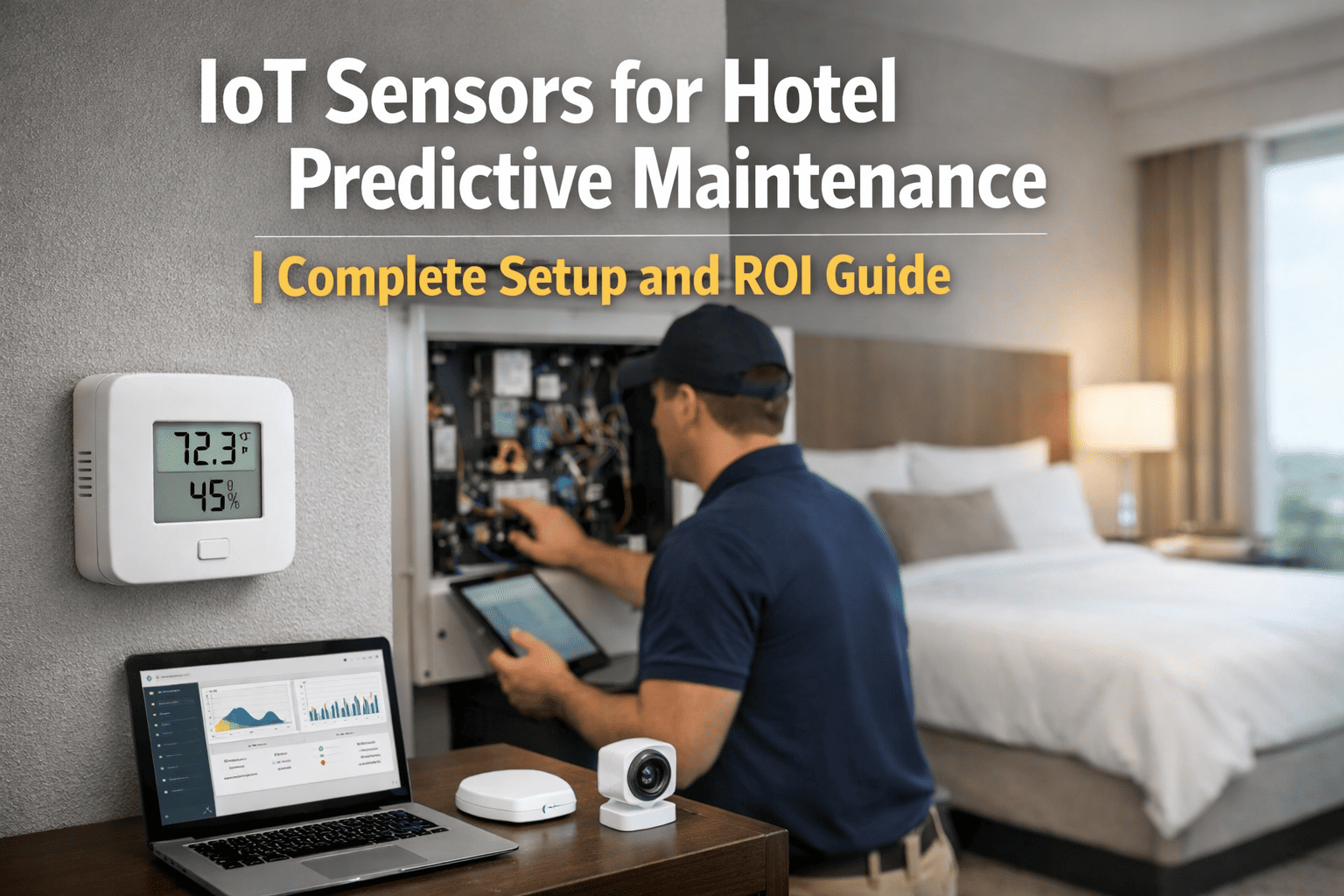
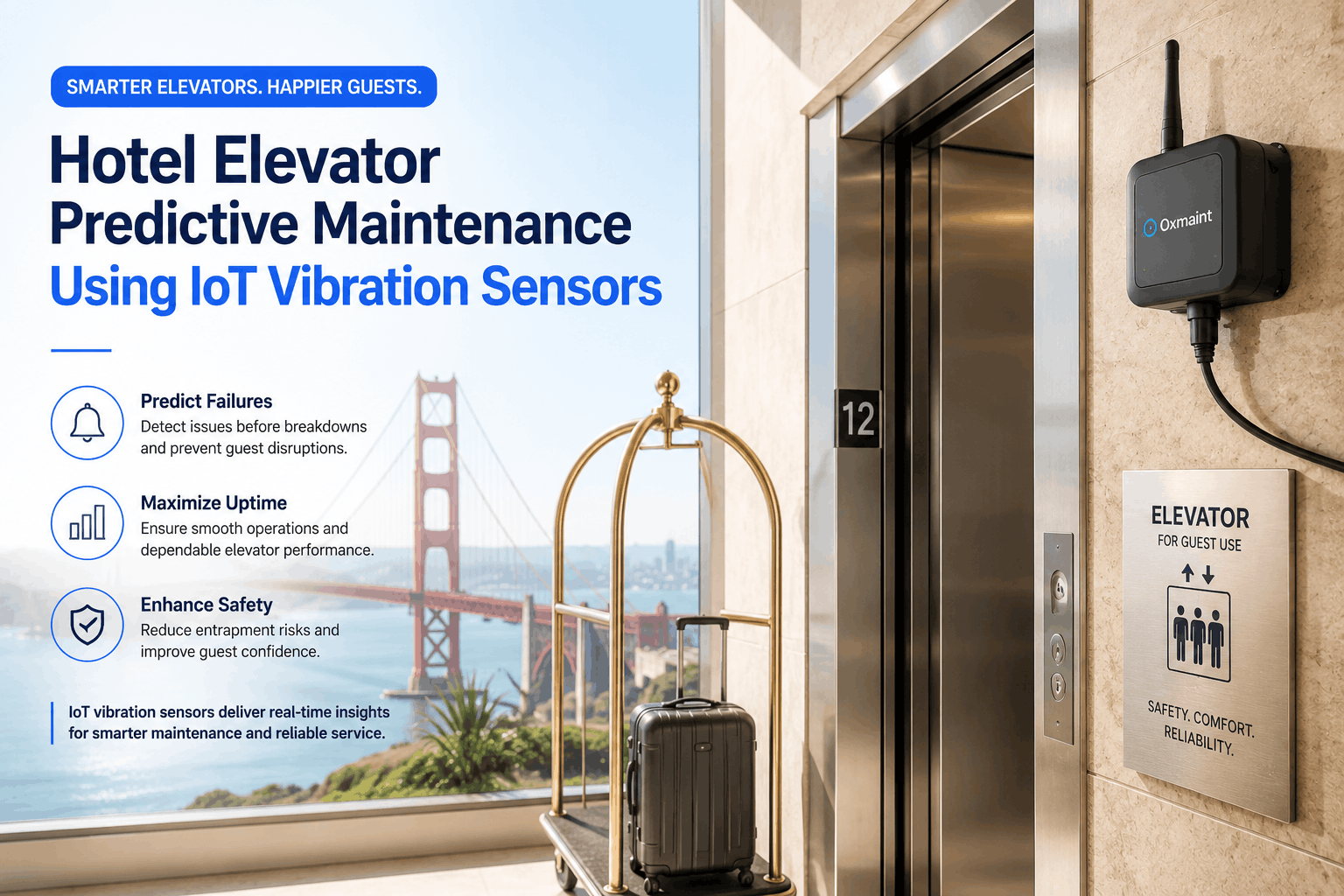
The gap between a hotel that detects HVAC failures 6 weeks in advance and one that discovers them at guest check-in is not the AI algorithm — it is the sensor data that feeds it. OxMaint's predictive maintenance engine is only as powerful as the sensor infrastructure it reads. This guide covers every sensor type relevant to hotel maintenance, where to place them, how to connect them to OxMaint, and the ROI each delivers — so your engineering team can build the monitoring foundation that makes 4–8 week failure detection windows possible. Book a demo to see OxMaint's IoT sensor integration configured on your property.
4–8 wks
Failure detection window unlocked by sensor data — versus zero advance warning without monitoring
6 wks
Average IoT sensor deployment payback period from HVAC setback and failure prevention savings
10,000+
Sensor data points processed per second by OxMaint's GPU AI engine at full property scale
No new HW
Required where existing BMS sensors are already in place — OxMaint connects via API from day one
OxMaint's Position
IoT sensors are not the product — they are the data source. OxMaint connects to any sensor that delivers data via API, MQTT, Modbus, or BACnet — including sensors already installed in your BMS today. The guide below covers the sensors that deliver the highest ROI for hotel maintenance, where to place them, and how OxMaint converts their data into autonomous work orders and predictive alerts.
HVAC Sensors: The Highest-ROI Category for Hotel Maintenance
HVAC is 40–60% of hotel energy spend and the #1 source of guest complaints. Sensors on HVAC assets deliver more predictive maintenance value per dollar than any other monitoring category in a hotel property.
Critical
Refrigerant Pressure Sensors
Chiller, VRF/VRV outdoor unit, condensing unit
Refrigerant undercharge — detects 4–6 weeks before capacity loss
Refrigerant leak — pressure drop pattern distinct from normal cycling
Compressor valve degradation — abnormal pressure differential signature
OxMaint alert: Auto work order on pressure deviation >5% from baseline
Critical
Vibration Sensors
Chiller compressor, AHU fan motor, pump, cooling tower fan
Bearing wear — vibration frequency shift detectable 6–8 weeks before failure
Rotor imbalance — amplitude asymmetry across rotation cycle
Misalignment — specific harmonic signature in vibration spectrum
OxMaint alert: LSTM model flags harmonic anomaly → immediate priority WO
High Value
Differential Pressure Sensors
AHU filter bank, chilled water circuit, condenser water circuit
Filter blockage — DP rise above threshold triggers filter change work order
Coil fouling — approach temperature and DP correlation analysis
Pump cavitation — DP instability pattern distinct from normal operation
OxMaint alert: PM work order triggered by DP — eliminates calendar-based filter changes
High Value
Temperature Sensors (Zone and Asset)
AHU supply/return, chiller approach, FCU discharge, BMS zone sensors
Chiller COP degradation — approach temperature drift from baseline
BMS sensor calibration drift — actual vs. set-point deviation pattern
FCU cooling capacity loss — discharge temperature above expected range
OxMaint alert: Cross-asset correlation: chiller + AHU + FCU temp anomaly = refrigerant fault
Energy
Current / Power Draw Sensors
Chiller compressor, AHU fan motor, pump motor, cooling tower fan
Motor bearing degradation — current draw increase preceding bearing failure
Energy efficiency loss — kW/TR above baseline signals chiller degradation
Filter blockage — fan motor current increases as static pressure rises
OxMaint alert: Energy anomaly flagged to analytics dashboard — links to asset PM history
High Value
Water Flow Sensors (Cooling Circuit)
Chilled water loop, condenser water loop, FCU branch circuits
Pump degradation — flow rate reduction below design specification
Valve failure — flow rate deviation from BMS command signal
Fouling — progressive flow restriction not explained by valve position
OxMaint alert: Flow deviation >8% from design → auto work order with hydraulic circuit context
OxMaint Connects to All of These Sensors on Day One
BMS, MQTT, Modbus, BACnet, or direct API — OxMaint ingests sensor data from any protocol and converts anomalies into autonomous work orders without a middleware platform.
Plumbing and Water System Sensors
Water-related incidents are among the most damaging events in hotel operations — damage to structure, guest belongings, and rooms can exceed the cost of the maintenance failure itself. Sensors on plumbing and water systems provide the only reliable early warning available.
Critical
Water Leak Detection Sensors
Plant room floor, below bathroom fixtures, ceiling void above occupied floors
Active leak — water contact triggers immediate alert and maintenance work order
Slow leak accumulation — moisture level trending above baseline over days
OxMaint alert: Immediate Critical WO — room blocked from front desk release until cleared
Critical
Legionella Risk Sensors (Water Chemistry)
Cooling tower basin, hot water calorifiers, domestic cold water storage
pH deviation — outside L8/ACOP acceptable range triggers chemical dosing alert
Temperature deviation — cold water above 20°C or hot water below 50°C
Biocide depletion — conductivity drop signals water treatment gap
OxMaint alert: L8-logged water chemistry deviation → compliance work order with timestamped evidence
Electrical and Power System Sensors
Critical
Power Quality Sensors
Main LV switchboard, generator output, UPS systems
Voltage sag/swell — preceding transformer or supply failure events
Harmonic distortion — indicates load imbalance or failing equipment
Neutral current elevation — earth fault indicator before trip event
OxMaint alert: Power quality deviation → electrical engineer WO with waveform data attached
High Value
Thermal / Infrared Sensors
Electrical panels, switchgear, busbar connections, transformer terminals
Hot spot detection — loose connection or overloaded circuit heating
Imbalanced loading — temperature differential across phases
OxMaint alert: Thermal anomaly >10°C above ambient → priority electrical inspection WO
Occupancy and Environmental Sensors
High Value
Room Occupancy Sensors (PIR / Infrared)
Guestrooms, meeting rooms, back-of-house corridors
Vacancy confirmed → HVAC setback triggered automatically via OxMaint-BMS link
Occupancy pattern data → AI refines energy schedule and maintenance window timing
OxMaint use: HVAC setback on vacancy — average 40% energy reduction on unoccupied rooms
High Value
CO₂ and Air Quality Sensors
Guestrooms, lobby, conference rooms, fitness centre
CO₂ above threshold → AHU fresh air damper increase or fault detected
Persistent high CO₂ → AHU capacity or filter fault generating alert
OxMaint use: Air quality deviation → AHU inspection WO with CO₂ trend data attached
Start With What You Already Have — Expand as ROI Is Proven
OxMaint connects to existing BMS sensors from day one. No new hardware required for initial AI monitoring. Sensor expansion programme justified by documented savings from Phase 1.
How OxMaint Integrates with Hotel Sensor Infrastructure
01
Protocol Connection — BMS, MQTT, Modbus, BACnet, API
OxMaint connects to your existing BMS and IoT sensor network via standard protocols. Schneider EcoStruxure, Siemens Desigo, Johnson Controls Metasys, and standalone IoT platforms all supported without middleware.
↓
02
Asset-Level Data Mapping
Each sensor stream mapped to a specific named asset in OxMaint's hierarchy — Chiller 01, AHU Floor 3, FCU Room 204 — so every anomaly alert is immediately traceable to its physical location.
↓
03
GPU AI Baseline Establishment
OxMaint's GPU AI engine ingests historical sensor data to establish asset-specific operational baselines. Typically 2–4 weeks of data is sufficient to begin anomaly detection on HVAC assets.
↓
04
Real-Time Anomaly Detection and Alert Generation
Live sensor data processed against baselines in under 50ms. Anomalies above configured thresholds generate autonomous work orders — assigned to the right technician with sensor evidence attached.
ROI by Sensor Type: What Each Category Delivers
Not Sure Where to Start Your Sensor Programme?
OxMaint's implementation team maps your existing sensor infrastructure and recommends the highest-ROI expansion path — based on your property's asset mix, energy spend, and maintenance history.
OxMaint IoT Integration vs. Competitors
Most CMMS platforms require a middleware platform to connect IoT sensors. OxMaint integrates natively with major BMS protocols and IoT platforms — no additional integration layer required.
Frequently Asked Questions
QWhich sensors should a hotel install first to maximise early ROI?
Start with refrigerant pressure sensors on the chiller, vibration sensors on AHU fan motors, and differential pressure sensors on AHU filter banks. These three categories deliver the fastest payback and feed the most valuable AI failure predictions. Water leak detection in plant rooms is the fourth priority — high consequence, low sensor cost.
QDoes OxMaint require new IoT sensors or does it work with existing BMS sensors?
OxMaint connects to existing BMS sensor data via BACnet, Modbus, or API from day one — no new hardware required for initial AI monitoring. Additional sensors are added where coverage gaps exist, justified by ROI evidence from Phase 1. See the
NVIDIA GPU AI analytics guide for on-premise processing options.
QHow long does it take for AI to start detecting anomalies after sensors are connected?
AI baseline establishment typically requires 2–4 weeks of operational sensor data. First anomaly detections usually appear within days for assets with significant deviation from normal — earlier alerts require more baseline data to distinguish genuine anomalies from normal variation.
QHow does OxMaint handle sensor data security and GDPR compliance?
All sensor data is encrypted at rest with AES-256 and transmitted with TLS 1.3. No sensor data is shared outside your OxMaint instance. EU, UK, AU, and UAE data residency options available. See the
on-premise vs. cloud security guide for the full data governance architecture.
Your Sensors Are Already Generating the Data. OxMaint Makes It Act.
Connect your existing BMS and IoT sensors to OxMaint's GPU AI engine — and turn every sensor reading into an autonomous work order, a failure prevented, and a guest complaint eliminated.
BACnet / Modbus / MQTT
No Middleware Required
GPU AI Processing
Autonomous Work Orders
Legionella L8 Logging