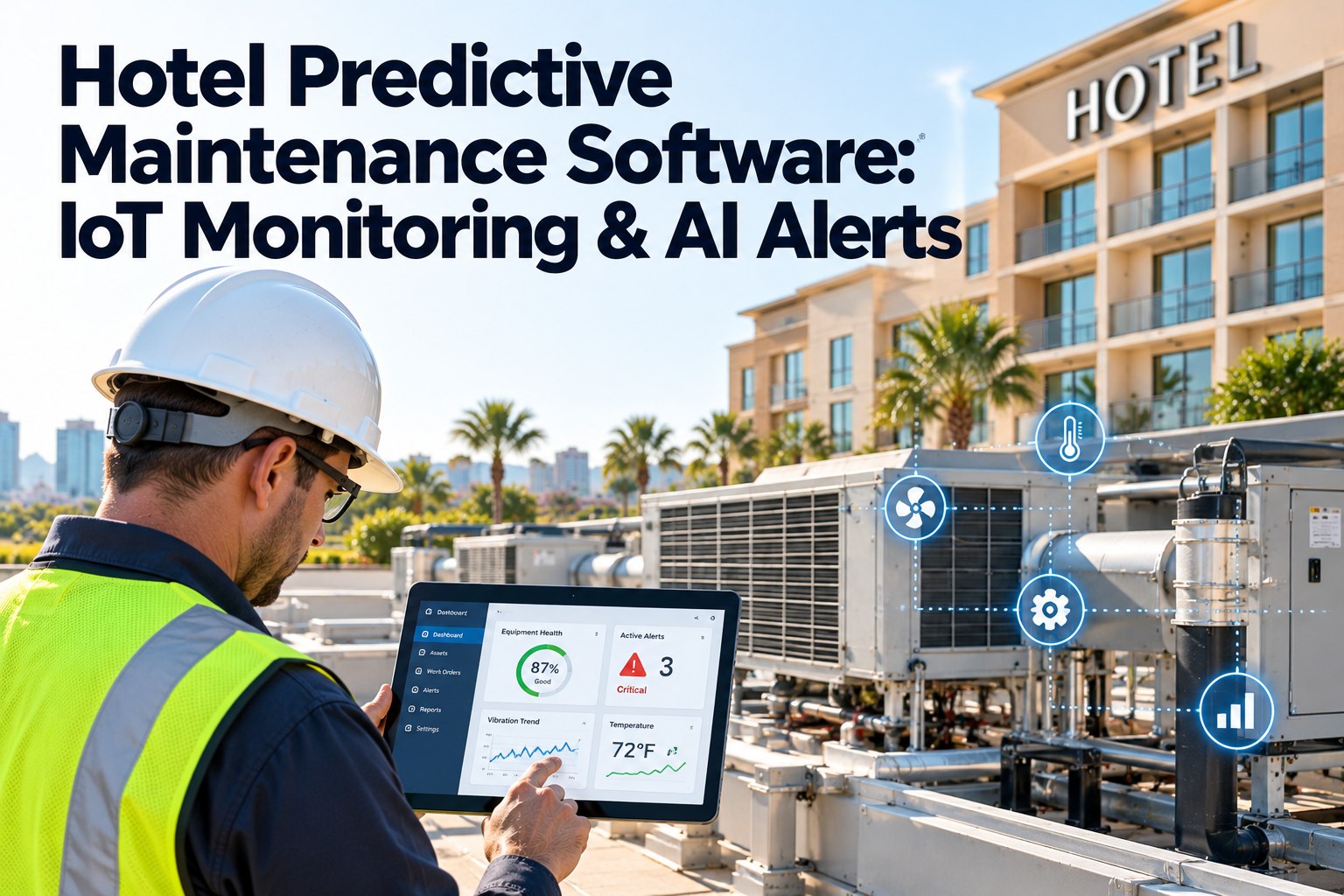
The difference between an AI maintenance platform that detects HVAC failures 6 weeks in advance and one that detects them 6 hours before breakdown is not the algorithm — it is the compute infrastructure processing the sensor data. OxMaint's AI analytics engine is built on NVIDIA GPU acceleration, enabling real-time processing of thousands of sensor data points per second across your entire hotel asset fleet — chillers, AHUs, FCUs, elevators, and building systems — without the latency that turns a detectable anomaly into a guest complaint. Book a demo to see OxMaint's GPU-accelerated AI engine running on your property's sensor data.
NVIDIA GPU-accelerated AI is not a marketing feature in OxMaint — it is the infrastructure that makes 4–8 week HVAC failure detection windows possible at the scale of a full hotel property. CPU-based analytics process sensor data in batch windows. GPU-parallelised AI processes every sensor reading in real time — closing the gap between when a failure signal first appears and when a maintenance team can act on it.
Why GPU Acceleration Changes What AI Maintenance Can Detect
CPU-based analytics platforms process sensor data in scheduled batches — hourly or nightly. A chiller approach temperature drifting 0.3°C over 4 hours generates a detectable signal at the sensor level. A batch-processed system sees it 8–24 hours later. A GPU-parallelised system detects it in under 50 milliseconds — weeks before it becomes a failure event.
A 300-room hotel with per-room FCU monitoring, chiller sensors, AHU telemetry, and elevator health data generates millions of sensor readings per day. Sequential CPU processing cannot maintain real-time anomaly detection at this scale without sacrificing either detection sensitivity or monitoring coverage across the asset fleet.
OxMaint's failure prediction models use LSTM and transformer-based neural networks trained on hotel-specific asset failure patterns. Running inference on these models at sub-second latency for continuous monitoring requires GPU computation. CPU inference at this model complexity would introduce 30–60 second delays — eliminating the real-time advantage entirely.
The most valuable anomaly detections are not single-asset signals — they are cross-asset correlations. A chiller running 8% above baseline energy draw combined with an AHU supply temperature variance and three FCU noise complaints on the same floor is a refrigerant charge issue. Correlating these signals in real time requires GPU-level parallel processing.
Every millisecond of detection latency is a week of lead time lost. OxMaint's GPU architecture closes that gap — turning sensor data into actionable work orders before any guest is affected.
OxMaint GPU AI Architecture — How It Works
NVIDIA Jetson-compatible edge processors at the property level ingest raw sensor data from BMS, IoT sensors, and building systems — preprocessing and normalising data streams before transmission to the OxMaint AI engine. Edge processing reduces bandwidth requirements and enables offline AI inference where cloud connectivity is intermittent.
NVIDIA A100 and H100 GPU clusters in OxMaint's cloud infrastructure run parallel anomaly detection across all monitored assets simultaneously. Each asset's sensor stream is compared against its individual baseline envelope using CUDA-parallelised computation — enabling sub-50ms detection latency at full property scale.
Anomalies are passed to OxMaint's hotel-specific failure pattern library — LSTM and transformer models trained on HVAC, elevator, and building system failure signatures across the OxMaint property network. GPU inference returns a ranked failure probability with contributing factor chain in under 200 milliseconds.
Multi-asset correlation analysis runs in parallel across the full property sensor network — identifying systemic fault signatures that span multiple assets and zones. A refrigerant circuit issue manifesting across chiller, AHU, and FCU data simultaneously is identified as a single root cause event, not three separate anomalies.
Confirmed anomalies above the configured risk threshold trigger autonomous work order creation — assigned to the correct technician by trade, floor zone, and asset type, with sensor evidence, failure probability, and recommended intervention attached from the point of creation. No human trigger required.
Every completed and validated work order feeds OxMaint's GPU training pipeline — retraining failure models on your property's specific asset behaviour. Detection windows lengthen and accuracy improves continuously as the model learns from your property's unique operating patterns, occupancy cycles, and historical failure signatures.
Hotel Assets Monitored by OxMaint GPU AI — Detection Specifications
| Asset | Sensor Inputs Processed | AI Model Type | Detection Window | Update Frequency |
|---|---|---|---|---|
| Chiller | Refrigerant pressure, COP, approach temp, compressor current, condenser delta-T | LSTM time-series + gradient boosting ensemble | 4–8 weeks | Real-time (<50ms) |
| AHU / MAU | Supply/return temp, DP across filter, fan current, coil delta-T, airflow volume | Transformer anomaly detection | 2–5 weeks | Real-time (<50ms) |
| Fan Coil Unit | Motor current signature, discharge temp, flow rate, runtime hours | CNN motor current analysis | 1–4 weeks | Every 15 min |
| Cooling Tower | Water chemistry, approach temp, fan vibration, basin level, drift eliminator pressure | Multi-variate regression + rules engine | Days to weeks | Continuous |
| Elevator / Lift | Motor torque curve, door open/close time, vibration, run count, speed deviation | LSTM sequence modelling | 2–6 weeks | Per journey |
| BMS / Controls | Sensor calibration drift, set-point deviation, loop response time, schedule compliance | Statistical process control + AI overlay | Continuous | Real-time |
No separate analytics platform. No nightly batch. GPU AI alerts, autonomous work orders, and real-time health scores — all in OxMaint's unified maintenance platform.
OxMaint GPU AI vs. Competitors: Hotel Maintenance Analytics
Most CMMS platforms offer scheduled reports. Analytics add-ons offer dashboards. OxMaint's GPU AI processes sensor data in real time and converts anomalies into closed work orders — in the same system your engineering team already uses.
| Capability | OxMaint | MaintainX | UpKeep | Fiix | Limble | IBM Maximo | Hippo/Eptura |
|---|---|---|---|---|---|---|---|
| GPU-accelerated real-time sensor processing | Yes | No | No | No | No | Add-on | No |
| Sub-50ms anomaly detection latency | Yes | No | No | No | No | Enterprise APM | No |
| Deep learning LSTM / transformer models | Yes | No | No | No | Basic ML | Maximo APM | No |
| Cross-asset correlation for systemic fault detection | Yes | No | No | No | No | Custom build | No |
| NVIDIA Jetson edge AI compatibility | Yes | No | No | No | No | Custom IoT | No |
| Continuous model retraining on property data | Yes | No | No | No | No | APM licence | No |
| Autonomous work order from AI anomaly — no manual trigger | Yes | No | No | No | Semi-auto | Enterprise only | No |
| Deployment without IT project — live in weeks | 3–4 weeks | 4–6 weeks | 4–6 weeks | 6–10 weeks | 4–8 weeks | 3–6 months | 6–10 weeks |
Regional Compliance: AI Analytics Data Security and Governance
GPU-accelerated AI processing introduces data sovereignty and security requirements that OxMaint addresses by design — not as an afterthought.
| Region | Data and AI Governance Frameworks | OxMaint Compliance Output |
|---|---|---|
| USA / Canada | NIST AI RMF, SOC 2 Type II, CCPA data privacy, FTC AI governance guidelines, HIPAA where guest health data intersects, state-level data residency requirements | SOC 2 Type II-aligned infrastructure, AES-256 encryption at rest, TLS 1.3 in transit, US data residency option, NIST AI RMF-aligned model governance documentation |
| UK | UK GDPR, ICO AI and data protection guidance, NCSC cloud security principles, UK AI Regulation framework, BS 8611 ethical AI in systems | UK GDPR-compliant data processing, ICO-aligned AI transparency documentation, NCSC cloud security principles compliance, UK data residency option available |
| Australia | Privacy Act 1988 (APPs), ASD Essential Eight, Australian AI Ethics Framework, Office of the Australian Information Commissioner guidance, Australian data sovereignty requirements | Privacy Act APP-compliant data handling, ASD Essential Eight-aligned security controls, Australian data residency option, AI Ethics Framework transparency documentation |
| Germany / EU | EU GDPR, EU AI Act (high-risk AI system requirements), ENISA cloud security, BSI IT-Grundschutz, EU data sovereignty and localisation requirements | EU GDPR-compliant processing, EU AI Act conformity documentation, EU data residency (Frankfurt region), BSI-aligned security controls, ENISA cloud security compliance evidence |
| Saudi Arabia / UAE | UAE PDPL data protection law, SAMA cybersecurity framework, Saudi NCA cybersecurity controls, DIFC data protection law, UAE AI Strategy data governance requirements | UAE PDPL-compliant data processing, SAMA cybersecurity-aligned controls, NCA compliance documentation, UAE/KSA data residency option, Arabic-language audit documentation |
All sensor data, asset records, and AI model outputs encrypted at rest with AES-256. No property sensor data stored in plaintext at any point in the processing pipeline.
All data transmission between edge sensors, OxMaint infrastructure, and client devices secured with TLS 1.3. No unencrypted data in transit at any layer of the GPU processing architecture.
Your property's sensor data and failure patterns train models that run exclusively within your OxMaint instance. No property data used to train models for other hotel operators without explicit consent.
AI analytics outputs — health scores, anomaly alerts, failure predictions — restricted to authorised maintenance, engineering, and management roles. Full audit trail on every AI recommendation and work order action.
OxMaint's GPU AI infrastructure meets the data governance requirements of the world's most demanding hotel brands and regulatory environments — and deploys in 3–4 weeks, not 6 months.
Implementation Roadmap: GPU AI Live on Your Property in 4 Weeks
OxMaint's implementation team maps existing BMS, IoT, and sensor infrastructure. API connections established to NVIDIA Jetson edge nodes where applicable. Historical sensor data imported to establish AI baseline models per asset type.
Full asset hierarchy built in OxMaint with room-level tagging. GPU AI models calibrated to your property's specific equipment configuration and occupancy patterns. Alert thresholds configured per asset class and criticality level.
Autonomous work order routing configured by trade and floor zone. Engineering team trained on AI alert review, health score interpretation, and mobile work order completion — half-day on-site session before go-live.
GPU model retraining activated on every closed work order. GM and chief engineer dashboards live with real-time health scores, anomaly alert history, and predictive maintenance analytics. Compliance reporting templates finalised for your region.
Results: What OxMaint GPU AI Delivers Across Hotel Properties
GPU real-time processing versus nightly batch analytics — catching chiller and AHU degradation before it becomes a guest-facing event.
Frequently Asked Questions
GPU-Speed AI. Hotel-Scale Deployment. 4 Weeks to Live.
OxMaint's NVIDIA GPU-accelerated AI engine processes your property's sensor data in real time — detecting HVAC failures 4–8 weeks in advance, generating work orders autonomously, and improving with every repair your team completes.