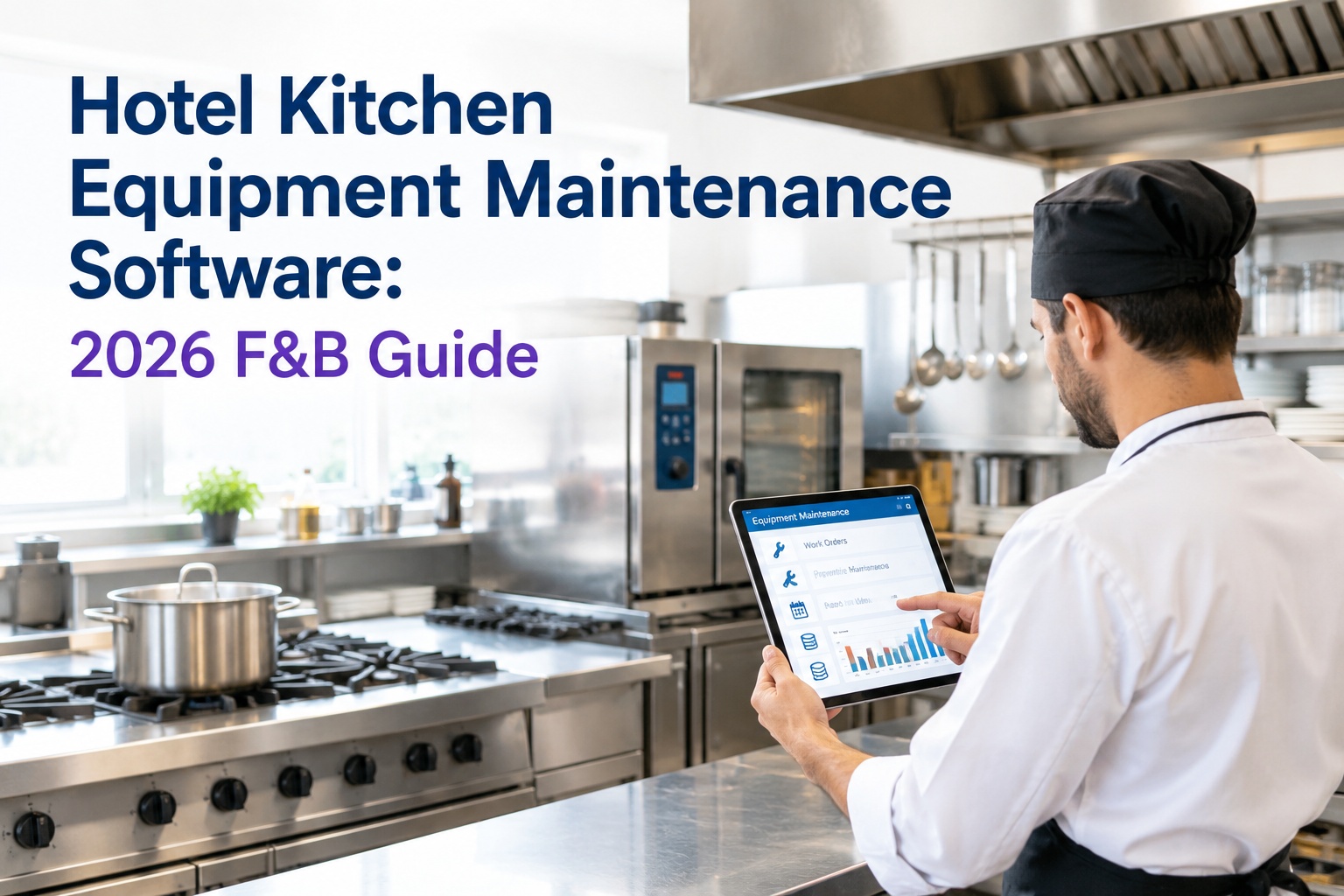
Predictive Maintenance for Hotel Kitchens, Laundry & MEP Systems
By Margot Robbie on February 12, 2026
The chief engineer at a 380-room waterfront resort received a CMMS alert on a Tuesday morning—the main commercial dishwasher's wash pump motor was drawing 18% more amperage than its 90-day baseline. The motor still ran fine. No strange noises. No guest complaints. No visible issues. But the predictive algorithm flagged the trend as a bearing degradation signature with 87% confidence of failure within 14-21 days. The maintenance team ordered a replacement pump motor ($340), scheduled installation during the Monday 6-10 AM kitchen dead zone, and swapped the component in 90 minutes with zero service disruption. Three floors downthe laundry facility's main dryer had been showing a gradual exhaust temperature increase over six weeks—the predictive system identified lint buildup in the exhaust ductwork as the cause and triggered a deep cleaning work order before the accumulation reached fire hazard levels. Meanwhilethe building's chilled water loop was flagged for a 0.3°F daily drift in return water temperature—an early indicator of condenser fouling thatleft unaddressed for another 60 dayswould have degraded cooling capacity by 22% heading into peak summer season. None of these issues would have been caught by calendar-based preventive maintenance. All three would have become emergencies. The dishwasher failure alone—on a Friday dinner service—would have cost $4,200 in emergency repair, $1,800 in disposable service ware, and a kitchen operating at 60% capacity for 36 hours until parts arrived.
Why Calendar-Based PM Fails Hotel Operations
The gap between scheduled maintenance and actual equipment condition
62%
Failures Between PMs
Equipment breaks down between scheduled service intervals—calendar PM can't detect developing problems
$47K
Avg Annual Emergency Cost
Per hotel in unplanned kitchen, laundry, and MEP repairs that predictive maintenance would prevent
14-21
Days Early Warning
Average lead time predictive systems provide before component failure—enough to plan repairs on your schedule
82%
Fewer Emergencies
Reduction in unplanned breakdowns when predictive monitoring replaces calendar-only maintenance programs
How Predictive Maintenance Works in Hotels
Predictive maintenance uses continuous sensor data—vibration, temperature, amperage, pressure, and acoustic signatures—to detect equipment degradation weeks before failure occurs. Unlike calendar-based PM that services equipment on fixed schedules regardless of condition, predictive systems trigger maintenance only when equipment behavior indicates an actual developing problem. Hotels that implement CMMS-based predictive maintenance tracking transform their operations from reactive firefighting to planned, scheduled repairs that never interrupt guest service, never require emergency parts markup, and never catch engineering teams off guard.
Predictive Maintenance Intelligence Architecture
How sensor data flows from equipment to actionable maintenance decisions
Data Collection Layer
Vibration Analysis
Detects bearing wear, imbalance, misalignment, and looseness in motors, pumps, and compressors
Thermal Monitoring
Tracks temperature drift in motors, electrical connections, heat exchangers, and exhaust systems
Electrical Signature
Monitors amperage draw, power factor, and harmonic distortion to detect winding and load issues
Analysis & Prediction Layer
Trend Analysis
Baseline drift detection
Pattern Matching
Known failure signatures
ML Prediction
Failure probability scoring
Remaining Life
Days-to-failure estimate
Action & Documentation Layer
Auto-generated CMMS work orders, prioritized by failure urgency and operational impact, with parts pre-ordering, technician assignment, and optimal scheduling around guest operations
Critical Systems for Predictive Monitoring
Hotel operations depend on three equipment ecosystems that each have distinct failure modes, degradation patterns, and operational impact profiles. Predictive maintenance monitors all three simultaneously—correlating data across systems to catch cascading failures that single-system monitoring misses. Properties ready to eliminate surprise breakdowns can schedule a predictive maintenance assessment to identify which equipment delivers the fastest ROI from continuous monitoring.
Predictive Monitoring by Hotel System
What sensors detect, what failures they prevent, and what each saves
Commercial Kitchen Equipment
$18K-$32K annual emergency cost
Dishwasher Pump MotorsVibration + amperage trendingHigh ROI
Walk-In CompressorsSuperheat, subcooling, amp drawHigh ROI
Exhaust Hood FansVibration + bearing temperatureMedium ROI
Ice MachinesCycle time + condenser tempMedium ROI
Cooking EquipmentIgnition reliability + temp accuracyMedium ROI
Commercial Laundry Systems
$12K-$22K annual emergency cost
Washer Drum BearingsVibration signature analysisHigh ROI
Dryer Exhaust SystemsTemp differential + static pressureHigh ROI
Steam Systems & IronersPressure + condensate return tempMedium ROI
Chemical Dosing PumpsFlow rate + cycle consistencyMedium ROI
MEP Systems (Mechanical, Electrical, Plumbing)
$25K-$55K annual emergency cost
Chillers & Cooling TowerskW/ton + condenser approach tempHigh ROI
AHU & Fan Coil UnitsFilter ΔP + coil temp differentialHigh ROI
Boilers & Water HeatersCombustion efficiency + stack tempHigh ROI
Pumps & MotorsVibration + flow + amp trendingHigh ROI
Electrical DistributionThermal imaging + power qualityMedium ROI
Predictive vs. Preventive vs. Reactive: What Hotels Actually Experience
Maintenance Strategy Comparison
Reactive (Run-to-Failure)
Equipment runs until it breaks. Emergency repairs at premium cost during worst possible timing.
Breakdown Rate:8-15/month
Repair Cost:2-4x planned
Guest Impact:Frequent
Costs: $55K-$110K/year in emergencies
Preventive (Calendar-Based)
Fixed-schedule service regardless of actual equipment condition. Better than reactive but still misses 62% of failures.
Breakdown Rate:4-8/month
Repair Cost:1.5x planned
Guest Impact:Occasional
Costs: $28K-$55K/year + PM labor
Predictive (Condition-Based)
Sensor-driven monitoring detects degradation 14-21 days before failure. Repairs planned around operations.
Breakdown Rate:1-2/month
Repair Cost:1x planned
Guest Impact:Near zero
Costs: $8K-$18K/year + monitoring
Stop Paying Emergency Prices for Predictable Failures
OXmaint's CMMS platform tracks equipment condition data, automates predictive work orders, manages parts inventory, and schedules repairs during operational dead zones—turning every potential emergency into a planned, budgeted maintenance event.
How often predictive data should be collected and analyzed per system
Continuous
24/7
IoT Sensors
Chillers, boilers, critical MEP
Daily
1x
Data Review
Kitchen, laundry equipment
Weekly
5
Trend Reports
All systems performance review
Monthly
12
Deep Analysis
Vibration routes, thermal scans
CMMS-Integrated Predictive Benefits
14-21 Day Warning: Detect failures weeks before they happen—schedule repairs during kitchen dead zones and laundry off-hours
Auto Work Orders: Sensor alerts auto-generate prioritized CMMS work orders with failure description, parts needed, and urgency level
Parts Pre-Staging: Order replacement components before they're needed—eliminating rush shipping and premium pricing
Implementation Roadmap
Predictive Maintenance Deployment for Hotels
01
Asset Criticality Ranking
Week 1-2
Rank all kitchen, laundry, and MEP assets by failure impact, repair cost, guest disruption, and safety consequence
02
Sensor & Baseline Setup
Weeks 3-4
Install vibration, thermal, and electrical sensors on high-criticality assets. Establish performance baselines over 2-4 weeks
03
CMMS Integration
Weeks 5-6
Connect sensor alerts to CMMS work order generation. Configure thresholds, escalation rules, and parts auto-ordering triggers
04
Optimize & Expand
Week 7+
Refine alert thresholds based on first detections. Expand monitoring to medium-criticality assets. Continuous model improvement
Key Performance Indicators
Metrics That Prove Predictive Maintenance Value
Reliability
Unplanned Downtime:↓ 82%
MTBF Improvement:↑ 3-5x
First-Time Fix:↑ 94%
Critical
Financial
Emergency Spend:↓ 75%
Parts Waste:↓ 40%
Equipment Life:↑ 40-60%
Operational
Operations
Kitchen Disruptions:↓ 85%
Laundry Delays:↓ 78%
HVAC Comfort:↑ 96%
Guest Impact
ROI Timeline
Payback Period:4-8 months
Year 1 ROI:250-400%
Annual Savings:$35K-$85K
Financial
Industry Insight
"After 22 years managing hotel engineering departments, I can tell you the biggest waste isn't the emergency repair bill—it's the cascade. A walk-in compressor fails Friday night: $3,800 emergency call, $6,200 in spoiled food, kitchen at half capacity for Saturday brunch, 340 covers lost at $42 average check, and a catering director who just lost trust in your kitchen's reliability. That single compressor failure cost $24,000 in total impact. The vibration sensor that would have caught it three weeks earlier costs $180 installed. We're not talking about sophisticated technology—we're talking about not being blind to what your equipment is telling you every single day."
— VP of Engineering, Full-Service Hotel Management Company, 42 Properties
Kitchen Is Ground Zero
Walk-in compressors and dishwasher pumps fail most often and cause the most expensive cascading damage. Monitor these first for fastest ROI.
Laundry Fire Risk
Dryer exhaust monitoring prevents lint fires—the #1 cause of hotel laundry fires. Predictive static pressure monitoring is a safety imperative, not optional.
MEP Drives Comfort
Chiller and AHU degradation directly impacts guest comfort and energy costs. A 10% efficiency drop costs more annually than the monitoring system.
Every Emergency Was Detectable 3 Weeks Earlier
OXmaint integrates predictive sensor data with automated CMMS work orders, parts management, and scheduling intelligence—giving your engineering team the early warning system that turns every potential crisis into a routine, planned repair completed on your schedule, not the equipment's.
What is predictive maintenance and how does it differ from preventive maintenance?
Preventive maintenance services equipment on fixed calendar intervals—monthly, quarterly, annually—regardless of actual condition. This means some equipment gets serviced too early (wasting parts and labor) while other equipment fails between service intervals because problems developed faster than the schedule anticipated. Predictive maintenance uses continuous sensor monitoring—vibration, temperature, amperage, pressure—to detect actual degradation patterns and trigger maintenance only when equipment condition indicates a developing problem. The result is 14-21 days of advance warning before failure, repairs scheduled around operations rather than disrupting them, parts ordered at standard pricing rather than emergency markup, and elimination of 82% of unplanned breakdowns.
Which hotel equipment should be monitored first for the fastest ROI?
Start with equipment that has the highest failure impact and cascading cost: walk-in cooler and freezer compressors (failure spoils $5K-$15K in food inventory), commercial dishwasher pump motors (failure cripples kitchen operations during service), dryer exhaust systems (lint buildup creates fire hazard and equipment damage), chillers and cooling tower fans (failure affects entire building comfort), and hot water boilers (failure eliminates guest hot water across the property). These five equipment categories typically account for 70-80% of emergency repair spending and deliver positive ROI within 2-4 months of predictive monitoring deployment. Expand to medium-criticality assets—ice machines, AHUs, laundry washers, kitchen exhaust fans—once the high-criticality program is established.
How much does predictive maintenance cost to implement in a hotel?
Wireless vibration and temperature sensors cost $150-$400 per monitoring point. A typical 250-room full-service hotel needs 25-40 sensors across critical kitchen, laundry, and MEP equipment—totaling $5,000-$12,000 for hardware. Gateway infrastructure adds $1,000-$2,500. Cloud analytics platform subscriptions range $300-$1,000 monthly. CMMS integration for automated work orders adds minimal incremental cost. Total first-year investment: $10,000-$25,000. Against average emergency repair savings of $35,000-$85,000 annually, most hotels achieve full payback within 4-8 months. The ROI accelerates in year two as the predictive models improve with more equipment-specific data and alert thresholds are refined.
Can predictive maintenance work alongside existing preventive maintenance programs?
Yes—and this is the recommended approach. Predictive monitoring doesn't replace preventive maintenance; it optimizes it. Calendar-based PM continues for tasks like oil changes, filter replacements, and lubrication that are consumption-based rather than condition-based. Predictive monitoring adds a condition-based layer that catches failures developing between PM intervals, identifies when PM intervals need to be adjusted (shortened or extended) based on actual equipment wear rates, and eliminates unnecessary PM tasks on equipment running within normal parameters. A CMMS platform like OXmaint manages both programs simultaneously—scheduling calendar PM tasks automatically while integrating predictive sensor alerts into the same work order system, creating a unified maintenance program that captures the benefits of both approaches.